 Databricks
Databricks is a unified data lake warehouse and AI platform founded by the founding team of Apache Spark. It provides full-link capabilities from data engineering SQL analysis to ML training and LLM fine-tuning. Its core products include Databricks MLflow, Feature Store, Model Serving and Mosaic AI.
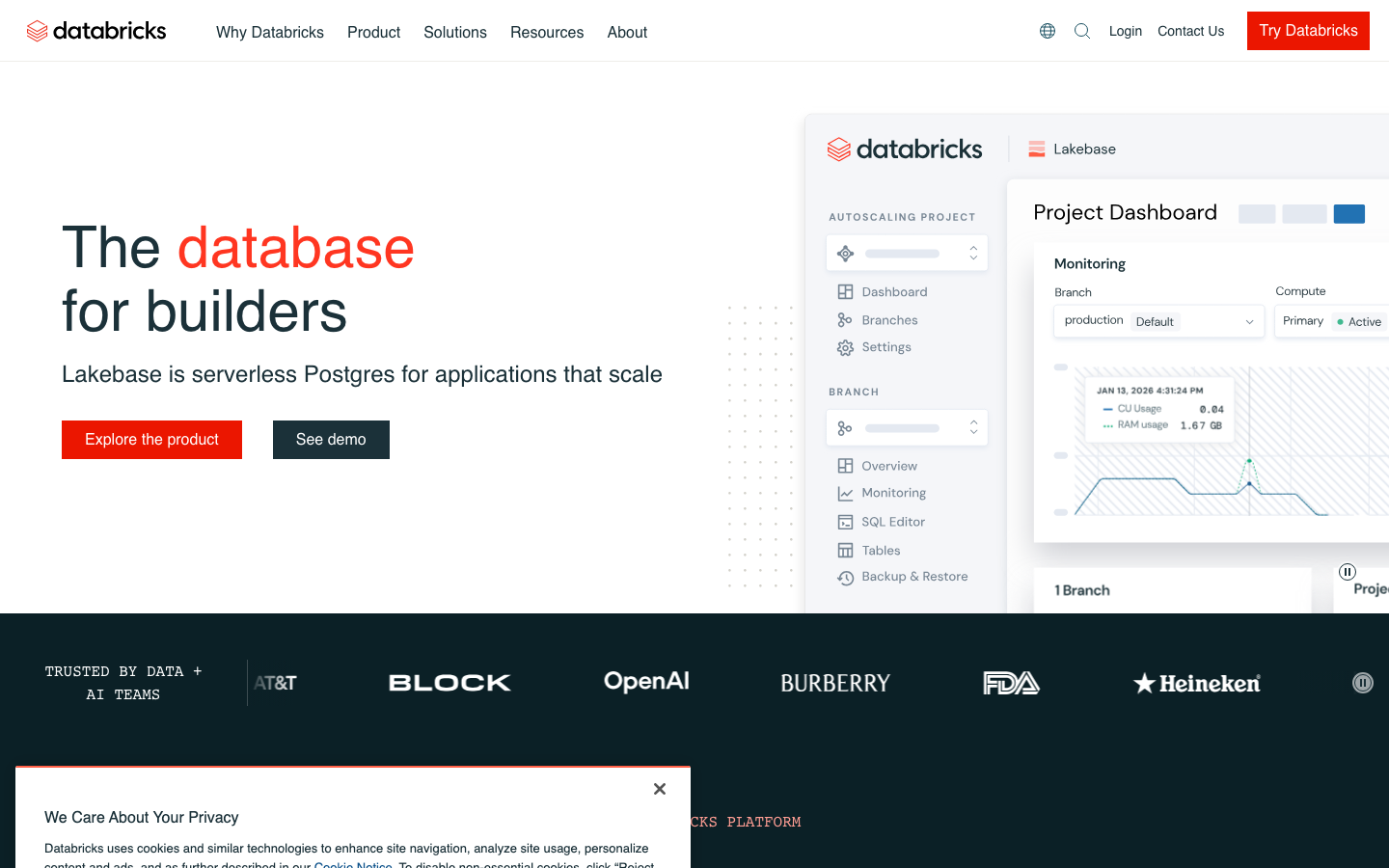
Databricks
Core parameters and statistics of Databricks
Databricks is positioned as a unified "data + AI" platform, rather than a simple training framework or data warehouse. It puts data lake warehouse (Delta Lake), SQL analysis, ML experiment tracking and large model training under the same governance system, and the core delivery form is an enterprise-level hosting platform.
| Projects | Public Information |
|---|---|
| Official positioning | Data + AI unified platform |
| Core form | Data lake warehouse + ML platform + AI inference deployment |
| Deployment path | Multi-cloud hosting (AWS, Azure, GCP), no stand-alone version yet |
| Core Components | Delta Lake, MLflow, Unity Catalog, Mosaic AI, Model Serving, Serverless SQL |
| Open source projects | Apache Spark, Delta Lake, MLflow, Apache Iceberg integration |
| Market valuation | About 43 billion US dollars (2024), and a new round of financing in 2025 is rumored to be valued at more than 60 billion |
| Key acquisitions | MosaicML (2023, $1.3B), Tabular (2024, undisclosed amount), Arcion (2024) |
| Enterprise customers | More than 10,000 enterprise customers worldwide (official disclosure as of 2025) |
The essence of Mosaic AI integration: After acquiring MosaicML in 2023, Databricks gained not only the LLM training framework, but also the MPT series of open source model weights and an engineering team with a background in MLSys summit meetings. This enabled Databricks to complete the identity switch from a "data lake warehouse company" to a "data + AI platform company" in the competitive landscape, directly forming a three-tier cross-competition with Snowflake, AWS SageMaker and Google Vertex AI.
Hidden costs of multi-cloud strategy: Although multi-cloud support is claimed, the service availability on each cloud is inconsistent - the Photon engine on AWS is the most optimized, Azure is deeply integrated with Active Directory, GCP is the latest to start and some advanced features are delayed in release. When selecting a model, enterprises need to confirm the completeness of functions on the target cloud to avoid underestimating the actual migration cost due to "multi-cloud" promises.
Databricks users and market recognition
Databricks' market recognition presents a clear pattern of "strong on the B side and weak on the C side". Its commercial value is mainly driven by the procurement decisions of enterprise-level data and AI teams, rather than the word-of-mouth spread of individual developers.
Enterprise customer scale: According to official disclosures, Databricks serves more than 10,000 enterprise customers around the world, covering financial services, healthcare, retail, manufacturing, media and entertainment and other industries. Typical customers include Shell Regeneron, Comcast H&M, etc. Revenue exceeds $2 billion in fiscal 2025, with year-over-year growth remaining above 40%. Its revenue structure is dominated by annual enterprise contracts (including reserved DBU packages and flexible pay-as-you-go portion). The community version and personal version generate almost no direct revenue.
Open source ecological influence: The data of its three major open source projects can be verified - Apache Spark has more than 39,000 stars on GitHub, Delta Lake has more than 7,500 stars, and MLflow has more than 19,000 stars. The community activity and enterprise adoption rate of these three projects are in the leading echelon of similar projects. However, it is worth noting that there is a functional layering of "open source community version vs enterprise enhanced version" between these open source projects and Databricks commercial products - some advanced features (such as Delta Sharing, Photon vectorization engine MLflow enterprise-level certification) are only available in the commercial version.
Industry competitive landscape: Databricks and Snowflake are in direct competition in the data warehouse/lake warehouse field. Snowflake is known for its "ease of use and hosting experience" and Databricks is known for its "openness and depth of AI integration." Analytical institutions such as Gartner have placed the two side by side in the leaders' quadrant in the field of data management. However, in actual selection, the two are not completely substitutes - teams that prefer standard SQL analysis and are not dependent on the Spark ecosystem tend to prefer Snowflake; companies that already have Spark/ML technology stacks and need to unify data and AI platforms tend to favor Databricks.
Third-party evaluation and benchmark: In the data+AI unified platform category, Databricks' performance in the TPCDS benchmark test is 2-4 times better than similar competing products (thanks to the Photon vectorization engine), but the advantage is not obvious in the TPC-H traditional data warehouse scenario. In the ML platform dimension, MLflow's community adoption rate is ahead of Kubeflow and SageMaker Pipelines, but there are still third-party tools (such as Weights & Biases, Arize AI) that can replace it in some scenarios in terms of production-level observability and model monitoring depth.
Cost Advantages of Databricks
The cost structure of Databricks presents the characteristics of "dual billing for computing and platform services". The cost is composed of the underlying cloud resource fee and the upper layer Databricks DBU (Databricks Unit). Understanding this two-tier architecture is a prerequisite for cost control.
C client/individual users: The community version provides limited free quota, suitable for personal learning and small-scale experiments. However, the Community Edition has many hard limitations - the number of cluster concurrencies is limited, Unity Catalog enterprise-level governance is not supported, there is no Mosaic AI training access, and the maximum storage capacity is limited. For individual users who want to learn data engineering and ML on Databricks, the community edition is enough to get started; once you get involved in LLM fine-tuning or production-level deployment, you must upgrade to a pay-as-you-go or prepaid plan.
Developer/API calls: When called through Serverless SQL Warehouse or Notebook API, billing is based on DBU usage, and there is no unified fixed package. DBU unit price varies by workload type (SQL, ETL, ML training, inference) and cloud vendor. Taking SQL Warehouse on AWS as an example, it is about $0.55 per DBU (reference price, subject to the official pricing page), and a single medium query consumes 1-5 DBU. This means that the direct computational cost of a simple analysis may be between $0.5-$3, making it suitable for flexible use by small teams.
Enterprise/Private Deployments: This is Databricks’ actual revenue core. Enterprises purchase through Enterprise contracts, which usually include three major cost elements:
| Cost Elements | Description | Proportion Estimation |
|---|---|---|
| DBU Pre-Purchase Packages | Pay up front on an annual or multi-year contract and get discounted rates (typically around 15-25% for a 1-year contract, up to 30-40% for 3 years) | Approximately 50-60% |
| Cloud infrastructure | Underlying AWS/Azure/GCP resources (EC2/VM, S3/Blob Storage, network traffic) are billed directly by the cloud vendor and not within the DBU | About 30-40% |
| Value-added services | Enterprise-level support plans, training, professional services (PS) and other optional add-ons | About 5-10% |
What is worth paying attention to in enterprise contracts are reservation cost-effectiveness and flexible oversold risk: pre-purchasing DBU packages can significantly reduce the unit price, but if the reserved DBU is not actually used up, it will often expire (use-it-or-lose-it), causing hidden waste; conversely, if oversales trigger pay-as-you-go (Overages), the unit price will be 40-60% higher than the pre-purchase price. Therefore, the recommended purchasing strategy is to purchase reserved packages based on 70-80% of the estimated usage, with the remaining flexible portion based on volume, and strive for the "reserved DBU can be extended" clause in the contract.
Cost Benchmarking with Competitive Products: Compared with Snowflake, Databricks avoids cross-platform data transfer fees due to native integration with Spark in ETL and ML training scenarios (Snowflake incurs additional egress fees when outputting data to the ML training environment). But in pure SQL analysis scenarios, Snowflake's per-second billing and auto-suspend strategies are usually more economical during low-activity periods. Compared with AWS SageMaker, Databricks' unified governance (Unity Catalog) eliminates the hidden operation and maintenance costs of permission synchronization between multiple tools.
Main features of Databricks
Databricks' functional system revolves around the complete concept of "data entry into the lake -> management -> analysis -> training -> deployment", rather than piecing together scattered tools.
-
Delta Lake Data Lake Warehouse: The unified storage layer provides ACID transaction Schema evolution and time travel (data version backtracking). Compared with directly using Spark to process original files, Delta Lake improves data reliability to the database level, avoiding data inconsistencies caused by "dirty writes" and "half-way updates". Acceptance concerns: In the lake warehouse scenario, the execution time and resource consumption of Delta Lake's OPTIMIZE/ZORDER maintenance operations on very large tables (PB level) need to be benchmarked before selection.
-
Unity Catalog Unified Governance: Fine-grained access control covering data, features, models and notebooks is the core barrier of Databricks' enterprise-level capabilities. Unity Catalog provides a unified view of metadata across workspaces, solving the core issues of "where is the data, who can access it, and how to audit it" when multiple teams share a cluster. Differences from competing products: Snowflake's governance is independent of the computing layer, while Unity Catalog is deeply integrated with Databricks' computing layer - which means that if an external engine is used to access data managed by Unity Catalog, the consistency of governance policies will be a challenge.
-
Mosaic AI model training and fine-tuning: Based on the capabilities acquired through the MosaicML acquisition, LLM distributed training, fine-tuning and evaluation are provided. Supports parallel strategies such as Megatron-LM and FSDP, as well as its own optimized Composer training library. The platform directly manages experiment tracking Checkpoint storage and model registration, reducing the cost of migration from experiment to production. Implementation Tips: Mosaic AI training operations will consume a large amount of DBU. It is recommended to use a small model (such as 7B parameter level) to verify the training pipeline and data quality during the development stage, and then expand to 70B+ scale after confirmation.
-
MLflow full life cycle management: Native built-in MLflow supports experiment tracking, model registration, version management and deployment. The openness of MLflow lies in the fact that it is not bound to Databricks - the same set of experimental records can be read by external reasoning context, but the MLflow deployment (Model Serving) provided by Databricks is better than the community version in terms of GPU scaling latency and A/B testing support.
-
Delta Sharing Open Data Sharing: A cross-platform, cross-organization secure data sharing protocol that allows recipients to read shared data without using Databricks. This provides a low-friction collaboration solution in large-scale data cooperation scenarios (such as sharing data between upstream and downstream supply chains, joint risk control modeling by financial institutions).
-
Photon Vectorization Engine: A native C++ engine optimized for Delta Lake that is 2-4x faster than traditional Spark JVM engines in SQL analysis and ETL scenarios (official benchmark). Photon is automatically enabled and does not require user adjustment - but it should be noted that its acceleration effect is most obvious in column scans and aggregation queries, and the improvement is limited in complex JOIN scenarios with frequent shuffles.
Databricks model and version evolution
As a hosting platform rather than an independent software, Databricks' version evolution is based on Runtime (Databricks Runtime, DBR), with an LTS major version approximately once every quarter, supplemented by monthly minor versions. The following are verifiable key release milestones:
DBR mainline LTS released
| Version | Release Date | Core Changes |
|---|---|---|
| DBR 10.4 LTS | 2022-04 | Spark 3.2.x, introducing Photon public preview |
| DBR 11.3 LTS | 2022-08 | Unity Catalog GA, MLflow 2.0 integration |
| DBR 12.2 LTS | 2023-04 | Photon GA, Serverless SQL is officially available, Delta Lake 2.3 |
| DBR 13.3 LTS | 2023-08 | MLflow 2.4, Mosaic AI integration begins, Delta Sharing GA |
| DBR 14.3 LTS | 2024-04 | Spark 3.5.x, Photon extended to ETL, Unity Catalog Lineage GA |
| DBR 15.4 LTS | 2025-12 | The latest LTS version, fully supports Mosaic AI training and enhances Lakehouse Federation |
Version Policy Note: LTS versions of Databricks provide a minimum maintenance cycle of 2 years, and non-LTS versions only 6 months. For production workloads, it is recommended to always use LTS releases and wait 2-3 months after a major release before upgrading - waiting for the community feedback cycle can help circumvent stability issues with earlier releases.
Product milestones (non-runtime level)
- 2020-06: Delta Lake is open source, laying the foundation for Lakecang’s technical roadmap.
- 2021-06: Databricks SQL GA, moving from data engineering to the SQL analysis market, directly benchmarking Snowflake.
- 2022-07: Unity Catalog is officially released to solve the problem of multi-team data governance fragmentation.
- 2023-06: Acquired MosaicML ($1.3B) to gain LLM training capabilities and MPT series models.
- 2024-06: Acquisition of Tabular (Apache Iceberg core contributor team) to strengthen Iceberg integration.
- 2025-05: Lakehouse Federation GA, unified querying of external data sources (Snowflake, Redshift, PostgreSQL, etc.) without migration.
Core Judgment: The main line of Databricks' version evolution is the transformation from "Spark hosting platform to data + AI unified platform". The MosaicML acquisition in 2023 was the turning point—each LTS release since then has narrowed the experience gap between data engineering and AI training. Lakehouse Federation in 2025 releases a signal: it no longer requires data to live in Delta Lake, but extends the governance scope to external data sources, which lowers the threshold for existing Snowflake/Redshift users to migrate to Databricks.
Technical Advantages of Databricks
The technical barrier of Databricks does not lie in the absolute performance leadership of a single component, but in solving the "mirror gap between data engineering and AI training" - in the traditional architecture, data is managed in the warehouse, but the training model needs to ETL the data into an independent environment, and the permissions, versions and quality tracking in the process are often broken.
Unified Storage and Governance: The combination of Delta Lake + Unity Catalog realizes the architecture of "where the data is, the AI is there". Model training no longer requires additional ETL to move data out of the data warehouse - the training script directly reads the curated data in Delta Lake and leverages Unity Catalog to inherit the row-level/column-level permissions of the table. The direct effect of this architecture is that the data engineering team and the ML team use the same data, the same set of permission configurations, and the same set of audit logs, eliminating the "translation cost" of cross-team coordination.
Vectorized execution of Photon engine: Photon is a query execution engine rewritten by Databricks in C++, replacing Spark's JVM-based execution with native vectorized execution. In the TPCDS benchmark, Photon reduced latency for common SQL queries by 2-4x. Its technical core includes: columnar vectorization processing (using SIMD instruction set), adaptive execution plan optimization (adaptive adjustment of the number of Shuffle Partitions), and specially optimized hash aggregation and JOIN algorithms. Photon is automatically enabled without requiring users to modify SQL or Pipeline code - meaning enterprises can gain performance improvements without changing existing code, and migration costs are close to zero.
Distributed training optimization for Mosaic AI: With the acquisition of MosaicML, Databricks deeply integrates its Composer training library and Flash Attention integration into the platform. In the Llama 2/3 series of fine-tuned benchmarks, Mosaic AI's throughput is approximately 1.3-1.8 times higher than the standard PyTorch FSDP implementation (official benchmark, subject to actual circumstances). Key optimizations include: automatic gradient accumulation, activation checkpointing, FP8 mixed precision training, and linkage with the Photon engine to achieve zero-copy reading of training data. Actual pitfalls: The stability of distributed training is significantly affected by network topology. It is recommended to use delay bandwidth testing to verify the communication performance between nodes before officially starting training to avoid frequent training interruptions caused by NCCL timeout.
Zero Migration Queries for Lakehouse Federation: Features of GA 2025. Allows users to directly query external data sources such as Snowflake, Redshift, BigQuery, PostgreSQL, etc. through Unity Catalog without moving data. The Federation layer uses predicate pushdown and statistical information pruning to pull only the rows and columns that are really needed back to the calculation layer instead of copying the entire table. This provides enterprises in the "migration transition period" with the ability for systems on both sides to coexist, reducing the decision-making pressure and business interruption risk of "ALL-IN migration".
Security and Compliance Architecture: Unity Catalog provides row-level filtering, column-level masking (Column-Level Masking) and attribute-based access control (ABAC). Audit logs can be exported to SIEM systems to meet SOC 2 and GDPR compliance requirements. Data is encrypted by default during transmission and storage, and customers can manage encryption keys through Bring Your Own Key (BYOK). Compliance Boundary: Databricks' certification covers SOC 2 Type II, ISO 27001 and HIPAA, but you need to pay attention to data residency restrictions when operating in China - compliance deployment in China needs to be completed through the Azure China region or partners, and direct multi-cloud global deployment may not fully meet the classification requirements.
How to use Databricks
The usage entrance of Databricks is divided into three paths based on roles and scenarios. Each path has different capabilities and permissions.
| How to use | Suitable for role | Features | Cost |
|---|---|---|---|
| Workspace UI | Data engineers, data scientists | Notebook development SQL query Dashboard building ML experiment tracking | By DBU + cloud resources |
| Serverless SQL Warehouse | SQL Analyst | Pure SQL query, no cluster management required, automatic expansion and contraction | Billing by DBU |
| API/SDK | Platform Engineer ML Engineer | Manage jobs, model deployments, and clusters programmatically via REST API or Python SDK | Billed per DBU |
Typical workflow:
-
Create workspace: Create a Databricks workspace on the target cloud (AWS/Azure/GCP), complete Unity Catalog metadata initialization and identity provider (IdP) integration. This step is usually completed in the cloud console or Databricks account console and takes about 1-2 days (including network configuration and security policy coordination).
-
Data into the lake: Load raw data (CSV, JSON, Parquet) into the Delta Lake table through Auto Loader (incremental reading of new files in cloud storage) or COPY INTO command. Auto Loader supports automatic inference and evolution of Schema, reducing the workload of manually defining Schema.
-
Data Transformation and Analysis: Use Python/SQL/Scala for ETL in Notebook, or perform ad hoc queries through Databricks SQL. For production ETL jobs, it is recommended to declaratively define data pipelines using Delta Live Tables (DLT), which automatically handles dependencies and incremental updates.
-
ML training and model deployment: Start the training job in Notebook or Mosaic AI interface, the experimental indicators are automatically recorded in MLflow, and the model products are registered in the model registry of Unity Catalog. Deploy the registered model to the Model Serving endpoint, configure the GPU auto-scaling rules, and expose the REST API for downstream applications to call.
Common integration scenarios: Databricks is natively integrated with MLflow Tracking. Calling mlflow.start_run() in the training code can automatically record parameters, indicators and model products without additional configuration. If using an external MLflow server, you need to install the mlflow library on the cluster and configure the tracking URI.
Product Pricing
The pricing model is subject to the official real-time page. Usually a freemium or subscription system is adopted, basic functions can be used for free, and advanced functions or high-frequency use require payment.
Application scenarios
The application scenarios of Databricks span the two dimensions of traditional data engineering and AI training. The following four scenarios have been widely verified in actual enterprise deployments:
-
Integrated construction of enterprise lakes and warehouses: Unify the original Hadoop/Spark cluster and multiple data sources onto Delta Lake to realize data management and AI training on the same platform. Typical customer path: First replace the old Hive tables on several key data fields (such as user behavior, transaction records), verify the performance improvement and data quality improvement, and then gradually expand to all data sources. Implementation Tips: It is not recommended to pursue all data migration in the first stage of lake warehouse construction - priority is given to migrating high-frequency queries and data domains that need to be managed. Archived data with low access frequency can be maintained in place through Delta Sharing or External Table.
-
Live and Batch ETL Pipelines: Build declarative data pipelines using Auto Loader and Delta Live Tables to incrementally load data from cloud storage and automatically handle schema evolution and data quality constraints. DLT's expectations mechanism allows you to define data quality rules (non-empty, uniqueness, referential integrity), and data that does not meet the rules enters the "failure" or "warning" queue without blocking the entire pipeline. Differences from the Airflow solution: DLT does not require manual writing of DAGs and configuration schedules - ETL logic is declared in SQL or Python, and the platform automatically manages execution plans and error recovery.
-
LLM Fine-tuning and Enterprise-Scale Model Deployment: Leverage Mosaic AI to fine-tune open source large models (Llama, Falcon, MPT, etc.) on proprietary datasets. The core value is not the training framework itself, but the integration with Unity Catalog - training data is read directly from the managed Delta Lake table, model products are registered to the Catalog and deployed by Model Serving, and the data lineage and permission control of the entire link are uniformly audited. Scenario Boundary: If the enterprise only needs to call external APIs (such as using OpenAI or Anthropic), rather than training models on its own data, the advantages of Databricks are not valid - lightweight tools (such as LangChain + vector database) are more cost-effective.
-
Data Science and ML Exploratory Analysis: Data scientists use Notebook to quickly explore data, train prototype models, and automatically record experiments to MLflow. The addition of Feature Store (online feature warehouse) allows the experimental model to be seamlessly connected to production inference, avoiding the classic breakpoint of "high offline AUC and no online features". Configuration concerns: The real-time feature latency of the Feature Store (usually seconds to minutes) needs to match the latency requirements of online inference. Millisecond-level real-time feature requirements require external online storage such as Redis.
Applicable people
Databricks has a clear adaptation strategy layered by role, but its learning curve and cost threshold determine that it is not suitable for all data practitioners.
-
Data Engineering Team: The core user group. Unified data management ETL and governance tools reduce multi-system maintenance costs. Delta Live Tables reduces the workload of pipeline maintenance from DAG-style orchestration to declarative definition, so teams can focus more on data quality rather than pipeline scheduling. Not Fitting the Boundary: If your team's core workload is already pure SQL analytics and has no ML or stream processing needs, Snowflake or Redshift may have a shallower learning curve and potentially lower total cost.
-
ML team and data scientists: We hope to work on the same platform from experiment to production to reduce the inconsistency problems caused by bounded migration. The value of MLflow integration and Feature Store is most evident in this role—experimental parameters, model artifacts, and feature pipelines are within the same governance domain. Unfit Boundary: For teams that require extremely high depth of control over the training framework (such as the AI Lab engaged in LLM pre-training research), the training scheduling flexibility of Databricks is lower than directly using Slurm + native PyTorch, and the GPU DBU cost in very large-scale training may be higher than using original GPU instances.
-
SQL Analysts and Business Analysis Team: Databricks SQL lets you query Delta Lake data using standard SQL without writing Python or Scala. Serverless SQL Warehouse removes the burden of cluster management, but a core obstacle is the difference in SQL dialects—some complex analytic functions may behave slightly differently in the Photon engine than in standard Spark SQL. Prerequisite: The team needs to have basic data warehouse concepts. It is not recommended for business personnel with absolutely zero SQL knowledge to get started directly.
-
Enterprise Architects and IT Decision-makers: Need to unify data and AI infrastructure in a multi-cloud environment, focusing on security audits, cost control and platform standardization. Unity Catalog and Delta Sharing provide a compliant foundation for enterprise-scale deployments. Not suitable for boundaries: If the enterprise's data governance has not yet reached a certain level of maturity (for example, basic metadata management has not been established), directly introducing Databricks will not automatically solve the governance problem, but may increase operation and maintenance pressure due to the complexity of the platform. It is recommended to establish a data governance framework first and then select platform technology.
Summary and Outlook
The core value of Databricks lies in the "same platform" concept of data engineering and AI training. Through the combination of Delta Lake, Unity Catalog and Mosaic AI, data governance, model training and inference deployment are unified in the same governance domain, reducing the cost of context switching from experiment to production and the hidden loss of data transfer.
Current core advantages: Delta Lake + Unity Catalog + Mosaic AI form one of the most complete combinations of the data + AI platform. The Photon engine achieves 2-4 times acceleration in SQL analysis scenarios with zero code changes. The open source ecosystem (Spark, Delta Lake, MLflow) provides enterprises with technology stack portability and avoids being locked in by a single cloud vendor. Lakehouse Federation further reduces the friction of migrating external data sources.
Major current limitation: DBU pricing can have a higher total cost in large-scale training scenarios than using raw GPU instances directly. Unified operation and maintenance complexity of multi-cloud deployments is higher than that of single-cloud solutions - data replication delays and consistency maintenance across clouds require additional engineering investment. In direct competition with Snowflake in pure SQL analysis scenarios, the learning and usage costs are at a disadvantage at the surface level (entry experience). Mosaic AI's training framework scheduling flexibility is still lower than directly using professional schedulers such as Slurm/PBS.
Follow-up observation points: The impact of the Tabular team acquired in 2025 on the Iceberg ecosystem - how will the format competition between Delta Lake and Iceberg go; whether the Serverless product line will be expanded to ML training (currently Serverless only covers SQL and ETL, and training still requires manual cluster management); Databricks' compliance progress in the domestic market - currently it mainly relies on the Azure China region, and direct full-stack localization alternatives are not yet mature.
Procurement and Adoption Risk Assessment: It is recommended that enterprises first select a non-critical data domain (such as marketing analysis reports or internal knowledge base) as a pilot, complete functional verification and team capacity building within 3-6 months, and confirm the adaptability of the platform to existing data pipelines before expanding. At the procurement contract level, focus on: DBU unit price locking period and oversold price limit, how to handle unused quota of reserved packages (extended vs. voided), data migration fee terms, and the maturity of the integration between Unity Catalog and existing IdP (LDAP/AD/Okta). For industries that have strict requirements for data sovereignty (finance, government affairs, medical care), it is recommended to simultaneously evaluate the self-built route of the open source technology stack (Trino + Iceberg + MLflow) as a control solution in addition to privatized deployment or Azure exclusive region solutions to avoid the risk of single supplier lock-in. Taken together, Databricks is one of the platforms with the most complete functionality in its field, but its value release is highly dependent on the company's data governance maturity and the technical reserve of the engineering team - when these two prerequisites are not met, the platform's return on investment will be significantly discounted.
Related tools:  Hugging Face, replicate
How to use Databricks
- Web client: You can use it by visiting the official website and registering an account. Most functions do not require installation.
- API access: Provides RESTful API, developers can obtain the API Key and integrate it into their own applications.
Version Info
- Databricks June 2026 Platform Update :The cloud platform is continuously iterating and has no fixed version number yet.
- Databricks Runtime 15.4 LTS :There is no official precise date yet.
User Reviews