 DataCamp AI
Free
DataCamp AI
Free
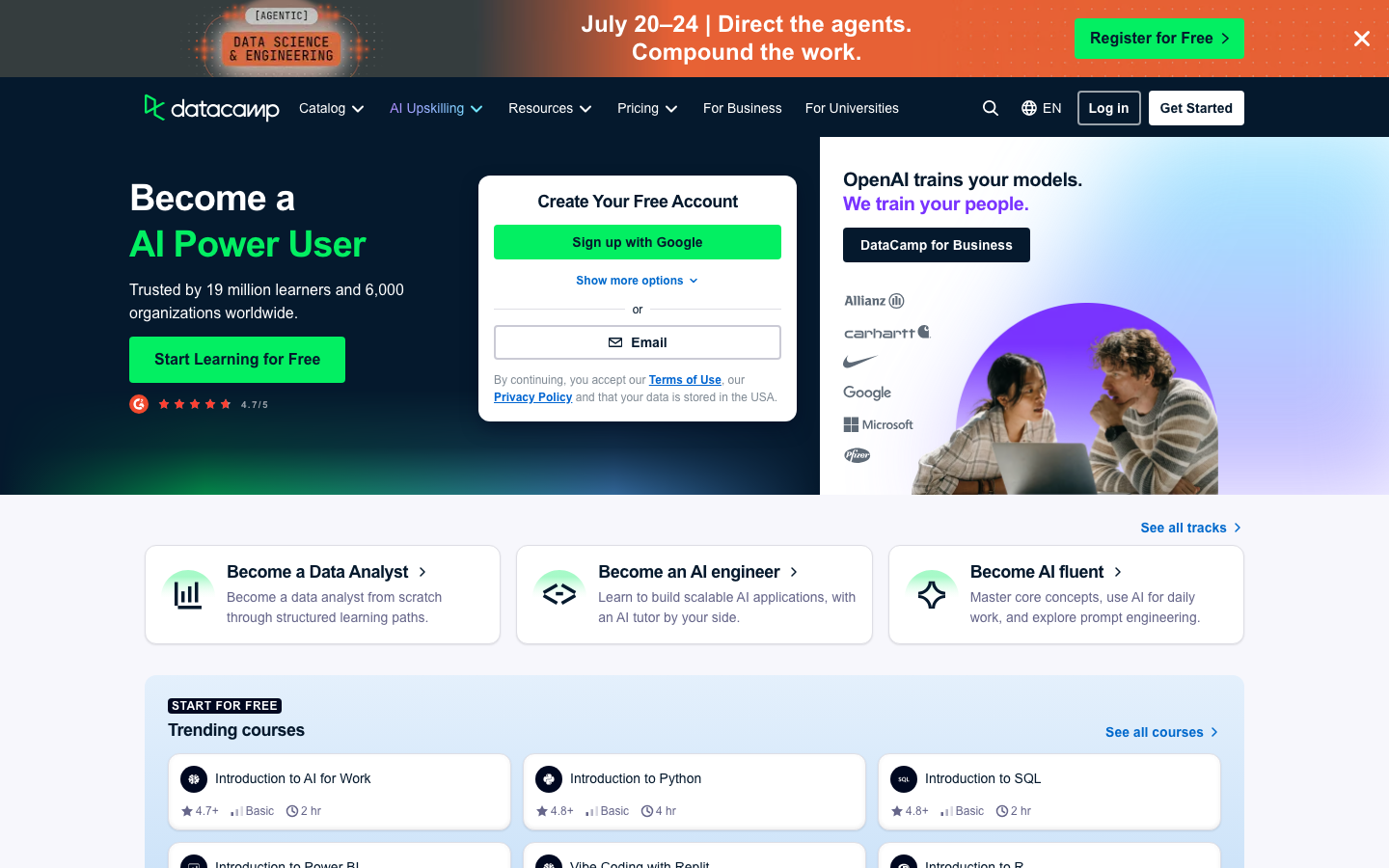
DataCamp is the world's leading data science and AI skills platform, offering 400+ interactive courses covering tools such as Python, R, SQL, Tableau, Power BI and more. AI capabilities drive instant feedback on code, personalized learning paths, and AI coaching assistants for individual learners and enterprise data teams.
DataCampAI
Core parameters and statistics
| Parameter item | Data |
|---|---|
| Platform Positioning | Data Science and AI Interactive Skills Platform |
| Product form | Web (encoding in browser) + mobile App |
| Registered Learners | 12 million+ |
| Total courses | 400+ interactive courses |
| Corporate Customers | 3,000+ |
| AI functions | AI Tutor, AI code feedback AI personalized path Workspace AI |
| Covered Tools | Python, R, SQL, Tableau, Power BI, Excel, Git |
| Certification Types | Skills Certification, Career Path Certificate |
| Latest version | 2026.06 (AI Learning) |
| Paid model | Free tier + Premium subscription + Enterprise plan |
The biggest product difference of DataCamp is "in-browser interactive coding" - learners do not need to install any software locally, they can write code directly in the web page and see the running results immediately. This low-friction experience is the core competitiveness of the entry-level data science scenario. AI functions are superimposed on this basis, with the goal of compressing the "when stuck" solution time from "Google search 15 minutes" to "AI prompt 30 seconds."
User and market recognition
- C-side coverage: 12 million+ registered learners, mainly data science beginners and career changers. Active users are concentrated in North America (40%) and Europe (30%), with the Asia-Pacific region growing fastest.
- Enterprise Penetration: 3,000+ enterprise customers, including Google, Apple, UBS, Deloitte, Pfizer, etc., used to popularize data literacy and upgrade data team skills.
- B-end recognition: Listed by Gartner as a representative platform in the field of data science training. The renewal rate of DataCamp for Business exceeds 90%, indicating that enterprise customers recognize its learning effects after using it.
- Industry Benchmarking: In the "Interactive Data Science Training" segment, DataCamp's number of courses and user scale are significantly ahead of Kaggle Learn (free but poorly structured), Mode Analytics Tutorials, and DataQuest (small content and community size). But it faces direct competition from Codecademy in the general programming education space.
Cost advantage
C client/individual user layer:
- Free tier: The first 1-2 chapters of each course are free, with a limited number of daily exercises. You can experience in-browser coding, but it is not enough to systematically master a skill.
- Premium subscription:
- Monthly payment: about $29/month
- Annual payment: about $12.42/month (annual payment is $149, the most cost-effective discount)
- Premium unlocks all 400+ courses, projects, certification assessments, and AI coaching features.
- HIDDEN COST: Free tier is very limited, skill certification requires Premium. Workspace (Cloud Notebook)'s AI-assisted features are only available in Premium.
Developer/API Layer:
- DataCamp does not open independent AI API. However, DataCamp Workspace provides a cloud coding environment based on Jupyter, and AI assistance is only available within the platform.
Enterprise/Team Level:
- DataCamp for Business: Quote based on years of active users, includes team management, custom learning paths, progress analytics, and SSO integration. The price is subject to the official real-time page.
- Hidden Cost: After enterprise deployment, the internal data team needs to be responsible for maintaining the consistency of Workspace content and the company's actual technology stack.
Main functions
- AI Tutor (AI learning tutoring): Open the AI dialogue sidebar in the coding practice interface, where you can ask questions about code debugging, concept explanations and best practices. The context of AI is limited to the scope of the current exercise and course, reducing the illusion of a universal model. Causal chain: The user is stuck at a certain step → opens the AI Tutor → AI reads the current exercise context + user code → gives targeted tips (rather than direct answers) → the user continues to complete.
- AI code instant feedback: After submitting the code, AI automatically checks for grammatical errors, logic problems and efficiency optimization suggestions, providing natural language explanations in addition to traditional test case pass/fail. Unlike traditional programming assignments which only tell you "which question you got wrong", but explain "why this is written incorrectly".
- AI Personalized Learning Path: After a new user completes the initial skills assessment, AI generates a customized course sequence based on current level + target role (data analyst, data scientist, data engineer, etc.). Continue to track progress and mastery during the learning process, and dynamically adjust subsequent recommendations.
- Workspace AI-assisted coding: DataCamp Workspace (cloud Jupyter Notebook) has built-in AI code completion and debugging assistants, supporting Python and R. In the notebook context, analysis requirements can be directly described in natural language, and AI generates corresponding code.
- AI project evaluation: Provide automatic scoring and feedback for data science projects (EDA, model training, visualization), and evaluate the coverage code correctness, analysis logic, and result presentation.
Model and version evolution
2013–2022: Interactive Coding Platform
- In the early days of DataCamp, "running R/Python code in the browser" was the core experience. The course content and exercises were manually arranged by instructional designers, and there was no AI function.
2023: Workspace AI
- In March 2023, DataCamp Workspace will integrate AI-assisted coding and support automatic code completion and basic debugging. This is DataCamp’s first attempt in the AI direction.
2024: Personalized Path
- In June 2024, AI personalized learning paths will be launched, with automatic recommendations based on skill assessment. The platform has shifted from "all users learn the same course" to "thousands of people, thousands of faces".
2025: AI real-time feedback
- In September 2025, the AI code instant feedback system will be launched, covering all programming exercises. The traditional "submit and wait for the result" has become "get prompts while writing".
2026: AI Tutor full coverage
- In June 2026, the official version of AI Tutor will be released, covering all 400+ courses. Currently, AI has embedded all the sections of "Learning→Practice→Feedback→Correction→Evaluation".
Technical advantages
- In-browser sandboxed coding context: All code runs in cloud containers and does not rely on the user's local context. This means that the AI can read the complete code execution context (including contextual variables, data files, library versions), whereas the universal editor AI plug-in can only see the contents of the current file. For debugging and feedback, contextual completeness is a key differentiator.
- Training advantages of fine-grained practice data: 12 million users + hundreds of millions of code submission records accumulated in 10 years constitute a huge "learner error pattern database". The underlying model of AI Tutor has been fine-tuned for domain adaptation based on this data, making it more capable of identifying common mistakes among beginners in data science than the general code model.
- Step-by-step guided prompt strategy: The design principle of AI Tutor is not to give answers directly, but to give progressive prompts based on the steps where the user is stuck (first layer: locating the problem line; second layer: prompting the missing concept; third layer: giving pseudo code; final layer: giving implementation). This design is derived from the "scaffolding theory" in educational psychology and is consistent with DataCamp's teaching methodology.
- Reproducible code execution context: All exercises run in standardized containers, and AI feedback is based on repeatable code execution results rather than text pattern matching. This means that the execution output of the same code seen in AI is exactly the same as what the user sees in Workspace, reducing the illusion caused by "AI guessing the code results".
How to use
- Web version: Visit https://www.datacamp.com/, register and complete the skills assessment (AI recommended initial path).
- In-browser exercises: Open any course and directly enter the interactive coding interface - the tutorial is on the left, the code editor is on the right, and the execution results are displayed at the bottom. When you encounter a problem, click the AI Tutor icon in the lower right corner.
- Skills Assessment: Complete a 15-minute initial skill test when using it for the first time, and AI will generate a personalized learning path. Progress assessments are automatically triggered every 4 weeks thereafter.
- Workspace: Visit workspace.datacamp.com to use cloud Jupyter Notebook to work on projects, and AI-assisted coding is always available.
- Mobile App: Search "DataCamp" on iOS/Android, which supports course videos and concept learning, but coding exercises need to be completed on the web page.
- Enterprise Access: Submit requirements through the DataCamp for Business page to get SSO integration and management panel.
Product Pricing
| Paid tiers | Price | Coverage |
|---|---|---|
| Free Tier | $0 | 1-2 chapters per lesson for free + daily exercises |
| Premium Monthly | $29/month | All 400+ Courses + Projects + AI Tutor + Certification |
| Premium annual payment | $149/year ($12.42/month) | Same as above, about 57% discount |
| Enterprise Solutions | Business Pricing | Customized Pathways + Team Management + Advanced Analytics |
Boundary of human-machine collaboration: AI Tutor’s practice prompts and code feedback can be 100% automated; however, it is recommended to set up manual proctoring or behavioral verification for the final skills certification exam to prevent AI-assisted answering from affecting the credibility of the certification. In enterprise-level deployment, Workspace data security compliance (whether data leaves the enterprise VPC) requires a manual confirmation point.
Application scenarios
- Zero-Based Switching to Data Science (Cost Reduction and Efficiency Increase Deduction): Traditional self-study data science requires configuring local context + finding tutorials + searching for answers to questions. It takes about 6–12 months to complete a data project independently from scratch. DataCamp’s in-browser coding + AI Tutor can reduce the contextual configuration time to 0, reduce the problem search time from 10–15 minutes to 30 seconds, and compress the entire cycle to 4–8 months. The monthly subscription cost of $29 is a significant price advantage compared to thousands of dollars for offline training classes.
- Popularization of Enterprise Data Literacy: Non-data positions (marketing, operations, finance, etc.) need to master SQL and basic data analysis capabilities. DataCamp for Business's standardized courses and AI coaching can quickly train employees who "don't know what SQL is" to "can write basic queries" in about 4–6 weeks. Cost reduction is approximately 60% compared to in-house training development.
- Supplementary Data Skills for College Students: Used as supplementary exercises for courses by students majoring in statistics and computer science, AI Tutor solves the problem of "I didn't understand in class and no one asked after class".
- Interview Preparation: Use DataCamp's SQL, Python algorithm and statistics courses to review the system before the interview. The AI personalized path can recommend exercises based on common interview questions at the target company.
Applicable people
- Data Science Beginners/Career Changers: Suitable for people with zero programming foundation or a small amount of Python/R foundation who want to systematically enter the field of data science. Not suitable for the boundary: Intermediate and advanced practitioners with 3+ years of data work experience. The content of DataCamp is relatively basic. It is recommended to directly participate in the Kaggle competition or work on real projects.
- Data learners in non-technical positions: professionals who require data analysis skills in marketing, operations, finance and other positions. Prerequisite: Basic English reading ability is required (Chinese courses are limited).
- Enterprise Data Training Leader: HR/L&D departments that need to improve their team’s data literacy on a large scale. Non-fit boundary: A situation where a team uses data tools that are not covered by DataCamp (such as a specific commercial BI tool).
- College Computer/Statistics Students: Supplementary classroom exercises and programming practice. AI Tutor reduces the time you wait for a reply from your tutor.
Summary and Outlook
DataCamp has clear product boundaries in the segment of "interactive data science training" - a three-tier experience of in-browser coding + structured courses + AI instant feedback, which changes the entry into data science from "the first hurdle of installation" to "just open the browser and start". AI functions (AI Tutor, code feedback) are experience upgrades rather than practical innovations, but they have considerable effects in reducing learning friction.
Current limitations: Insufficient content depth - advanced chapters on data engineering and machine learning are not comprehensively covered; AI Tutor's prompts are of limited help for questions of moderate difficulty or above; the free tier is too limited to serve as a long-term learning tool; no Chinese localization limits penetration into the Asian market.
Procurement/Adoption Risk Assessment: Individual users are recommended to start with an annual payment of $149 (57% savings over monthly payment), and then use AI personalized paths to confirm whether they match personal career goals. Enterprise procurement recommends trial allocation of 20-50 seats by department, using "course completion rate + skill pre- and post-test difference" as the core indicator of ROI. DataCamp is cost-effective in the field of basic data literacy training, but it still needs to be paired with other resources in areas such as advanced data engineering and MLOps.
Expert View: DataCamp’s core competitiveness is not in the quality of individual courses, but in its learning path design and code context integration. For individual learners, it is closer to actual work scenarios than university MOOCs.
Related tools:  Khanmigo, quizlet
Version Info
- DataCamp AI Learning 2026 :Launched AI Tutor to provide code debugging, concept explanations and practice tips based on LLM.
- DataCamp AI Feedback :Introducing an AI code instant feedback system to provide real-time optimization suggestions and error diagnosis for user codes. There is no official precise date yet.
- DataCamp Personalized Paths :Launched AI personalized learning paths to automatically recommend course sequences based on skill assessments. There is no official precise date yet.
- DataCamp Workspace AI :Integrate AI-assisted coding function in DataCamp Workspace to support automatic code completion. There is no official precise date yet.
User Reviews