 DataRobot
DataRobot is a pioneer in enterprise-level AutoML and AI operation platforms, covering the entire life cycle from data preparation to model deployment monitoring and AI governance, allowing enterprise AI to be implemented on a large scale.
DataRobot
Core parameters and statistics of DataRobot
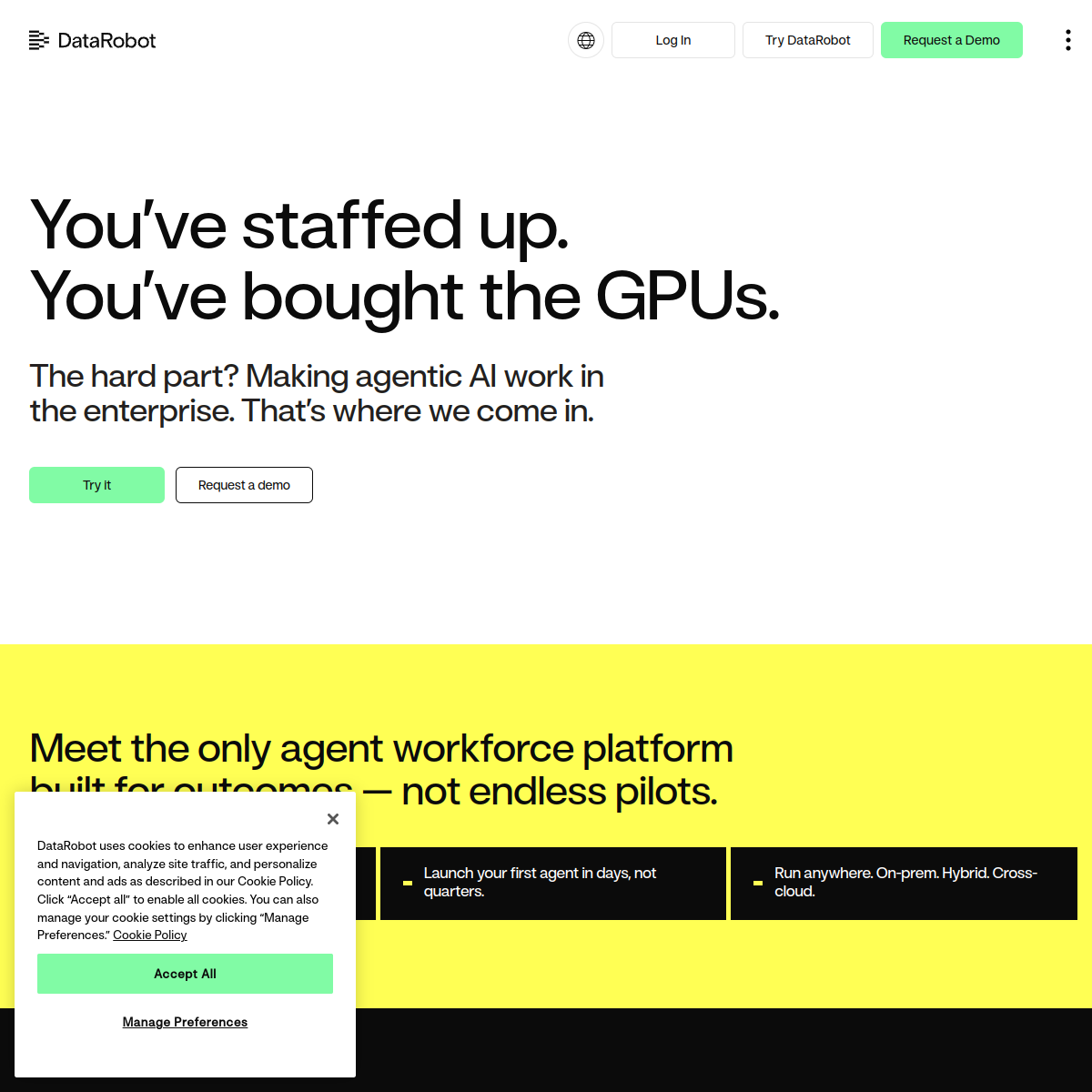
DataRobot's latest positioning has been upgraded from "AutoML Platform" to "Agentic AI Workforce Platform" - not only automated machine learning modeling, but also extended to the entire life cycle of AI agent (Agent) construction, deployment, monitoring and governance. The core parameters of its latest version AI Platform 10.0 are as follows:
| Parameter item | Description |
|---|---|
| Product positioning | Agentic AI Workforce Platform (enterprise-level agent AI platform) |
| Core competency areas | AutoML, MLOps, AI governance Agentic AI, GenAI/RAG, predictive AI |
| Deployment method | Public cloud SaaS, VPC hosting, private deployment (Kubernetes cluster) |
| Supported algorithms | 1,000+ model algorithm automatic training and hyperparameter tuning |
| Security Certifications | SOC 2 Type II, ISO 27001, FedRAMP, HIPAA |
| Industry Recognition | Gartner Magic Quadrant for DSML Platforms Leader for many years |
| Customer scale | 1,000+ global large enterprises, covering finance, medical care, energy, manufacturing, and government |
| Cumulative financing | USD 1 billion+ |
| Open source components | Covalent (agent orchestration), Syftr (model cost/latency/accuracy optimizer) |
Parameter Interpretation: DataRobot is not just an AutoML tool, but uses AutoML as the underlying engine MLOps as the operation and maintenance skeleton, AI governance as the compliance guardrail, and Agentic AI as the overlay platform for the new interaction layer. Its core competitive logic is that companies can use the platform as a medium to complete the process from data to AI decision-making without setting up a data science team of more than 10 people.
Business meaning of the core parameter table: The product positioning has been upgraded from AutoML to Agentic AI Workforce Platform, which means that DataRobot no longer positions itself as a "modeling tool", but attempts to become an "operating system" for enterprise AI - all AI-related tasks (modeling, deployment, monitoring, governance, agent orchestration) are completed on the platform. Security certifications cover SOC 2, ISO 27001, FedRAMP, and HIPAA, indicating that its target customer base is clearly directed towards heavily regulated industries. The existence of open source components Covalent and Syftr is the entrance to the "developer ecology" in the platform strategy - attracting the technical community through open source and lowering the psychological threshold for companies to try Agentic AI.
Users and market recognition of DataRobot
DataRobot's market recognition is reflected in the ratings of third-party analysis agencies and the practice of top customers. At the same time, its strategic focus in recent years has been shifting from "predictive AI" to "agent AI", which is also changing the market's perception of it.
Gartner Consecutive Multi-Year Leader: DataRobot has been named a Leader in the Gartner Magic Quadrant for Data Science and Machine Learning Platforms (DSML Platforms) for multiple consecutive years and will continue to be a Leader in the 2025-2026 report. Gartner recognizes its combined strengths in AutoML automated MLOps operational capabilities and AI governance.
Industry Analysis and Customer Verification: Listed in the AI Governance and ML Operations MarketScape report by IDC, selected into the Forbes Cloud 100 and AI 50 lists, and named an AI Innovation Future 50 company by Fortune. The customer ROI cases disclosed on the official website show:
- The world's leading consumer technology brand: Achieved USD 60 million in ROI, covering 50+ AI use cases, covering the entire chain from procurement to freight.
- Global energy innovator: Achieved $200 million in ROI, covering 600+ AI use cases ranging from pipeline blockage detection to oil well performance.
- Top 5 global banks: Achieved USD 70 million ROI, covering 40+ AI use cases, from capital markets to wealth management.
- Norfolk Iron & Metal: The company stated that the iteration speed has increased significantly, and it can quickly put new models into production and adjust based on feedback.
Market perception differentiation: Among traditional ML practitioners, DataRobot is often referred to as the "AutoML platform". This perception underestimates its depth in AI governance and MLOps. And in regulated industries (banking, insurance, healthcare), DataRobot’s AI governance capabilities are a key differentiator in procurement decisions. As Agentic AI becomes the core of its latest strategy, the market's positioning as an "agent work platform" is still being verified - some customers report that the agent function is still in its early stages, and its production-level maturity remains to be seen.
Position in the competitive landscape: In the enterprise ML platform market, the main difference between DataRobot and cloud vendor platforms (AWS SageMaker, Google Vertex AI, Azure ML) is that DataRobot is "platform neutral" - not tied to any cloud infrastructure. This is a differentiator in multi-cloud or private deployment scenarios. Compared with independent platforms such as H2O.ai and Dataiku, DataRobot is more advanced in the depth of AutoML automation and AI governance, but it is not as good as H2O in terms of open source community influence and flexible customization. Gartner's continuous leader rating also shows that it maintains a stable advantage in the "ability to execute" dimension.
Cost Advantages of DataRobot
DataRobot completely adopts an enterprise customized sales model and does not disclose standard quotations. The following price analysis is based on industry practice and customer information inference, and is subject to official real-time quotations.
C-side/Personal User: DataRobot no longer provides a standalone personal/free version. Cloud trials provide a limited-term SaaS experience (typically 14-30 days) and require the purchase of a subscription after the trial ends. For individual data scientists, it is recommended to prioritize open source alternatives (H2O AutoML, AutoGluon) or pay-as-you-go models of cloud vendor ML platforms (AWS SageMaker, Vertex AI).
Developers/API Calls: DataRobot provides a REST API and Python SDK, but API calls are not sold separately as a retail product. API access is bound to a platform subscription. For independent developers, this is not a LLM API model billed by token, but an extended interface for the enterprise platform.
Enterprise/Private Deployment: DataRobot’s core commercialization model.
| Deployment model | Pricing method | Typical annual fee range (estimate) | Typical scenarios |
|---|---|---|---|
| Cloud SaaS | By computing resources (training/inference nodes) + user authorization | $100,000-300,000/year | Medium-sized team, quick start |
| VPC hosting | Based on bounded resources + annual subscription + number of users | $200,000-500,000/year | Data sovereignty required |
| Private deployment | Per-node licensing + annual subscription + 7×24 support | $300,000-1,000,000+/year | Finance/Government/Healthcare |
| Agent Workforce Platform Add-on | Superimpose agent node fees on the basic subscription | Basic + 30-50% increase | Use Agentic AI capabilities |
Compare the cost structure of open source AutoML: Open source solutions (H2O AutoML, AutoGluon, FLAML) are free at the software level, but enterprises need to bear the cost of data science team formation (usually 3-5 people, total annual salary of $500,000+), infrastructure operation and maintenance (GPU cluster $50,000-200,000/year) and AI governance tool chain integration costs. Although DataRobot's annual fee threshold is as high as hundreds of thousands of dollars, its "platform replacement team" pricing logic is commercially reasonable when the following conditions are true: the number of enterprise AI projects > 10/year, and compliance audit capabilities in regulated industries are required.
Hidden costs: Platform lock-in - models and processes are deeply bound to the DataRobot ecosystem, and migration to competing platforms requires redevelopment and verification. Compute resource costs may exceed expectations when inferring at scale—automated optimization features such as Syftr can mitigate but not eliminate this. In addition, the implementation and integration of enterprise-level platforms usually require the intervention of DataRobot's professional services team or certified partners, which is a labor cost that is easily overlooked before signing a contract.
Procurement Suggestion: DataRobot’s integrated platform model can only generate positive ROI if the annual AI budget exceeds $200K and compliance requirements are clear. Organizations below this threshold should prioritize cloud vendor ML platforms or open source options. It is recommended to specify model migration terms (such as model export format API compatibility guarantee) in the contract to reduce the risk of platform lock-in.
Main functions of DataRobot
DataRobot's functional system has grown from the original AutoML core to a complete platform covering the three major sections of "build-run-manage". The following descriptions are classified according to competency areas:
-
Automatic Machine Learning (AutoML) Engine: Automatically completes data preprocessing (missing value filling, anomaly detection, type inference), feature engineering (automatic derivation, cross combination, high-order transformation), multi-algorithm parallel training (1,000+ algorithm families), automatic hyperparameter tuning and model rankings. Synergy: AutoML does not run in isolation - training results are automatically synchronized to the model registration center, and the best models can be entered into the deployment pipeline with one click, eliminating the need for manual export and import. Implementation Tips: In highly customized deep learning scenarios (such as custom CNN architecture), the automation advantages of AutoML are limited, and it is recommended to use Composable ML to manually build the blueprint.
-
MLOps model operation and maintenance: One-click deployment as REST API, supporting blue-green deployment A/B testing and canary release. Built-in load balancing, automatic scaling and model version management. Synergy: Monitoring is automatically activated after model deployment - data drift detection, accuracy degradation alarms and automatic retraining triggers are all interconnected, eliminating the need for manual inspection in turn. The deployment environment supports three modes: cloud, edge and local.
-
AI Governance Hub: DataRobot’s moat product in regulated industries. Provides model bias detection (Bias & Fairness), SHAP interpretability analysis, data lineage tracking, automatic generation of audit logs and compliance document templates. Supports applying unified governance policies to LLM and traditional ML models. Synergy: Compliance documents are not written manually - the platform automatically captures key information from training data, feature importance, and model performance indicators, fills it into templates to generate compliance reports, and compresses compliance audit preparation time from weeks to hours.
-
Agentic AI: The latest strategic core. Provides an agent building framework (supporting tool call RAG, multi-step planning), agent evaluation playground, agent deployment workflow and agent monitoring panel. Jointly built the "Agent Workforce Platform" (embedded with NVIDIA Enterprise AI) with NVIDIA, and exclusively cooperated with SAP to build an AI agent within the SAP ecosystem. Synergy: Agents and traditional ML models share the same governance framework - ML models called by agents are also subject to bias detection and interpretability, and there will be no blind spots of "AI agents escaping governance". Implementation Tips: The agent function is still in the rapid iteration stage currently (mid-2026). It is recommended to verify it in experimental projects before expanding to the core production process.
-
Generative AI (GenAI) and RAG: Supports building LLM blueprints in Playground, integrating multiple LLM providers (including NVIDIA NIM), and building RAG applications and conversational agents. Supports vector database management, prompt word template management and LLM evaluation indicators. Synergy: GenAI applications directly use the interpretability and monitoring capabilities of ML models - LLM input and output are also covered by auditing, bias detection and compliance reporting, and will not become a governance blind spot.
-
Data connection and preparation: Supports 50+ data source connectors (Snowflake, BigQuery, S3, Azure, Databricks, SAP HANA, etc.), built-in data wrangling tool SQL editor and Feature Discovery engine - automatically mines derived features from multiple related tables, and officially claims to improve model accuracy by 5-15%.
DataRobot’s model and version evolution
DataRobot's version evolution reflects the three positioning transitions of the enterprise AI platform from "automated modeling tool" to "full-stack AI operation system" to "agent AI work force platform".
Founding Period: AutoML Pioneer (2012-2018)
- 2012: Jeremy Achin and Tom de Godoy found DataRobot in Boston.
- ~2015: AutoML product is officially released - this is an early commercialization attempt for enterprise-level machine learning automated training. The core selling point is to replace the repetitive work of data scientists with automation. At that time, there was no "AutoML" category in the industry, and DataRobot was almost the category definer.
- 2016-2018: Continuous financing expansion, with cumulative financing exceeding US$200 million, and customers are mainly financial institutions.
Expansion period: MLOps + platformization (2019-2023)
- 2019: Series E raised $206 million and was valued at over $1 billion.
- 2020: Accelerate MLOps capability building and launch model deployment and monitoring functions.
- 2021: Acquired the ML model management platform algorithmia to strengthen model registration and deployment capabilities. It’s valued at $6.3 billion.
- 2022-2023: Upgraded from "AutoML" brand to "AI Platform", added AI governance center MLOps full-stack capabilities and preliminary support for generative AI (corresponding to the
series-e-ai-platform-2023version in frontmatter).
Transformation Period: Agent AI + Deepening of Governance (2024 to present)
- 2024: Launch of AI Platform 10.0 (corresponding to
ai-platform-10-llm), fully integrating generative AI and LLM application development capabilities, adding an AI Governance Hub, and optimizing model monitoring anomaly detection algorithms. - 2025-2026: The strategic focus will be fully shifted to Agentic AI and the "Agent Workforce Platform" will be launched. The product definition on the official website has evolved from "AI Platform" to "Agentic AI Platform", which consists of six product lines: AI Apps & Agents, Generative AI, Predictive AI, AI Governance, AI Observability and AI Foundation. Open source Covalent (agent orchestration framework) and Syftr (cost/latency/accuracy optimizer). Jointly verify the Agent Workforce Platform with NVIDIA, and jointly develop the SAP ecological agent solution with SAP.
Summary of key version context:
| Version node | Time | Core changes | Positioning keywords |
|---|---|---|---|
| AutoML first release | ~2015 | Enterprise-level automated machine learning | AutoML pioneer |
| AI Platform rebranding | 2023-06 | Expanding MLOps, AI governance GenAI | Full-stack AI platform |
| AI Platform 10.0 | ~2024-12 | LLM application, governance center, anomaly detection | Generative AI fusion |
| Agent Workforce Platform | 2025-2026 | Agent AI, NVIDIA/SAP cooperation | Agent Workforce Platform |
DataRobot’s technical advantages
DataRobot's technical barrier is not a single algorithm, but the integrated effect formed by the deep coupling of "automation engine + operation and maintenance system + governance framework" at the platform level.
Engineering depth for automated modeling: DataRobot's AutoML engine is not a wrapper that simply calls GridSearchCV or Optuna. It runs multiple pipelines in parallel during the training process, and each pipeline contains different data preprocessing strategies (such as automatic selection of missing value filling methods, comparison of outlier processing schemes), feature engineering combinations (polynomials, interaction terms, binning) and algorithm families. The platform automatically tracks the indicators of all running experiments and generates model rankings after training is completed. Mechanism-Effect-Scenario Chain: Multi-pipeline parallelization → The same data set explores more model space in the same time → More suitable for scenarios where "model accuracy is high but data science manpower is limited". However, in extreme customized requirements (such as special loss functions, custom evaluation indicators), automation is less flexible than manual modeling.
Composable ML: This is DataRobot’s balanced design between AutoML automation and manual customization. Data scientists can drag and drop to build a custom modeling pipeline through Blueprint Workshop, modify pre-processing steps, replace algorithms, and adjust post-processing logic based on automatically generated blueprints. This design preserves the efficiency of AutoML while providing an on-ramp for customization by experienced teams.
Engineering for model interpretability: DataRobot has built-in full pipeline support for SHAP (SHapley Additive Explanations) - from training to deployment, each model automatically comes with feature importance analysis and single-sample prediction explanations (Prediction Explanations). This is a difference from 0 to 1 in scenarios such as bank credit approvals, insurance pricing, etc. where you need to explain to customers or regulators "why the loan was denied" - without explainability, ML models simply cannot go online in these scenarios.
Compliance engineering of AI governance: The core difference of the DataRobot governance platform is that it is not a post-installed "audit tool", but a "compliance guardrail" embedded in the modeling process. Automatically detect data bias (such as uneven distribution of gender and race) before model training, track data lineage and use feature lists during training, and continuously monitor fairness degradation after deployment. Compliance reports are automatically populated from governance data and exported directly to PDF for audit use. This "Governance Left-Shift" capability enables regulated enterprises to use AI safely under the compliance requirements of the EU AI Act and GDPR.
Hybrid deployment architecture for agent AI: DataRobot implements hybrid orchestration of agents through the open source project Covalent - agents can execute in the cloud, on-premises or edge nodes, and manage the life cycle through a unified Workload API. Covalent supports dynamic resource allocation and cross-border migration to solve the mixed scenario needs of "agent development in the cloud and production locally". Syftr solves the cost-accuracy-delay triangle optimization in agent deployment - automatically routing requests between multiple LLM providers to optimize single inference costs while ensuring accuracy.
The engineering significance of NVIDIA's deep integration: The cooperation between DataRobot and NVIDIA is not only an alliance at the market level, but also reflected at the technical architecture level - the Agent Workforce Platform is embedded in the NVIDIA Enterprise AI platform, using NVIDIA NIM for LLM inference optimization, and using NeMo Guardrails to implement agent safety guardrails. This means that DataRobot's agent can directly call NVIDIA's optimized inference service, which may be better than general deployment solutions in terms of latency and throughput. For enterprises with existing NVIDIA infrastructure, this integration reduces the need for additional GPU purchases.
Engineering depth of data connection and feature engineering: DataRobot supports 50+ data source connectors, but the real technical barrier lies in "Feature Discovery" - automatically mining derived features from multiple related tables (such as user table + transaction table + behavior table). This can replace a large amount of manual feature engineering work by data engineers in scenarios such as bank credit scoring (which requires the integration of multi-source information such as the People's Bank of China's credit report, transaction flow, and behavioral data) and insurance pricing (which requires the integration of policies, claims, and external data). It should be noted that the performance of Feature Discovery on large-scale data (billions of rows) relies on underlying computing resources. It is recommended to evaluate its impact on the query load of the data warehouse during the pilot phase.
How to use DataRobot
DataRobot provides multiple access paths, covering different team needs from zero code to pure code, from SaaS to self-hosting.
| How to use | Applicable teams | Features | Obtain path |
|---|---|---|---|
| Cloud SaaS | Medium to large enterprises | Browser access, DataRobot hosting infrastructure | datarobot.com/trial Request a trial |
| VPC hosting | High data sovereignty requirements | Running within customer cloud environment (AWS/Azure/GCP) | Contact sales for deployment |
| Privatized deployment | Finance/Government/Medical | Run entirely within customer data center, K8s cluster | Contact sales to obtain installation package |
| NextGen UI | Non-technical users | New web interface, automatically guides the modeling process | Log in to the platform to use |
| Python API | Data Scientist | Code-driven, datarobot Python package | pip install datarobot |
| REST API | Integrated development team | HTTP interface, integrated with CI/CD | Platform API Key authentication |
| DataRobot CLI | DevOps | Command line management agents and applications | Get from the official repository |
| Workload API | Advanced DevOps | Containerized agent deployment and orchestration | Documentation guide configuration |
Typical business implementation steps:
- Pilot phase (1-3 months): Select a specific business scenario (such as credit score prediction), import data to Cloud trial context, and run AutoML to verify the accuracy of the model. Acceptance indicators: model AUC increased > 5%, and the modeling cycle was shortened from 2 weeks to 2 days. Key action: It is necessary to turn on the AI governance configuration during the pilot stage, because it is more difficult to add governance data later than to add governance steps in the early stage.
- Expansion Phase (3-6 months): Expand in 3-5 scenarios simultaneously, deploy the model to the production environment through MLOps, and configure monitoring alarms. Acceptance indicators: Stable operation of the production model > 90 days, drift alarm accuracy > 80%. Key actions: Establish a model approval process (change management from development to production) to ensure that each model has a compliance review record before going online.
- Platformization stage (6-12 months): Introduce an AI governance center, establish an enterprise-level model approval process, and expand Agentic AI pilots. Acceptance indicators: model compliance audit pass rate 100%, agent automation processing rate > 60%. Key actions: Develop enterprise-level AI usage specifications and clarify the agent's authorization scope and manual intervention threshold.
API Quick Start: Developers can quickly access the DataRobot platform through the Python SDK. Here is a typical workflow example:
import datarobot as dr

# Connect to DataRobot platform
dr.Client(token='<YOUR_API_TOKEN>', endpoint='https://app.datarobot.com/api/v2')

#Create project and upload data
project = dr.Project.create('my_credit_scoring', credited_as='CREDIT_SCORING')
project.upload_dataset('loan_data.csv')

# Start AutoML training (using recommended mode)
project.set_target(target='default_flag', mode=dr.AUTOPILOT_MODE.QUICK)

# Wait for training to complete and get the best model
project.wait_for_autopilot()
model = project.get_top_model()

# Deployment model is REST API
deployment = dr.Deployment.create_from_learn_model(model, label='credit-scoring-prod')

# Make predictions
predictions = deployment.predict('loan_data_new.csv')
Note: The above code is for illustration only. For complete parameters and authentication methods, please refer to the DataRobot Python API documentation.
Product Pricing for DataRobot
DataRobot's pricing strategy is a typical enterprise-level platform model - no public pricing, and customized quotations based on customer size and needs. The following analysis is based on industry practices and customer public information.
Three-tier structure of enterprise subscription:
- Platform license fee: Annual subscription, covering the core functions of the platform (AutoML + MLOps + AI governance). This is the base tier that all customers must purchase.
- Computing resource fee: Billed based on the training/inference nodes used. The Cloud version is billed based on computing instance hours; the privatized version is billed based on node authorization fees.
- User Authorization Fee: Charged based on the number of active users on the platform. Data scientists, engineers, and administrators typically charge per seat.
Industry Annual Fee Estimate: Based on public customer cases and industry analysis, DataRobot’s typical enterprise annual fee ranges from $100,000-500,000+, depending on:
- Deployment mode (Cloud < VPC < Private)
- Computing resource consumption (concurrency of training tasks, amount of inference calls)
- Number of users (small team 10 people vs. enterprise level 100+ people)
- Additional modules (AI Governance Center Agentic AI usually costs extra)
ROI reference dimension: Official website cases show that DataRobot customers achieve positive ROI within 3-12 months on average. Key drivers include shortening the model development cycle from 6 months to 2 weeks, increasing data scientist productivity by 3-5 times, and reducing model governance compliance time by 80%. But be warned: these data come from official cases, and the actual ROI for different organizations may vary depending on scenario complexity, data quality, and team acceptance.
Cost comparison with alternatives:
| Dimension | DataRobot | Cloud vendor ML platform (SageMaker/Vertex AI) | Open source AutoML (H2O/AutoGluon) |
|---|---|---|---|
| Annual fee threshold | $100K-500K+ | Pay-as-you-go, starting <$10K | Free (only manpower + infrastructure) |
| Team size requirements | A small team (2-3 people) is enough | A data science team is required (3-5 people) | A strong data science team is required (5+ people) |
| AI governance capability | Built-in, ready to use out of the box | Requires additional tool integration | None, needs to be built by yourself |
| Deployment flexibility | Multi-cloud + local + edge | Bound to cloud vendor ecosystem | Free deployment |
| Compliance report | Automatically generated | Manual preparation required | None |
Application scenarios of DataRobot
DataRobot’s implementation scenarios focus on the AI penetration process in traditional industries. The following are typical scenarios that have been verified at scale:
-
Bank Credit Risk Control: Automatically build credit scores, default predictions and anti-fraud models. The platform automatically generates decision explanation reports to meet Basel Accord and local regulatory requirements, and model drift monitoring ensures the continued effectiveness of credit strategies. Human-machine collaboration boundary: Model output is submitted to credit approvers as "auxiliary recommendations", and 100% of the final decision-making is still done manually - the platform's governance function ensures that each auxiliary recommendation has a traceable explanation record. Quantification of cost reduction and efficiency improvement (deduction): For a medium-sized bank, the cycle from data import to risk control model launch was shortened from the original 6 months to 2 weeks; model iterations were increased from once per quarter to 2-3 times per month.
-
Insurance Underwriting and Claims: Claims fraud detection, actuarial pricing models, customer retention predictions. Interpretable output helps insurance regulators understand pricing logic, and bias detection ensures pricing is fair across different customer groups. Human-machine collaboration boundary: Cases with a claim amount exceeding the threshold must be reviewed manually, and the model only performs preliminary classification and risk scoring. Quantification of cost reduction and efficiency improvement (deduction): The single case processing time of claims reviewers is reduced from 30 minutes to 5 minutes (model pre-classification + abnormal marking), and the fraud detection rate is increased by 20-30%.
-
Retail & Supply Chain Demand Forecast: Accurate demand forecasting at the SKU level, automatically handling external variables such as promotional calendars, seasonal fluctuations and supply chain disruptions. Implementation Tips: The accuracy of time series prediction is highly dependent on the quality and length of historical data - the cold start prediction effect of new products is limited. It is recommended to use the Cold Start module to cover multiple scenarios. Quantification of cost reduction and efficiency improvement (deduction): Inventory holding costs are reduced by 15-25%, and the out-of-stock rate is reduced by 30-50%.
-
Medical Forecasting and Patient Management: Patient readmission risk prediction, medical resource demand estimation, and clinical path optimization. Privatized deployment ensures that data does not leave the medical institution's network. Human-machine collaboration boundary: Model output can be used as a reference for clinical decision support, but any changes to the treatment plan must be finally confirmed by a practicing physician. Quantification of cost reduction and efficiency improvement (deduction): After the hospital readmission rate prediction model was launched, the readmission rate dropped by 10-18% within 30 days.
-
Manufacturing Predictive Maintenance: Equipment sensor data trains fault prediction models, and MLOps monitors production context model performance. Automatically trigger model retraining when concept drift occurs. Implementation Tips: There are usually very few labeled fault samples (<1%) in manufacturing scenarios. It is recommended to use the anomaly detection module with AutoML to process imbalanced data.
-
Government and Public Sector: Based on DataRobot’s cooperation with SAP and NVIDIA, it supports tax fraud detection, welfare eligibility determination, public resource scheduling optimization, etc. FedRAMP certification enables it to meet U.S. federal government compliance requirements. Human-machine collaboration boundary: Decisions involving citizens’ rights and interests (such as welfare qualifications) must retain manual appeal channels, and models cannot be used as the sole basis for decision-making.
Applicable groups of DataRobot
DataRobot covers the full spectrum of enterprise users from business analysts to IT operation and maintenance teams through layered product design and different usage entrances:
-
Business Analysts & No-Code Users: Through the NextGen UI's guided workflow, non-technical users can upload data, run AutoML, view model leaderboards, and deploy predictions. Unfit Boundary: Users who have in-depth customization requirements for data analysis (requiring custom loss functions, complex feature engineering) will be limited to the no-code mode and require the intervention of the data science team.
-
Data Scientists & ML Engineers: Find the balance between automation and customization with the flexibility of drag-and-drop building custom blueprints using Composable ML, coupled with the code-level control of the Python API. Not suitable for boundaries: Deep learning researchers who are accustomed to the pure code route of PyTorch/TensorFlow may feel that the platform abstraction layer is too thick - the black-box nature of AutoML is not conducive to research-based exploration.
-
AI Governance and Risk Management Team: DataRobot's governance center provides one-stop tools for bias detection, compliance reporting, and audit logs, and is the core beneficiary of this group of people. Implementation Tips: The effectiveness of governance tools is highly dependent on the organization's governance policies and processes - without clear AI usage specifications and data governance systems, platform tools can only produce "blank reports."
-
IT Operations and DevOps Team: Manage model deployment, monitor service health, and configure alert policies through Workload API and CLI. DataRobot’s Kubernetes-native architecture allows it to fit into existing CI/CD pipelines. Not suitable for boundaries: The operation and maintenance team needs to have K8s container orchestration and GPU resource management capabilities - small IT teams may face a learning curve problem.
-
Enterprise Procurement and Decision Management: DataRobot's ROI cases and industry recognition (Gartner, IDC) provide third-party endorsement for procurement decisions. Purchasing Prerequisites: Enterprises should have at least 3-5 clear AI application scenarios and corresponding quantified revenue targets. It is not recommended to purchase high-priced platforms just to "keep up with the AI trend".
Summary and Outlook
DataRobot's core competitiveness is the integrated effect of the trinity of "AutoML automation + MLOps operation and maintenance + AI governance compliance" - it is not the ultimate in a single dimension (pure AutoML is not as flexible as H2O, pure governance is not as focused as Credo AI), but the deep coupling of the three at the platform level constitutes irreplaceability for regulated enterprises.
Current Core Advantages: Gartner's market endorsement as a leader for many years provides a sense of purchasing security; the AI Governance Center has become a necessary entry point for regulated industries under the pressure of EU AI Act and GDPR compliance; flexible deployment from cloud to privatization covers different data sovereignty requirements; exclusive cooperation with NVIDIA and SAP builds an ecological moat.
Main current limitations: The annual fee threshold ($100K+) excludes small and medium-sized enterprises; the platform lock-in effect leads to high late migration costs; Agentic AI functions are still in the early rapid iteration period, and production-level maturity needs to be verified; automatic modeling is not as effective as manual construction by experts in highly customized deep learning scenarios; the presence and influence in the open source community are far lower than that of cloud vendor ML platforms.
Follow-up observation points: The actual implementation speed and customer feedback of Agent Workforce Platform in the SAP and NVIDIA ecosystem; whether the community activity of open source components (Covalent, Syftr) can form an external ecosystem; the impact of the continuous price reduction of cloud vendors' ML platforms (SageMaker, Vertex AI) on DataRobot's high pricing strategy; whether to launch a lightweight version or SaaS pay-as-you-go solution for small and medium-sized enterprises.
Procurement and Adoption Risk Assessment: For financial/insurance/medical companies with an annual AI budget of more than $200K and clear compliance needs, DataRobot is currently the most integrated enterprise AI platform choice on the market. Its governance capabilities are a differentiation barrier that competing products are difficult to copy in the short term. It is recommended to use the 3-month POC to verify the platform's accuracy improvement and modeling efficiency improvement in specific scenarios (such as credit scoring, claims prediction), and to use the depth of ISV integration (such as the need to interface with core systems such as SAP/Workday) as one of the evaluation dimensions. For small and medium-sized enterprises or teams with strong technical capabilities, it is recommended to prioritize the cost-benefit ratio of cloud vendors' ML platforms - although the former is not as mature as DataRobot in terms of governance and automation, its price advantage and cloud ecosystem integration can produce a better total cost of ownership.
Version Info
- AI Platform rebranded version :Expanded from AutoML tools to end-to-end AI platforms, adding AI governance MLOps full-stack capabilities and preliminary support for generative AI.
- DataRobot AI Platform 10.0 :Comprehensively integrate generative AI and LLM application development capabilities, add an AI Governance Hub, and optimize model monitoring anomaly detection algorithms.
- AutoML platform is online :Released core AutoML products and created the first enterprise-level machine learning model automated training platform.
User Reviews