 dbt (data build tool)
Free
dbt (data build tool)
Free
dbt is a standard tool in the field of data analysis engineering. It defines data conversion models through SQL, supports version control, testing, documentation and CI/CD integration, covering the entire process from data loading to analysis readiness.
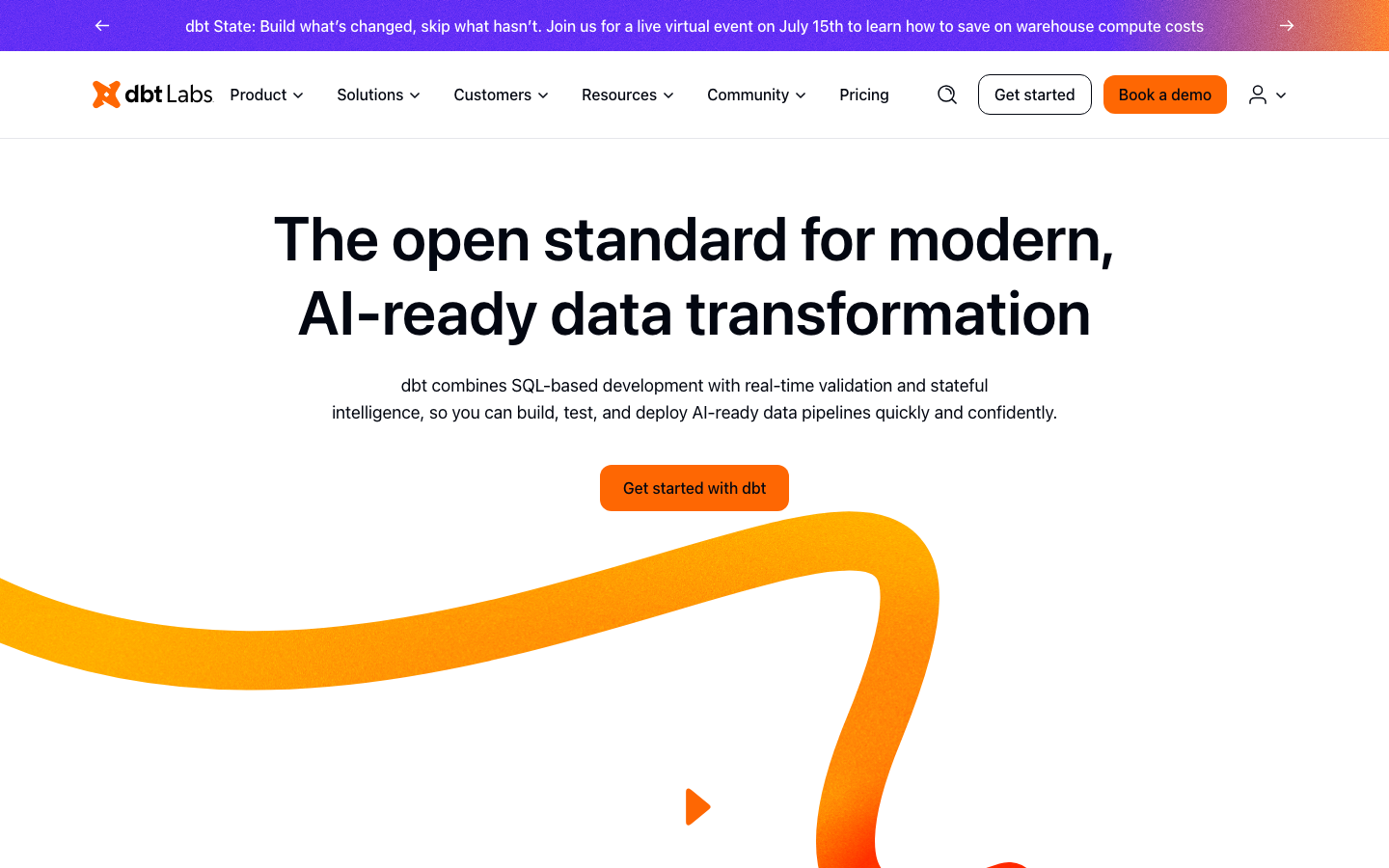
dbt (data build tool)
Core parameters and statistics of dbt
dbt is the de facto standard tool in the field of data analysis engineering, covering all transformations (T) from data loading completion to analysis readiness. It is not a data movement tool in traditional ELT, but allows data teams to define transformation logic in SQL, automatically manage dependencies, test quality, generate documentation, and plug into CI/CD pipelines. Between 2025 and 2026, dbt successively launched the Fusion engine (Rust rewrite), dbt Wizard (AI Agent) and dbt MCP Server, evolving it from a pure SQL conversion framework to an "AI-ready data conversion platform".
| Projects | Public Information |
|---|---|
| Official positioning | The open standard for modern, AI-ready data transformation (The open standard for modern, AI-ready data transformation) |
| Core capabilities | SQL model definition, data testing, automatic document generation, CI/CD integration, lineage tracking |
| Deployment form | dbt Core v1 (Python, open source) + dbt Core v2 (Rust, alpha) + dbt Cloud (SaaS) + Fusion engine |
| Engine route | dbt Core v1 (Python engine, stable) → dbt Core v2 (Rust rewritten, alpha) → Fusion engine (Rust, including LSP and state awareness) |
| AI product line | dbt Wizard (AI Agent), dbt Copilot (inline AI assistance), dbt MCP Server (Model Context Protocol Service) |
| Open Source License | Apache 2.0 (dbt Core Series) |
| Community size | GitHub approximately 13.5k stars, 2.5k forks, 429 contributors, 334 releases |
| Adapted data platform | 20+ adapters for Snowflake, BigQuery, Redshift, Databricks, DuckDB, Postgres, ClickHouse, Exasol, etc. |
| Parent company | dbt Labs (valued at over $4 billion in 2024, merged with Fivetran into the same company in 2025) |
| Latest version | dbt Core v1.12.0 (2026-07-16)/dbt Core v2.0-alpha in progress |
Industry status: dbt has basically become the industry standard language for data analysis engineering - similar to SQL itself in data query. The merger with Fivetran in 2025 further consolidated its core position in the Modern Data Stack, forming a product portfolio of "Fivetran is responsible for data access (EL) and dbt is responsible for data transformation (T)".
AI transformation signal: dbt will intensively launch AI capabilities in 2025-2026 - dbt Wizard (full life cycle AI Agent), dbt Copilot (inline SQL/document/test generation), dbt MCP Server (standardized AI data access layer), marking its strategic expansion from "SQL framework for data engineers" to "data infrastructure in the AI era".
Users and market recognition of dbt
dbt’s market recognition is at the highest level in its segment, but the specific number of C-end users and the total number of enterprise customers have not been officially disclosed.
Open source community popularity: The GitHub warehouse has about 13.5k stars, 2.5k forks, 429 contributors and 334 releases. It is among the top echelons in data engineering open source projects. Community contributors include engineers from ecological partners such as Snowflake, Databricks, Fivetran, etc., forming a stable flow of external contributions.
Enterprise Customer Matrix: The customers publicly displayed on the official website include Nasdaq, Affirm, Toyota, Siemens, CHG Healthcare, Infinite Lambda, phData and other leading companies across finance, retail, manufacturing, and medical care. The actual customer base is much larger than the public list, covering the vast majority of Fortune 500-level data-driven companies.
Community ecological scale: dbt Community Slack has more than 100,000 members, and the Discourse forum dbt Hub package manager has centralized thousands of open source dbt packages (such as dbt_utils, dbt_expectations). The annual dbt Summit, the largest industry conference in its field, will be held in Las Vegas in September 2026.
Industry Standard Status: dbt's language specification (SQL + YAML + Jinja templates) has become the de facto industry standard in the field of analytical engineering. Most modern data warehouse and ELT tools provide native dbt integration or adapters. The merger of Fivetran and dbt Labs further strengthens this ecological niche - Fivetran is responsible for data ingestion and dbt is responsible for conversion. The two form a unified product experience for the entire EL+T link.
Analyst and media recognition: Analyst organizations such as Gartner and Forrester frequently cite dbt as a core component of the modern data stack in data management-related reports. The technical media generally regards dbt as the initiator and standard bearer of the "analytical engineering movement".
Cost advantage of dbt
The cost structure of dbt presents a typical "open source base + commercial value-added" model. The core value lies in using open source solutions to significantly reduce the entry threshold for data conversion, while using the commercial version to provide the collaboration and governance capabilities required for large-scale operations.
C client/individual: completely free open source path
- dbt Core: Apache 2.0 licensed, completely free. Individual developers or small teams can run on-premises or on any infrastructure with zero licensing fees.
- dbt Cloud Developer Plan: Free, includes 1 developer seat, 3,000 successfully built models per project per month. Sufficient for personal study and small project verification.
- Fusion Engine CLI: Free, available from the local command line, faster than dbt Core v1 and includes SQL static analysis capabilities.
Developer/Team: Billed by seat + model volume
| Plans | Pricing | Seats | Monthly model build caps | Key add-on capabilities |
|---|---|---|---|---|
| Developer (Free) | $0 | 1 | 3,000 | Web IDE, MFA, task scheduling |
| Starter | $100/user/month | Starting from 5 | 15,000 | Basic Catalog, Semantic Layer, dbt Copilot, API access |
| Enterprise | Business Quotation | Custom | 100,000 | Advanced Catalog, dbt Wizard, Canvas, Insights, dbt Mesh |
| Enterprise+ | Business Quote | Custom | 100,000 | PrivateLink, IP Restrictions, Rollback, Mixed Projects |
Corporate/Privatization Cost Considerations:
- The enterprise version is signed on an annual basis, and the fee includes seat fee + model construction overage fee + optional additional services (implementation support, dedicated account manager, security review).
- Advanced security features like PrivateLink, IP Restrictions, Hybrid Projects, etc. are only available on the Enterprise+ plan.
- The dbt Core self-hosted path has zero license fees, but the team needs to maintain the infrastructure (CI/CD runner, metadata storage, scheduler) by itself. The hidden cost lies in operation and maintenance manpower rather than software licenses.
- The Starter plan only supports monthly payment by credit card and does not support invoice settlement; the Enterprise plan can be signed on an annual basis and supports invoices.
Note on hidden costs: The core of dbt Cloud's billing model is "successful models built per month". The model volume is not the computational complexity or the number of data rows, but the number of models successfully built in each run of dbt. Teams with high iteration frequency need to pay attention to the monthly usage limit, and if it exceeds the limit, they need to contact business expansion. Tool calls to the remote MCP server (only text_to_sql) consume the dbt Copilot action quota, and all tools on the remote MCP will be unavailable after the quota is exhausted.
Main functions of dbt
The functional system of dbt revolves around "managing data conversion with software engineering best practices". After adding the AI product line in 2025-2026, it will be expanded to the dual engine of "data conversion + AI-assisted development".
-
SQL Model Definition: Analysts only need to write
SELECTstatements and dbt automatically handles DDL/DML and materialization strategies (View, Table, Incremental, Ephemeral, Materialized View). Dependencies are established between models through theref()function, and dbt automatically parses the DAG and executes it in topological order. -
Data Testing and Assertion: Built-in test types such as uniqueness, non-null, foreign key reference, custom SQL assertion, etc. Tests are automatically run every time
dbt buildordbt testis run, and the results are written torun_results.json. Combined with CI/CD, data quality incidents can be intercepted before PR is merged. -
Automatic generation of documents and lineage: Automatically generate a data directory website from the
descriptionfield anddocsblock in the model YAML configuration, including a complete data lineage (Lineage) diagram. The lineage diagram is automatically drawn based onref()and does not require manual maintenance. The local document experience of dbt Core v2 has been rewritten using new Parquet format products to support large-scale projects. -
Package management and reuse: dbt Hub collects thousands of community packages (such as
dbt_utils,dbt_expectations,dbt_date), which are declaratively introduced throughpackages.yml. Enterprises can build private package indexes. -
Incremental model: Implement incremental construction through the
is_incremental()macro, only process new or changed data, and avoid full table scans. Coupled with the "state-aware orchestration" of the Fusion engine, it automatically detects code changes and data changes, and only builds models that need to be updated - officially claiming to save 30%+ warehouse computing costs. -
dbt Copilot (Inline AI): Provides single-click generation of SQL, documentation, tests and semantic models in Studio IDE, Canvas, Insights. Data analysts can invoke AI assistance without leaving the editor. Starter and above plans only.
-
dbt Wizard (AI Agent): The AI Agent launched in 2026 is specially designed for data development and completely covers the four stages of investigation (Investigate), construction (Build), verification (Validate), and release (Ship). It does not simply write SQL, but uses the native metadata engine to understand the project's lineage, tests, contracts, and indicator definitions, and then performs collaborative modifications of multiple files. Lineage consistency is automatically verified after changes are completed, and governance and audit trails are enabled by default. Supports two user interfaces within the dbt Cloud platform and terminal CLI.
-
dbt MCP Server: Provides a standardized Model Context Protocol interface, allowing AI applications (Claude, Cursor, VS Code, Snowflake Cortex, etc.) to access dbt metadata Semantic Layer, Discovery API and CLI commands through structured tool interfaces. Supports two access methods: self-hosted (running locally, supporting complete CLI commands) and remote (hosted by dbt, suitable for data consumption scenarios).
Expert view: The AI function of dbt is not "adding a chat box to the SQL editor", but a three-layer nesting deeply embedded in the data development workflow: the bottom layer is the MCP protocol to open the access channel between AI and data assets, the middle layer is the wizard to complete the "understanding-encoding-verification-publishing", and the top layer is Copilot to provide lightweight real-time assistance. This layered design allows teams of different maturity levels to find a suitable AI entry angle - small teams start with Copilot's single point of assistance, mature teams use Wizard to automate the entire development cycle, and platform teams expose dbt metadata to the enterprise AI infrastructure through MCP.
dbt model and version evolution
The version evolution of dbt has experienced a three-stage transition of "Python steady state → Rust rewriting → AI capability injection" between 2024 and 2026, developing from a single SQL compilation engine to an open data platform including AI Agent and MCP protocol.
dbt Core v1 series: Python engine steady state (2024-2025)
| Version | Date | Key Changes |
|---|---|---|
| v1.5 | 2024-03 | Introducing Model Contracts to enforce column name and data type consistency |
| v1.6 | 2024-06 | dbt Mesh is officially available and supports cross-project reference (cross-project ref) |
| v1.7 | 2024-09 | New version of dbt Explorer, enhanced lineage visualization and project search |
| v1.8 | 2025-01 | dbt Semantic Layer GA, supports indicator-based query (MetricFlow) |
| v1.9 | 2025-06 | Performance optimization and adapter ecological expansion, introducing dbt Cloud CLI |
| v1.10 | 2025-09 | Enhance the functionality of dbt Explorer and improve CI/CD ticket integration |
| v1.11 | 2025-12 | JSON product stability improved, community adapter compatibility improved |
| v1.12 | 2026-07-16 | The latest stable version, continuous iteration and maintenance of historical versions |
dbt Core v2 / Fusion engine: Rust rewrite (2025-2026)
| Version | Date | Key Changes |
|---|---|---|
| v2.0-alpha | 2025-10 | The first Rust rewritten alpha version, greatly improving the parsing and compilation speed |
| v2.0-preview | 2026-06 | Preview version, introducing Parquet product format, self-contained binary distribution Rust LSP |
| Fusion Engine | 2026-06 | Extend SQL static analysis, state-aware orchestration, and native SQL understanding based on dbt Core v2 |
Core changes in dbt Core v2:
- Performance jump: Parsing and compilation speeds are increased by 5-10 times on large projects, and the Rust implementation is an order of magnitude faster than the Python implementation.
- Stricter Grammar Specification: Grammatical and logical errors are discovered during the parsing stage instead of being exposed at runtime.
- Parquet product:
manifest.jsonhas been added to the Parquet format product, which can be directly queried and analyzed using SQL. - Single Binary Distribution: No Python runtime and dependency management required, just download and use.
- Enhanced local documentation:
dbt docshas been rewritten based on the new product format, scalable to large projects.
AI product line version history (2025-2026)
| Product/Version | Date | Key Changes |
|---|---|---|
| dbt Copilot (initial) | 2025-06 | Introducing inline AI code generation in Studio IDE with support for SQL and documentation |
| dbt Copilot (Extended) | 2026-01 | Extension to Insights analytics agent to support natural language data query |
| dbt MCP Server v1 | 2026-03 | The first MCP server released, supporting Discovery API and Semantic Layer |
| dbt Wizard (internal beta) | 2026-04 | Internal beta for the Enterprise plan, covering research-build-verification-release |
| dbt Wizard (GA) | 2026-06 | Officially released, supporting both dbt Cloud platform and CLI terminal use |
| dbt MCP Server v2 | 2026-07 | Support remote MCP server (zero installation), integrate Snowflake Cortex |
Version Note: The dbt Core v1.x series is still the choice for most current production environments. v2.0 is still in the alpha/preview stage and is not recommended for use in production environments. The Fusion engine can be experienced locally through the free CLI, which does not require a dbt Cloud account.
Technical advantages of dbt
The technical advantage of dbt does not lie in processing large-scale data (this is not its responsibility), but in the technical implementation of the concept of "managing data transformation logic with engineering means", and the leap in capabilities brought about by Rust rewriting and AI injection in 2025-2026.
SQL is logic, not boilerplate code: The core technology choice of dbt is to let analysts only write SELECT, and all other work (DDL generation, dependency resolution, execution orchestration, state management) is automatically completed by the framework. This design significantly lowers the threshold for conversion from analysis to production - analysts do not need to understand the DDL syntax, materialization strategy or transaction management of the data warehouse, but only need to understand the SQL expression of business logic. Mechanically, dbt's compiler compiles the Jinja template + SQL + YAML configuration into native SQL for the target data platform, and adapts to the dialect differences of different warehouses through the adapter mode at runtime.
Fusion engine: Qualitative changes brought about by Rust rewriting: The dbt Core v2/Fusion engine is rewritten in Rust, which brings not only a speed increase (parsing/compilation speed is 5-10 times), but more importantly, SQL static analysis capabilities - detecting syntax errors, type mismatches and potential logical problems before SQL is sent to the database. This changes the working paradigm of dbt: from the trial and error mode of "compile-run-wait for error reporting" to the IDE experience of "check while writing-immediate feedback". Fusion's "state-aware orchestration" automatically determines which models need to be rebuilt by comparing code changes and data changes to avoid unnecessary full calculations. It is officially claimed to save 30%+ warehouse computing costs.
Technical architecture of AI capabilities: dbt's AI capabilities are not simple LLM packaging, but a deeply integrated design based on a "native metadata engine".
- dbt Wizard reads the complete lineage diagram, test results, contract definitions and indicator metadata of the project through the metadata engine, making its "understanding" of the project far beyond the pure code context. When performing changes, the Wizard automatically coordinates multi-file modifications (such as automatically updating all
ref()references after renaming a model) and verifies lineage integrity and test coverage before committing. - dbt MCP Server exposes dbt's Discovery API, Semantic Layer, Admin API, and CLI commands as standard MCP tool interfaces. The self-hosted mode supports CLI commands such as
dbt run,dbt build, anddbt test, while the remote mode focuses on data consumption scenarios (querying indicators, exploring metadata, and viewing lineage). - The underlying layer reuses dbt’s existing open standards (SQL + YAML + Git) without introducing proprietary data formats or locking protocols.
Adapter Ecology and Open Architecture: dbt’s adapter plug-in architecture (dbt-adapters) enables it to support 20+ data platforms. Each adapter package encapsulates the connection DDL dialect and materialization strategy of the corresponding data platform. Adapters for the new platform can be developed by the community based on the dbt-adapters SDK, and have covered mainstream platforms such as Snowflake, BigQuery, Redshift, Databricks, DuckDB, Postgres, ClickHouse, Exasol, SQL Server, and Trino. This open architecture is the key to dbt becoming an industry standard - instead of locking users into a specific platform, it allows users to get a consistent engineering experience on any platform.
Semantic Layer and MetricFlow: dbt Semantic Layer provides the ability to "define indicators once and consume them with any tool" based on the MetricFlow engine. Metric definitions are written in YAML in the dbt project, metric calculations are performed in the data warehouse, and the results are exposed to BI tools (Tableau, Mode, Looker, etc.) and AI tools through the Semantic Layer API. MetricFlow automatically handles fractal dimension drill-down, time aggregation and unit conversion of indicators, and separates the "declarative definition" and "executive calculation" of indicators.
How to use dbt
dbt provides multi-level usage entrances, covering the different needs from novices with zero experience to enterprise-level platform teams.
| How to use | Suitable for the crowd | Engine | Features | Cost |
|---|---|---|---|---|
| dbt Core CLI | Personal/technical team | Core v1 (Python) | Install pip install dbt-core and corresponding adapter, command line operation |
Completely free |
| Fusion CLI | Team pursuing speed | Fusion (Rust) | A single binary can be run, SQL static analysis + instant feedback, faster compilation | Completely free |
| VS Code Extensions | Developers | Fusion | Get LSP, autocompletion, inline errors, lineage preview in VS Code/Cursor | Free installation |
| dbt Cloud (Studio IDE) | Team collaboration | Fusion / Core | Browser IDE, task scheduling CI/CD, log, document hosting | Free/Starter/Enterprise |
| dbt Cloud (Canvas) | Visual modeling | Fusion | Drag-and-drop model editing, visual lineage | Enterprise plan |
| dbt Cloud CLI | Local development + platform | Fusion | Local command line but associated with dbt Cloud project, supports CI/CD triggering | Requires dbt Cloud account |
| dbt Wizard (in Cloud) | Enterprise team | AI Agent | Conversational data development, automatic research-build-validation-release | Enterprise plan |
| dbt Wizard (CLI) | Developer | AI Agent | Terminal native AI Agent, can be paired with local dbt project or Cloud project | dbt Cloud account required |
| dbt MCP (self-hosted) | AI integration developer | MCP protocol | uvx dbt-mcp starts a local MCP server and exposes CLI+API+SQL tools |
Free |
| dbt MCP (remote) | AI data consumption | MCP protocol | Zero installation HTTP connection, query indicators, metadata, lineage | Consume Copilot quota |
Quick Start Path:
- Getting Started: Visit docs.getdbt.com → Select the Quickstart guide → Select your data platform (DuckDB, BigQuery, Snowflake, etc.) → Follow the steps to create the first dbt project → Run
dbt buildto complete model building and testing. - AI Assisted Getting Started: Users with a dbt Cloud account can directly use dbt Copilot to generate SQL models or dbt Wizard to complete complete model development in Studio IDE. The former is suitable for single assistance, and the latter is suitable for complex multi-file changes.
- MCP integration: AI application developers can connect dbt MCP Server to clients such as Claude Desktop through the following configuration:
{
  "mcpServers": {
    "dbt": {
      "command": "uvx",
      "args": ["dbt-mcp"]
    }
  }
}
The tool categories exposed by self-hosted MCP include: dbt CLI command Semantic Layer query SQL execution, metadata discovery (Discovery API), management API, code generation Fusion tool, and product document retrieval. CLI commands and code generation tools are not supported on remote MCPs.
Enterprise landing path: It is recommended to advance in three steps: "pilot → comparison → expansion". First try dbt Cloud (14-day free trial) on 1-2 high-value data pipelines, covering the complete development-test-deployment process, running in parallel with existing ETL scripts and comparing model build time, quality incident rate and team onboarding costs; after confirming the benefits, choose the Starter or Enterprise plan according to team size. The Enterprise assessment needs to focus on SSO integration PrivateLink network configuration, audit logs and SLA terms, as well as the actual governance overhead of dbt Mesh cross-project collaboration.
dbt product pricing
dbt adopts a hybrid pricing model of "open source Core free + cloud pay-as-you-go". The capability differences between different plans are mainly reflected in collaboration functions, AI functions and advanced security features.
| Plan | Price | Developer Seats | Monthly Successful Models | Number of Projects | Key Differentiators |
|---|---|---|---|---|---|
| Developer (Free) | $0 | 1 | 3,000 | 1 | Basic IDE + Scheduling; no API, no Copilot |
| Starter | $100/user/month | Starting from 5 | 15,000 | 1 | API access to dbt Copilot, Basic Catalog and Semantic Layer |
| Enterprise | Business Quotation | Custom | 100,000 | 30 | dbt Wizard, Canvas, Insights, dbt Mesh, Advanced Catalog |
| Enterprise+ | Business Quote | Custom | 100,000 | Unlimited | PrivateLink, IP Restrictions, Rollback, Mixed Projects |
FREE OPTION:
- dbt Core: Fully open source, Apache 2.0 licensed, fully functional, suitable for individuals and small teams of any size.
- Fusion CLI: Free, faster than Core v1, available from the local command line, no dbt Cloud account required.
- VS Code Extension: Free, providing Fusion engine + LSP integrated development experience.
- dbt Cloud Developer: Free, but limited to 1 developer seat.
Key constraints for paid options:
- The Starter plan only supports credit card monthly payments and does not support invoices. The enterprise version supports annual signatures and invoices.
- If the model construction usage exceeds the limit, you need to contact the business for expansion. The official excess unit price has not been disclosed.
- The dbt Copilot action quota is capped in all plans and is consumed by the
text_to_sqlfunction of the remote MCP tool. All tools on the remote MCP are blocked after quota exhaustion, including SQL and Fusion tools from the self-hosted MCP agent to the remote. - dbt Wizard is only available on Enterprise and above plans.
Selection logic of open source vs. Cloud: Teams with strong technical capabilities and sufficient operation and maintenance resources are suitable for the dbt Core/self-hosted path to obtain maximum flexibility and zero licensing costs; teams that require Web IDE, hosting scheduling AI assistance, team collaboration and governance auditing are suitable for dbt Cloud. In actual deployment, a hybrid model of "Core local development + Cloud production scheduling" is common - using Core or Fusion CLI to develop and test locally, and using Cloud's managed running environment in the CI/CD pipeline.
Application scenarios of dbt
The core application scenarios of dbt cover three progressive levels: "data conversion standardization → data quality governance → AI data preparation", and have been deployed on a large scale in finance, retail, medical, manufacturing and other industries.
-
Enterprise data warehouse standardization: Unify the ETL scripts and stored procedure Python conversion codes scattered in various business lines into the dbt model. Each business indicator corresponds to a dbt model, and traceable dependencies are established through
ref(). Implementation Tips: When migrating, it is recommended to proceed in stages by business domain. After each domain is completed, compare the model construction time and the execution difference of the old script. Theunique_keyconfiguration of the incremental model (Incremental) in the initial stage of migration is a common pitfall and needs to be fully verified during the testing phase. -
Data Quality Monitoring System: Automatically detect outliers, duplicate records, reference breaks and logical consistency through dbt testing when data is stored in the database. After each
dbt buildordbt testis executed, the test results are written torun_results.json, which can be connected to alarm channels such as PagerDuty and Slack. Implementation Tips: It is recommended to start with basic tests such as uniqueness, non-nullity, and referential integrity, and gradually introduce customgeneric_testandsingular_test. Test coverage should increase with the importance of business data rather than covering all fields at once. -
Data preparation for AI and machine learning: Use dbt to build a feature data set for AI model training and inference to ensure that the data origin is traceable and the quality is verifiable. dbt MCP Server provides a standardized data asset access interface for AI applications, allowing LLM Agent to perceive the project's lineage structure and indicator definitions when generating SQL or analyzing data. Implementation Tips: AI scenarios have high requirements on data timeliness and consistency. It is recommended to configure the Incremental materialization strategy for the feature model and set
alert_onto monitor data delay. -
Cross-line data product delivery: The data team uses dbt to build a business-oriented data mart (Data Mart), defines unified business indicators (such as GMV, DAU, LTV) through dbt Semantic Layer, and then exposes them to Tableau, Mode, Excel or custom applications through APIs. dbt Mesh supports cross-project references and is suitable for multi-business line scenarios - each business line maintains an independent dbt project and shares the upstream core dimension model through
cross-project ref. Implementation Tips: In Mesh mode, contract consistency between projects is the core governance point. It is recommended to enable thecontractconfiguration for all models referenced across projects. -
Fivetran + dbt unified data pipeline: Fivetran completes data ingestion (EL), dbt completes transformation (T). Fivetran automatically synchronizes raw data to the data warehouse, and dbt runs model builds, tests, and documentation updates on a schedule. The metadata of the two systems can be connected through the API of dbt MCP Server and Fivetran. Implementation Tips: The unified billing and account management of the two sets of products after the merger are still evolving. The overall SLA and support path of EL+T need to be confirmed when purchasing.
Applicable groups of dbt
The core user group of dbt is "data analysts and engineers who understand SQL but not necessarily engineering." Its value lies in making SQL coding have the quality assurance of software engineering.
-
Analytics Engineer: The core target group. They bring SQL coding best practices (version control, testing, documentation CI/CD) to the data transformation layer. dbt allows analysts to evolve from "writing one-time queries" to "building reusable data products". Not Fitting the Boundary: If the team's data transformation needs are extremely simple (fewer than 5 models, no incremental builds required), the engineering overhead of dbt may outweigh the benefits. In such scenarios, it is recommended to directly use the built-in ETL of the BI tool.
-
Data Platform Team: Need to uniformly manage the data modeling logic and testing standards of multiple business lines. dbt Mesh and model contracts allow platform teams to define core dimensions and metrics without intruding on business projects. Prerequisite: The platform team needs to have experience in Git workflow management and be able to design reasonable branch strategies and CI/CD pipelines.
-
Business analysts for data-driven enterprises: Through dbt Copilot and dbt Wizard, business analysts with limited SQL capabilities can also complete basic data model development and indicator queries with the assistance of AI. However, business analysts still need to understand basic data warehouse concepts (fact tables, dimension tables, granularity), and dbt cannot replace domain knowledge. Not suitable for the boundary: For analysts who cannot write SQL and do not understand the basic concepts of relational databases, the learning curve of dbt will be very steep. This type of user is more suitable to use the visual interface of the BI tool directly.
-
AI/ML Engineers and Data Scientists: Need to build high-quality feature datasets for model training. dbt provides a versionable, testable, and lineage conversion pipeline to ensure the reproducibility and auditability of training data. dbt MCP Server allows AI Agents to directly access the metadata and metric definitions of data assets. Prerequisite: The AI team needs to collaborate with the data engineering team to define the upstream dependencies of the dbt model to ensure that the timeliness and consistency of the feature data meet the model requirements.
Summary of unsuitable scenarios:
- Scenarios where no SQL programming is required, the data volume is extremely small (below the GB level), and ETL can be completed directly in the BI tool.
- Organizations that have not yet built a data warehouse or are in the technology selection stage - dbt does not solve data storage and computing issues.
- Temporary analysis scenarios that do not require version management and quality testing of data conversion logic.
- Requires real-time/streaming data transformation (dbt is designed as a batch ELT tool, not suitable for stream processing with millisecond latency).
- Organizations that have a strong reliance on Fivetran integration but are unable to accept post-merger unified commercial terms (contract paths will need to be evaluated individually).
Summary and outlook of dbt
dbt has evolved from an open source SQL compilation tool in 2016 to a de facto standard in the field of data analysis engineering. The Rust rewrite (Fusion engine) and AI product line (dbt Wizard, dbt Copilot, dbt MCP Server) in 2025-2026 have completed its positioning upgrade from "SQL conversion framework" to "AI-ready data conversion platform".
Current core advantages:
- Industry standard status: dbt's language specifications and engineering methodologies have been widely adopted, with a community size of over 100,000 and adaptable to 20+ data platforms. The merger with Fivetran further consolidates EL+T’s leading position in the full link.
- Differentiated design of AI capabilities: dbt Wizard is not a simple LLM code generator, but an AI Agent with a deep understanding of project lineage and metadata - governance and auditing are enabled by default, and verification is built into the workflow. This combination of "AI + governance" is extremely attractive for enterprise scenarios with high compliance requirements.
- Open Architecture: Apache 2.0 licensed, open source engine, based on standard SQL and Git, no risk of vendor lock-in. The adoption of MCP protocol makes it a natural integration into the growing Agent ecosystem.
- Performance jump: 5-10x parsing/compilation speed improvements from the Rust rewrite, and 30%+ compute cost savings from state-aware orchestration, directly translate into quantified benefits in team efficiency and data infrastructure costs.
Major current limitations and risks:
- dbt Core v2/Fusion is still in its early days: v2.0 is still in the alpha/preview stage and is not recommended for production use. The v1.x Python engine is stable in production but has obvious performance bottlenecks on very large projects.
- Enterprise barriers to AI functionality: dbt Wizard is limited to the Enterprise plan, and Copilot's quota mechanism creates an implicit ceiling for high-frequency usage. For small teams, there is a mismatch between the value of AI capabilities and their ability to pay for them.
- Integration uncertainty of the Fivetran merger: Unified billing, unified account management, and unified technical support of the two sets of products are still evolving, and the contract renewal and support paths for existing customers require business confirmation.
- Ecological Binding Risk: Although dbt itself is open, its best practices are tightly coupled with the Modern Data Stack. If the organization has not completed the ELT architecture transformation (still using traditional ETL tools and stored procedures), the advantages of dbt will be difficult to play.
- Real-time scenarios are not covered: dbt is designed as a batch processing tool and does not support streaming data conversion. For data pipelines that require second-level latency, additional stream processing engines are required.
Follow-up observation points:
- The release rhythm and production readiness of the official version of dbt Core v2.0 - determines the technology upgrade path for existing v1.x users.
- The depth of product integration after the merger of Fivetran + dbt - whether to maintain independent operations of the dual brands or to gradually unify the product experience.
- The speed of community adoption of dbt Wizard and MCP Server - whether it can continue the open source ecological appeal of dbt Core.
- The trend of fragmentation in the data warehouse field - new storage formats and query engines (such as Apache Iceberg, DuckDB, etc.) require continuous adaptation.
Procurement and Adoption Risk Assessment:
- Individual/Small Team: Get started risk-free with dbt Core (free) or Fusion CLI (free). It is recommended to use the duckdb adapter to experience the complete model-test-document workflow locally before evaluating whether you need a Cloud paid plan.
- Medium-sized teams: 14-day free trial of dbt Cloud Starter, focusing on verifying Copilot's auxiliary effect, Semantic Layer's indicator management efficiency and team onboarding cycle. Confirm that the model building usage is within the Starter limit and can be expected to grow in the next 12 months.
- Large Enterprises: The following verifications need to be completed before purchasing the Enterprise plan: compatibility testing of SSO integration and existing IdP (including JIT and SCIM); feasibility of PrivateLink/network isolation under the enterprise network policy; whether the dbt Mesh governance model can meet the data permission isolation requirements of multiple business lines; evaluation of the accuracy and false positive rate of dbt Wizard on real data assets (it is recommended to use sample testing of the enterprise's own data); Fivetran and dbt Combined contract terms - including unified SLA, data residency and end-of-support path. For compliance-sensitive industries (finance, medical, government affairs), privatized deployment is still a must. The combination of dbt Core self-hosting + VS Code extension can obtain the local development experience of Fusion engine at zero license fees.
Version Info
- dbt Core 1.9 :There is no official precise date yet.
- dbt Core 1.8 :There is no official precise date yet.
User Reviews