 Decagon
Decagon is an AI agent platform for enterprise customer experience and customer service operations teams. It builds AI concierge workflows around Chat, Email, Voice, AOP, Integrations, Experiments, Testing & QA, Insights, Watchtower and Suggestions.
decagon
Core parameters and statistics
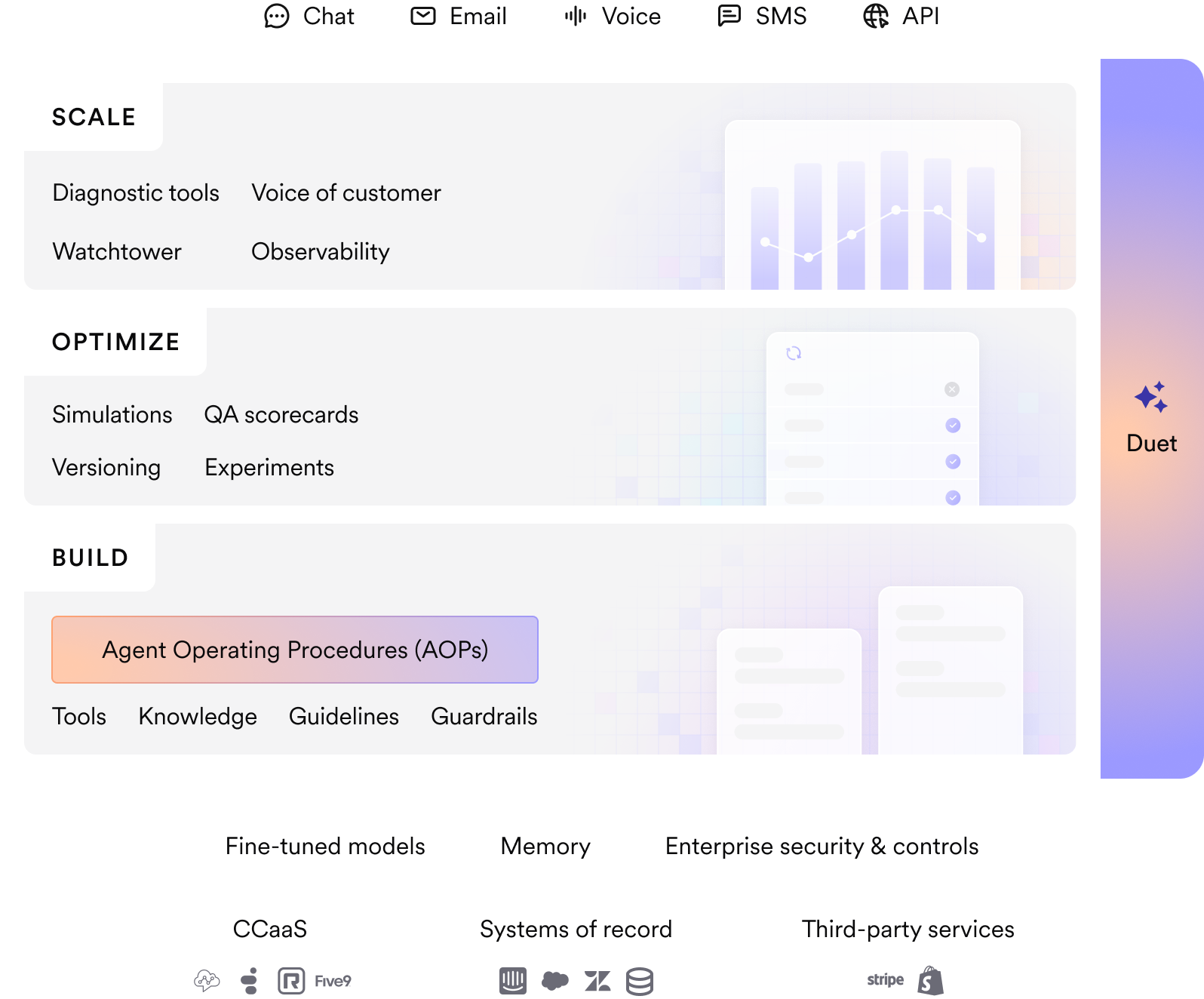
Decagon's public positioning is "The AI concierge for every customer". The product goal is not a single chatbot, but an AI agent that allows enterprise customer experience teams to build, optimize and run executable operations at scale. The product page divides the platform into four layers: channel, construction, optimization, and scale: Chat, Email, and Voice are responsible for reaching customers; AOP and Integrations are responsible for connecting business processes and system actions to agents; Experiments, Testing & QA are used for verification before and after going online; Insights, Watchtower, and Suggestions are used for continuously discovering problems and supplementing knowledge.
| Projects | Public Information |
|---|---|
| Official positioning | AI concierge for every customer |
| Main target audience | Enterprise customer experience, customer service operations, contact center and support teams |
| Core form | AI customer support agents across Chat, Email, and Voice |
| Construction method | Agent Operating Procedures, using natural language to define agent workflow |
| Optimization Tools | Experiments, Testing & QA, Watchtower, Insights & Reporting |
| Knowledge capabilities | Suggestions are used to identify knowledge gaps and generate knowledge drafts |
| Typical industries | Retail, travel and hospitality, technology, financial services, health, media, telecommunications |
| Public client signals | Avis Budget Group, Chime, Duolingo, ClassPass, Hertz, Mercado Libre, Notion, Rippling, Oura Health and more appear on official pages or cases |
| Recent financing signals | 2026-01-28 Officially announced Series D of US$250 million, valued at US$4.5 billion |
| Business entrance | Get a demo / Contact Sales, undisclosed standard self-service package |
Clear boundaries: Decagon is more suitable for complex enterprise support processes and is not suitable for scenarios that only require FAQ bots or personal chat assistants. Its value comes from the combination of "business actions + customer context + test management", rather than simply replacing the online customer service window.
User and market recognition
Decagon’s market recognition comes primarily from corporate cases and financing disclosures. Series D Announcement disclosed that Decagon added more than 100 new global enterprise customers in the last fiscal year. Customer examples include Avis Budget Group, Block, Deutsche Telekom, etc.; the same announcement showed that Series D raised US$250 million, led by Coatue Management and Index Ventures, with a valuation of US$4.5 billion.
Customer case granularity: Chime case discloses 70% chat and voice resolution; Duolingo case discloses 80% deflection rate; ClassPass case discloses 95% cost reduction, and claims deflection when going online 10x higher than expected; 1-800-Flowers page demonstrates 93% CSAT in Case Index. They illustrate that Decagon's verifiable results focus on customer service resolution rates, diversion rates, cost reductions, and customer satisfaction, rather than generalized "smart" narratives.
Financing context: Series A Announcement on 2024-06-18 announced US$5 million Seed and US$30 million Series A; Series B Announcement on 2024-10-15 announced US$65 million Series B, bringing the total financing to 1 US$100 million; the Series C Announcement on 2025-06-23 announced US$131 million Series C, with a valuation of US$1.5 billion; the Series D announcement on 2026-01-28 announced US$250 million Series D, with a valuation of US$4.5 billion. This context shows that enterprise customer service agent is its main line, rather than a temporarily expanded single point product.
Cost advantage
Decagon does not have a public and stable self-service price list, and the public entrance is mainly for demo and sales communication. Its cost advantage needs to be viewed from three levels: individuals or small teams are almost not the target customer group; the cost of developers/APIs comes from integration, testing and maintenance; at the enterprise level, it depends on whether the AI agent can reduce repeated work orders, shorten response times, and shift manual teams to high-value issues.
| Cost Hierarchy | Public Information | Cost Judgment |
|---|---|---|
| C-side/Personal | Undisclosed personal package or free self-service version | Not suitable for evaluation as a personal customer service robot or lightweight chat tool |
| Developer/API | The Integrations page mentions preset integration API and MCP support | Explicit costs are not disclosed, and implicit costs are in CRM, helpdesk, call center, knowledge base and permission system access |
| Enterprise/Privatization | Business entrance is Get a demo / Contact Sales | Price SLA, data residency SSO, audit, and contract terms require business confirmation |
Cost Establishment Conditions: Decagon can more easily demonstrate ROI when the company already has a high volume of work orders, cross-channel support pressure, and clear automation goals. If the problem volume is small and the business rules are simple, procurement and integration costs may be higher than the benefits.
Main functions
- Cross-channel AI agent: Chat page emphasizes responses that are safe and in line with the brand tone; Email page emphasizes fast, accurate and empathetic responses; Voice page is geared towards voice interaction. When multiple channels work together, businesses can extend the same support logic to chat, email, and phone calls.
- Agent Operating Procedures: The AOP page describes it as a way to build and iterate AI agents in natural language, compiling instructions into executable workflows. It lowers the threshold for business teams to modify rules while allowing technical teams to retain auditable logical boundaries.
- Integrations: The integration page clearly mentions pre-built integrations, APIs and MCP support, covering CRM, helpdesk, call centers and knowledge bases. The key value is enabling the agent to retrieve data, perform actions, and handle upgrades.
- Experiments: The experiment page provides A/B testing ideas to compare the impact of changes in tone, refund logic, entry experience, etc. on CX indicators.
- Testing & QA: The testing page emphasizes simulations, which are used to verify agent behavior, discover risks and optimize performance. It is suitable for regression verification before large-scale launch.
- Insights, Watchtower, Suggestions: Insights focuses on performance metrics and Voice of the Customer; Watchtower is used for continuous QA; Suggestions is used to discover gaps in the knowledge base and generate new article drafts.
- Duet: Duet is positioned as an agent building partner to help teams build self-improving agents faster and reduce the time between problem discovery and agent updates.
What these functions jointly solve is not "can you answer a question", but the more difficult part of the enterprise support system: whether the answer is controllable, whether the action is executable, and whether problems can be discovered and continuously improved after going online.
Model and version evolution
Decagon does not disclose traditional software version numbers, and its evolution is more like the superposition of cloud platform capabilities and financing milestones. For procurement and implementation, the important thing is to disclose the boundaries of capabilities and the maturity of the enterprise, rather than a certain client version number.
| Time | Milestone | Public Meaning |
|---|---|---|
| 2024-06-18 | Seed + Series A, totaling US$35 million | Released from stealth, focusing on enterprise customer support agent |
| 2024-10-15 | Series B $65 million, total financing $100 million | Official emphasizes customer support AI agent’s productivity gains and complex business logic capture |
| 2025-06-23 | Series C US$131 million, valued at US$1.5 billion | AOP is clearly placed in Decagon difference to strengthen controllable workflow |
| 2026-01-28 | Series D US$250 million, valued at US$4.5 billion | Officially disclosed that more than 100 new global enterprise customers were added in the last fiscal year |
| ~2026-03 | Duet / Spring 26 related capabilities | User memory Outbound Voice, Agent Workbench, Duet Autopilot and other directions enter the public narrative |
Version Judgment: Decagon can currently be regarded as the enterprise-level AI concierge platform form in 2026 Q2. If used for formal procurement, the availability of Voice, SMS, MCP, data retention, regional deployment and specific integrations in the target contract still needs to be confirmed on an item-by-item basis.
Technical advantages
AOP mechanism: Natural language process definition separates customer service SOP from engineering configuration, so business teams can more quickly modify rules such as refunds, upgrades, identity verification, compensation, etc.; at the same time, technical teams can still establish governance around versions, permissions, logs, and testing. The effect of the mechanism is faster iteration, which is suitable for companies with frequent changes in customer service policies.
Cross-system action capabilities: The Integrations page puts CRMs, helpdesks, call centers, knowledge bases, APIs, and MCP support on the same layer. Mechanically, the agent not only retrieves answers, but can also read account status, create or update records, and trigger upgrades. The effect is to merge "answering questions" and "solving problems" and is suitable for scenarios such as finance, travel, and e-commerce that require back-end actions.
Testing and continuous optimization partnership: Experiments, Testing & QA, Watchtower, Insights and Suggestions form a partnership from pre-launch simulation to post-launch monitoring. The mechanism is to first use simulations and A/B testing to reduce the risk of errors, and then use dialogue insights and knowledge suggestions to make up for the agent's weak points; the effect is to transform the customer service agent from a one-time delivery into a continuous operation object.
How to use
The entrance to Decagon is mainly enterprise demo. The typical path is to submit a demo from the official website first, and then the customer experience, operations, data, security, and IT teams jointly define the target channels, key work order types, systems that need to be connected, and acceptable automation boundaries.
| Usage phase | Main actions | Key points of acceptance |
|---|---|---|
| Pilot | Select high-frequency work orders from categories 1 to 3 and access the necessary knowledge base and helpdesk | Resolution rate, upgrade rate, error response rate, manual takeover experience |
| Comparison | Use Experiments or parallel processes to compare the old process with the Decagon agent | CSAT, NPS, response time, manual processing time QA score |
| Extension | Access to Voice, Email, more business actions and cross-channel memory | Permissions, auditing, data retention, failure fallback, cross-channel consistency |
Prerequisites for implementation: Enterprises need to prepare a stable knowledge base, clear customer service policies, callable back-end systems and manual upgrade paths. Without these foundations, AI agents tend to stay at "answering similar questions" and find it difficult to solve real customer problems.
Product Pricing
Decagon does not publish a standard price list. The official website mainly provides Get a demo and Contact Sales. AI agent pricing ideas and resolution-based pricing concepts have been discussed in his blog, but the specific contract amount, free quota, concurrency, channel SLA, data terms and privatization methods have not been stably disclosed on the public page.
- C-side/Personal: The personal free version or personal subscription is not disclosed and cannot be valued as a consumer-level chat assistant.
- Developer/API: Integrations, APIs and MCP support are the boundaries of capabilities. The standard API billing page is not public and must be subject to the business plan.
- Enterprise: More likely to be priced around channel, interaction volume, resolution rate, integration complexity, support level, security terms and data governance requirements, as determined by the official live page and sales contract.
When evaluating prices, it’s not advisable to just compare subscription fees. What's more important is to put the automatic resolution rate, manual transfer reduction QA costs, knowledge base maintenance costs and changes in customer satisfaction brought by Decagon into the same ROI table.
Application scenarios
- High-frequency customer service automation: suitable for handling high-frequency issues such as order status, membership rights, refunds and returns, account issues, appointment changes, etc. The focus of acceptance is the automatic resolution rate and error escalation rate.
- Voice and Contact Center Upgrade: Voice and call center integration are suitable for finance, travel, health, communications and other industries that require telephone support. The focus of acceptance is identity verification, call experience, and context transfer during transfer.
- Proactive Customer Experience: Hertz proactive outbound case and Proactive Agents Directions indicate that Decagon not only handles inbound inquiries but also reaches customers before issues occur. The focus of acceptance is access permission, business trigger conditions and customer acceptance.
- Voice of the Customer Analytics: Insights, Watchtower, and Suggestions are great for turning support conversations into leads for product, operations, and knowledge base improvements. The focus of acceptance is the accuracy of insights, the quality of knowledge drafts and the speed of follow-up.
- Multi-region enterprise support: Mercado Libre case shows LATAM scenario, suitable for multi-market and multi-channel support teams. Acceptance focuses on language, policy differences, regional data and local system access.
Applicable people
- Customer Experience Leader: Needs to improve resolution rates, satisfaction, and cross-channel consistency, and wants to see quantifiable changes in customer service metrics.
- Customer Service Operations and QA Team: Need to continuously monitor agent output, discover knowledge gaps, conduct testing and regression, instead of relying on manual modifications by the supplier each time.
- IT and platform team: It is necessary to integrate CRM, helpdesk, call center, knowledge base, permissions and logs into a manageable architecture.
- Product & Growth Team: Looking to distill needs, churn risks, and product improvement leads from customer support conversations.
Not suitable for boundaries: Decagon is not suitable for small teams without stable support processes, sites that only need simple web chat plug-ins, pilot projects that cannot be connected to core business systems, or organizations that have not yet formed clear requirements for data cross-border, voice compliance, and audit retention.
Summary and Outlook
Decagon's core competitiveness lies in advancing customer service AI agents from "answerers" to "enterprise customer experience operating systems": AOP is responsible for business logic, Integrations is responsible for action execution, Testing/Experiments/Watchtower is responsible for risk control, and Insights/Suggestions are responsible for continuous improvement. Official customer cases and financing milestones indicate that it has entered the stage of enterprise-level scale.
The current limitations are also very clear: the standard price is not disclosed, and deployment boundaries and data terms require business confirmation; the public page does not provide a unified list of availability in different regions, different channels, and different integrations; enterprise effectiveness strongly depends on the quality of the knowledge base, business rule clarity, and back-end system callability. To implement it, it is recommended to first select high-frequency work orders with clear boundaries for small-scale pilots, and use the resolution rate CSAT, manual transfer rate QA pass rate, and error recovery experience as acceptance indicators, and then decide whether to expand to Voice, proactive reach, and cross-channel memory.
Related tools:  CrewAI,
  LangChain
Version Info
- Series D Enterprise Platform Expansion :Officially announced Series D of US$250 million, raising the valuation to US$4.5 billion, and disclosed that more than 100 new global enterprise customers were added in the last fiscal year, marking the enterprise-level AI concierge platform entering the scale expansion stage.
- AOP-centered Concierge Platform :Officially announced $131 million Series C, with a valuation of $1.5 billion, and emphasized Agent Operating Procedures as an enterprise-controllable, iterable way to build agents.
- Decagon 2026 Q2 Public Platform :The public product matrix has covered Chat, Email, Voice, Duet, AOP, Integrations, Experiments, Testing & QA, Insights & Reporting, Watchtower and Suggestions; as a continuously iterative cloud platform, there is currently no official semantic version number. Specific function availability is subject to the real-time product page and business confirmation results.
- Duet Autopilot :Decagon promotes self-improving agent capabilities based on Duet to help teams identify improvement opportunities and perform optimization across platforms; if there is no official precise date, the month of the public blog shall prevail.
User Reviews