 Deel AI
Deel is the world's leading remote team employment and payroll management platform, covering EOR (Employer of Name) services in 150+ countries/regions, with AI capabilities embedded in the entire process of contract generation, compliance inspection and cross-border payment.
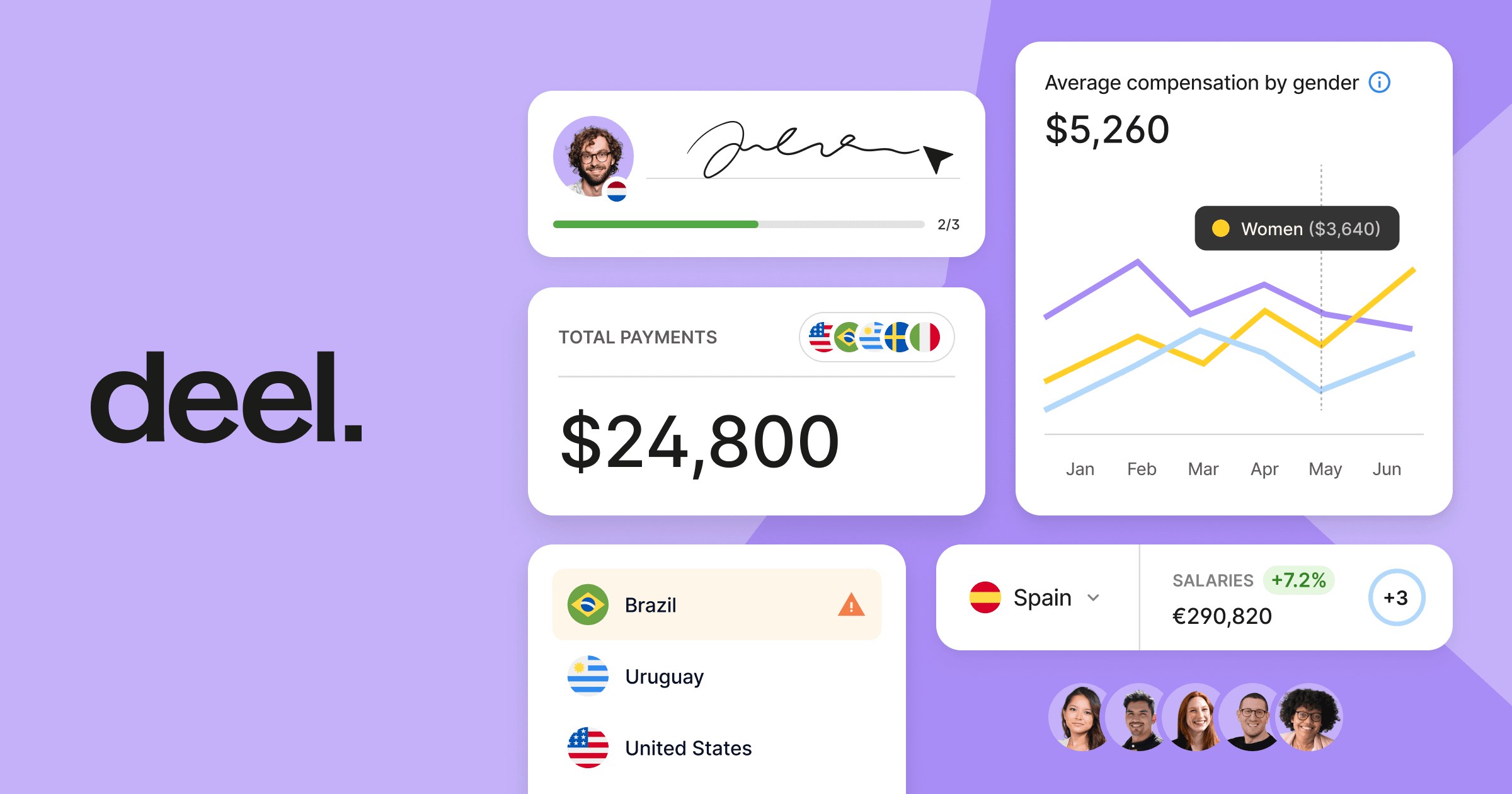
DeelAI
Core parameters and statistics of Deel AI
| Parameter item | Description |
|---|---|
| Product positioning | Global remote team employment and EOR (nominal employer) salary management platform |
| Core AI capabilities | Contract generation, compliance inspection, exchange rate optimization, labor law monitoring, employment classification recommendations |
| Countries/Regions Covered | 150+ |
| Serving corporate customers | 30,000+ |
| Total platform employees | Over 350,000 (including contract and EOR employees) |
| Deployment method | Public cloud SaaS |
| Compliance Certification | SOC 2 Type II, ISO 27001, GDPR, PCI DSS |
| Supported languages | en-US, zh-CN, es-ES, fr-FR, de-DE, ja-JP, etc. 20+ languages |
| Open Interfaces | REST API, Webhooks, integration with 200+ HR/Financial systems (Slack, QuickBooks, Xero, NetSuite, etc.) |
| Latest platform version | 2026.05 |
| Total financing | More than $650 million (led by SoftBank Vision Fund Andreessen Horowitz and others) |
| Latest valuation | $12 billion (2025 secondary market transaction valuation) |
One-sentence positioning: Deel is not a traditional HR SaaS, but a global employment infrastructure with "compliance" as the engine - by encoding the labor laws, tax laws and welfare rules of 150+ countries into an AI-executable knowledge graph, the legal threshold for companies to recruit people across borders is reduced from "setting up an overseas entity" to "filling in a form".
Its core growth logic follows the flywheel model: The wider the country coverage → the more sufficient the AI compliance model training data → the more accurate the contract generation and risk detection → the higher the enterprise occupancy rate → more country needs are proposed → coverage continues to expand. As of mid-2026, Deel has covered 150+ countries around the world, with direct teams covering approximately 60 core markets and the rest delivered through local partner law firms and EOR partners.
Users and market recognition of Deel AI
Enterprise customer size and structure
Deel has more than 30,000 publicly disclosed enterprise customers, ranging from 1-person startups to large enterprises with 5,000+ employees. The customer structure presents a "long tail + head" dual driver:
- Small and medium-sized enterprises (1-50 people): accounting for about 65%, the typical image is a remote start-up team without overseas entities, using Deel to complete the compliant employment of the first batch of overseas employees.
- Medium-sized enterprises (50-500 people): accounting for about 25%, using multiple product lines (EOR + Global Payroll + Deel HR), using Deel as the main global HR system.
- Large enterprises (more than 500 people): accounting for about 10%, well-known customers include Nike, Revolut, Coinbase, Shopify, Reddit, etc. Large enterprises often use a mix of Deel EOR (a transitional solution when entering a new market) and Global Payroll (integrating payroll data from existing overseas entities).
Industry reputation and third-party evaluation
- G2 Rating: 4.5/5 (as of Q2 2026), long-term top two in both EOR and Global Payroll categories. The dimensions with the highest user satisfaction are "country coverage breadth" and "contract template quality", and the most commonly complained about is "customer service response speed in some non-English speaking countries".
- Trustpilot Rating: 4.3/5 (approximately 10,000+ reviews), positive feedback focuses on the smoothness of the onboarding process and on-time payment rates, while negative feedback mainly relates to the communication efficiency of EOR partners in a few countries.
- Forrester Wave: Ranked as a "Leader" in the 2025 global multinational payroll management platform assessment, receiving the highest scores in the two dimensions of product roadmap and compliance capabilities.
- Gartner Magic Quadrant: In the "Leader" range in the 2025 Global EOR Services Quadrant report, both execution ability and completeness of vision are in the first tier.
Financing and market position
Deel has experienced 5 rounds of financing since its establishment in 2019. In 2021, it completed a $430 million Series D (led by SoftBank Vision Fund) with a valuation of $5.5 billion, and in 2023, it completed a $150 million Series E with a valuation of $12 billion. This valuation makes it one of the most highly valued unlisted companies in the global HR technology track. Its main competitors, Remote, were valued at about $3 billion during the same period, and Rippling was valued at about $13.5 billion (but Rippling's product line spans HR, IT, and finance, and EOR is only part of it).
Market share estimate: In the independent EOR market, Deel occupies about 30-35% share according to third-party estimates (leading Remote by about 15-20% and Oyster by about 8-10%), but this data has not been officially confirmed by Deel and is for reference only.
Deel AI’s cost advantage: three-tier cost structure and hidden benefits
Explicit cost: four levels of pricing
| Service module | Pricing model | Monthly fee | Typical annual per capita cost | Applicable scenarios |
|---|---|---|---|---|
| Deel HR | Free | $0 | $0 | Teams that only require core HR records and architecture management |
| Contractors | Per capita | $49/person/month | $588/person/year | Freelancers, independent contractors, project-based cooperation |
| EOR (Employer Notional) | Per capita | $599/person/month | $7,188/person/year | Requires full-time employment in a country without entity |
| Global Payroll | By country/capita | Starting from $29/person/month | Starting from $348/person/year | The company has entities in multiple countries and needs unified payroll management |
Horizontal comparison of competitive product EOR prices
| Service provider | EOR monthly fee (per person) | Contract worker monthly fee (per person) | Free HR tier | Country coverage | AI compliance depth |
|---|---|---|---|---|---|
| Deel | $599 | $49 | Yes | 150+ | High (AI clause detection + labor law change tracking) |
| Remote | $599 | $29 | Yes | 180+ | Medium (Contract Generation + Localization, No Clause Risk Analysis) |
| Rippling | $500+ | $50 (including platform fee) | Yes (limited to basic functions) | 90+ | Medium to high (linked with IT assets, but shallow AI compliance) |
| Oyster HR | $499 | $29 | Yes | 180+ | Medium (Localization Contract + Compliance Tips) |
| Papaya Global | $650+ | $50 | No independent free tier | 160+ | Medium (Payroll automation is strong, AI contract is weak) |
| Multiplier | $500 | $35 | None | 150+ | Low (Basic Contract Template) |
Deel’s price positioning: The EOR unit price of $599 is at the upper-middle level in the industry, the same as Remote, higher than Oyster ($499) and Multiplier ($500), and lower than Papaya Global ($650+). The key to the price difference is not the base rate, but the "depth of included services" - Deel's EOR fee already includes AI compliance monitoring, labor law change reminders, contract clause risk detection and benefit management in some countries, which are required to pay extra in some competing products.
C-side/personal cost
Deel is primarily geared towards enterprise customers, and there are no fees for individuals (contractors/employees) to use the Deel platform itself – the fees are paid by the enterprise. However, contract workers should pay attention to the following when using the Deel payment function:
- Payment Processing Fee: Generally borne by the enterprise, but the enterprise may include it in the contract quote.
- Cryptocurrency Withdrawal Fee: When withdrawing salary using Deel Crypto, the on-chain gas fee is borne by the individual (approximately $1-20, depending on network congestion).
- Cross-border bank wire transfer fee: When paying salary to a personal bank account through Deel, the $49/month paid by the enterprise covers the payment processing fee in most scenarios, and no additional expenditure is required on the personal side.
API/Integration Developer Cost
Deel provides a REST API for integration by enterprise customers or partners, and does not charge developers separately based on API calls. API access is included in the Enterprise subscription tier (generally enabled on the Enterprise plan). This means:
- For enterprise IT teams: There is no additional charge for API integration (but API call caps must be confirmed in the Enterprise contract).
- For ISVs/Partners: Deel has a Partner program and API access is subject to approval; no public pricing for third-party developers is currently available.
- Webhook Notifications: Free, push status changes via standard HTTPS callbacks.
Hidden cost analysis
- Staff scale amplification effect: With an EOR rate of $599/person/month, the annual cost for a team of 50 people is approximately $359,400. Compared with the initial investment of about $100,000-200,000 + operating costs for a self-built subsidiary's global team (including legal outsourcing, local accountants, registration fees), Deel has no significant advantage in the first year; but from the second to third years, the ongoing compliance costs of the self-built entity (average annual $50,000-100,000) may exceed Deel's service fees. Threshold estimate: For a single-country team of 30-60 people, the cumulative cost after using Deel EOR for 3 years is comparable to or slightly higher than that of a self-built entity; when there are more than 60 people and expected to stay for a long time, the self-built entity is more cost-effective.
- Hidden benefits: Deel's AI compliance monitoring is included in the EOR service for free, and companies do not need to purchase additional labor law databases or hire local legal consultants for regular updates. Based on the annual legal compliance consulting fee of $30,000-80,000 for a medium-sized enterprise (employing 50 people in 10 countries), Deel's AI compliance module is equivalent to saving this cost.
- Hidden costs: Once an enterprise chooses Deel EOR, subsequent switching to other service providers or self-built entities involves end-to-end contract transfer, employee visa/EIN transfer out of payroll, and historical migration. The switching cost ranges from $10,000-50,000 (depending on the number of countries and staff size), forming a certain degree of vendor lock-in.
Main functions of Deel AI
1. AI contract generation and localization
Core Mechanism: Enter the employee’s country, position, salary, working hours, contract type (full-time/part-time/contract), and the AI engine generates the contract with reference to the following data sources:
- Minimum requirements of local labor laws (maximum probation period, dismissal notice period, annual leave days, overtime compensation ratio)
- Local tax rate and social security payment ratio
- Industry practices (contract template matching for common positions)
- Historical contract data (the company’s past contract preferences in this country)
Output effect: A directly signable employment contract that conforms to the local language and legal format, including probationary period clauses, dismissal clauses, non-compete restrictions (in jurisdictions that allow competition), and intellectual property ownership clauses. Supports 20+ languages, and contracts default to the official language version of the employee’s country.
Hidden linkage: After the contract is generated, AI will automatically extract key terms (salary, probationary period, dismissal notice period) into the compliance monitoring panel of the dashboard, which will be linked with subsequent detection of labor law changes - if a country's minimum annual leave standard is raised from 15 days to 20 days, AI will automatically mark the terms and recommend renewal of the appendix contract.
2. Compliance monitoring and labor law change tracking
Mechanism: Deel's built-in AI compliance engine continuously tracks the government gazettes, Ministry of Labor websites and legislative databases of 150+ countries, identifies employment-related regulatory changes (minimum wage adjustments, changes in social security rates, enhanced dismissal protection, new data privacy regulations, etc.), and then automatically scans the corresponding terms of all active contracts in the country to generate a "change list to note".
Practical effect: Companies no longer need to deploy legal staff in each country of employment to monitor regulatory changes. Deel's product roadmap has planned an "automatic renewal addendum" function - AI automatically generates a contract addendum after detecting mandatory legal changes and pushes it to both parties for signature. This feature is currently still in grayscale testing.
3. Cross-border payment and exchange rate optimization
Mechanism: Deel aggregates a variety of cross-border payment channels (Swift, ACH, SDFS, Local Bank Transfer, PayPal, cryptocurrency, etc.). The AI payment engine evaluates the real-time exchange rate, handling fee and arrival time of each channel every time a salary is paid, and automatically selects the optimal combination. If the payroll currency is different from the employee's local currency, AI can also lock the exchange in advance when the exchange rate is favorable.
Cost reduction effect: Deel official promotion can reduce the total cost of cross-border payment by about 2-5%, which comes from exchange rate difference optimization and handling fee screening. For a company with 500 global employees (average monthly salary $5,000) and annual cross-border payments totaling approximately $30 million, an optimization of 2-5% corresponds to annual savings of $60-1.5 million.
Payment Method Matrix:
| Payment method | Arrival time | Cost bearer | Applicable scenarios |
|---|---|---|---|
| Local Bank Transfer | 1-2 working days | Deel borne | Mainstream method, covering 80+ countries |
| Swift International Wire Transfer | 3-5 working days | Enterprise | Countries without local channels |
| PayPal / Payoneer | Instant - 1 business day | Enterprise (additional $2-5) | Freelancer preference |
| Cryptocurrency (USDC/BTC/ETH) | Instant - on-chain confirmation | Personal (gas fee) | High-frequency micropayments or high-inflation countries |
4. Employment model classification and compliance risk warning
AI decision support: When a company plans to hire an overseas employee, AI recommends the optimal employment model based on the following dimensions:
- Employee location (whether local EOR laws and regulations restrict the contract labor model)
- Working hours (weekly working hours exceeding the threshold need to be treated as EOR rather than contract employment - most countries stipulate that 30+ hours/week is presumed full-time)
- Degree of control (whether the company provides equipment, sets working hours, and prohibits accepting other customers - the stronger the control, the more likely it is to be deemed a de facto employment relationship)
- Industry practices (some industries such as software development have a significantly higher proportion of contract workers than the pharmaceutical industry)
Risk Tip: AI will not give an "absolutely correct classification" - it will output a risk level (high/medium/low) and mark past ruling cases of local regulatory agencies as a reference. The final classification decision is still confirmed by the corporate legal affairs department.
5. Employee self-service onboarding (AI Onboarding)
Process: The company issues a job invitation → Employees receive multi-language guidance → AI guides employees to complete:
- Fill in personal information (name, address, passport/ID document upload)
- Tax form submission (W-8BEN, W-9, local tax number registration, etc.)
- Benefit plan selection (if Deel provides optional benefits in your country)
- Electronic signing of contracts (DocuSign integration)
- Payment method settings (bank account/Payoneer/crypto wallet)
AI Quality Inspection: After the file is uploaded, AI automatically performs integrity verification (confirming that the four corners of the document are complete, the text is readable, and key fields are not blocked). If a blurred copy, wrong file type, or missing information is detected, a retransmission prompt will be immediately prompted. Deel officials claim that after calling this step, onboarding completion time dropped from 3 days for the traditional HR process to about 1 hour.
6. AI-driven welfare advice and localization
Mechanism: Based on the employee’s country, job level and historical data, AI recommends locally competitive benefit packages (medical insurance amount, pension plan, additional vacation, etc.). For benefits that do not have legal requirements, AI refers to the common benefit composition of companies in the same industry in the same region and gives a "reasonable competitive range".
Model and version evolution of Deel AI
Deel's product evolution can be divided into 4 stages based on "depth of AI capability penetration":
Phase 1: Infrastructure construction period (2019-2021)
- 2019: Deel is launched. The early version is a pure EOR service management platform without AI capabilities. The core functions are manual selection of contract templates and cross-currency payments.
- 2020: Coverage expanded to 50+ countries, basic compliance checklist introduced (non-AI, static rules based).
- 2021: Completed Series D financing of $430 million and began to build an AI team. Automatic filling of contract templates was launched in the same year (based on template field matching, non-generative AI).
Phase 2: AI function introduction period (2022-2023)
- 2022 Q1: Launched a contract generation engine (AI-powered contract generation), which parses employee information based on NLP models and matches labor law rules to generate contract drafts. A basic exchange rate comparison function was launched at the same time.
- Q3 in 2022: Added employee self-service onboarding (AI Onboarding) and introduced file integrity verification.
- 2023 Q1: Labor law change monitoring is launched (first batch of 30 countries), AI regularly scans government websites and pushes change summaries.
- 2023 Q3: The "2023.09" version is released, contract generation supports 20+ languages, accesses GPT-4 as a clause polishing engine, and also launches a labor classification risk prompt function.
Phase 3: AI deep integration period (2024-2025)
- Q1 2024: Launch of compliance risk clause detection (AI scans "high-risk clauses" in contracts - excessive liquidated damages, overly broad non-compete restrictions, dismissal compensation that does not meet local minimum standards) to support flagging potential legal risks before signing.
- Q3 2024: Global Payroll module goes online AI anomaly detection - automatically identifies abnormal payment amounts, incorrect tax numbers, duplicate payments and other abnormal patterns in payroll data.
- 2025 Q1: Cross-border payment AI engine upgrade to support multi-currency batch aggregation of payments (batch optimization).
- 2025 Q2: "2025.08" is released, introducing the local welfare recommendation function, and AI recommends welfare plans based on data from the same industry and region. At the same time, Deel HR free tier was launched, extending AI compliance monitoring to the entire HR record layer.
- Q4 in 2025: Launch of AI contract risk scoring - output a "risk score (1-100)" for each contract, indicating the location of high-risk clauses that require manual review.
Phase 4: Independent Compliance Agency Period (2026-)
- Q1 2026: Start grayscale testing of "Automatic Renewal Addendum" - AI automatically generates contract addendums and initiates the signing process after detecting mandatory legal changes.
- 2026 Q2: "2026.05" is released, core updates include:
- Contract risk clause detection upgrade: Covers 40+ risk types (from salary clauses to data privacy), and the detection accuracy is approximately 15% higher than the previous generation
- Recommended optimal path for cross-border payment exchange rates: Supports real-time exchange locking + batch aggregation of payments, which can reduce exchange rate losses by 0.5-1.5% in typical scenarios
- Automatic reminders for local labor law changes: coverage of countries expanded to 100+, reminders pushed to Dashboard and Slack/email
- AI Compliance Report: One-click generation of compliance self-certification reports supporting the format of each country's labor inspection office
Version node comparison table
| Version ID | Time | AI critical update |
|---|---|---|
| Pre-AI (2019-2021) | 2019-2021 | Manual contract template + static compliance checklist, no generative AI |
| AI v1 (2022.03) | 2022-Q1 | NLP contract generation + exchange rate comparison |
| AI v2 (2023.09) | 2023-Q3 | GPT-4 clause polish + 20 language support + labor classification risk warning |
| AI v3 (2024.01) | 2024-Q1 | Compliance risk clause detection (high-risk clause marking) |
| AI v4 (2025.08) | 2025-Q2 | Territorial Benefit Advice + Deel HR Free Tier + Labor Law Monitoring Extension |
| AI v5 (2026.05) | 2026-Q2 | Automatic renewal addendum (grayscale) + one-click generation of compliance reports + 40+ risk type detection |
Deel AI’s technical advantages
Compliance knowledge graph engine
Deel’s core technical barrier lies not in the large model itself, but in its compliance knowledge graph construction and continuous maintenance mechanism:
- Data source: 150+ countries’ official government gazettes, Ministry of Labor website, tax law database, and social security agency announcements. Deel has an internal "compliance content team" (about 50 people, distributed in different time zones), which is responsible for labeling and verifying regulatory changes collected by AI - first using automated crawlers to collect policy page changes, and then entering the knowledge graph after manual review by the team.
- Knowledge Structured: Regulations are not stored as full-text indexes, but in the form of "rule triples" (condition → clause type → parameter value), for example:
[Country=Germany] & [Employment Relationship=EOR] & [Contract Type=Full Time] → [Minimum Number of Annual Leave Days=20] (Working Days). This structured representation enables AI to perform clause-level reasoning and comparisons. - Version Comparison Capability: When a change in regulations is detected, the knowledge engine will automatically compare the triples of the old and new rules to accurately locate the affected contract terms and employees, instead of pushing vague notifications such as "German Labor Law has been updated."
Contract generation technology stack
Deel's contract generation adopts a hybrid architecture of "rule engine + LLM":
- Step 1 (Rules Engine): Based on the structured data in the knowledge graph, generate a contract framework - fill in deterministic data such as statutory mandatory terms, local tax rates, social security ratios, etc.
- Step 2 (LLM Polishing): Enter the framework into the large model (the current version uses GPT-4) and perform localization polishing of the clause language - ensuring that the contract reads like it was drafted by locals, rather than a literal translation of the template. Before 2023, the self-trained Seq2Seq model was used. After switching to GPT-4 in September 2023, the fluency of terms was significantly improved.
- Step Three (Second Scan of Compliance Rules): After the generation is completed, use an independent rules engine to do compliance post-checking - detect whether the LLM has "created" content that does not comply with local laws during the polishing process (for example, adding non-competition clauses in states where non-compete restrictions are prohibited). If there are violations, it will be returned and regenerated.
This "rules in front, LLM in the middle, rules in the back" architecture not only utilizes the language capabilities of LLM, but also avoids the disastrous consequences of LLM illusion in high-compliance scenarios such as contracts through the constraints of the rule engine.
Cross-border payment optimization algorithm
Deel’s payments AI isn’t a simple exchange rate comparator—it runs a real-time optimization engine that evaluates the following dimensions every time a paycheck is issued:
- Exchange rate: the real-time buying/selling spread (spread) of each channel, plus Deel’s own exchange markup rate
- Handling fee: fixed fee + proportional fee (different channels vary greatly)
- Arrival Time: Whether employees need urgent funds (the algorithm supports setting the "Arrival Priority" parameter)
- Compliance Friction: Certain channels trigger additional AML/KYC reviews for transactions of specific nationalities/amounts, resulting in delays
- Batch collaborative optimization: When paying salaries to multiple employees in the same country at the same time, the engine can combine them into one local transfer payment, significantly reducing the per capita channel fee
Data Security and Compliance Architecture
- Data Partition: Employee data is stored in country partitions (data resides locally), with the master server located in AWS US, a copy of European employee data stored in AWS Frankfurt, and a copy of Asia Pacific employee data stored in AWS Singapore.
- Encryption Standards: Data at rest is encrypted using AES-256 and data in transit uses TLS 1.3. Sensitive PII (passport numbers, bank account numbers, tax ID numbers) additionally uses field-level encryption.
- Access Control: Enterprise customers can use RBAC to set the data visibility range of administrators' HR, finance, legal and other roles. All data access operations by Deel's internal employees are recorded in audit logs and are subject to the "just-in-time" permission mechanism (only temporarily open when support tickets need to be processed).
- Compliance Certification Matrix: SOC 2 Type II (annual audit), ISO 27001, GDPR compliance (including DPIA), PCI DSS Level 1 (processing payment data). For clients with businesses that are regulated by PCI or HIPAA, Deel can sign a DPA (Data Processing Addendum).
How to use Deel AI
Enterprise registration and team settings
- Register a business account: Visit Deel’s official website and register using your business email. The registration process takes about 5 minutes and requires your business name, country of registration, and tax ID number or EIN.
- Create teams and roles: Set up the company's internal organizational structure (departments, cost centers) in the Dashboard, and assign role permissions such as Admin/HR/Finance/Manager.
- Add payment method: Bind a corporate bank account (supports ACH / Swift / local bank transfer), or set up a cryptocurrency wallet for payment.
- Configuration Integration: Optional connections to Slack (push notifications), QuickBooks/Xero/NetSuite (financial data synchronization), and mainstream HRIS (BambooHR, Workday, etc.).
Initiate hiring process
Process Overview: Corporate HR clicks "Hire" on the Dashboard → Enter candidate information (name, email, country, position, salary, working hours) → AI automatically determines the recommended employment model (EOR/Contractor) and generates compliance analysis → HR confirms the model and signs the enterprise contract → Candidates receive multi-language onboarding guidance → Complete upload of personal information and tax forms → AI verifies documents → Both parties sign the contract → The first salary is paid.
Daily operation and maintenance operations
- Compliance Monitoring Dashboard: The main page displays the latest status of all active contracts, and the compliance status is marked in three levels: "Normal/Requires Attention/Emergency". Click the emergency mark to directly view the list of affected contracts and specific terms changes.
- Batch operations: Supports batch renewal of contracts, batch adjustment of salaries, and batch initiation of compliance reviews. AI will perform cross-checking before batch operations (for example, when batch salary increases are made, it will detect whether the minimum wage increase redline of each country is touched).
- Report Export: Supports exporting compliance reports, salary reports and worker lists by country, department, contract type and other dimensions. Data formats include CSV, PDF, and XLSX.
API integration portal
Deel's API documentation is located at developers.deel.com, and the core endpoints include:
/contracts: Contract management (creation, query, update, termination)/payments: payment management (initiate payment, query history, obtain exchange rate quotes)/workers: employee information management (query, update, resignation)/compliance: Compliance status query (get current compliance score, pending items)
The API authentication method is Bearer Token (OAuth 2.0), which is generated by enterprise customers in Dashboard → Settings → API. API calls are calculated according to the agreed quota in the Enterprise contract. If the amount exceeds the quota, you need to negotiate with the account manager for adjustment.
Product Pricing for Deel AI
Price Matrix
| Service layer | Unit price | Billing dimensions | Core AI capabilities included | Typical annual payment discount |
|---|---|---|---|---|
| Deel HR (Free) | $0 | Enterprise Account | Organizational structure management, employee files, document storage, basic compliance monitoring Dashboard | — |
| Contractors | $49/person/month | Number of active contract employees | AI contract generation (localization), payment processing, compliance checking, employee self-service onboarding | Annual payment about 8-10% off |
| EOR | $599/person/month | Number of active EOR employees | Full stack EOR (payroll + tax + social security + welfare) + AI compliance monitoring + labor law change tracking + contract risk detection | Annual payment 8-12% off, scale discount depends on the contract |
| Global Payroll | Starting from $29/person/month | Number of employees participating in payroll (billed by country) | Unified payroll management in multiple locations, AI anomaly detection, compliance report generation | Tiered quotation by number of countries and number of employees |
| Enterprise | Custom Quotes | On Demand | All Above + Dedicated Account Manager + API Priority + Custom Compliance Reports + Custom Integrations | Annual Contract |
Functional layer comparison (Deel HR vs EOR vs Global Payroll)
The premise for understanding Deel's pricing is to distinguish between different combinations of "employment models" and "product modules":
| Business needs | Recommended product portfolio | AI function coverage | Monthly fee (10 people) |
|---|---|---|---|
| Manage existing employee information only | Deel HR | Basic Compliance Dashboard | $0 |
| Hire Overseas Contract Workers | Deel HR + Contractors | AI Contracting + Payment Optimization | $490 |
| Hire overseas full-time employees (no entity) | Deel HR + EOR | Full-stack AI compliance + benefits management | $5,990 |
| Existing entities in multiple countries, unified payroll and tax management | Deel HR + Global Payroll | AI payroll anomaly detection | $290+ |
The "truth" about the free model
Deel HR free tier includes:
- Core employee records (name, position, department, contract, salary) -Organizational chart
- Document management (contract PDF storage, file version management)
- Basic Compliance Dashboard (monitor the basic status of active contracts)
Not included: AI contract generation (paid tier only), labor law change tracking (EOR/Contractors tier only), payment processing (requires Contractors or Global Payroll tier), API access (requires Enterprise tier). The compliance dashboard of the free tier only displays the "basic status" (whether the contract is in effect, expired, and signed), and does not include risk clause detection and legal change reminders.
Hidden charges and precautions
- EOR additional person lock-in period: The number of EOR people stipulated in some contracts is an annual commitment. The number of people added midway can be prorated, but the number of people reduced may be limited by the "minimum number of committed people" (usually 5-10 people).
- Benefit surcharge: EOR's $599 covers statutory social security and basic benefits, but additional commercial supplementary medical insurance or employee option management services purchased by the enterprise need to be billed separately.
- Termination fee: When the contract expires and is not renewed, Deel will charge a termination assistance fee (approximately $200-500/person, depending on the complexity of the country) to handle tax write-offs, social security account closure, and compliance settlement of the last salary.
- Currency conversion fee: If the company's payroll currency is different from the employee's local currency, Deel implies an exchange markup of approximately 0.5-1.5% in the EOR pricing (that is, the exchange rate is not a mid-market rate). This part of the price increase is less clearly stated in the contract labor pricing. It is recommended that corporate customers confirm the exchange rate basis in writing in the contract.
Deel AI application scenarios
Scenario 1: Global talent recruitment for remote native start-up teams
Typical portrait: An AI start-up team (15 people) headquartered in Singapore. The founding team is in China and India, the designers are in Argentina, and the engineers are in the United States. The team does not have any overseas entities.
Deel’s solution:
- Contract workers in Argentina use the Contractors tier ($49/person/month), AI generates an independent contractor agreement (including a Spanish version) that complies with Argentine labor law, and automatic monthly salary payment.
- Due to local regulatory restrictions on EOR, employees in China complete payroll issuance through Deel's local partners (categorized in the Global Payroll layer).
- Engineers in the US are hired as full-time employees through Deel EOR ($599/person/month), and AI automatically handles federal, state and FICA social security withholdings.
Verification Points: Start-up teams need to pay attention to the contract upgrade channels in various countries - the contract labor model in some countries has a "maximum contract period" limit. If it cannot be converted to EOR or full-time after expiration, AI should remind you in advance.
Scenario 2: Global expansion pilot of large enterprises
Typical portrait: A Chinese overseas SaaS company (2,000 employees) plans to enter the Brazilian, Mexican and Indonesian markets. Before determining that it needs to build its own entity, it first uses EOR to hire the first batch of 5 local employees.
Deel’s solution:
- 5 people in each of the three countries were hired through Deel EOR, and AI automatically generated contracts in Portuguese, Spanish and Indonesian, and processed local tax registration and social security payments.
- Enterprises can simultaneously view payroll and compliance status in three countries through Deel's Global Payroll module.
- After the 6-month pilot period, if the company decides to set up an entity in Brazil, Deel EOR supports "EOR to Entity" conversion - transfer the existing contract from Deel's nominal employer to the name of the company's new entity, and AI will automatically update the compliance status.
Cost reduction deduction: The initial registration and legal costs for a self-established Brazilian subsidiary are about $50,000-80,000 (including registration fees, hiring local lawyers, bank account opening, etc.), and the cost for five people using Deel EOR in the first year is about $35,940. Companies can save $15,000-45,000 in upfront investment before confirming product-market fit.
Scenario 3: Unified compliance management of globally distributed teams
Typical portrait: A European game development studio (300 people) with employees in 25 countries, some hired through owned entities, some through EOR, and 50 contractors.
Deel’s solution:
- Access payroll data from existing entity countries (France, Germany, Poland, Spain) through Global Payroll, and AI detects abnormal patterns in payroll data in various places.
- EOR employees (Türkiye, Vietnam, Philippines) are managed uniformly through the EOR layer, and AI monitors labor law changes in these countries.
- Contract generation and payment for contractors are processed in batches through the Contractors layer.
- Management can view the full compliance status of all 300 people through a unified dashboard.
Verification focus: The quality of data integration between Global Payroll and existing payroll systems is key - if the company is already using SAP SuccessFactors or Workday to manage its own entity payroll, Deel's Global Payroll pulls data from these systems through APIs rather than replacing them, and the timeliness of data synchronization needs to be confirmed in the contract.
Scenario 4: Compliance audit and cross-border reorganization
Typical portrait: A US public company (5,000 people) is preparing for its annual SEC audit, requires proof of global employment compliance, and plans to reorganize its contract labor model in 10 countries.
Deel’s solution:
- The AI compliance reporting module generates self-certification reports on compliance in various countries with one click, covering: contract signing status, tax form submission records, social security payment certificates, and local labor law compliance confirmation letters.
- For 200 high-risk contract workers (deemed by the AI to be "at risk of being reclassified as full-time employees by local regulators"), the AI generated person-by-person risk scores and recommendations for remediation (conversion to EOR or adjustment of hours).
- Enterprise audit teams connect compliance data to internal GRC systems through APIs.
Scenario 5: Atypical - short-term project and event operation
Medium Applicability: Companies are hosting cross-border events or short-term projects (1-3 months) and need to quickly hire temporary workers from multiple countries. Deel's Contractors layer can quickly generate short-term contracts, but the lowest rate of $49/person/month is a monthly subscription system and does not support daily billing. For extremely short-term projects (1-2 weeks), Deel is not the most cost-effective option - in this case it would be better to use a per-task platform like Upwork or Fiverr.
Applicable groups of Deel AI
Core Group 1: International HR and Global Compensation Managers
Adaptation value: HR teams can be liberated from tedious manual compliance operations - AI automatically handles contract generation, regulatory template updates, and payroll anomaly detection. For global payroll managers who manage employees in 10+ countries, Deel's Dashboard provides a "single view" to monitor the compliance status of all countries, replacing the inefficient process in the past that required logging into each country's payroll system or sending and receiving emails.
Prerequisite: The HR team is required to have basic English operation capabilities (the system interface is mainly in English, and localized interfaces are provided in a few languages). For HR who are not familiar with cross-border labor laws, Deel's AI compliance tips can significantly lower the entry barrier, but it cannot completely replace legal judgment - it is recommended that enterprises allocate at least one legal or external lawyer to conduct compliance reviews.
Core Group 2: CFOs and financial teams of multinational technology companies
Adaptation value: The integration of Deel's Global Payroll module with QuickBooks, Xero, and NetSuite allows the financial team to automatically synchronize payroll data to the financial system and reduce manual entry errors. The AI exchange rate optimization function can bring quantifiable cost savings to companies with large cross-border payment volumes (monthly payroll of $500K+).
Prerequisite: The enterprise needs to have established a basic financial integration process. Deel's API integration requires the cooperation of the IT team to complete the initial configuration.
Core group three: Overseas business development manager (MBB/overseas operations)
Adaptation value: In the new market verification stage, business development leaders do not need to wait for legal and HR approval for overseas entity establishment - using Deel, the first local employee can be hired in compliance with regulations within 48 hours, compressing the time to "enter a new market" from 3-6 months to 1-2 weeks.
Prerequisites: The company and Deel need to have an enterprise-level contract (signing and payment process). For clients with annual spend over $100K, Deel offers dedicated account managers to assist with cross-border compliance issues.
Core group four: Freelancers and remote contractors (indirect users)
Adaptation value: It is completely free for contract workers to use the Deel platform, and they can enjoy multi-currency payment options, automatic generation of tax forms, and clear payroll records. For contract workers working in countries with high inflation, Deel’s cryptocurrency payment options offer a fiat alternative.
Not suitable for scenarios: Deel’s contract labor model is suitable for long-term cooperative relationships with stable monthly payments or task-based settlement. For one-time microtasks (such as labeling data, filling out questionnaires), Deel’s minimum $49/person/month rate threshold makes it clearly unsuitable—such scenarios are better suited to PayPal direct transfers or the Upwork platform.
Not suitable for the crowd
- Enterprises with purely domestic employment scenarios (no cross-border needs): If the enterprise only hires employees in a single country, Deel's core value (cross-border compliance + multi-country coverage) does not take advantage of it. At this time, local HRIS (such as Zoho People, BambooHR, iHR, etc.) are recommended - they are better in terms of functional depth and lower cost in the home country.
- Legal-intensive scenarios that require deeply customized contracts: Deel's AI contract generation and compliance checks rely on pre-coded rules in its knowledge graph. For highly customized contracts (such as those involving complex equity incentives and unique industry regulatory requirements), the AI-generated contract can only be used as a starting point and still requires a lot of manual modification - this part of the scenario is not applicable.
- Multinational companies in highly regulated industries (such as military industry, biotechnology export controls, operations in sanctioned countries): Deel's EOR services are limited by the capabilities and compliance willingness of its local partners. Deel cannot guarantee coverage for technology transfer involving export controls (ITAR/EAR) and employee employment in sanctioned countries/regions. Such businesses will need to use a specialist global law firm or an EOR provider that specializes in this type of business.
- Small and medium-sized teams (less than 5 people) pursuing extreme pricing transparency: Deel’s pricing is transparent at the enterprise level, but the unit price of EOR $599/person puts obvious pressure on ultra-small teams of less than 5 people. This scale is better suited to using Remote’s Contractors tier ($29/person) or hiring directly through Deel’s Contractors tier without upgrading to EOR.
Summary and Outlook
Core competitiveness
The core barrier of Deel AI is the scale effect of the compliance knowledge graph - labor regulations in 150+ countries are continuously encoded into structured rules. The wider the coverage, the higher the accuracy of AI compliance detection, and the lower the entry threshold for new customers. Compared with competing products such as Remote, Oyster, and Papaya Global, Deel has established differentiation in three dimensions:
- The deepest AI function: Competitive products mainly focus on contract generation and basic compliance prompts, while Deel extends to clause risk detection, automatic tracking of labor law changes, exchange rate batch optimization and compliance report generation, forming a complete AI chain of "contract → payment → compliance → reporting".
- The most complete product matrix: HR (free tier) + Contractors + EOR + Global Payroll. The four layers cover a one-stop path from employee information management to global payroll tax. This combination is unique among independent EOR service providers.
- The most open integration ecosystem: 200+ third-party integrations and enterprise-level openness of REST API, allowing it to be embedded into the existing HR/finance technology stack of large enterprises rather than replacing it.
Current limitations and uncertainties
- The "last mile" of AI compliance still relies on manual labor: AI can mark risk clauses and detect regulatory changes, but the final compliance decision (whether to sign an addendum, whether to adjust the employment model, whether to fire) still requires manual judgment by corporate legal affairs or management. The "automatic renewal addendum" planned by Deel in the 2026 roadmap is still in grayscale, and the official GA time has not been disclosed.
- The quality of EOR services in some countries is uncontrollable: Deel's direct sales team covers about 60 core markets, and the remaining countries deliver EOR services through local partners. This means that in non-directly operated countries, the response speed and quality of employee contract management, salary payment and compliance support are affected by the partners, and complaints about this in user feedback are ongoing.
- Future Risks of Data Sovereignty and Privacy Compliance: As more countries introduce data localization laws (such as India's DPDP Act, Brazil's LGPD, and China's "Data Security Law"), Deel's data partitioning architecture needs to continue to adapt. Currently, Deel commits to storing employee data in regional servers (Europe → Frankfurt, Asia → Singapore), but some countries require EOR service providers to store data completely within the country - this requires Deel to build or rent a local server cluster in each such country, and the cost will increase significantly and may be reflected in EOR pricing.
- Big language model dependency risk: Contract polishing relies on GPT-4 (through Azure OpenAI service). If OpenAI's service is interrupted, the API version is incompatible or the pricing strategy is adjusted, Deel's contract generation process will be affected. Deel is internally evaluating multi-model redundancy solutions (Anthropic Claude, open source model self-deployment), but there is currently no public switching schedule.
Procurement/Adoption Risk Assessment
Suitable for immediate adoption: A) Growing companies planning to enter 3+ new country markets; B) Remote-first companies with 50+ overseas employees dispersed in 10+ countries; C) Large companies that are moving from "building entities in each country" to "unified global HR platform". In these three types of scenarios, Deel’s comprehensive cost and compliance efficiency advantages are significant.
It is recommended to pilot first and then expand: A) Small teams going overseas for the first time (it is recommended to use the Contractors layer to familiarize themselves with the process first, and then expand EOR after confirming compliance cooperation); B) Enterprises in highly regulated industries (it is recommended to confirm the industry coverage with Deel's compliance team first, and clarify the data protection responsibility boundaries of both parties in the contract); C) Enterprises that are extremely sensitive to data sovereignty (it is recommended to ask Deel to provide DPIA and detailed data flow diagrams during the selection stage to confirm that its partitioning strategy meets its own compliance requirements).
Not recommended for current procurement: A) Purely domestic enterprises with all employees in a single country (local HRIS is more cost-effective); B) Very large enterprises that require deep integration with SAP SuccessFactors or Oracle HCM (when Deel's Global Payroll is used as a "supplementary layer" rather than a "replacement layer", the integration cost may be higher than the expected benefits); C) Enterprises with large employment needs in sanctioned or high-risk countries (Deel's EOR Coverage is extremely limited in these areas, and it is recommended to consult a professional global law firm first).
Related tools:  Notion AI, google-workspace
Version Info
- Deel Global Platform 2026 :Added AI-driven contract risk clause detection, cross-border payment exchange rate recommendation, and automatic reminder function for local labor law changes.
- Deel Global Platform 2025 :Introducing AI contract automatic generation (supports multiple languages), compliance checklist automation, and employee local benefit suggestion functions.
User Reviews