 DeepEval
Free
DeepEval
Free
DeepEval is an open source LLM evaluation framework maintained by the Confident AI team. It is suitable for incorporating RAG, Agent, chatbot and model migration testing into the AI training model quality process.
DeepEval
Core parameters and statistics
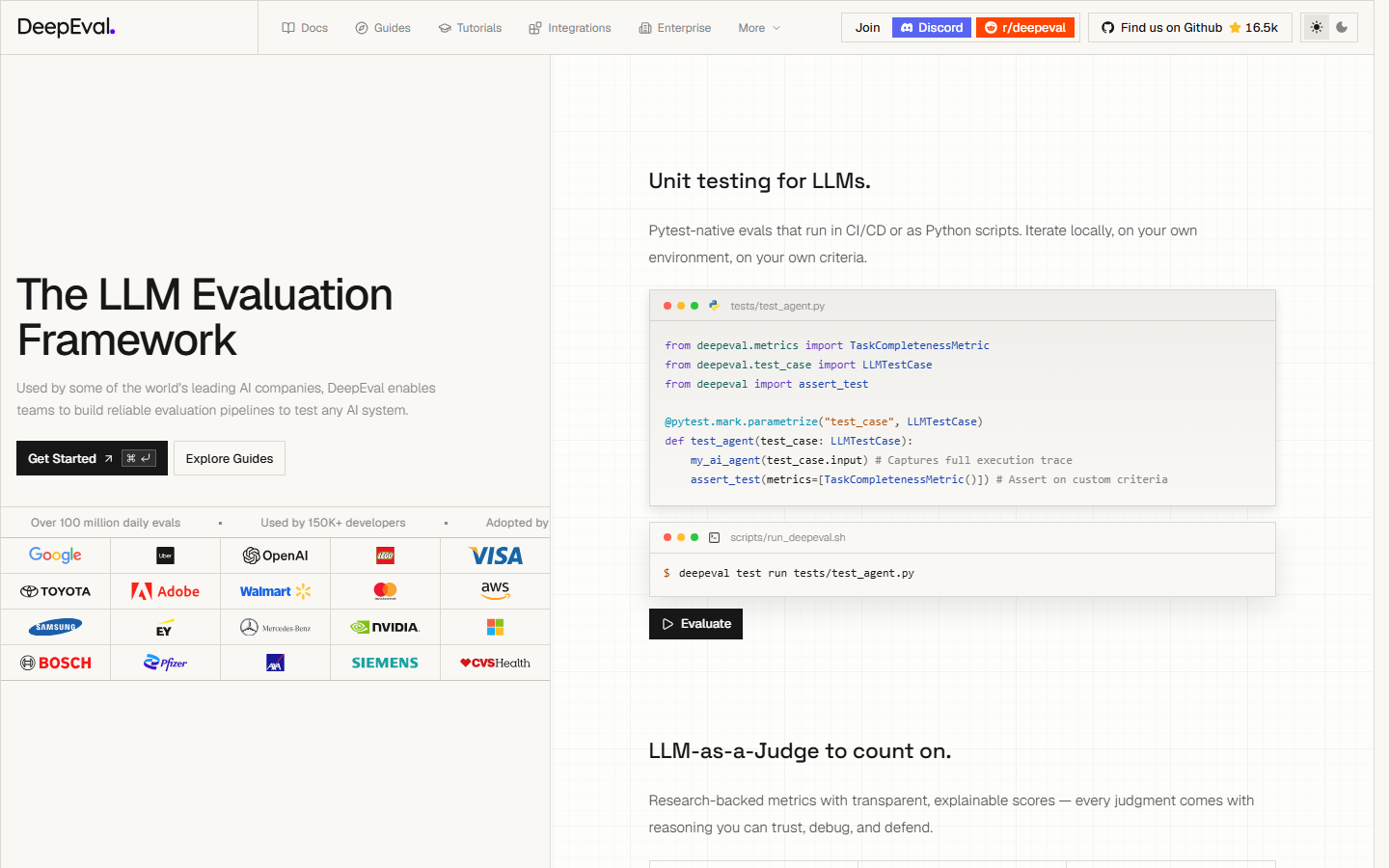
DeepEval's public positioning is "The LLM Evaluation Framework". It is not an AI content detector for end users to judge the authenticity of articles, but a testing framework for engineering teams to evaluate the quality of LLM applications: organize test cases in Pytest style, use indicators to measure the effects of RAG, Agent, chatbots, multiple rounds of dialogue and model migration, and connect the results to the local CI or Confident AI platform.
| Projects | Public Information |
|---|---|
| Product form | Open source Python package + Confident AI cloud quality platform |
| Official entrance | Confident AI; DeepEval documentation and product page is deepeval.com |
| Open source warehouse | confident-ai/deepeval |
| License | Apache-2.0 |
| Current PyPI version | 4.0.7, uploaded on 2026-06-22 |
| Python requirements | Python >=3.9, <4.0 |
| GitHub community size | About 16.4k stars, 1.5k forks |
| Core indicator coverage | Agentic, RAG, multi-turn dialogue MCP, multi-modality, hallucination, bias, toxic JSON correctness, etc. |
| Typical entry | pip install -U deepeval, deepeval test run, Confident AI platform |
Classification Judgment: DeepEval works on LLM application quality, test sets, indicators, regression and model/prompt word improvement, which is closest to ai-model-training. Although it contains detection indicators such as hallucination, bias, toxicity, etc., the goal is to evaluate the model system rather than providing AI-generated content recognition services for content platforms.
Specification boundary: DeepEval can write evaluation into code and CI/CD, but the evaluation results still depend on the quality of the test set, threshold setting judge model and indicator selection; for production quality management, manual annotation, log tracking, version baseline and business acceptance are still required.
User and market recognition
DeepEval’s recognition mainly comes from the open source community, developer workflow and Confident AI’s enterprise platform positioning. The official product page shows that DeepEval has been used for "over 100 million daily evals" and displays the adoption logos of Google, OpenAI, Toyota, Adobe, Walmart, Mastercard, AWS, NVIDIA, Microsoft, etc.; these logos can be used as official display signals, but the specific contract scope, deployment scale and payment level are not disclosed.
Open Source Community: The GitHub repository publicly displays approximately 16.4k stars and 1.5k forks, indicating that DeepEval has gone beyond the early experimental project stage and has formed a stable developer entrance around indicators, integrations, data sets, and test commands.
Developer Ecosystem: README is integrated with frameworks such as OpenAI, OpenAI Agents, LangChain, LangGraph, Pydantic AI, CrewAI, Anthropic, AWS AgentCore, LlamaIndex, etc. For the team, this type of integration reduces the friction of "modify the application first and then evaluate", and is more suitable for supplementing the quality baseline in existing RAG or Agent projects.
Corporate signal: Confident AI positions itself as an AI quality platform, covering benchmark, test, monitor, trace, dataset management, etc. DeepEval provides evaluation execution at the local code layer, and Confident AI serves as the commercial entrance for team collaboration, reporting, data persistence, and production monitoring.
Cost advantage
- C-side/Individual: Usually a free version is provided to experience the core functions, and high-frequency use requires a paid package subscription.
- API/Developer: Billed by call volume, suitable for development teams that can be flexibly integrated into their own systems.
- Enterprise/Privatization: Contact the business owner to obtain customized quotation and deployment plan. The specific price is subject to the official real-time pricing page.
Main functions
DeepEval's functions revolve around "making LLM quality testable, explainable, and regressible", and its core capabilities cover indicators, test cases, tracking, data sets, integration, and platform synchronization.
- LLM-as-a-Judge indicators: G-Eval, DAG, and custom indicators are used to convert business standards into executable evaluations, suitable for scenarios where there is no deterministic answer but quality judgment is required.
- RAG Evaluation: Indicators such as Answer Relevancy, Faithfulness, Contextual Recall, Contextual Precision, and RAGAS are used to split retrieval quality and generation quality to facilitate locating whether to retrieve contextual questions or answer generation questions.
- Agentic Metrics: Metrics such as Task Completion, Tool Correctness, Goal Accuracy, Step Efficiency, Plan Adherence, Plan Quality, Tool Use, and Argument Correctness are suitable for evaluating whether the Agent completes the task, calls the tool correctly, and detours.
- Multi-round and MCP evaluation: Knowledge Retention, Conversation Completeness, MCP Task Completion, MCP Use and other indicators are oriented to multi-round sessions and MCP server call links, suitable for customer service, sales, operation assistants and tool-based Agents.
- Local testing and CI/CD: DeepEval adopts a testing method similar to Pytest, which can be run locally, in scripts or CI contexts, reducing the quality blind spots of relying solely on manual spot checks.
- Confident AI platform synchronization: After logging in, test results, reports, data sets and traces can be synchronized to the cloud platform to facilitate team collaboration and production quality observation.
When it comes to implementation, the function selection should not be covered all at once. A more prudent approach is to first establish an indicator baseline for 1 to 2 high-value links, such as "RAG answers must be faithful to the retrieval context" or "Agent must call the correct tool", and then gradually expand to multiple rounds of MCP and production monitoring.
Model and version evolution
There are two public clues to DeepEval's version evolution: PyPI package versions for installation and dependency management, and GitHub Releases for viewing major feature nodes. The current PyPI shows 4.0.7, and the latest release on GitHub shows v4.0.5; when the two are out of sync, the production environment should be verified with the locked package version and the corresponding change description.
Mainline version
- 4.0.7, 2026-06-22: The current public version of PyPI, suitable as a baseline for new project installation; supports Python 3.9 to 3.14.
- v4.0.5, 2026-05-28: GitHub Release node, adds
claude-opus-4-8model preset support, and includes multi-modal, structured output and pricing metadata updates. - v4.0.2, 2026-05-13: DeepEval 4.0 node, introducing eval harness for coding agents, terminal trace inspection and 10+ native integration.
- v3.9.9, 2025-12-01: Public release record focusing on agentic evals and multiple rounds of synthetic data generation.
Version usage suggestions
| Version Node | Public Changes | Using Concerns |
|---|---|---|
| 4.0.7 | PyPI current package version | New project installation, dependency locking Python version compatible |
| v4.0.5 | Claude Opus 4.8 preset | Model presets, price metadata, structured output scenarios |
| v4.0.2 | DeepEval 4.0 capability line | coding agent eval loop, TUI trace, framework integration |
| v3.9.9 | Agent indicators and multi-round synthetic data | Agent regression, multi-round session test set generation |
High-frequency iteration frameworks are not suitable for lock-free upgrades in production CI. The team should fix the deepeval version, record the judge model, record the indicator thresholds, and play back a set of stable goldens before upgrading to avoid changes in indicator logic being misjudged as changes in model quality.
Technical advantages
DeepEval's technical advantage comes from the combination of "test framework + indicator system + tracking integration" rather than the performance of a single model.
Pytest style mechanism: Package LLM output into test cases, and then use assert_test and indicator thresholds to determine whether it passes. The effect is that evaluation can enter the PR, CI and release processes; applicable scenarios are engineering projects that require continuous iteration of models, prompt word RAG chunking or Agent tool chains.
Indicator interpretable mechanism: Many indicators not only output scores, but also reasons. The effect is that failure results are easier to locate to answer relevance, fact fidelity, tool calling, step efficiency or role compliance issues; the applicable scenario is multi-team collaborative debugging, rather than just a "pass/fail" black box conclusion.
End-to-end and component-level evaluation coexist: The document supports the entire LLM application as a black box evaluation, and also supports running indicators on trace, span and component-level calls. The effect is that the team can locate the user experience results all the way to retrieval, tool invocation or generation nodes; suitable for complex RAG, Agent and multi-service orchestration.
Framework integration mechanism: OpenAI, LangChain, LangGraph, CrewAI, LlamaIndex and other integrations reduce access costs. The effect is that the evaluation does not need to rewrite the main application process; the applicable scenario is to supplement quality management of existing AI applications, rather than building a test platform from scratch.
Limit Bounds: LLM-as-a-judge itself is also affected by model preferences, prompt words, context and thresholds. Key business scenarios still require joint verification of manual annotation sets, deterministic rules, online monitoring and regression samples.
How to use
The shortest path to DeepEval is to install the package, write test samples, select indicators, and run the CLI. The basic commands given in the documentation are:
pip install -U deepeval
deepeval test run test_example.py| Entrance | Suitable for the crowd | Typical uses | Key premises |
|---|---|---|---|
| Python package | Developer, algorithm engineer | Local evaluation notebook, unit test | Python >=3.9 |
| Pytest/CLI | Engineering team | CI regression, pre-release quality gates | Test cases and thresholds defined |
| Confident AI | Team and enterprise | Reports, data set trace, production monitoring | Account API key, data governance strategy |
| MCP / IDE workflow | Agent developer | Pull data, run assessments, and check traces in the editor | Confident AI MCP server configuration |
The typical usage path can be divided into three steps: first use a small number of goldens to cover core business problems; then select corresponding indicators for RAG, Agent or multiple rounds of sessions; finally, connect the test command to CI and precipitate failed samples into regression sets. For model migration, such as switching from one model to another, the value of DeepEval lies in making the quality difference before and after migration reproducible, rather than relying solely on manual trial chatting.
Product Pricing
The pricing model is subject to the official real-time page. Usually a freemium or subscription system is used, and basic functions can be used for free. Advanced functions or high-frequency use require paid subscriptions, and users are advised to evaluate the optimal solution based on actual usage.
Application scenarios
DeepEval is more suitable for LLM applications that "continuously change but must be delivered stably" rather than a one-time demo.
- RAG Knowledge Base Quality Regression: Evaluate whether the answers are relevant, whether they are faithful to the search context, and whether the retrieved fragments cover the expected information. The benefit is to quantify the impact of chunking, embedding, reranking, and prompt word changes.
- Agent tool call acceptance: Check whether the Agent completes the task, calls the correct tool, whether the parameters are correct, and whether the steps are redundant. The benefit is turning something that "looks like it can use the tool" into a regression test.
- Model migration and prompt word revision: Compare the performance of different models, different prompts or different system architectures on the same set of goldens. The benefit is to reduce the risk of subjective judgment when replacing models.
- Multiple rounds of customer service and sales assistant: Evaluate knowledge retention, dialogue integrity, role compliance and task completion. The payoff is early detection of multiple rounds of context drift and role deviation.
- Production Quality Monitoring: When combined with the Confident AI platform, offline evaluation traces and online response monitoring can be connected. The benefit is to turn quality issues from case feedback into trend indicators.
The common premise of these scenarios is that the business team can define the criteria for a "good answer" or a "successful task." In the absence of business standards, the evaluation framework can only produce scores and cannot replace quality consensus.
Applicable people
DeepEval is most valuable to three groups of people.
- AI application developers: Need to write the quality of RAG, chatbot or agent into the testing process, especially suitable for teams that already use Python, Pytest or CI/CD.
- Machine Learning/LLM Platform Team: It is necessary to unify the evaluation indicators, test sets, model migration baselines and release access control of different projects to reduce the need to write a set of scripts for each business line.
- QA and Product Quality Leader: Interpretable scores and reports need to be used to track whether the LLM system meets business standards, rather than relying solely on human experience.
- Enterprise AI Governance Team: When you need to integrate evaluation, monitoring, auditing and data set management into a unified platform, you can pay attention to Confident AI's business capabilities.
Less suitable situations are when the team only does one-off demos, does not have stable test samples, does not have clear quality standards, or the product is not Python/CI friendly engineering. At this time, it is more important to establish business acceptance criteria first than to directly introduce a complete evaluation framework.
Summary and Outlook
DeepEval's core competency lies in turning LLM application evaluation into an engineering testing framework: developers can use familiar test file CLI and CI pipelines to evaluate RAG, Agent, multi-round conversations and model migration; Confident AI extends these evaluation results to team collaboration, reporting and production monitoring. It's a clear entry choice for teams looking to upgrade from "manual trial chat" to "returnable quality gates."
Current limitations also need to be faced squarely: PyPI and GitHub Release rhythms are not always completely consistent; public pricing does not disclose all corporate terms; LLM-as-a-judge indicators need to be calibrated and cannot directly replace manual annotation and business acceptance; the officially displayed customer identification cannot be equivalent to the specific deployment scale. When purchasing and implementing, you should first select 1 to 2 high-risk links as pilots, record baseline scores, manual intervention rates, misjudgment samples, and model call costs, and then decide whether to expand to full CI and enterprise platforms.
Related tools:  Hugging Face, replicate
Version Info
- DeepEval 4.0.7 :The current public package version of PyPI supports Python 3.9 to 3.14 and continues the Agent evaluation, tracking and CI testing capabilities of DeepEval 4.x.
- Opus 4.8: Day 0 Support :The 4.x version node published by GitHub Releases adds support for the claude-opus-4-8 model preset and includes pricing metadata related to multi-modal and structured output.
- DeepEval 4.0 :The DeepEval 4.0 node disclosed by GitHub Releases introduces the eval harness for coding agents, terminal trace inspection and 10+ native integrations.
User Reviews