 Deepgram API
Deepgram is the industry's leading voice AI API platform, providing real-time speech recognition (STT), text-to-speech (TTS), voice agent orchestration, and audio intelligence analysis through a unified set of APIs. The Nova-3 model supports 50+ languages with a transcription latency of less than 300ms; the Flux conversational model has built-in turn detection; and the Aura-2 TTS latency is less than 200ms. The platform is SOC 2, HIPAA, GDPR certified, and enterprise-level customers include Twilio, Cloudflare, Sierra, and more.
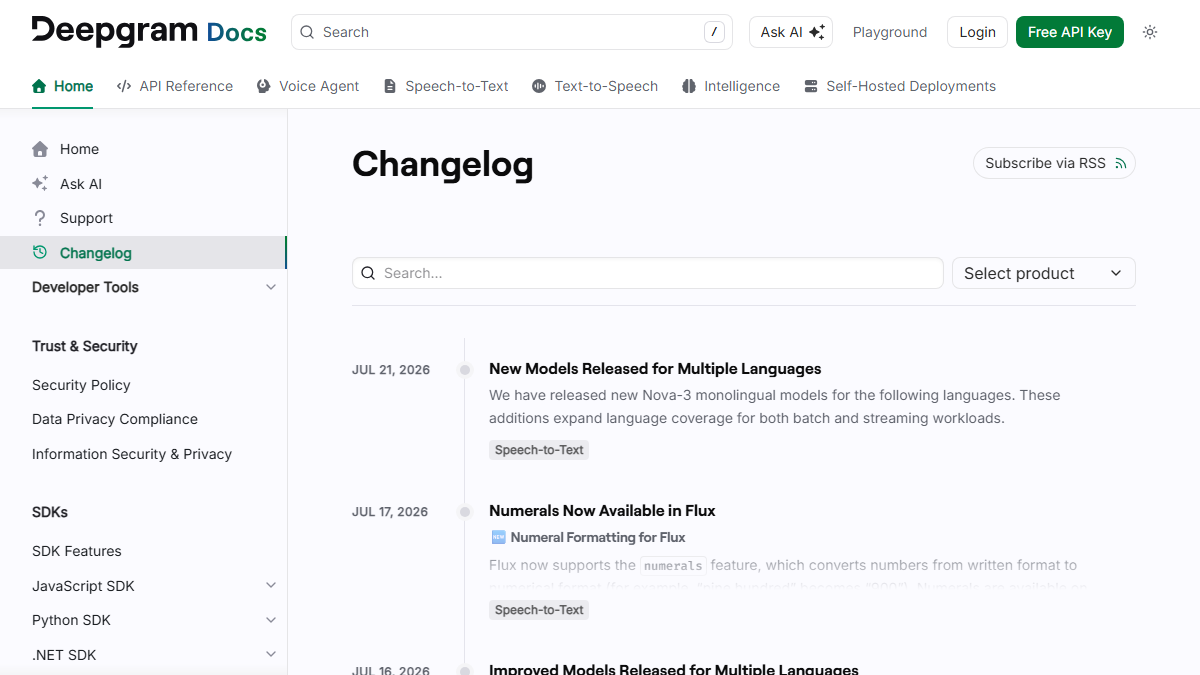
A comprehensive breakdown of the Deepgram API: Unifying Speech AI Infrastructure
Core parameters and statistics
| Dimensions | Specifications |
|---|---|
| Product Positioning | Unified Voice AI API Platform (STT/TTS/Voice Agent/Audio Intelligence) |
| Delivery form | Cloud API (public cloud/private cloud/self-hosted) |
| Base Model | Nova-3 (Universal Transcription, 50+ languages), Flux (Conversational STT, 10 languages), Aura-2 (TTS, 40+ English speech) |
| STT Latency | Live streaming <300ms (Nova-3), Flux built-in turn detection |
| TTS Latency | Streaming <200ms (Aura-2) |
| Supported Languages | STT 50+ languages, TTS mainly English (including multiple accents) |
| Security Compliance | SOC 2 Type 1 & 2, HIPAA (signed BAA), GDPR, CCPA, PCI |
| Deployment Method | Public cloud API, private cloud/single-tenant VPC, local self-hosting |
| GitHub Organization | 658 followers, 115 repositories, 450+ stars (Python SDK) |
| Company established | 2015, headquartered in San Francisco, USA |
| Financing Status | Completed $130M Series C in January 2026, valued at $1.3B (unicorn) |
| Latest version | 2026.07 — Flux Multilingual + Voice Agent API GA |
Parameter Interpretation: Deepgram's core competitive barriers are reflected in three "unifications" - a unified API entrance (a single Voice Agent API integrates STT/LLM/TTS), a unified streaming infrastructure (STT and TTS share the same streaming pipeline, reducing handshake delays), and a unified deployment solution (the same API can run in public cloud, private cloud or local). This architectural design enables the full-link delay of end-to-end voice interaction to be compressed to one of the lowest levels in the industry. For developers, this means that there is no need to splice three independent systems of STT, NLU, and TTS between multiple service providers. One API Key can complete the process from voice input to voice output.
User and market recognition
Enterprise-level customer coverage: Deepgram’s customer list spans leading companies in multiple industries, including Twilio (communication infrastructure), Cloudflare (edge computing), Sierra (enterprise AI Agent), Cresta (customer service intelligence), Kore.ai (enterprise dialogue AI), Daily (real-time communication framework), Vapi (voice agent platform), Granola (meeting notes), Jack in the Box (fast food chain), etc. The product page shows that its customers span contact centers, healthcare, media, financial services and other fields.
Developer Community: The GitHub organization has 658 followers, and the official SDK covers Python (450 stars), JavaScript/TypeScript (268 stars), Go (87 stars), .NET (53 stars), Java (8 stars), and Rust (66 stars). The community is active in Discord and GitHub Discussions, and the official technical documentation API Playground and sample code library are provided.
Market Recognition: In January 2026, it completed a US$130 million Series C financing, with a valuation of US$1.3 billion and entered the unicorn camp, led by well-known investment institutions. During the same period, it acquired OfOne (a voice AI company for drive-in restaurants), indicating its expansion ambitions in vertical scenarios. Industry media such as Reuters, SiliconAngle, and Forbes have reported on it.
Cost advantage
C-side/individual developer
Deepgram provides $200 free credit, and you can register and use it without binding a credit card. All public model endpoints can be experienced within the free quota. It is suitable for individual developers to do prototype verification, small-scale experiments or learning integration.
API / Developer Level
The billing model is Pay-As-You-Go, and supports pre-purchase of annual packages (Growth plan, with up to 20% discount):
Speech Recognition (STT) Price Comparison:
| Model | Pay-As-You-Go (streaming/minute) | Growth (streaming/minute) | Pay-As-You-Go (pre-recorded/hour) | Growth (pre-recorded/hour) |
|---|---|---|---|---|
| Flux English | $0.0065/min | $0.0057/min | $0.0077/min | $0.0065/min |
| Flux Multilingual | $0.0078/min | $0.0068/min | Same as above | Same as above |
| Nova-3 Monolingual | $0.0048/min | $0.0042/min | $0.0077/min | $0.0065/min |
| Nova-3 Multilingual | $0.0058/min | $0.0050/min | $0.0092/min | $0.0078/min |
| Custom | Contact Sales | Contact Sales | Contact Sales | Contact Sales |
STT additional functions: Sensitive information desensitization (Redaction) $0.0020/min, keyword enhancement (Keyterm Prompting) $0.0013/min, speaker separation (Diarization) $0.0020/min; Smart Formatting is included for free.
Speech Synthesis (TTS) Price:
| Model | Pay-As-You-Go | Growth |
|---|---|---|
| Aura-2 | $0.030/1k characters | $0.027/1k characters |
| Aura-1 | $0.015/1k characters | $0.0135/1k characters |
Voice Agent API Price (All Inclusive):
| Packages | Pay-As-You-Go | Growth |
|---|---|---|
| Standard (Deepgram full stack) | $0.075/min ($4.50/hr) | $0.068/min |
| Standard - BYO TTS | $0.065/min | $0.051/min |
| Custom - BYO LLM + TTS | $0.050/min | $0.041/min |
| Advanced | $0.163/min | $0.146/min |
Audio Intelligence: Summary generation $0.0003-$0.0006/1k tokens (input/output), topic detection, sentiment analysis, and intent recognition are included in the pricing.
Enterprise / Privatization Level
The enterprise version is priced on demand, please contact the sales team for confirmation. Supports the following differentiated capabilities: Custom Model Training, single-tenant VPC deployment, local self-hosted, HIPAA BAA signing, higher concurrency limits, and exclusive SLA. For high-usage scenarios that average over tens of thousands of hours of audio per month, enterprise contracts often receive further discounts on the Growth price.
Hidden Cost Tip: Deepgram does not bill silence segments or round up the audio duration, and the actual effective cost may be lower than expected based on the original duration. However, additional functions (desensitization, keyword enhancement, speaker separation) are billed independently, and when multiple additional functions are used in combination, the single transcription cost will be significantly increased.
Main functions
-
Real-time Speech Recognition (Streaming STT): Streaming audio through WebSocket, the Nova-3 model returns intermediate results with a delay of less than 300ms, and supports turn-turn detection and automatic sentence segmentation. Suitable for real-time conversation scenarios that require low-latency feedback, such as voice assistants and online customer service.
-
Pre-recorded Audio Transcription (Pre-recorded STT): REST API submits audio files (supports multi-channel). Nova-3 supports 50+ languages, and the batch processing speed is up to 40 times that of competing products. Suitable for non-real-time scenarios such as podcasting, conference recording, and call center quality inspection.
-
Conversational Speech Recognition (Flux): A recognition model specially designed for voice agents, with built-in natural turn-of-thought detection (End-of-Thought Detection) and interruption processing (Barge-in), without relying on VAD (Voice Activity Detection) external components. Supports 10 languages, with multi-language versions available in July 2026.
-
Text to Speech (Aura-2 TTS): Streaming neural network speech synthesis, with a latency of less than 200ms, providing 40+ English voices (including American, British, Australian and other accents), and supporting context-aware speech speed and emotion adjustment. Fine-tune your pronunciation style with Deepgram Prompting technology.
-
Unified Voice Agent API: Single API integrates STT → LLM orchestration → TTS full link, supporting BYO LLM (OpenAI, Anthropic, etc.) and BYO TTS. Built-in function calls, intent routing, and dynamic configuration switching in sessions. Fixed price $4.50/hr all-inclusive.
-
Audio Intelligent Analysis: Provides summary generation, sentiment analysis (three-level word/sentence/dialogue), intent recognition, and topic detection based on lightweight specialized models. Extract structured insights from conversational audio without invoking expensive general-purpose large language models.
-
Advanced Transcription Enhancement: Speaker separation (Diarization) automatically marks who spoke when; automatic punctuation/capitalization/number formatting (Smart Formatting); keyword enhancement (Keyterm Prompting) can increase the recognition and recall rate of terms in specific fields by up to 90%; sensitive information desensitization (Redaction) automatically removes PII such as social security numbers and credit card numbers; filler words transcription (Filler Words) retains spoken marks such as "um" and "ah".
Expert View: There are significant synergies between Deepgram's product lines - the output of STT can be used as direct input to Audio Intelligence, and the summary of Audio Intelligence can be used as input to TTS for automatic speech report generation. The Voice Agent API connects STT and TTS into an end-to-end voice conversation pipeline through the LLM orchestration layer, so developers do not need to separately handle the synchronization, codec, and connection management of streaming audio. This "acquisition-understanding-generation" capability makes Deepgram not just a collection of APIs, but a complete voice AI operating system.
Model and version evolution
Mainline release
- 2025.02 — Flux Conversational STT: For the first time, turn detection is directly embedded in the acoustic model, saying goodbye to traditional independent VAD components. Supports English single language and is oriented to real-time voice Agent scenarios.
- 2025.04 — Aura-2 TTS: Second generation neural network speech synthesis model, 40+ English voices, latency <200ms. Compared with Aura-1, the pronunciation accuracy, naturalness and processing of professional terms (medical terms, financial terms) have been greatly improved.
- 2026.01 — Nova-3 GA: The third generation universal transcription model is officially commercially available. Compared with the previous generation Nova-2, the recognition of proper nouns (such as product names, people's names, place names) has been significantly improved. With Keyterm Prompting, the recognition accuracy of specific terms can be increased from 10% to more than 90%. Supports 50+ languages, and its robustness in strong noise environments has been greatly improved.
- 2026.06 — Flux Multilingual + Voice Agent API GA: Flux expanded to 10 languages (English/Spanish/German/French/Hindi/Russian/Portuguese/Japanese/Italian/Dutch). The Voice Agent API is officially commercialized, marking a key node in Deepgram's transformation from a single API to a full-stack voice AI platform.
- 2026.07 — Continuous iteration: CLI tools, self-hosted resource API specifications and other infrastructure are continuously updated, and 115 warehouses under the GitHub organization remain highly active.
Candidate Verification
Deepgram also provides a Custom Model Training service, which allows enterprise users to fine-tune the Nova-3 model based on proprietary data sets to further improve the recognition accuracy of edge scenes. This service requires contacting the sales team to evaluate the data volume and scenario requirements.
Technical advantages
End-to-end deep learning architecture: Deepgram has adopted end-to-end deep learning (instead of the traditional acoustic model + language model pipeline) since its establishment in 2015, and directly learns the mapping from audio waveforms to text through a single deep neural network. The advantage of this architecture is that it eliminates the information loss between modules in the traditional pipeline, and the model can more fully utilize contextual information for inference.
Unified streaming infrastructure: STT and TTS run on the same streaming infrastructure, sharing WebSocket connection management, audio codec and streaming buffer scheduling. The direct effect of this is that when STT converts audio to text TTS and then converts reply text to voice, there is no need to switch network connections between different services in the middle, and the delay in end-to-end voice communication is compressed to a minimum.
Low Latency Engine: The product page claims that Nova-3's real-time transcription intermediate results can be returned in less than 300ms, and Aura-2's first audio byte can arrive in less than 200ms. Measured data (from Phonely CEO’s public comments) shows that Aura-2’s end-to-end latency is typically less than 200ms, which is 2-4x faster than other mainstream TTS providers. This low latency is critical for voice agent scenarios - the human ear can perceive latency above 300ms, below which a natural conversational rhythm can be achieved.
Specialized task model vs. general-purpose large model: The Audio Intelligence function uses lightweight, task-specific small models (rather than general-purpose large language models) to achieve higher domain accuracy and lower reasoning costs in the four dimensions of summary, emotion, intention, and topic. The product page makes it clear that these models are fine-tuned on domain conversation data and therefore are more accurate for specific tasks (such as customer service conversation summarization) than similarly costed general-purpose LLM solutions.
Flexible deployment topology: Public cloud API → Private cloud/single-tenant VPC → Local self-hosting, covering all deployment needs from prototype verification to strict compliance enterprises. The self-hosted solution is based on Docker/Kubernetes and provides a complete Helm Chart and deployment script (GitHub: self-hosted-resources, 39 stars).
How to use
Registration and API Key
- Visit console.deepgram.com to register an account.
- Register to get $200 free credit, no need to bind a credit card.
- Create an API Key in the console and select the required permissions (STT / TTS / Agent / Intelligence).
- Initiate a request through REST API, WebSocket or official SDK.
Quick call example
Python: Real-time Speech Recognition (WebSocket):
from deepgram import Deepgram
import asyncio

dg_client = Deepgram('<YOUR_API_KEY>')

async def transcribe_stream():
    # Real-time streaming transcription using Nova-3 model
    connection = await dg_client.transcription.live(
        {"model": "nova-3", "language": "en-US", "smart_format": True}
    )
    async def on_message(self, result, **kwargs):
        print(result.channel.alternatives[0].transcript)
    connection.on("transcript", on_message)

asyncio.run(transcribe_stream())
cURL: Pre-recorded audio transcription:
curl -X POST https://api.deepgram.com/v1/listen、model=nova-3&smart_format=true \
  -H "Authorization: Token <YOUR_API_KEY>" \
  -H "Content-Type: audio/wav" \
  --data-binary @audio.wav
cURL: Text to Speech (Aura-2):
curl -X POST https://api.deepgram.com/v1/speak、model=aura-2-odysseus-en \
  -H "Authorization: Token <YOUR_API_KEY>" \
  -H "Content-Type: application/json" \
  -d '{"text": "Hello, welcome to Deepgram voice AI."}' \
  --output speech.mp3
Voice Agent API configuration: Connect to wss://agent.deepgram.com/agent through WebSocket and send a JSON message containing Agent configuration (LLM selection, system prompt word TTS voice) to start the session. For a complete example, see Official Documentation.
Available SDKs
Deepgram provides official SDKs: Python, JavaScript/TypeScript, Go, .NET, Java (community version of Rust is also available). All SDKs are open source at github.com/deepgram. In addition, the official CLI tool supports calling STT/TTS/audio smart functions directly from the terminal.
Product Pricing
Paid model summary:
| Level | Applicable objects | Payment method | Starting conditions |
|---|---|---|---|
| Free quota | Personal developer, prototype verification | $200 bonus | Register to get |
| Pay-As-You-Go | Small and medium-sized teams, growing applications | Pay-as-you-go, no minimum consumption | Automatically switch after the bonus is used up |
| Growth | Medium to high usage applications | Pre-order annual plan (save 20%) | $4K+/year |
| Enterprise | Large usage, compliance requirements, customization needs | Contact sales | Business confirmation |
Free Credit Details: $200 credit available for all public API endpoints (STT/TTS/Audio Intelligence/Agent). Unused bonuses do not expire. There is no need to bind a credit card to register.
Concurrency limit: STT REST API under Pay-As-You-Go 50 concurrency WebSocket 150 concurrency; TTS 45 concurrency; Voice Agent 45 concurrency. The Growth package is correspondingly upgraded to REST 50, WSS 225, TTS 60, and Agent 60. Enterprise can negotiate higher concurrency.
Application scenarios
-
Contact Center and Customer Service Voice AI: Transcribe customer and agent conversations in real time, combine with Audio Intelligence to automatically generate call summaries, detect customer emotions, identify intent, and classify by topic. Typical users include Stream It, Sharpen, Cresta, Revenue.io. Verification focus: In a noisy call center environment, does the accent and noise robustness of Nova-3 meet the actual recognition rate requirements; can Keyterm Prompting cover business-specific vocabulary.
-
Voice Agent and Conversational AI: Build an end-to-end voice AI agent based on the Voice Agent API, which can be used in scenarios such as takeout ordering (Jack in the Box), customer service (Sierra, Aircall), and medical appointments. Flux’s built-in turn-taking detection and interruption handling make the conversation experience closer to real-person interaction. Verification focus: In BYO LLM mode, the response delay of LLM will become the bottleneck of end-to-end delay; it is necessary to evaluate the suitability of LLM selection and Deepgram streaming pipeline.
-
Media Podcasting & Video Captioning: Leverage the high-speed batch processing capabilities of pre-recorded STT (up to 40x real-time rates) to generate captions and search indexing for podcasts, videos, and live streams. Combined with speaker separation and intelligent formatting, manual proofreading costs are significantly reduced. Key points of verification: Whether the accuracy of diarization in multi-speaker scenarios meets the production standards; for multi-language content, it is necessary to confirm whether the target language is in the supported list.
-
Medical Clinical Documentation: Enables real-time transcription of clinical conversations via HIPAA-compliant STT API, supports medical terminology (enhanced with Keyterm Prompting), and reduces physician paperwork burden. The Deepgram product page shows that a customer in the veterinary field (Talkatoo) has improved the accuracy of professional term recognition from 10% to 625% through Nova-3. Key points for verification: BAA must be signed; support for Chinese medical terminology needs to be independently verified.
-
Speech Analysis and Enterprise Intelligence: Analyze customer service recordings, sales calls, and meeting records at scale, and extract trends and patterns through Audio Intelligence. Compared with general-purpose LLM solutions, Deepgram's specialized model is 10-100 times cheaper and is suitable for audio analysis at the level of millions of minutes per day. Key points of verification: Whether the accuracy of the summary/sentiment/intent meets the needs of business decision-making; whether it supports a custom classification system.
Applicable people
-
Voice Application Developer: Backend engineers who need low-latency, high-accuracy STT/TTS APIs to build voice assistants, voice customer service, or conversational AI products. Deepgram's SDK covers mainstream languages, has complete documentation, and the API Playground allows you to experience the effects immediately. Prerequisites: Have REST API or WebSocket programming capabilities; $200 bonus is enough to complete MVP verification.
-
AI Agent Platform and Framework: Platform-level products such as Vapi, Daily (Pipecat), Cognigy, and Kore.ai embed Deepgram’s voice capabilities as modules of their own platforms. The Voice Agent API's BYO LLM capabilities allow these platforms to retain their own choice of models. Prerequisites: Requires enterprise-grade contract for higher concurrency and SLA guarantees.
-
Enterprise Contact Center and Technical Leader: Decision-maker responsible for customer service system upgrades, call quality analysis, or the introduction of AI agents. Deepgram's SOC 2/HIPAA/GDPR compliance system and native integration with Amazon Connect lower the risk threshold for enterprise procurement. Prerequisites: Private cloud or self-hosted deployments typically require a 6-12 month technical assessment and PoC cycle.
-
New Media and Content Creators: Content teams with high-frequency speech-to-text needs (podcast transcripts, interview compilation, video subtitles). Turn hours of audio into structured documents in minutes with pre-recorded STT's batch processing and smart formatting capabilities. Prerequisites: Requires docking tools or self-developed integration scripts; Chinese support is available through Nova-3 Multilingual, but the accuracy needs to be measured.
-
Not suitable for the crowd: Projects that require pure offline bulk transcription (no network dependency) with extremely low budgets (it is recommended to consider open source solutions such as Whisper); high-quality TTS scenarios that require the use of Chinese speech synthesis (Deepgram's current TTS is mainly in English, and Chinese voice support has not been disclosed, and it needs to be subject to official documents); scenarios that require video-level expressive emotional speech (such as game character dubbing, audio books) - Aura-2 is aimed at professional dialogue scenes rather than artistic performance scenes.
Summary and Outlook
Deepgram's core competitiveness lies in the "unified delivery of full-stack voice AI" - it integrates the STT, TTS, and NLU capabilities that used to be spliced into a set of APIs, and on this basis it adds a low-latency streaming engine, specialized audio intelligent models, and flexible deployment options. The release of Flux Multilingual and Voice Agent API GA in the first half of 2026 marks Deepgram's transition from "speech recognition API provider" to "voice AI operating system platform".
Current Limitations and Uncertainties:
- The voice diversity of TTS is still mainly in English. The coverage and application effects of multi-language TTS have not been disclosed. Customers in non-English markets need to confirm the availability.
- In the BYO LLM mode of the Voice Agent API, the end-to-end delay is restricted by the response speed of the external LLM. The official price of $4.50/hr given by Deepgram assumes the use of its recommended LLM configuration.
- Although the STT accuracy of Asian languages such as Chinese is supported by Nova-3 Multilingual, there is less public benchmark data than English, so potential users need to conduct actual corpus testing.
- The resource requirements (GPU model, number of inference nodes) of self-hosted deployment are not clearly stated on the public page. You need to contact sales to obtain hardware recommendations.
- Audio Intelligence's summary/sentiment/intent model currently does not support custom training. If an enterprise has highly vertical classification requirements, it may require additional manual rules.
Procurement and Adoption Risk Assessment:
- For small and medium-sized teams, it is recommended to start with a free quota of $200, first verify whether the core scenarios (STT accuracy, TTS naturalness, end-to-end latency) meet the business baseline, and then upgrade to the Growth plan as needed.
- For enterprise-level procurement, three things must be verified through the PoC: ① Whether the deployment topology (public cloud vs private cloud vs self-hosted) meets the compliance matrix; ② The identification accuracy of key scenarios (especially proprietary vocabulary and noise context); ③ Whether the annual TCO is within the budget (confirm additional feature fees, concurrency peak costs, and pricing for additional support).
- Pay attention to Deepgram's product iteration rhythm (about 2-3 months for a major version), and it is recommended to include transition period clauses for version upgrades and API abandonment in the contract.
Related tools:  ElevenLabs, udio
Version Info
- Flux Multilingual + Voice Agent API GA :Launched the Flux Multilingual multilingual conversational speech recognition model (10 languages), the Voice Agent API is officially commercially available ($4.50/hr), the Aura-2 TTS model is online, and Nova-3 becomes the default production transcription model
- Nova-3 General Availability :Nova-3 model is officially released, significantly improving the recognition accuracy of proper nouns and noise, supporting 50+ languages, Keyterm Prompting improves keyword recall rate by up to 625%
- Aura-2 Text-to-Speech Launch :Released Aura-2 TTS model, 40+ English voices, latency less than 200ms, optimized for enterprise-level dialogue scenarios
- Flux Conversational STT Launch :Released the Flux conversational speech recognition model, with built-in turn detection and interruption processing, specially designed for real-time voice agent scenarios
User Reviews