 DeepL
Free
DeepL
Free
DeepL is a AI office and efficiency product that unifies translator Write, Voice, document translation and API into the same language AI platform. It is obviously focused on enterprise communication, cross-language collaboration and professional document scenarios.
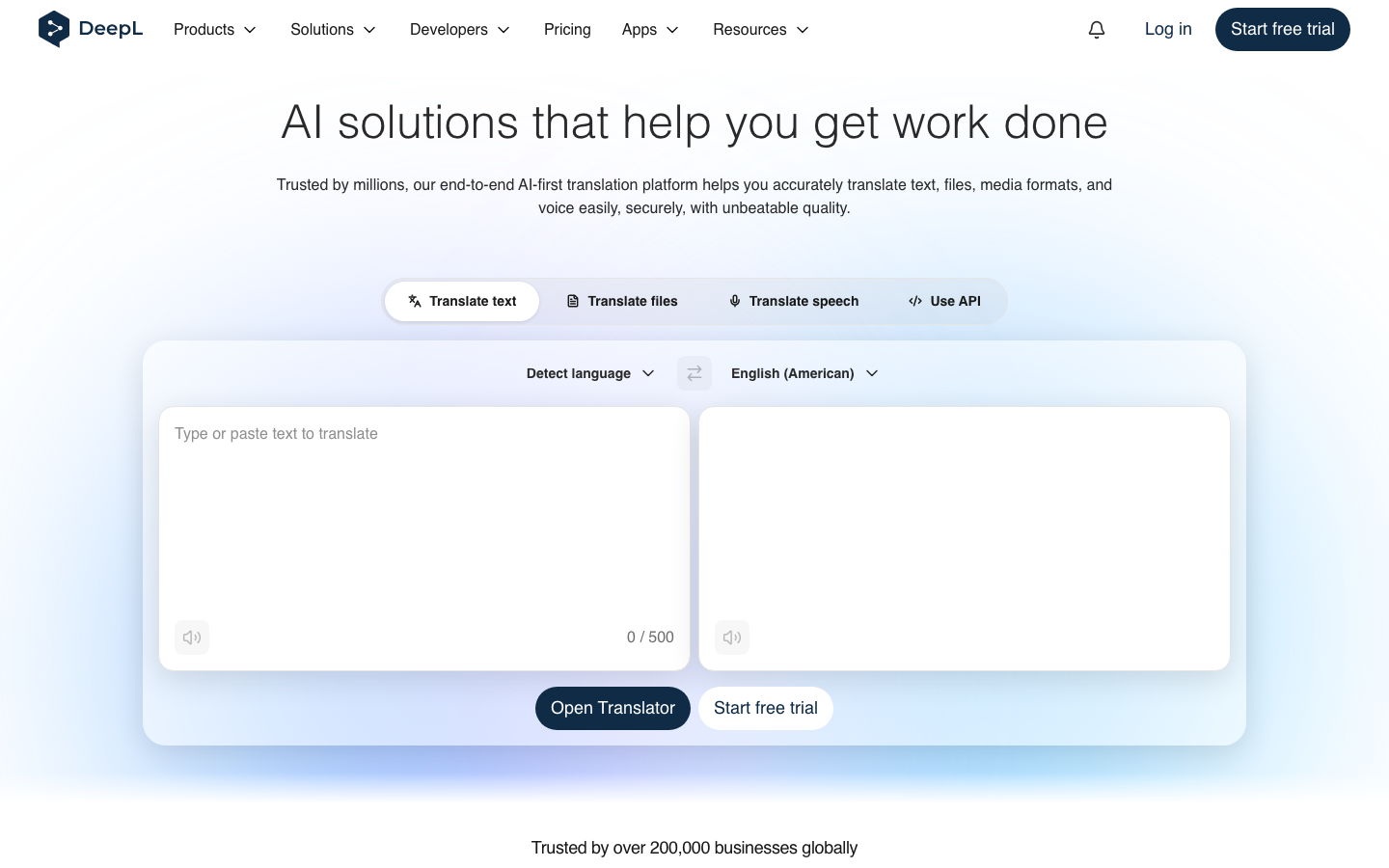
DeepL - Enterprise Language AI and Translation Platform
Core parameters and statistics
| Projects | Public Information |
|---|---|
| Official Positioning | Artificial Intelligence-first end-to-end translation platform |
| Corporate customers | Trusted by more than 200,000 companies around the world |
| Language range | Supports over 100 languages |
| Product Line | Translator, Write, Voice, Document, API |
| Platform | Web, Desktop, Mobile, Browser Extensions, Office/Workspace Integration |
| Packages | Free, Individual, Team, Business, Enterprise |
A brief comment: DeepL is not a stand-alone translation tool, but a set of enterprise-level language infrastructure.
Publicity Verification: The official website emphasizes "Translation + Writing + Speech + API + Documentation + Enterprise Security". This proposition is valid because the pricing page, product page and integration page have grouped these capabilities into a set instead of isolated products.
Expert view: What really makes enterprises willing to pay for DeepL is not ordinary web page translation, but the ability to glossary, document translation, security compliance, writing style control and embedding into existing office systems.
User and market recognition
Market Signal: The official website directly lists more than 200,000 companies, and lists customer stories such as banks, railways, and payments, indicating that it has entered the perspective of standard corporate procurement.
Adopt logic: The most painful thing for cross-lingual enterprises is never "translating a paragraph", but the consistency of a large number of documents, customer service communications, knowledge bases, market materials, and internal and external system collaboration. DeepL’s platform approach addresses exactly this problem.
Hidden benefits: Unifying the glossary and writing style has a greater impact on long-term communication costs than the accuracy of a single translation.
Cost advantage
| Package | Public Price | Key Benefits |
|---|---|---|
| Free | Free | 50,000 characters 1 file, basic translation |
| Individual | US$8.74/month (paid annually) | 300,000 characters 3 documents/month |
| Team | US$28.74/user/month (paid annually) | 1,000,000 characters, 20 documents/month, team management |
| Business | US$57.49/user/month (paid annually) | Higher file limits, unlimited entries and enhanced management |
| Enterprise | Custom pricing | Enterprise security, control and scalability |
The truth about free: The free version is sufficient for daily short text translation, but the number, size, and glossary capabilities of files are very limited and cannot replace team-level multilingual collaboration.
Hidden Costs: The most often underestimated is the governance of terminology within an organization. Without a glossary and style rules, no matter how strong the translation is, it will continue to be reworked in cross-team collaboration.
Hidden benefits: Once document translation, email writing, and browser/Office extensions are unified, the fragmentation cost of cross-language workflows will drop a lot.
Main functions
- Translator: Text translation is the basic entrance.
- Document Translation: Supports translation of PDF, Word, PPT, Excel and other documents.
- DeepL Write / Write Pro: Do expression optimization, tone adjustment and error correction.
- DeepL Voice: Covers conference and conversational voice translation.
- API: Embed translation capabilities into business systems.
- Glossary / Customization: Glossary, style rules and translation memory.
Hidden linkage: Translate + Write + Glossary + Office integration Once connected, DeepL is not just a translator, but an organization-level language console.
Model and version evolution
DeepL's external evolution is very clear: starting with high-quality translation, and then expanding to document, writing, voice, and enterprise capabilities.
Current stage: The basic outline of language AI platform has been completed.
Historical context: The emergence of Write Pro and Voice means that it is no longer limited to translation, but extends to the entire language production chain.
Current limitations: The model version number is not exposed to the outside world like open source projects, so procurement should pay more attention to capability boundaries and organizational fit.
Technical advantages
Mechanics -> Effects -> Scenes:
Proprietary language model + expert data training: The effect is more suitable for professional business context, not just ordinary chat text.
Enterprise Security System: Data-free training SOC 2 Type II, ISO 27001, SSO, SCIM, self-contained keys and other capabilities determine whether it can enter a large organization.
Multiple portal integration: Browser, desktop, mobile Google Workspace, Word, PowerPoint, Outlook co-exist, suitable for real office work.
Boundary of human-machine collaboration: Routine business translation, document drafts, and multilingual communication can be highly automated; final legal texts, key medical documents, and external brand statements still require professional review.
How to use
- Use Free or Individual to try text and document translation first.
- For team scenarios, first create a glossary and then open Team/Business.
- For frequent users of email PPT, Word and browsers, priority should be given to installing extensions and add-ons.
- The development team integrates translation into customer service, knowledge base and product interface through API.
Quantified cost reduction and efficiency improvement: For cross-border teams, a multi-lingual business document may originally have to go through three rounds of manual translation, proofreading, and terminology unification; after the introduction of glossary and document translation, the first round of drafting time can often be reduced from hours to dozens of minutes. This is a workflow deduction, not an official commitment.
Product Pricing
DeepL's price is not the lowest, but companies usually buy it not for the "cheapest" price, but to unify quality, terminology, security and multiple entrances.
Current Limitations: The free and low-level personal versions are strong enough for single-player use, but what really makes the difference is the glossary size, file translation limits, sharing rules SSO, SCIM and security controls in Team, Business and Enterprise. If the team does not need these, buying too high a level will be a waste; if the team needs these but only buys the personal version, the process will be stuck.
Compliance and Risk: The biggest risk of linguistic AI is not spelling errors, but terminological distortion, legal semantic deviation and cross-departmental expression inconsistency. The advantage of DeepL lies in governance, but if the organization does not have its own terminology leader and review mechanism, no matter how good the platform is, it can only solve half of the problem.
Dissuade Scenario: If you only occasionally read a few short paragraphs of text, the free version or a lighter tool is enough; there is no need to go to the enterprise level too early.
Application scenarios
- Multinational Enterprise Communication: emails, meeting materials, policy documents.
- Market and e-commerce localization: multilingual materials and product copywriting.
- Customer Service and Knowledge Base: Combined with API for multi-lingual support.
- Professional document processing: legal, financial, manufacturing and life sciences texts.
Applicable people
- Cross-lingual team and international business department: The most direct benefit.
- Content and Market Localization Team: People who need terminology consistency.
- Developers and Platform Team: People who want to embed translation into the product.
Not suitable for the boundary: Individual users who pursue completely free, completely optional, and no need for process governance do not necessarily need DeepL’s enterprise capability layer.
Summary and Outlook
DeepL's strength is not to let you "turn faster", but to incorporate language issues into formal business systems. It touches on the long-term complexities of cross-language collaboration, rather than the one-time gadget thrill. The current risks mainly lie in the fact that the price is not low compared to ordinary users, and it is difficult for organizations to gain full value without terminology governance. Before using it, first determine whether your problem is "translation" or "long-term multilingual collaboration out of control".
If the answer is the latter, DeepL's value magnifies as the organization grows larger: the more documents, more departments, and more languages, the more it becomes an infrastructure rather than an application layer tool. Conversely, no matter how powerful a platform is, it will be difficult to justify an enterprise-level budget if it is only used sporadically.
Related tools:  Notion AI, google-workspace
Business process integration and ROI analysis
As a productivity tool for enterprises or professional positions, the true value of DeepL depends on the depth of integration with existing workflows and the quantifiable efficiency improvement effect. The following is a systematic analysis from three core dimensions.
System integration and data interoperability The ability to interoperate with existing business systems is a key prerequisite for productivity tools to be integrated into workflows. It is recommended to focus on evaluating the following integration dimensions: the openness and documentation quality of the RESTful/GraphQL API (whether a complete API reference and SDK examples are provided), the support scope of Webhook event notifications (which business event types are supported for automatic push), the number and depth of pre-built integrations with common collaboration SaaS tools (WeChat Enterprise, DingTalk, Feishu, Slack, Notion, Jira, etc.), and enterprise-level identity authentication support (SSO/SAML/OAuth and LDAP/AD directory integration). Products that lack integration capabilities are easily isolated into information islands, which in turn increases the cognitive cost and operational friction for teams to switch between different tools.
Efficiency Quantification and ROI Estimation Methodology Before purchasing decisions, it is recommended to quantify the input-output ratio through a structured method: Step 1, choose 3-5 Standardized tasks that are frequently repeated and time-consuming in each team are used as test samples; in the second step, the average time consumption of a single task before and after tool intervention, first-time pass rate or error rate, and the number of links requiring manual intervention are recorded under controlled conditions; in the third step, the saved manpower time is converted according to the comprehensive cost of the position (salary, benefits, management sharing), and soft benefits (increased employee satisfaction, standardization of work quality, and improvement in response speed to core business) are superimposed to obtain a comprehensive ROI estimate. It is recommended to continue tracking ROI trends on a monthly basis, as the value of a tool usually increases over time as team proficiency increases and workflows are optimized.
Phase-based implementation strategy and risk control It is recommended to adopt a three-stage implementation path of "pilot verification-gradual promotion-continuous optimization". In the pilot stage (1-2 weeks), a single team or a single business scenario is selected for small-scale verification. The core goal is to verify technical feasibility and user acceptance, and establish preliminary usage specifications and success standards; in the promotion stage (2-4 weeks), after the pilot verification is passed, the coverage is gradually expanded, and standardized activation processes and training materials are developed; in the optimization stage (continuous), the workflow configuration is continuously adjusted based on actual usage data and user feedback, and more high-value application scenarios are explored. Clear quantitative key result indicators should be set at each stage to avoid blindly expanding the scope of use without data support.
Version Info
- Language AI platform stage :The current official website unifies Translator, Write, Voice, Document, and API into the DeepL language AI platform, and there is no official precise date yet.
- DeepL Voice stage :Voice and Voice for Meetings/Conversations have entered the public product navigation, and there is no official precise date yet.
- Write Pro add-in stage :Write Pro has entered the external pricing system as an additional capability for translation subscriptions. There is no official precise date yet.
User Reviews