 Deno
Free
Deno
Free
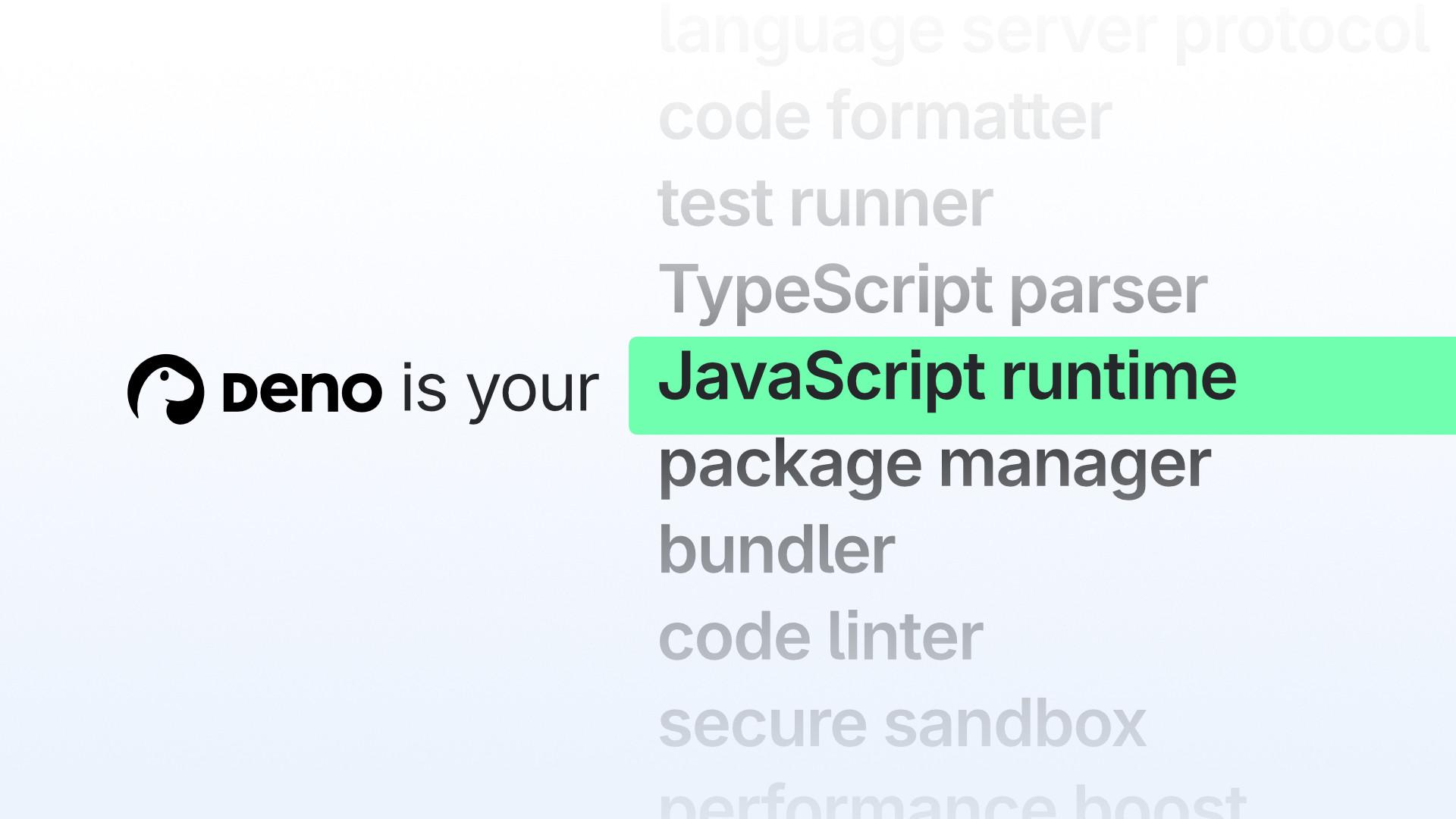
Deno is a modern JavaScript/TypeScript runtime created by Ryan Dahl, the original author of Node.js, with built-in AI inference API (Deno.KV + AI model API), native TypeScript support and decentralized package management, and provides a managed deployment platform Deno Deploy.
Deno
Core parameters and statistics
| Parameter item | Description |
|---|---|
| Product positioning | Modern JS/TS runtime + Serverless deployment platform |
| Core AI capabilities | Native AI reasoning API (Deno.AI), LLM calling Embedding generation |
| Runtime language | JavaScript, TypeScript (native support, no compilation configuration required) |
| Node.js compatible | Supports package.json, node_modules and npm packages (Deno 2+) |
| Package Management | JSR (JavaScript Registry) + npm compatible |
| Deployment platform | Deno Deploy (35+ edge nodes worldwide) |
| License | MIT Open Source |
The core value of Deno is not "another Node.js" but "a JS runtime redesigned for the cloud-native and AI era." It has the full toolchain built in that Node.js requires dozens of tools to implement—formatting, testing, code inspection, compilation—and Deno does it right out of the box. Deno 2’s npm compatibility solves the biggest barrier to adoption, allowing existing Node.js projects to be migrated incrementally.
User and market recognition
Gradually build user awareness in the field, and product capabilities are used by content creators and teams to improve work efficiency. Some industry users have incorporated it into their daily workflow. It is recommended to refer to the latest official disclosures for specific user scale and industry adoption rate data.
Cost advantage
- C-side/Individual: Usually a free version is provided to experience the core functions, and high-frequency use requires a paid package subscription.
- API/Developer: Billed by call volume, suitable for development teams that can be flexibly integrated into their own systems.
- Enterprise/Privatized: Contact the business owner for customized quotation and deployment plan. The specific price is subject to the official real-time pricing page.
Main functions
- Native AI Inference API:
Deno.AIbuilt-in API supports direct calling of LLM (text generation Embedding, chat completion) without additional SDK. Simplyconst ai = new Deno.AI()in the code can start reasoning. - Deno Deploy edge deployment: Deploy scripts to 35+ edge nodes around the world with one click, natively supports edge AI inference - run AI models on the nodes closest to users, reducing latency.
- Deno.KV distributed database: Built-in key-value storage, automatically synchronized in multiple Regions, suitable for session state memory, caching and RAG vector storage of AI applications.
- Native TypeScript support: No tsconfig.json, no compilation step,
.tsfiles run directly. Performance is optimized to compile 5-10 times faster than tsc. - Security Permission Model: The script does not have file/network/bounded access permissions by default, and explicit
--allow-readand other authorizations are required to avoid malicious packages from stealing data. - npm compatibility (Deno 2): Can directly import npm packages (
npm:express,npm:react), supports package.json workflow, and reduces migration costs.
Model and version evolution
Continuous iterative updates, the latest version introduces performance optimization and new features. Historical version information can be viewed on the official release page. There is no complete public version evolution timeline yet. It is recommended to pay attention to the official announcement to understand the rhythm of feature updates.
Technical advantages
- Algorithm Optimization: Special optimization at the model or algorithm level has been carried out for the corresponding scenario to achieve a balance between response speed and result quality.
- Low-latency architecture: Adopts streaming or asynchronous processing architecture to reduce user waiting time and is suitable for high-frequency interaction scenarios.
How to use
- Web client: You can use it by visiting the official website and registering an account. Most functions do not require installation.
- API access: Provides RESTful API, developers can obtain the API Key and integrate it into their own applications.
Product Pricing
The Deno runtime is completely free and open source, and the Deno Deploy hosting platform comes with free tier usage quota.
| Tier | Price | Description |
|---|---|---|
| Deno runtime | Free (MIT open source) | Local development/own server deployment, no restrictions |
| Deno Deploy Free | Free | 300,000 requests/month, 10GB bandwidth, 2 KV databases |
| Deno Deploy Pro | $20/month | 1.5 million requests/month, 100GB bandwidth, 10 KV databases |
| Deno Deploy Enterprise | Contact Sales | Custom quotas, SSO, private data centers |
The runtime itself has no cost lock-in and can be deployed on any infrastructure. Deno Deploy’s free quota is sufficient to support prototype verification and low-traffic use of small and medium-sized AI applications.
Application scenarios
- Edge AI API Service: Build a lightweight AI agent API on Deno Deploy - receive user requests → call Deno.AI inference → return streaming responses, with latency reduced by 40-60% compared to central servers.
- AI Chatbot Backend: Use Deno.KV to store conversation history and user sessions, combined with
Deno.AI's streaming reasoning, to implement a chat backend without additional infrastructure. - AI-driven serverless functions: AI logic (such as content moderation, summary generation, text classification) is run on edge nodes, and user requests are processed at the nearest node.
- npm project gradual migration: Migrate existing Node.js projects to Deno module by module, and enjoy the improved development experience brought by native TS support and security permission model.
- Full stack TypeScript web application: front-end React + back-end Deno, full TypeScript zero configuration, API and type definitions are shared between the front and back ends.
Applicable people
- Individual Users: Content creators and knowledge workers who need AI assistance to improve their daily work efficiency.
- Developers: Technical teams who need to integrate AI capabilities into their own products or services through APIs.
- Enterprise: Organizations seeking to deploy AI at scale in their field.
Summary and Outlook
Deno's core competitiveness lies in "simplified development experience + built-in cloud native capabilities + native AI API" - it is a combination of a runtime, a tool chain, a deployment platform and a set of AI APIs. Deno 2’s npm compatibility solves the biggest barrier to adoption.
Not suitable for boundaries: The migration cost of old projects that rely heavily on Node.js native modules (C++ Addons) is higher; the support for Deno by old Linux distributions and CI/CD tools is not as mature as Node.js. Procurement Risk: Deno Deploy relies on the V8 Isolate architecture, which is limited for long-running or CPU-intensive tasks. The AI API currently supports a limited variety of models (mainly OpenAI compatible APIs). It is recommended that new projects be used first, and legacy projects make decisions after evaluating the migration costs.
Related tools:  GitHub Copilot,
  Cursor
Version Info
- Deno 2 :Major version update, achieving compatibility with the Node.js/npm ecosystem (supporting package.json and node_modules), introducing Deno.AI native AI API, Deno.KV distributed database enhancement, and JSR package registration center.
- Deno 1 :The first stable version is released, introducing standard libraries for HTTP servers, file systems and Web APIs, as well as the Deno Deploy cloud deployment platform.
User Reviews