 Descript Overdub
Free
Descript Overdub
Free
Descript Overdub is Descript's AI voice cloning function. Users only need to record a small number of samples to create their own digital voice clone for dubbing and content creation.
Descript Overdub
Core parameters and statistics
Descript Overdub is the built-in AI voice cloning function of Descript audio and video editor, which belongs to Type D (productivity/business application). It is not a stand-alone voice generation tool, but a plug-in module embedded in the editor workflow - allowing users to "type" voiceovers with their own digital voice avatar, rather than recording repeatedly into a microphone.
| Projects | Public Information |
|---|---|
| Product positioning | AI voice cloning and dubbing correction functions |
| Products | Descript (one-stop audio and video editing platform) |
| Sample required | Minimum 10 minutes of original recording material |
| Covered languages | Subject to the latest official support list |
| Supported Platforms | Web, Desktop, Desktop |
| Home | US |
Brief review in one sentence: Overdub is not an "AI dubbing generator", but a plug-in module that "changing the text is equivalent to changing the sound" embedded in the audio and video editor - what it really solves is the pain point of "re-recording the entire paragraph if you say a wrong word".
Promotion Verification: Descript official promotion Overdub can "say anything with your voice". The actual measurement effect is highly dependent on the sample quality - a 10-minute sample in a quiet environment with clear pronunciation can achieve better results, but the quality of the sample recorded in a noisy environment will be significantly reduced. There are idealized simplifications in propaganda.
User and market recognition
Descript is a product in the field of audio and video editing, widely used by podcasters, video creators, and corporate training teams. As its core differentiated function, Overdub has real demand support in scenarios such as late-stage revision of podcasts and supplementary recording of oral broadcasts.
Market positioning: Overdub does not directly compete with independent TTS products such as ElevenLabs and Fish Audio, but exists as part of the Descript editing experience - what users buy is "editing efficiency" rather than "speech synthesis capability" itself. This means that its target users are Descript’s existing editor users rather than the general TTS market.
Cost advantage
C-side/Individual: Overdub is not sold separately and is included in Descript’s Pro subscription (approximately $24/month). The free version allows you to experience basic functions but has limitations, and the Pro version unlocks unlimited overdub generation. If the user only needs voice cloning and no editing needs, ElevenLabs (starting at $5/month) is cheaper - but what Overdub saves is the time cost of "repeated recording and editing" rather than the cost of voice generation itself.
API/Developer: Descript does not open Overdub’s independent API. It is positioned as a feature within the end-user product, not as a developer service.
Enterprise/Private: Descript provides Team and Enterprise plans, including Overdub usage rights and team collaboration management. Specific pricing needs to be confirmed by the business.
Hidden Cost: The sample recording investment of voice cloning - recording 10 minutes of high-quality quiet samples, and optimizing the model output multiple iterations, the cumulative investment may be several hours. In addition, the emotional expression ability of cloned voices is limited, and highly expressive scenes still need to be recorded by real people, which time cannot be saved by Overdub.
Main functions
- Voice Clone Modeling: Record about 10 minutes of voice samples, AI trains the user's digital voice model, and subsequently generates the corresponding voice of any text.
- Text-to-dubbing: Enter text in the editor and automatically generate dubbing clips with cloned voices, supporting fine-tuning of speech speed, pauses, and accent.
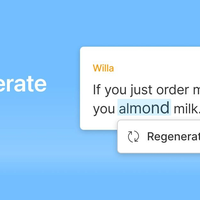
- Dubbing correction: Modify the text directly on the subtitle track, and AI will automatically locate the corresponding position on the audio track and replace it with the cloned sound - no need to re-record the entire audio. This is the core scene value of Overdub.
- Multiple Voice Management: One project supports multiple cloned voices, suitable for post-processing of multi-character dialogue or interview scenes.
[Expert View·Hidden Linkage]: The value of Overdub lies not in speech synthesis itself, but in the workflow transformation of "text editing = audio editing". In traditional audio editing, correcting the pronunciation of a word requires: positioning the audio track → muting the original segment → opening the recording device → rereading the entire sentence → import and replace. Overdub compresses this process into: modify text → automatic replacement. The difference in the operation paths between the two can be quantified by "reducing from the minute level to the second level".
Model and version evolution
Continuous iterative updates, the latest version introduces performance optimization and new features. Historical version information can be viewed on the official release page. There is no complete public version evolution timeline yet. It is recommended to pay attention to the official announcement to understand the rhythm of feature updates.
Technical advantages
- Algorithm Optimization: Special optimization at the model or algorithm level has been carried out for the corresponding scenario to achieve a balance between response speed and result quality.
- Low-latency architecture: Adopts streaming or asynchronous processing architecture to reduce user waiting time and is suitable for high-frequency interaction scenarios.
How to use
- Web client: You can use it by visiting the official website and registering an account. Most functions do not require installation.
- API access: Provides RESTful API, developers can obtain the API Key and integrate it into their own applications.
Product Pricing
The pricing model is subject to the official real-time page. Usually a freemium or subscription system is used, and basic functions can be used for free. Advanced functions or high-frequency use require paid subscriptions, and users are advised to evaluate the optimal solution based on actual usage.
Application scenarios
- Post-Podcast Correction: Stuttering and word errors that occur during recording can be corrected by directly changing the text on the subtitles. Key points to check: The replacement clip is consistent with the original recording in terms of timbre, volume and background noise.
- Video narration replacement: You can modify the explanation copy in the tutorial video without re-recording. Key points to check: Naturalness of intonation when synthesizing long paragraphs.
- Multi-version content generation: Use the same set of cloned voices to generate different versions of dubbing for different channels. Key points to check: sound consistency across versions.
Applicable people
- Podcast Creator: Need to frequently correct slips of the tongue or adjust content without re-recording the entire episode.
- Video Tutorial Producer: Need to quickly update the explanation content in the course video.
- Corporate Training Team: Need to batch produce multi-language or multi-version training videos.
Not suitable for the boundary: Professional dubbing with high emotional tension (film and television dialogue, game character dubbing, emotional reading of audio books) still needs to be recorded by real people. Overdub's voice naturalness performs better in short sentence replacement scenes, but the emotional expressiveness of long monologues is still weaker than that of professional voice actors.
Summary and Outlook
Overdub's value proposition is clear and pragmatic - not to replace all dubbing needs with AI, but to provide significant efficiency improvements on the specific pain point of "re-recording the entire paragraph to change a sentence".
Current limitations: The quality of recording samples has a great impact on the final effect; the quality of Chinese and other non-English voice cloning is subject to the latest official tests; the commercial authorization boundary of cloned sounds requires users to confirm the Descript terms of service.
Purchase/Adoption Risk Assessment: Recommended path of operation - first use the Descript Free version to experience basic editing functions and confirm that the product is suitable for the workflow → record samples and test Overdub's performance in the target language → upgrade to a paid subscription if you are satisfied. Before purchasing, enterprises need to confirm the storage location and processing method of voice data and whether it meets internal data compliance requirements.
Related tools:  ElevenLabs, udio
Version evolution of Descript Overdub
Overdub is updated iteratively with the major version of Descript. The specific version history is subject to the official release log of Descript, including changes in sample length requirements, supported language expansion and sound quality improvements.
Version Info
- current :Current version.
- launch :Product goes online.
User Reviews