 Devin Review
Devin Review is an AI code review tool in the Devin system. Its key capabilities include logical grouping diff, vulnerability and bug detection CWE annotation, code base-aware Q&A, and the ability to directly turn repair suggestions into reviewable PRs.
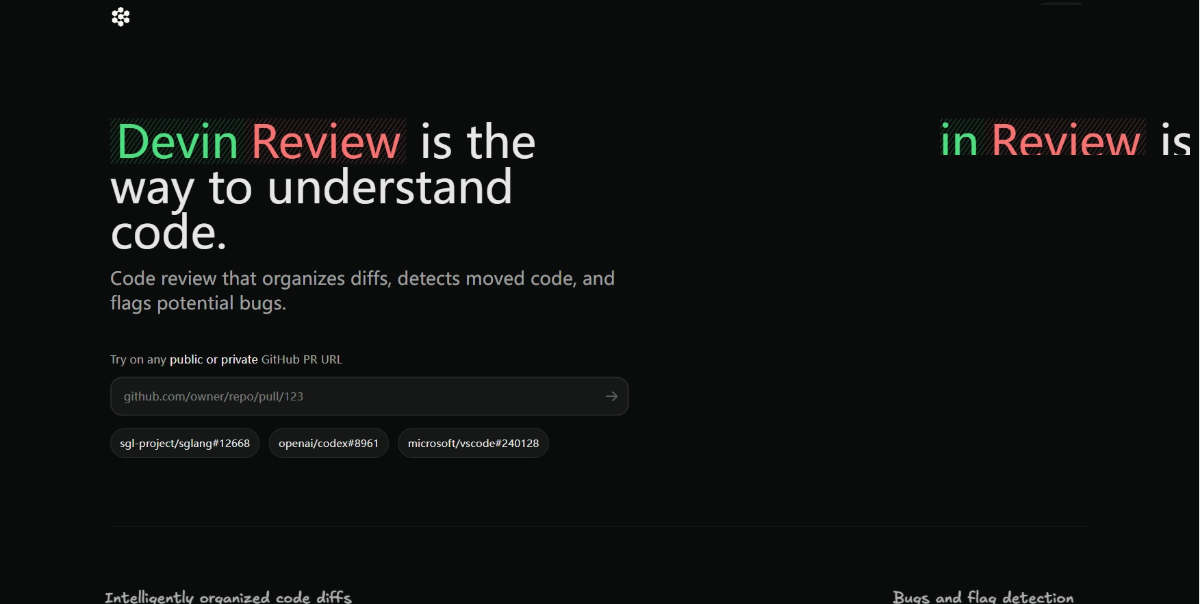
DevinReview
Core parameters and statistics
The main delivery form of Devin Review belongs to [Productivity/Business-side Application]. It's not just "let AI read the diff for you", but tries to shift the focus of review from formatting and superficial changes to logical holes, contextual understanding and fixable suggestions.
| Projects | Public Information |
|---|---|
| Official positioning | Code review that organizes diffs, detects moved code, and flags vulnerabilities and bugs |
| Core capabilities | diff logical grouping, vulnerability detection, CWE annotation, Q&A, repair PR |
| Key upgrades | Security review becomes a default component of every Review |
| Integration direction | GitHub PR workflow |
| Supplementary capabilities | Code base-aware Q&A, copy movement detection |
A brief comment: The most valuable thing about it is not "seeing faster", but "picking out the really dangerous places first".
Publicity Verification: The official emphasizes that every code review is now also a security review. This formulation is attractive, but be clear: it can catch logical loopholes and obvious flaws, and it is not equivalent to replacing manual architecture review and formal security processes.
User and market recognition
Devin Review is aimed at engineering teams that have struggled with PR review efficiency issues. Especially when the PR becomes large, there are many cross-file movements, and the business logic is complex, the cost of understanding the traditional diff view will be very high.
Expert view: What it really changes is not who gets to approve, but how teams allocate review attention. By exposing high-risk paragraphs, possible loopholes, and logic shifts first, senior engineers can focus their time on truly important judgments.
Hidden benefits: For multi-warehouse teams or remote teams, the throughput improvement of Review is not only reflected in faster merging, but also in reducing upstream and downstream waiting.
Current Limitations: The official has not disclosed a more detailed pricing structure and enterprise SLA, so concurrency review capabilities and data boundaries must still be verified before large-scale team purchases.
Cost advantage
Free truth: Public information mentions that public PRs can be reviewed for free, but the real value of private warehouses, enterprise processes, and automated security reviews are most likely still commercial capabilities.
C-side/Individual: For open source maintainers, free public PR is an attractive entry point.
Developer/Team: The core benefit is not to eliminate manual review, but to reduce the probability of low-value reads and missed high-risk changes.
Enterprise/Commercial: If a senior engineer spends a lot of time reading big PRs every day, even if it only reduces invalid reading by 20% to 30%, it may be worth the tool fee. This is a deduction, not an official commitment.
Hidden Costs: Code uploads, warehouse permissions, internal security policies and compliance requirements are the real purchase thresholds that all AI Review tools cannot bypass.
Main functions
- Logical diff grouping: Group related changes together instead of purely expanding them in file order.
- Vulnerabilities and Bug Detection: Focus on potential logical vulnerabilities rather than just grammatical issues.
- CWE labeling and severity sorting: allows the team to triage quickly.
- Codebase-aware Q&A: Ask questions around PR and code context.
- Copy/Move Detection: Reduce reading noise during large refactorings.
- Generate mergeable fix PR: not only point out the problem, but also promote the implementation of the fix.
Expert’s View: Hidden linkage is "review discovery -> explain the reason -> directly give repair suggestions". This is closer to project-related issues than reporting an issue separately.
Model and version evolution
The focus of Devin Review's iteration is very clear, which is to upgrade from "better aware of PR" to "PR agent with a security perspective by default".
Mainline release
- Security Update: Security review has become a default capability, which means that the product has pre-installed security findings into the daily review process.
Historical nodes
- Review Launch: Initial focus on diff organization, issue tagging, and GitHub integration.
Publicity verification: The evolution of the version shows that it is moving towards high-value review scenarios instead of being a general chat shell.
Technical advantages
Quantified cost reduction and efficiency improvement: For large-scale PR, high-frequency refactoring and cross-module change scenarios, a common pain point for the team is "it took half an hour to read it, and the key points may not have been grasped." The value of Devin Review lies in shortening the most laborious part of the half-hour and bringing the high-risk points to the forefront first. This is a deduction, not an official commitment.
Human-machine collaboration boundary: AI can do diff organization, preliminary risk scanning, contextual Q&A, and repair drafts; final approval, architecture-level trade-offs, and business risk judgments still must be manually responsible.
Current limitation: For codes with a high degree of business coupling and strong implicit domain knowledge, AI review can easily give "technically correct, business incorrect" suggestions.
How to use
| Usage | Suitable for the crowd | Description |
|---|---|---|
| GitHub PR integration | Most teams | Use within existing PR process |
| Automatically trigger reviews | High-frequency collaboration team | Automatic analysis when PR is created or updated |
| CLI / Local workflow | Private or special context | Suitable for teams that place more emphasis on local control |
Usage Suggestions: It is best to introduce it on big PRs, refactoring PRs and security-sensitive PRs first, instead of forcing it on for all minor fixes.
Dissuade scenario: If the team's code specifications are extremely inconsistent, test coverage is poor, and PR descriptions are missing for a long time, then AI Review can only help you see the chaos faster, but will not automatically improve the process.
Product Pricing
The official page does not disclose the full standard pricing, which is currently more based on product access and team purchasing strategies.
- Personal/Open Source: Public PR profiles show free trial.
- Development Team: It needs to be verified according to the actual access method and warehouse scope.
- Enterprise: Emphasis should be placed on confirming private repository permissions, data retention, and security terms.
Free truth: The real decision to adopt is not a free public PR, but whether the private repository is willing to open up enough context for it to analyze.
Application scenarios
- Large PR review: Reduce reviewer's cognitive overhead in file-level jumps.
- Security Sensitive Projects: Assist in discovering authentication, permissions and logic vulnerabilities.
- Refactoring and Migration Project: Copy move detection and logical grouping are of great value.
- Remote Engineering Team: Structure review notes and contextual discussions.
Dimensionality reduction attack scenario: Teams with more code changes, deep context, and tight manpower will most obviously feel its value.
Applicable people
- Medium to Large R&D Teams: Best for saving senior engineer time on complex PR reviews.
- Teams with high security requirements: Put security findings into the development process.
- Open Source Maintainer: Public PR free strategy is attractive.
Dissuade/Not Applicable to People: Projects with extremely small teams, almost no PR process, or warehouses with very light code changes may not necessarily need such a heavy review tool.
Summary and Outlook
The core value of Devin Review is to advance code review from "reading differences" to "understanding risks and promoting repairs." It works well as an attention amplifier for senior engineers, but not as an automated approver that replaces the senior engineer's judgment.
Current Limitations: Private code permissions, domain knowledge gaps, and false positives and negatives still exist.
Procurement/Adoption Risk Assessment: It is recommended to pilot it in a large PR team with high security requirements first, focusing on three things: whether the high-risk problem discovery rate is improved, whether the review time of senior reviewers is reduced, and whether false positives are controllable. If all three of these are true, it is worthy of larger-scale access.
Related tools:  GitHub Copilot,
  Cursor
Version Info
- Devin Review Security Update :The official page publicly displays "security review is now part of every Devin Review". There is no official precise date yet, indicating that vulnerability review has become a default capability.
- Devin Review Launch :The initial launch phase of Devin Review, which is displayed on the public directory site, emphasizes logical grouping of PR, issue tagging and GitHub integration. There is no official precise date yet.
User Reviews