 Devv AI
Free
Devv AI
Free
Devv AI is an AI search engine for developers, focusing on code search and technical document retrieval, helping programmers quickly find accurate answers to technical questions.
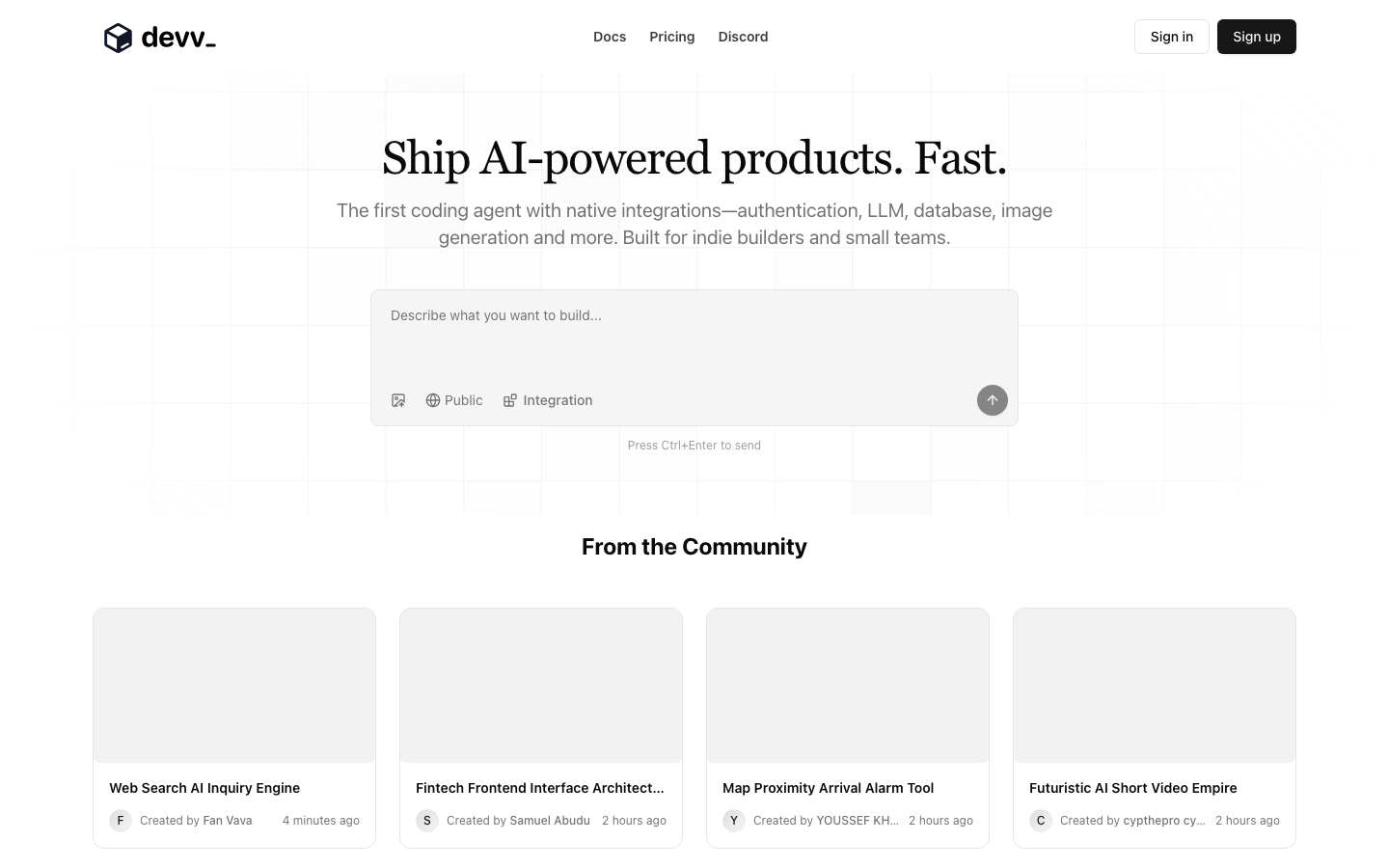
DevvAI
Core parameters and statistics of Devv AI
Devv AI has evolved from a single-function "AI developer search engine" in 2023 to an "AI native application construction platform" in 2025-2026, forming dual product lines of Devv Code (application construction) and Devv Search (developer search). The following parameters cover the core specifications of both products:
| Dimensions | Devv Code (application building platform) | Devv Search (developer search) |
|---|---|---|
| Product positioning | AI native application building platform, natural language → Deployable Web App | AI-driven developer search engine |
| Target users | Non-technical creators, independent developers, small teams | Full stack/front-end/back-end developers |
| Core capabilities | Code generation, native integration (Auth/DB/LLM/Email/Image Gen), one-click deployment | Code semantic search, multi-source technical content aggregation AI answers |
| Third-party integrations | OpenRouter, ElevenLabs, Replicate, Supabase, and more | — |
| Platform coverage | Web (devv.ai) | Web (devv.ai/search) |
| Billing model | Credit system, $0-49/month + additional volume package | Free, Pro subscription includes advanced model quota |
| Monthly visits | ~119.75k (overall domain name, derived from AIbase estimate) |
Positioning differences between the two products: Devv Code solves the end-to-end requirement of "building a complete AI application from 0 to 1" - users only need to describe their ideas in natural language, and the platform automatically completes the entire process of code generation, database configuration, certification system, and deployment. Devv Search solves the information retrieval needs of "quickly finding accurate technical answers during the development process" - similar to Phind and Sourcegraph but focusing more on code-level semantic understanding. The two complement each other under the big proposition of "development efficiency", but the focus of resource allocation and user perception has clearly tilted towards Devv Code.
User Scale: As of mid-2026, Devv has not officially disclosed the number of registered users. Third-party traffic estimates show that devv.ai has about 120,000 monthly visits (AIbase data), of which about 64% come from direct visits and 25.8% come from natural searches, indicating that there is a certain proportion of returning users and brand awareness. Compared with competing products such as Cursor (tens of millions of monthly visits) and Phind (millions), Devv's traffic volume is 1-2 orders of magnitude lower and is still in the early climbing stage after product transformation.
Users and market recognition of Devv AI
The market acceptance of Devv AI must be divided into two stages: the "search engine stage" from 2023 to 2024 and the "application building platform stage" from 2025 to the present.
Search engine stage (2023-2024): As a search tool for AI developers, Devv has obtained about 1.5k Stars on GitHub, and its early users are mainly English and Chinese developer communities. Product reputation focuses on "search results are closer to programmers' needs than general search engines" - the ability to understand code context rather than pure keyword matching. However, compared with competing products such as Phind and Sourcegraph Cody, the functional depth and index coverage of Devv Search are not enough to form strong user stickiness. The last code submission of its GitHub warehouse was at the end of 2023, indicating that the team has shifted its research and development focus to a new direction in 2024.
Application Building Platform Phase (2025-2026): Devv 2.0 entered Private Beta in February 2025 and was officially launched publicly in August of the same year. The core narrative of new products has shifted from "search for answers" to "generate and deliver." According to the official changelog disclosure, after the public launch in August 2025, the team has advanced at a rate of one functional iteration every 1-2 weeks, integrating native modules such as Authentication, Database, LLM, Email, Web Search, Image Generation, and third-party services such as OpenRouter, ElevenLabs, and Replicate. The target user profile has also expanded from mid- to senior-level developers to "product managers, beginner programmers, designers, founders—anyone who has concepts but does not have engineering capabilities for the time being."
Competitive Position: In the "AI application construction platform" track, Devv faces direct opponents including Bolt.new (similar to natural language → Web App), Replit Agent, v0, Lovable, Bubble, etc. Devv's differentiation strategy is "native integration density" - it has complete back-end capabilities built-in (Auth + DB + Email + Image Gen), and users do not need to configure Supabase or Auth0 as they do on Bolt.new. However, the depth of the moat at this point of difference is limited because competing products such as Bolt.new and Cursor are also rapidly adding integration capabilities.
Cost Advantages of Devv AI
The cost structure of Devv AI needs to be examined from two dimensions: "C-side free search" and "Building platform credit billing".
C-side/individual users: Devv Search basic search is free and open, and Pro subscription ($25/monthly payment) unlocks advanced model quotas such as o1 and Claude Sonnet. The free version is enough to cover daily code queries and API document retrieval. Devv Code free users can generate a small prototype application (1-2 pages + basic database) with 300 credits per month, which can complete the proof of concept but is not enough to support official release.
API/Developer Dimension: Devv does not directly sell API access capabilities. Developers and teams use Devv Code’s models and integrated resources as a Credit subscription. After the monthly quota is exceeded, you can replenish it through the additional package:
| Add-up package name | Number of Credits | Price | Unit price per 100 Credits |
|---|---|---|---|
| Starter Pack | 1,000 | $10 | $1.00 |
| Developer Pack | 5,000 | $45 (10% off) | $0.90 |
| Power Pack | 10,000 | $85 (15% off) | $0.85 |
| Launch Pack | 40,000 | $320 (20% off) | $0.80 |
Important terms of the additional volume package: One-time purchase, never expires, but only open to Pro/Team users. Free users who exceed the limit can only wait for reset or upgrade next month.
Enterprise and Team Dimension: The Team plan is billed by seat ($49/seat/month, including 3,000 Credit/seat, for team pool use), suitable for small teams of 2-5 people. Devv currently has no public private deployment or On-Prem plans, and no data isolation SLA. For teams in finance, medical, government, etc. that have data sovereignty requirements, the hosting model may not pass compliance audits. Comparison with competing products:
| Comparison items | Devv Code | Bolt.new | Replit Core |
|---|---|---|---|
| Free tier | 300 Credit/month, 3 projects | Daily limit | Free public projects |
| Entry fee | $25/month (annual payment) | $20/month | $25/month |
| Team plan | $49/seat/month | $40/seat/month | Undisclosed |
| Private deployment | Not supported | Not supported | Supported (Enterprise) |
| Additional billing | Recharge package $0.80-1.00/100 Credit | Not applicable | Not applicable |
Hidden Cost Tip: Devv's Credit consumption mechanism is officially described only as "a model based on the complexity and usage of AI actions", and the specific Credit consumption formula is not disclosed. This means that users cannot accurately predict the Credit cost of a development task under the Pro subscription. It is recommended to use the free quota to conduct a small-scale test before the critical development stage, evaluate the actual consumption, and then decide whether to upgrade.
Main features of Devv AI
Devv AI's current product functions are distributed across two product lines, of which Devv Code (application construction) is the current main product, with function iteration speed and frequency of use far exceeding Devv Search.
Devv Code Core Functions:
-
Natural Language→Application Generation (Prompt-to-Endpoint™): Users describe an application idea in natural language, and Devv Code automatically completes code generation, database schema design, API routing construction, and front-end UI rendering in the background. It takes about 3-5 minutes to complete the first version from an idea to a deployable Web App. Use value: Shorten the "idea → code → deployment" cycle from days to minutes.
-
Native Integrations: This is the core difference between Devv and competing products such as Bolt.new. Users can add Authentication, Database (Devv DB), LLM to call Email to send Image Generation, Web Search/Reader, OpenRouter (hundreds of LLM), ElevenLabs (speech synthesis), Replicate (thousands of open source models) and Supabase integration to the application without leaving the platform. Expert View: Traditionally, services such as Auth0, Supabase, SendGrid, and OpenAI need to be configured separately. In Devv, they can all be ready through a project description. Non-technical founders do not need to understand the concepts of "API Key" and "Webhook" to build a complete AI SaaS.
-
Interactive Preview and Debugging: After generating the code, the Playground provides a real-time rendering preview, and the Element Selection mode allows you to directly click on the UI component to modify it - select the button → describe the new style → AI updates the code in real time and refreshes the preview. Applicable tasks: UI adjustment, interaction logic verification.
-
One-click deployment and CI/CD: zero-configuration server deployment, automatic scaling SSL management. After users complete development, they can deploy the application to a publicly accessible URL with one click. Value in Use: Removes the biggest barrier to deployment for non-technical users who have never been exposed to DevOps.
-
GitHub Sync (Coming Soon): Pro subscription will provide the ability to synchronize code to GitHub repositories, implying that Devv's goal is a combination of "low code generation + professional code management" rather than platform locking.
Devv Search Core Functions:
- Code-aware semantic search: Semantic-level analysis of variable names, function names, and framework APIs in the code - When searching for "React useEffect infinite loop", you can understand that this is a question about the dependency array, not a simple keyword match.
- @Context context selection: Enter the
@symbol to select a programming language, framework, and platform to limit the search scope (such as@Python @Django), and the search results will automatically focus on the selected technology stack. This is the differentiated feature with the highest user stickiness of Devv Search. - Multiple model selection (Pro): Pro users can switch between different AI underlying models (o1, Claude Sonnet, Gemini) in the search results, and choose flexibly when they need to compare answer quality or deal with specific types of questions.
- Playground code sandbox: Code blocks in search results can be run, modified, and previewed directly in the sandbox without copying to the local environment, which is a higher interactive dimension than traditional search.
Devv AI model and version evolution
Devv AI's product evolution path clearly reflects the team's strategic pivot from "information retrieval tool" to "application construction platform". The core version nodes are as follows:
Search engine stage (2023-2024)
| Time nodes | Key changes |
|---|---|
| 2023 | The first version of Devv Search is launched, and GitHub open source wins 1.5k Stars |
| 2023-12 | Devv Desktop released (v0.1.0), macOS/Windows client |
| 2024-09 | Devv AI Profile——Personalized search configuration, memory technology stack preferences |
| 2024-10 | Devv Contexts (@limited search scope) + Playground code sandbox |
| 2024-10 | OpenAI o1 series + Claude 3.5 Sonnet access |
| 2024-12 | Mermaid chart preview support |
Transformation Phase (2025 - 2026)
| Time nodes | Key changes |
|---|---|
| 2025-02 | Devv 2.0 Private Beta, refactored from a search tool to an application building platform |
| 2025-05 | Devv Builder Public Beta (Prompt-to-Endpoint™ Natural Language→API) |
| 2025-08 | Devv 2.0 is publicly launched, comprehensively transforming the "AI application construction platform" |
| 2025-08 | Element Selection (GUI click to modify UI) + native Image Gen |
| 2026-01 | OpenRouter native integration, access to hundreds of LLM models |
| 2026-04 | Devv Email integration goes live |
Version evolution features: Before 2024, "search function enhancement" will be the main line; after the pivot in 2025, iteration will be accelerated to 1-2 weeks/function, all focusing on "allowing non-technical users to build complete applications". There will be no major updates to Devv Search from the end of 2024, and team resources will be completely transferred to Devv Code. Devv does not adopt a semantic version number system. The above timeline is compiled according to the official changelog, and some intermediate versions may not be fully covered.
Technical advantages of Devv AI
Devv AI's technical route selection reflects the team's unique understanding of "AI native application development" - not to make a better code generator, but to build a complete application generation package.
AI Agent Coding Architecture: The core of Devv Code is a multi-step AI Agent. After receiving the user description, independently complete the requirements analysis → architecture design (select the integrated module) → database schema generation → API routing code → front-end UI rendering → deployment configuration. The essential difference between this "pipeline Agent" and Bolt.new's "single-round generation + manual iteration" model is that Devv establishes internal component dependencies during the generation phase (such as automatically associating Auth integration when generating the Login component), reducing the workload of subsequent manual patching.
Integration-as-Abstraction: Devv does not leave a "please configure it yourself" comment in the generated code template, but provides an abstract API backend at the platform level - the user declares "requires login", Devv automatically assigns authentication endpoints, user tables and session management, without generating authentication code. This means that the generated code is more lightweight (the front end only calls the API), but the application is strongly bound to the Devv platform and cannot be migrated to other infrastructure.
Front-end rendering solution: Using modern React technology stack, supporting responsive layout and custom domain names. "Export Source Code" of Pro subscription can export code, but the exported code requires supporting integration configuration to run independently.
Code semantic indexing on the search side: Devv Search can distinguish variable names, function signature API documents and natural language comments, sorting by semantic relevance rather than text hits. The @Context mechanism expands the search intent from "keywords" to a three-dimensional vector of "technology stack + keywords + task type" to obtain more accurate results in modern web development scenarios where multiple languages are mixed.
How to use Devv AI
The usage paths of Devv AI vary significantly depending on the product line. The following is divided into two paths: Devv Code and Devv Search.
| How to use | Entrance | Suitable for the crowd | Core steps | Fees |
|---|---|---|---|---|
| Devv Code - Application Building | devv.ai | Non-technical creators, independent developers | Describe ideas → Automatically generate → Iterative adjustments → Deploy and go online | Free/Pro/Team |
| Devv Search - Developer Search | devv.ai/search | Intermediate and Advanced Developers | Enter question → Get AI code answers → Run verification in Playground | Free/Pro Unlock premium models |
Devv Code Quick Start (3 minutes):
- Visit devv.ai and register an account using GitHub or email
- Click "New Project" and describe the application to be built in natural language (for example: "An AI image generation tool that allows users to upload photos and select an artistic style to generate new images")
- Wait for the Agent to automatically complete code generation, database construction and integration configuration (about 1-3 minutes)
- Preview the application in the Playground and use Element Selection to select UI elements for fine-tuning.
- Click "Deploy" to obtain a publicly accessible URL (domain name and certificate are automatically processed)
Devv Search typical usage process:
- Visit devv.ai/search and enter a programming question (such as: "How does Python FastAPI implement WebSocket")
- You can enter
@to select a limited technology stack (such as@FastAPI @WebSocket) - Browse AI answers and code examples, and mark the source of information at the bottom of the answer
- Click the Playground icon to directly run and modify the code block
- Pro users can switch the underlying model (o1, Claude, etc.) in the settings
Devv Code integrated mounting: Integration requires no manual configuration - capability requirements are naturally mentioned in the project description, and the Agent automatically matches the required modules. For example, "User needs to log in" automatically activates Authentication, and "Send email to new user" automatically activates Email. You can also manually switch the integrated module on and off in the project settings page.
Product Pricing for Devv AI
Devv AI adopts a three-tier billing structure of "free trial + credit subscription + volume increase package". The specific plan is as follows:
Free version (Free):
- Monthly fee: $0
- Monthly Credit: 300
- Maximum number of projects: 3
- Function: Basic model generation, playground preview, community support
- Suitable scenarios: technical verification, learning experiments, small personal projects
- Restrictions: Private projects cannot be created, custom domain names cannot be bound, and Pro is required to export code
Pro version ($25/month·annual payment / $30/month·monthly payment):
- Monthly fee: $25 (paid annually, save about 20%) / $30 (paid monthly)
- Monthly Credit: 2,500 -Number of projects: no limit
- Features: Private project, custom domain name, remove "Built with Devv" logo, priority mail support, export source code, access to advanced AI models (including Devv Search advanced model quota)
- Suitable scenarios: Rapid prototype verification of formal products, Freelance project delivery, MVP development of personal SaaS products
- Note: GitHub synchronization mark is "Coming Soon", you need to manage project backup by yourself during the contract period
Team version ($49/seat/month):
- Monthly fee: $49/seat
- Monthly Credit: 3,000/seat (shared by team pool)
- Features: Contains all Pro features + workspace collaboration (Coming Soon) + centralized billing
- Suitable scenarios: collaborative development of small teams of 2-5 people
- Note: The Team plan is in Waitlist status and is not yet open to registration for all users
Add-up Pack (only for Pro/Team subscribed users):
- 4 levels available, $10 to $320, corresponding to 1,000 to 40,000 Credit
- Unit price reduced from $1.00/100 Credit to $0.80/100 Credit
- Never expires, suitable for sudden peak scenarios
Credit consumption estimate: The official has not disclosed the specific Credit consumption formula. A rough estimate based on the median value of community feedback: a simple application with 2-3 pages of UI + database + Auth consumes approximately 200-500 Credits; a complex application (including Image Gen, Email, and workflow orchestration) consumes approximately 1,000-3,000 Credits. With the free version of 300 Credit/month, approximately 1 complete small prototype project can be completed. With 2,500 Credits/month for the Pro version, you can maintain approximately 3-5 iterations of medium-complexity projects at the same time.
Devv AI application scenarios
Devv AI's product dual-line structure enables it to cover a wider range of development scenarios than a single search tool or a single application building tool, but the scene adaptability of the two product lines is clearly differentiated.
-
AI SaaS MVP rapid construction (Devv Code): Entrepreneurs use natural language to describe AI product concepts (such as "SaaS that helps e-commerce sellers automatically generate product descriptions"), and the platform automatically generates front-end UI, DB Schema, certification and LLM call links, and obtains a deployable prototype in about 10 minutes. Actual benefits: The cycle from "idea" to "interactive prototype" is compressed from 1-2 weeks to half a day. The premise is that the requirements are clearly described and do not involve complex custom business logic.
-
Quick delivery of internal tools (Devv Code): Small teams need management panels, data dashboards or automated workflows (such as "customer service ticket management panel, supporting role permissions and email notifications"). Devv's native integration makes the construction cost of such CRUD+Lite applications extremely low. Implementation Tip: It is recommended that the key write operation logic be manually reviewed before deployment of the database operation code.
-
Precise information retrieval in development (Devv Search): When troubleshooting bugs, @Context restriction can narrow the answer range to a specific framework version (such as Next.js 14+), reducing misleading caused by version differences. Actual benefits: For mainstream ecosystems such as React, Next.js, and Python, the search accuracy is close to or even better than Google + Stack Overflow manual search. For niche frameworks (such as the Svelte experimental library), index coverage is significantly insufficient.
-
Outsourcing/Freelance project rapid delivery (Devv Code): Freelancer uses Devv Code to generate the project skeleton and standard modules (login, user management), and then export the source code for customized secondary development. "Export Source Code" turns Devv from a binding platform to an "AI-driven code generator". Implementation Tip: The exported code does not contain platform runtime dependencies, so you need to supplement your own alternatives. The migration cost should be included in the project quotation.
Applicable groups of Devv AI
Devv AI's product dual-line structure determines that its user profiles span a wide range, from non-technical roles who do not understand programming to senior full-stack developers, and have corresponding usage scenarios.
-
Non-technical entrepreneurs and product managers: The core target users of Devv Code - no need to write code, just a clear description of "what you want" to go from concept to demonstrable product. Not suitable for boundaries: When it comes to complex business logic such as multi-tenant architecture and refined permission systems, the abstraction capabilities of Devv Code may be insufficient, and technical partners are still required to intervene. The scalability of the Devv hosting architecture has not been proven on a large scale to achieve high-concurrency scenarios of >100,000 DAU.
-
Indie Developers and Freelancers: Devv Code as a rapid prototyping tool and project skeleton generator. Pro's "Export Code" feature allows you to bypass platform lock-in and migrate generated code to your own infrastructure. Implementation Tips: It is recommended to position it as an "initial accelerator" - rapid trial and error in the prototype stage, and then reconstruct and implement after confirming the direction. The credit consumption of a medium-complexity project is about 1,000-5,000, corresponding to the cost of an additional package of $8.5-$45, which should be included in the quotation.
-
Intermediate and Advanced Developers: Devv Search’s @Context and Playground are particularly effective in full-stack scenarios where multiple languages/frameworks are mixed. Unfit boundary: Index coverage on ultra-niche technology stacks (such as industry-specific embedded frameworks) may be zero; in in-depth debugging that requires a line-by-line understanding of compiler behavior or runtime memory layout, the reliability of AI answers drops significantly.
-
Programming beginners and career changers: Devv Code reduces the desire to build and helps quickly get positive feedback of "I made a usable application". Devv Search directly gives code examples and explanations, which is more suitable for beginners than general search engines. Not suitable for boundaries: Devv should not replace systematic programming learning - it hides configuration details and underlying principles, and long-term dependence may not establish engineering foundations such as debugging capabilities, performance optimization awareness, and safe coding habits.
Summary and Outlook of Devv AI
Devv AI's pivot is a risky but logical decision: in the AI developer search track, there are already strong competitors such as Phind, Sourcegraph Cody, GitHub Copilot Chat, etc., and it is difficult to acquire users of latecomer tools. After turning to the AI native application building platform, Devv found a gap where "big manufacturers have not paid attention to it for the time being, and competing products have just started" - the demand for "non-technical users to build complete AI applications" is growing rapidly with the popularity of AI.
Current core advantages: The completeness of the native integration system and the zero-configuration experience, with a high degree of completion in the dimension of "natural language → complete backend". Interactive innovations such as Element Selection reduce the communication cost of UI iterations. Product iteration speed (1-2 weeks/feature) shows engineering execution.
Current major limitations: Low brand awareness after the transformation (120,000 monthly visits, 1/100 of Cursor, etc.); Insufficient credit billing transparency - users cannot predict the actual consumption of tasks; Platform lock - although there is code export, the exported code depends on the platform back-end service and cannot run independently; the Team version is still in Waitlist status; enterprise-level functions (SSO, audit logs, data residency) are completely missing.
Follow-up observation points: Whether Devv Code can establish a deeper "integration moat" than Bolt.new; whether GitHub will truly solve platform lock-in concerns after synchronized launch; improvement of Credit consumption transparency (real-time dashboard or prepaid estimate); whether Devv Search will continue to be maintained or integrated into Devv Code; market acceptance after the official launch of Team version.
Procurement and Adoption Risk Assessment: For individual creators to validate their MVP and quickly build in-house tools, the Free and Pro versions are extremely low-risk – $25/month is far less than equivalent human hours and requires no pre-configured infrastructure. When Freelance is officially delivered, it is recommended to make it clear in the quotation that the Devv-generated code will be delivered after manual review and reconstruction to avoid passing on the risk of platform lock-in to customers. It is not recommended for enterprise teams to introduce Team version as the main development platform before it is officially launched and the collaboration function is fully verified. Enterprises should focus on checking before purchasing: Credit consumption transparency (whether there is a real-time billing panel), exported code portability (whether the Devv runtime needs to be retained), service SLA (availability commitment and compensation terms for AI-generated services). Devv AI is currently best suited as a "prototype accelerator for independent creators and micro-teams" rather than a full lifecycle development platform for enterprise-level applications.
Related tools: perplexity, you-com
Version Info
- Devv AI latest version :There is no official precise date yet, and the search algorithm and code analysis capabilities will continue to be iterated.
- Devv AI first version :There is no official precise date yet when Devv AI products will be launched.
User Reviews