 Diagrimo
Diagrimo is an AI chart generation tool owned by Tenorshare. It focuses on using natural language descriptions to quickly generate diagrams such as flow charts, mind maps, and organizational charts. It lowers the threshold for non-designers to produce professional charts, and supports online editing and exporting.
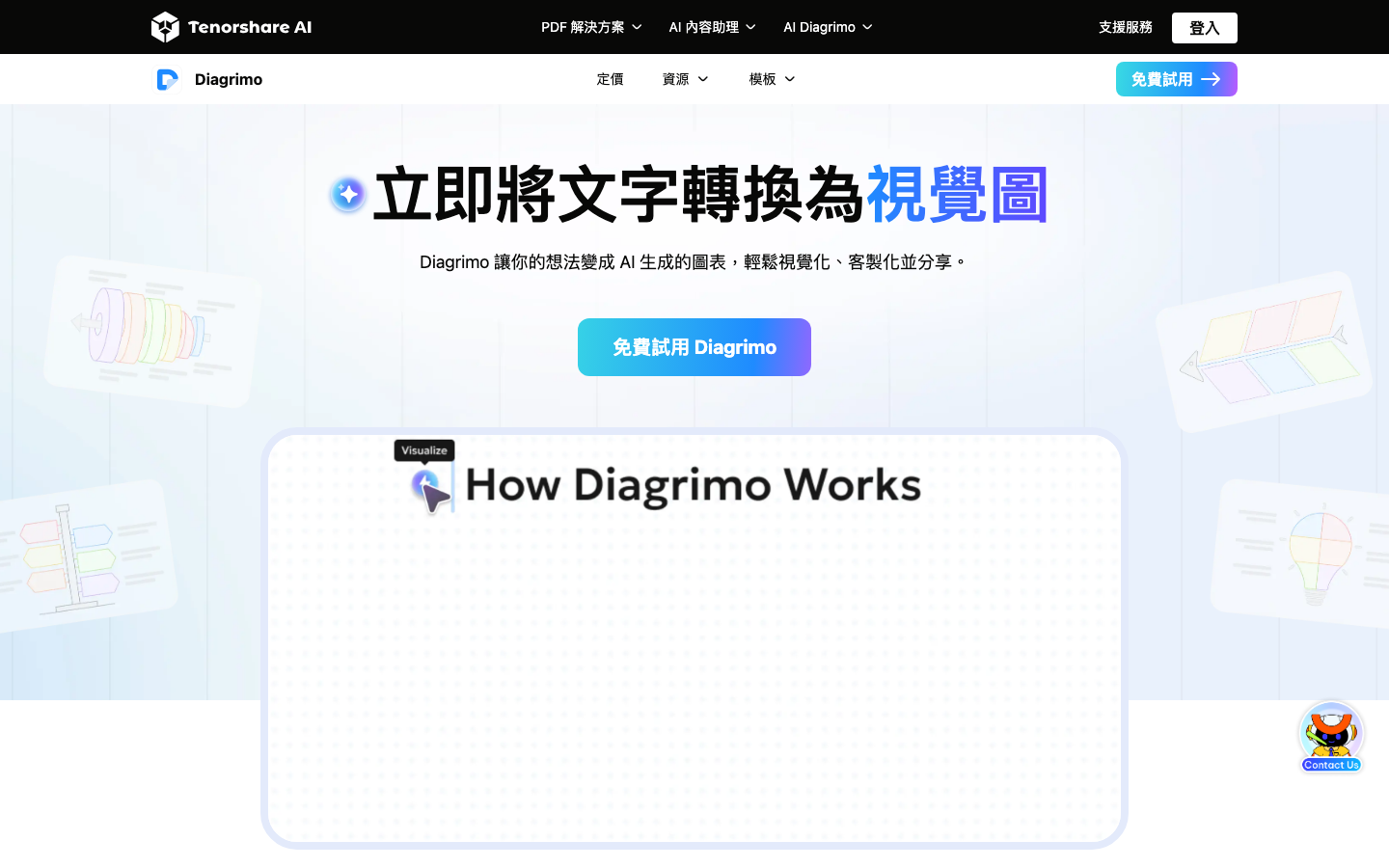
diagrimo
Core parameters and statistics
Specific technical parameters (such as model size, context length, supported file formats, input and output restrictions, etc.) are subject to the official product page. It is recommended that users verify the latest technical specifications and system requirements before choosing to ensure that they match their own usage scenarios.
User and market recognition
Gradually build user awareness in the field, and product capabilities are used by content creators and teams to improve work efficiency. Some industry users have incorporated it into their daily workflow. It is recommended to refer to the latest official disclosures for specific user scale and industry adoption rate data.
Cost advantage
Diagrimo's cost logic is to "use AI drawing to replace the time cost of manual drawing."
- C client/individual: Usually provides a limited free trial amount, and most of the full functions are subscriptions. Please refer to the official website for details.
- Developer/API: Whether API is provided is not disclosed.
- Enterprise/Team: For team version or commercial authorization, please refer to the official page or business communication.
True cost structure: The explicit expense is the subscription fee, and the implicit benefit is the compression of repeated chart drawing time. When evaluating, you should pay attention to the usability of the generated charts (whether a lot of rework is required) and whether the export format meets actual use.
Main functions
Diagrimo's capabilities are organized around "natural language generation diagrams":
- Text to generate charts: Enter a description to generate flow charts, mind maps, etc.
- Multiple diagram types: covering common diagram forms such as processes, structures, relationships, etc.
- Online Editing: You can continue to adjust nodes, text and layout after generation.
- Export for sharing: Supports exporting pictures or shareable formats for easy embedding in documents and reports.
The key to the value of a feature is the usability of the first build: the closer the build is to being usable, the more manual tweaking time is saved.
Model and version evolution
Diagrimo runs as an online tool and does not have a public version number system.
- Launch Period (~2026-01): Launched as a Tenorshare AI tool line product.
- Current version (~2026-06): Continue to expand icon types and editing capabilities.
The official unified version number and precise date have not been disclosed, and the version context is expressed in public milestones.
Technical advantages
The advantage of Diagrimo is to "automate the chart drawing process":
Mechanism: Use AI to analyze the structural relationships in natural language descriptions and automatically generate nodes, connections and layouts.
Effect: Users do not need to master professional drawing software to obtain standardized diagrams, and the drawing speed is significantly faster than manual drawing.
Applicable Scenarios: Most suitable for office and reporting scenarios where ideas need to be quickly transformed into visual diagrams.
The trade-off is that AI has limited understanding of complex structures, and professional or highly customized illustrations still require manual refinement.
How to use
Diagrimo is used directly via the web:
| Usage | Suitable objects | Features |
|---|---|---|
| Online web page | Personal/office users | Enter a description to generate a chart |
| Online editing | Those who need fine-tuning | Adjust the nodes and layout of the generated results |
| Export | Document/Report Scenario | Export image or shareable format |
The typical process is "Describe requirements → generate charts → online fine-tuning → export for use". For first-time users, it is recommended to use simple structures to verify the generation quality before processing complex charts.
Product Pricing
The pricing model is subject to the official real-time page. Usually a freemium or subscription system is used, and basic functions can be used for free. Advanced functions or high-frequency use require paid subscriptions, and users are advised to evaluate the optimal solution based on actual usage.
Application scenarios
- Process sorting and reporting: Quickly visualize business processes, and the focus of verification is structural accuracy.
- Mind mapping and brainstorming: Organize ideas into structured diagrams and pay attention to whether the node organization is clear.
- Document Illustration: Quickly generate schematic diagrams for reports and plans, and the focus of verification is export quality.
Applicable people
- Office staff: Need to frequently make flow charts and schematic diagrams but are not familiar with drawing software.
- Product and Operation: Use diagrams to sort out processes and structures.
- Students and Teachers: Quickly create mind maps and knowledge structure diagrams.
Scenarios that are not suitable are: scenarios that require highly accurate engineering drawings, professional drawings that strictly comply with specific specifications, or scenes that have strong customization requirements for the layout.
Summary and Outlook
The core value of Diagrimo is to use natural language to automate diagram production, allowing non-designers to quickly produce diagrams. It is suitable for high-frequency and lightweight graphics needs. Its advantages are speed and threshold, but its limitation is that complex graphics still require manual refinement.
The pricing and capability boundaries in the current public information are not yet complete. It is recommended to use the free quota to verify the generation quality and export format of commonly used chart types before deciding whether to subscribe; the team should confirm whether the commercial authorization and export format meet the actual workflow before purchasing.
Related tools:  Notion AI, google-workspace
Business process integration and ROI analysis
As a productivity tool for businesses or professional positions, Diagrimo's true value depends on its depth of integration with existing workflows and quantifiable efficiency improvements. The following is a systematic analysis from three core dimensions.
System integration and data interoperability The ability to interoperate with existing business systems is a key prerequisite for productivity tools to be integrated into workflows. It is recommended to focus on evaluating the following integration dimensions: the openness and documentation quality of the RESTful/GraphQL API (whether a complete API reference and SDK examples are provided), the support scope of Webhook event notifications (which business event types are supported for automatic push), the number and depth of pre-built integrations with common collaboration SaaS tools (WeChat Enterprise, DingTalk, Feishu, Slack, Notion, Jira, etc.), and enterprise-level identity authentication support (SSO/SAML/OAuth and LDAP/AD directory integration). Products that lack integration capabilities are easily isolated into information islands, which in turn increases the cognitive cost and operational friction for teams to switch between different tools.
Efficiency Quantification and ROI Estimation Methodology Before purchasing decisions, it is recommended to quantify the input-output ratio through a structured method: Step 1, choose 3-5 Standardized tasks that are frequently repeated and time-consuming in each team are used as test samples; in the second step, the average time consumption of a single task before and after tool intervention, first-time pass rate or error rate, and the number of links requiring manual intervention are recorded under controlled conditions; in the third step, the saved manpower time is converted according to the comprehensive cost of the position (salary, benefits, management sharing), and soft benefits (increased employee satisfaction, standardization of work quality, and improvement in response speed to core business) are superimposed to obtain a comprehensive ROI estimate. It is recommended to continue tracking ROI trends on a monthly basis, as the value of a tool usually increases over time as team proficiency increases and workflows are optimized.
Phase-based implementation strategy and risk control It is recommended to adopt a three-stage implementation path of "pilot verification-gradual promotion-continuous optimization". In the pilot stage (1-2 weeks), a single team or a single business scenario is selected for small-scale verification. The core goal is to verify technical feasibility and user acceptance, and establish preliminary usage specifications and success standards; in the promotion stage (2-4 weeks), after the pilot verification is passed, the coverage is gradually expanded, and standardized activation processes and training materials are developed; in the optimization stage (continuous), the workflow configuration is continuously adjusted based on actual usage data and user feedback, and more high-value application scenarios are explored. Clear quantitative key result indicators should be set at each stage to avoid blindly expanding the scope of use without data support.
Version Info
- Diagrimo online version (current version) :Provide AI chart generation in the form of online tools, and continue to expand chart types and editing capabilities. The official unified version number has not been disclosed, and there is no official precise date yet. It is recorded according to the current online form.
- Product launch :Diagrimo is launched as a chart product of the Tenorshare AI tool line, providing basic natural language chart generation capabilities. There is no official precise date yet, it is recorded according to the public collection time.
User Reviews