 Dify
Free
Dify
Free
Dify is an open source LLMOps platform that provides visual AI workflow orchestration, RAG pipeline agent construction and model management capabilities, allowing developers to quickly build production-level AI applications in a low-code manner.
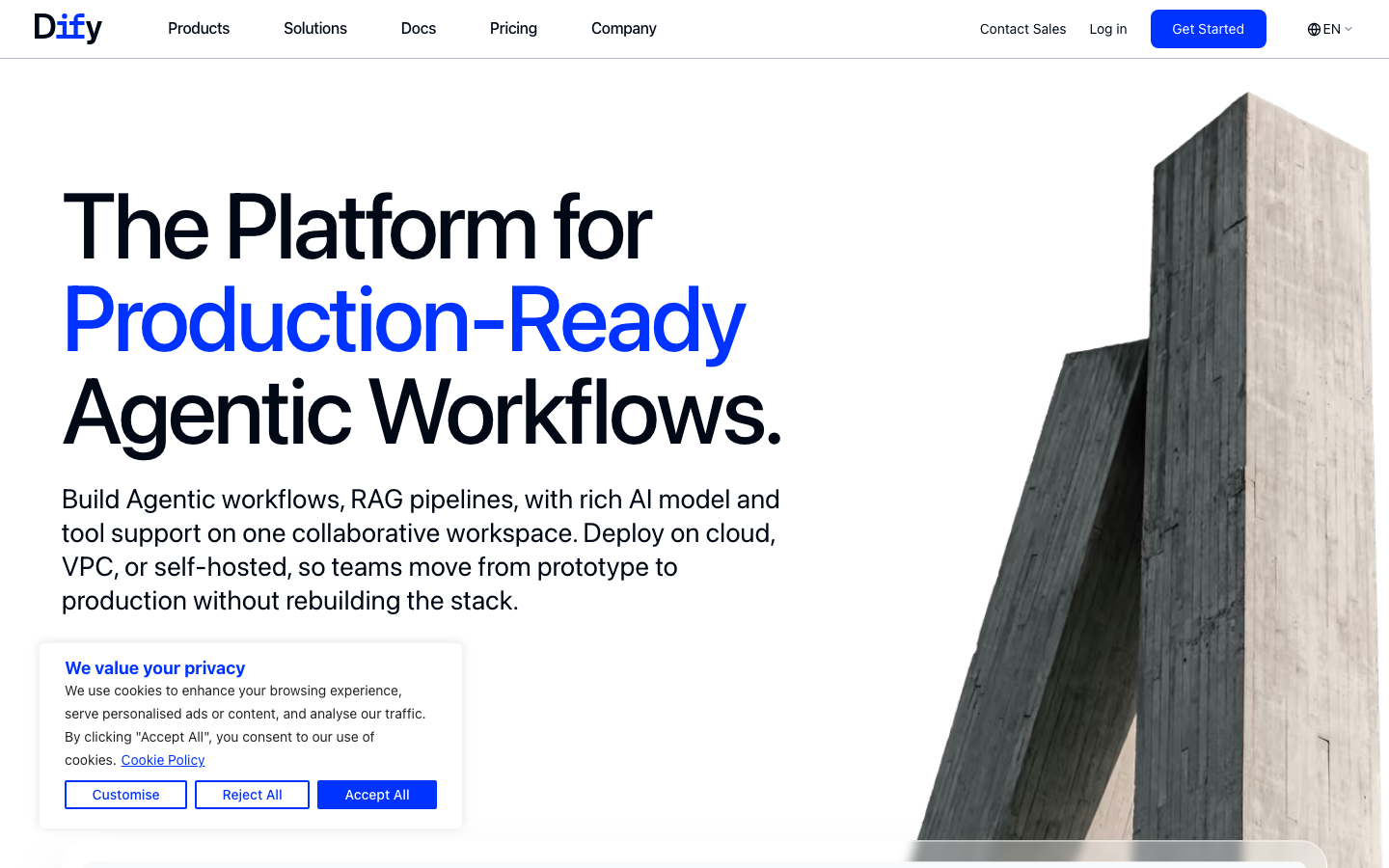
Dify: Open source LLM application development platform, visually orchestrating AI workflow
Dify’s core parameters and statistics
Dify is one of the most popular open source projects in LLM application development infrastructure. It encapsulates complex AI projects such as model calling, prompt word management, and knowledge base retrieval agent tool calling into visual components, allowing developers to build production-level AI applications in a building-block manner. The core difference lies in "model neutrality + visual orchestration" - users can switch between different large model vendors (DeepSeek, OpenAI, Anthropic, etc.) on the same platform, and design the AI application process by dragging and dropping without writing integration code from scratch.
| Projects | Public Information |
|---|---|
| Official positioning | LLMOps open source application development platform |
| Core capabilities | AI workflow orchestration RAG pipeline Agent construction, model gateway |
| Deployment method | Docker private deployment Dify Cloud SaaS, enterprise private cloud |
| Open Source License | Apache 2.0 |
| GitHub Stars | 65,000+ (continuously growing) |
| GitHub Forks | 10,000+ |
| Supported models | OpenAI, Anthropic, DeepSeek, Llama, Gemini, etc. 50+ |
| Application form | Web console RESTful API, Web Chat Widget, iframe embedding |
| Business model | Open source community version + Cloud paid version + Enterprise privatized version |
| Place of Belonging | Shenzhen, China (CN) |
| Core Team | Founder Zhang Luyu, core members come from the open source community and enterprise service fields |
One sentence positioning: Dify is not an independent chat tool, but an AI application "operating system" for developers - it provides a full-link infrastructure from model access, knowledge management to application release.
Dify’s users and market recognition
GitHub Community Activity: With 65,000+ Stars and 10,000+ Forks on GitHub, Dify is one of the fastest growing open source projects in the LLMOps track stars. Its release frequency is maintained at 1-2 small versions per month, and its issue response speed and PR merge efficiency are at the forefront among similar projects.
Enterprise adoption: According to official disclosures and public cases, Dify has been used by thousands of companies around the world for internal knowledge base Q&A, intelligent customer service, content review and other scenarios. The adopting companies cover industries such as the Internet, finance, education, and manufacturing. Typical users include SaaS entrepreneurial teams of medium-sized Internet companies and the AI innovation departments of some financial institutions. The number of registered workspaces for the Cloud version has increased quarter-on-quarter, but the precise number of MAU and paying customers has not been disclosed.
Industry Benchmarking: In the open source LLMOps platform track, Dify is in direct competition with Flowise and LangFlow, all three of which provide visual AI workflow orchestration capabilities. Dify's core advantage lies in "product completeness" - it also covers RAG knowledge base management Agent construction, model gateway and monitoring panel, while Flowise focuses more on pure workflow orchestration, and LangFlow is deeply bound to the LangChain ecosystem. In the closed-source camp, Coze (ByteDance) and Botpress are Dify's main benchmark products, but Dify's open-source, self-hosted features have won it access to enterprise customers who are sensitive to data sovereignty.
| Compare Dimensions | Dify | Flowise | LangFlow | Coze |
|---|---|---|---|---|
| Open Source License | Apache 2.0 | Apache 2.0 | MIT | Closed Source Free |
| Self-hosted deployment | ✅ Docker / K8s | ✅ Docker | ✅ Docker | ❌ Cloud only |
| RAG Knowledge Base | ✅ Built-in, supports multiple document formats | ❌ Requires external connection | ❌ Requires external connection | ✅ Built-in |
| Agent Tools | ✅ Built-in Tools + Customization | ✅ Customization | ✅ LangChain Tools | ✅ Built-in Plugins |
| Model Gateway | ✅ Unified management and monitoring | ❌ | ❌ | ❌ |
| Community size | 65k+ Stars | 45k+ Stars | 25k+ Stars | N/A (closed source) |
Market recognition conclusion: Dify is the platform with the most complete comprehensive capabilities in the open source LLMOps field, and is especially suitable for technical teams that require the integration of self-hosting + knowledge base + Agent. However, in terms of the flexibility of pure workflow orchestration and the richness of the plug-in ecosystem, Flowise and LangFlow each have their own advantages.
Dify’s cost advantage: using open source to lower the entry barrier for AI applications
Dify's cost structure can be divided into three levels: C-side/individual developers, API developers, and enterprises/privatization. The explicit and implicit costs of each level are significantly different.
C-side and individual developers:
- Explicit Cost: Community Edition is completely free (Apache 2.0), you only need to bear the server cost. The minimum configuration is a 2-core 4GB server to run, and the monthly cloud server fee is about $10-30 (depending on the scale of deployment).
- Hidden Cost: Self-deployment requires basic Docker operating capabilities; LLM API calling costs are additional (depending on the Token consumption of the selected model). If you use the free version of Dify Cloud, you are subject to message quotas and knowledge base capacity limits.
- Recommended path: Individual developers give priority to using the community version for self-deployment. With low-price models (such as DeepSeek, Llama 3 local deployment), the cost of a single conversation can be reduced to less than 0.001 yuan.
API Developers and Small Teams:
- Explicit Cost: Dify Cloud Professional Edition starts at $59/month (based on workspace size), including higher API call quota, priority support, and custom branding. Discounts are available for annual payments.
- Hidden Cost: Moving from Community Edition to Cloud Edition involves data export and configuration migration; Cloud Edition does not support all custom integrations in the plugin marketplace.
- Recommended path: When a small team of 3-5 people has no operation and maintenance manpower, the cost of the Cloud version of $59/month is much lower than hiring a DevOps engineer, making it a cost-effective choice.
Enterprise and Privatized Deployments:
- Explicit Cost: The price of the enterprise version needs to be confirmed by the business, and usually includes private cloud deployment SSO integration, audit log SLA guarantee and dedicated customer success manager. The price range is estimated to be $2,000-20,000/year based on industry information, subject to the official quotation.
- Hidden costs: Operation and maintenance costs of privatized deployment (K8s cluster, monitoring and alarming, backup and recovery), Embedding model selection and tuning costs, and testing and verification costs of subsequent version upgrades.
- Recommended path: In industries such as finance, medical care, and government affairs that have strict requirements for data sovereignty, the compliance value of the enterprise version is much higher than its explicit price.
Three-tier cost comparison:
| Cost Dimension | Community Edition (self-deployment) | Cloud Professional Edition | Enterprise Edition |
|---|---|---|---|
| Software license fee | $0 | Starting from $59/month | Business confirmation |
| Server Cost | $10-30/month | Included in subscription | Pay for yourself or included in contract |
| LLM API fee | additional | additional | can be bundled and negotiated |
| Operation and maintenance manpower | Need to be prepared by the team | No need | Depends on the deployment mode |
| Data Sovereignty | Fully Autonomous | Hosted on Dify Cloud | Private Cloud/On-Premise |
| Compliance Certification | None | SOC2 (Ongoing) | SOC2 + Custom Compliance |
The main functions of Dify: the trinity of workflow and knowledge base agent
Dify's functional system revolves around the core task of "building AI applications". The key is not the strength of a single function, but the synergy between functions.
-
Visual AI workflow orchestration: Build an AI application pipeline by dragging and dropping nodes (input LLM, knowledge retrieval, code HTTP request, conditional branching, looping, etc.). Synergy: Context variables can be passed between workflow nodes. For example, the output of the previous LLM node can be used as the input parameter of the next HTTP request, realizing the "think-execution-verify" structure and solving the pain point of traditional AI applications requiring handwritten callback logic.
-
RAG Knowledge Base Engine: Automatically slice, vectorize and index documents after uploading them (PDF, TXT, Markdown, HTML, Excel). Synergy: Knowledge base retrieval nodes can be seamlessly embedded anywhere in the workflow - retrieval before the LLM node as a contextual supplement, or after the LLM node for fact-checking. Supports hybrid retrieval of multiple knowledge bases and custom weight sorting.
-
Agent Builder: Configure a collection of tools for AI Agent (built-in search engine, calculator, image generation API call, database query, etc.), set system prompt words, and achieve autonomous task completion. Synergy: Agents can call workflows as subtasks to implement the "meta-workflow" mode - for example, when a customer service agent encounters a complex return or exchange request, it calls a predefined workflow to perform a multi-step review process.
-
Model Gateway and Monitoring Panel: Unified management of API Keys of multiple LLM Providers, providing Token usage statistics, cost tracking, response delay monitoring and failure rate alarms. Synergy: The gateway layer supports the "model routing" strategy - automatically selecting the optimal model according to the task type (lightweight model for simple question and answer, high-performance model for complex reasoning), reducing Token consumption while ensuring quality.
-
Application publishing and embedding: The built AI application can be published through RESTful API, Web Chat Widget (embedded in iframe), sitemap integration, etc. Synergy: The published API automatically inherits the permission management and frequency control strategies of the workflow, without the need to develop separate authentication middleware.
-
Prompt Word Engineering IDE: Built-in prompt word debugger, supports variable injection, few-shot sample management, output format constraints (JSON Mode, Function Calling), and can directly conduct A/B testing in the production environment.
Dify’s model and version evolution
Since Dify was open sourced in 2023, it has maintained an iteration rhythm of 1-2 versions per month, with a clear functional evolution.
Mainline version context
-
v0.3.x - v0.4.x (2nd half of 2023): Initial open source phase. The core capabilities are based on Chatbot construction and simple Prompt management, and the model only supports OpenAI. The community responded positively and Stars grew from 0 to 5,000+.
-
v0.5.x - v0.6.x (first half of 2024): Introducing RAG knowledge base capabilities to support document upload and vector retrieval. At the same time, the model gateway is opened and connected to multiple providers such as Anthropic and Gemini. Stars cross 15,000.
-
v0.7.x - v0.8.x (second half of 2024): Launched Agent builder and workflow engine, supporting conditional branching, looping and code nodes. Introducing Dify Cloud Business Edition. The number of community contributors has grown significantly, reaching 35,000+ Stars.
-
v0.9.x - v0.10.x (first half of 2025): Refactor the workflow engine to support nested sub-workflows and parallel execution. Enhance RAG capabilities: Hybrid Search and Rerank integration of multiple knowledge bases. Enterprise version released. Stars cross 50,000.
-
v0.11.x (~2026-03): Advanced RAG pipeline, supporting multi-round conversation context management. Enhance the Agent's Tool Calling capabilities and support MCP protocol integration. Enterprise Edition adds SSO and audit logging.
-
v0.12.x (about 2026-06): Enhanced Agent orchestration and model gateway capabilities, supporting more LLM Providers. Optimize workflow execution performance and introduce distributed task queues. Improved developer experience: OpenAPI specification document SDK update.
Version evolution characteristics
- RAG Priority: Knowledge base capabilities are always the core upgrade items of every major version, reflecting Dify's strategic focus on the "enterprise knowledge management" scenario.
- From Chatbot to Agent: The version evolution path clearly shows the transformation from "chatbot builder" to "universal AI application platform".
- Commercialization and open source in parallel: The launch of the Cloud version and the enterprise version has not slowed down the iteration speed of the open source version, and the community version has always kept pace with the latest features.
| Version | Time | Core Changes |
|---|---|---|
| v0.3-v0.4 | 2023 H2 | Initial open source, Chatbot + Prompt management |
| v0.5-v0.6 | 2024 H1 | RAG knowledge base, multi-model gateway |
| v0.7-v0.8 | 2024 H2 | Agent builder, workflow engine Dify Cloud |
| v0.9-v0.10 | 2025 H1 | Nested workflow, parallel execution, enterprise version |
| v0.11 | ~2026-03 | Advanced RAG, MCP integrated SSO |
| v0.12 | ~2026-06 | Agent orchestration enhancement, distributed execution |
Dify’s technical advantages
Architecture design: model neutral + pluggable gateway
Dify's core architecture is designed around the "model abstraction layer". All LLM calls are routed through a unified Model Gateway, which implements the Provider adapter pattern - adding a new model vendor only needs to implement the standard interface contract (Completion, Embedding, Rerank) without modifying the core business logic. This means that when the user switches models, the upper Prompt template, knowledge base index, and workflow definition are not affected at all.
Mechanism -> Effect -> Scenario: The model abstraction layer makes Dify a "manufacturer lock-in terminator" - when a model increases in price or degrades in quality, users can switch to alternative models with one click on the console without any business awareness. This is one of the core procurement considerations for companies pursuing supply chain resiliency.
RAG engine: multi-level recall and precision optimization
Dify's RAG pipeline adopts a three-stage architecture of "retrieval -> reordering -> injection":
- Search phase: Supports Hybrid Search of dense vector retrieval (Embedding) + sparse keyword retrieval (BM25), taking into account semantic similarity and keyword hits.
- Reranking stage: Use the Rerank model to refine the preliminary screening results to eliminate the "semantic drift" problem of vector retrieval.
- Injection phase: Dynamically crop the retrieval results according to the context window of LLM to avoid exceeding the Token limit.
Mechanism -> Effect -> Scenario: The three-stage architecture can significantly improve the first hit rate in the knowledge base Q&A scenario. Compared with pure vector retrieval, the recall accuracy of Hybrid Search + Rerank combination on professional documents (such as legal provisions and technical specifications) is improved by about 15-25%, depending on the document type and Embedding model selection.
Workflow engine: DAG execution and status management
Dify's workflow engine is based on the Directed Graph (DAG) model and supports parallel execution of nodes and conditional routing. When each node runs, the upstream output is automatically injected as a context variable, and the nodes are referenced through variable names.
Key technical decisions:
- Variable Scope: Supports global variables and node local variables to avoid naming conflicts in large workflows.
- Error handling: Each node can independently configure the failure strategy (terminate/skip/retry) to prevent single point failure from causing the entire process to fail.
- Execution Mode: Supports two modes: synchronous (real-time response) and asynchronous (background task), adapting to the different needs of online Q&A and offline batch processing.
Comparison of technical differences with competing products
| Technical Dimension | Dify | Flowise | LangFlow |
|---|---|---|---|
| Model Gateway | ✅ Unified Management + Monitoring | ❌ None | ❌ None |
| RAG Engine | ✅ Built-in Hybrid Search + Rerank | ❌ Requires external connection | ❌ Requires external connection |
| Workflow model | DAG + variable scope | DAG | DAG + LangChain |
| Agent framework | Built-in Tool Calling + MCP | Custom tools | LangChain full version |
| Deployment complexity | Medium (Docker Compose) | Simple (single container) | Medium |
| Scalability | Plugin + API | Node customization | LangChain Ecology |
Engineering pitfall guide (deduction based on Dify technical architecture)
Based on the architectural features of Dify, the following are typical engineering issues and response strategies used in production context:
-
Insufficient knowledge base recall accuracy: When the document contains a large number of professional terms or multi-lingual mixed content, the default Embedding model (such as text-embedding-ada-002) may produce semantic shifts. Solution: Switch to a domain-specific Embedding model (such as BGE-Large or industry fine-tuned version), cooperate with Hybrid Search (dense + sparse retrieval) and Rerank fine sorting, and optimize the chunking strategy (cutting according to Markdown titles instead of fixed length).
-
Workflow execution timeout and Token loss of control: Chain calls of LLM nodes in complex workflows may produce far greater than expected Token consumption, resulting in a single execution taking >30 seconds or Token overflow. Solution: Set a
max_tokensupper limit for each LLM node, insert a "digest-lite" node compression context between key nodes, and enable a timeout termination policy for the workflow (a maximum of 60 seconds for a single execution is recommended). -
Performance bottleneck in concurrent scenarios: When self-deploying Dify has 50+ concurrent requests, the PostgreSQL connection pool and Celery task queue may become bottlenecks. Solution: Use PgBouncer to manage the database connection pool, extend Celery workers to multiple copies, and enable Redis to cache frequently accessed knowledge base retrieval results. For higher concurrency requirements, it is recommended to evaluate the enterprise version of the distributed architecture.
How to use Dify
Dify provides four access forms, covering all scenarios from personal trials to privatization of large manufacturers.
Entry Matrix:
| How to use | Applicable scenarios | Cost of getting started | Recommended people |
|---|---|---|---|
| Dify Cloud (SaaS) | Personal trial, small team quick verification | Sign up and use, zero deployment | Non-technical users, small team |
| Docker self-deployment | Internal use by technical teams, data-sensitive scenarios | Docker basics required, about 30 minutes | Developers, small and medium-sized teams |
| K8s cluster deployment | Highly available production environment, large-scale concurrency | K8s operation and maintenance capabilities required, about 2-4 hours | Devops team, enterprise |
| Enterprise private cloud | Financial/government scenarios with strict compliance requirements | Deployment supported by Dify team | Medium and large enterprises |
Typical Getting Started Steps (Community Edition Docker Deployment):
- Make sure Docker and Docker Compose are installed on the server (recommended configuration is 2 cores and 4GB or above).
- Clone the official repository and start:
git clone https://github.com/langgenius/dify.git cddify/docker cp .env.example .env docker compose up -d - Visit
http://<server IP>:3001to complete the administrator account initialization. - Add LLM API Key (such as OpenAI, DeepSeek) in "Settings > Model Supplier".
- Create the first application: Select the "conversational" or "workflow" application type, and drag and drop nodes to arrange the process.
- Publish the application: embed the site through the Web Chat Widget, or connect to the existing system through the API.
Tips: The Dify Cloud version can experience all functions without setting up, and is suitable for scenarios where verification is required before decision-making. The GitHub repository's README and official documentation provide more complete deployment parameters and configuration instructions.
Dify’s Product Pricing
Dify adopts a three-tier pricing system of "Open Source Community Edition + Cloud Subscription Edition + Enterprise Privatization". The target users and cost structure of each tier are significantly different.
Community Edition (Open Source):
- Price: $0
- License: Apache 2.0, free to modify and redistribute
- Capability: synchronized with Cloud version functions, no function castration
- Limitations: You need to solve deployment, operation and maintenance, monitoring and high availability by yourself
- Applicable to: Organizations with technical teams and cost-sensitive
Dify Cloud Pro:
- Price: Starting from $59/month (pay monthly), there is a discount for annual payment
- Includes: higher API call quotas, priority technical support, custom domain names, and Branding
- Limitations: There is an upper limit on the number of workspace members and knowledge base storage capacity
- Applicable: Teams of 3-20 people, without full-time operation and maintenance personnel
Dify Cloud Team Edition (if available, please refer to the official page):
- Price: Usually in the range of $200-500/month
- Includes: workspace expansion, advanced permission management, audit logs
- Applicable: Teams of 20-50 people who need more fine-grained permission control
Enterprise Edition (Private Deployment):
- Price: Business confirmation is required (according to industry practice, it is estimated to be $2,000-20,000/year, subject to the official quotation)
- Includes: Private cloud or on-premises SSO integration (SAML/OIDC), audit log SLA guarantee (99.9%+), dedicated customer success manager, priority feature request channel
- Applicable to: regulated industries such as finance, medical care, and government affairs, or multinational enterprises with strict requirements for data sovereignty
Cost Control Tips: Set a "model routing" strategy in Dify's model gateway - routing simple tasks to cost-effective models (such as DeepSeek, Llama 3), and only calling high-performance models (such as GPT-4, Claude 3.5) for complex tasks, which can reduce the overall API cost by 40-60%. Combined with Dify's Token usage monitoring dashboard, you can review cost trends and adjust routing strategies every week.
Dify application scenarios
Dify's application scenarios cover a wide range from personal efficiency to enterprise-level production environments. The following four scenarios are the most representative:
-
Internal enterprise knowledge base Q&A system: Upload internal enterprise documents (system manuals, product descriptions, training materials, technical specifications) to build an "AI internal consultant". Benefits from implementation: The time employees spend searching for information is shortened from an average of 15 minutes (turning through documents + asking colleagues) to less than 1 minute. Verification Points: The update frequency and recall accuracy of the knowledge base directly affect the quality of answers. It is recommended to synchronize document updates at least once a week.
-
Intelligent Customer Service Robot: Through RAG pipeline + Agent tool call, build a customer service AI that can check orders, check logistics, and handle returns and exchanges. Implementation benefits: Deduction shows that the first-level customer service interception rate can reach 60-80%, and the single processing time of manual customer service is reduced from 3 minutes to 30 seconds (only upgrade work orders are processed). Key points of verification: Tool call success rate when Agent needs to call external systems (such as ERP, CRM). It is recommended to first connect to 2-3 high-frequency APIs for trial operation.
-
Content review and classification pipeline: Design AI workflow to automatically read the content to be reviewed → LLM classification judgment → conditional branch routing to the corresponding processing queue (pass/reject/manual review). Implementation benefits: For review tasks with clear rules (such as community comment review, product description compliance inspection), the automation rate can reach 70-85%, and the manual review volume is reduced to 1/3 of the original. Verification Points: The threshold settings for the "Reject" and "Review" branches in the workflow need to be calibrated and tested with at least 1,000 samples.
-
Automated research report generation: Configure Agent workflow to collect data from multiple information sources (search engines, internal databases, knowledge bases) → integrate LLM analysis → generate structured reports. Implementation benefits: The production cycle of the market competitive product analysis report is shortened from 2-3 days to 2-4 hours, but manual verification of data accuracy is required. Verification focus: Agent's Factuality control - it is recommended to mark the AI-generated content in the report and set up a manual review node.
-
Personalized learning assistant: Individual developers use Dify to build an AI learning companion that integrates note-taking tools and knowledge bases to achieve "conversational learning" - when you encounter problems, you can ask questions in the assistant, and the assistant retrieves answers from personal note bases and network searches. Applicable Boundary: Suitable for fragmented knowledge Q&A, not suitable for systematic course learning and skill training.
Quantitative deduction of cost reduction and efficiency improvement (estimate based on Dify platform characteristics)
| Job roles | Typical tasks | Traditional time-consuming | After Dify assistance | Efficiency improvement |
|---|---|---|---|---|
| New media operation | Writing weekly/monthly reports | 2-4 hours/copy | 20-40 minutes (manual verification) | ~80% |
| Customer service specialist | Return and exchange processing | 5-10 minutes/order | 30 seconds (AI completion) + 1 minute (manual confirmation of key operations) | ~70% |
| Junior Programmer | Writing API documentation | 3-6 hours/part | 30 minutes (AI generation) + 20 minutes (human correction) | ~80% |
| Legal/Compliance | Contract terms search | 30-60 minutes/copy | 5-10 minutes (RAG search) | ~80% |
| Product Manager | Competitive Product Analysis | 2-3 days | 2-4 hours (requires manual verification of data sources) | ~70% |
The above data are deduced values based on typical scenarios. Actual efficiency improvement depends on the sophistication of workflow design and the capabilities of the underlying model.
Boundary of human-machine collaboration
Dify's workflow engine supports setting a "human-in-the-loop" at any node, which determines which sections can be automated and which require manual intervention:
-
Can be 100% automated: information retrieval, content classification and marking, document summary generation, data format conversion, standard question and answer responses. These sections have a high fault tolerance rate, and even if there are occasional errors, they will not cause significant losses.
-
Manual confirmation points must be set: Involving fund operations (refunds, transfer approval), contract clause generation, review of externally released content, and output of medical advice and legal opinions. Dify's workflow design should insert a "waiting for manual approval" pause node before these nodes, and then continue execution after the manual review is passed.
-
Recommended semi-automation: Customer service work order processing - AI generates reply suggestions, which are sent after manual confirmation; Competitive product analysis report - AI completes the first draft, and manually verifies the accuracy of data sources and conclusions.
Applicable groups of Dify
-
Full stack developer and technical team: Dify’s core user group. Developers use visual workflows to quickly build AI application prototypes, and then publish them to production environments through APIs. Not suitable for boundaries: If the team already has a mature LLM calling infrastructure (such as a self-developed model gateway and Prompt management system), Dify's abstraction layer may become a limitation rather than a help.
-
Internal enterprise AI innovation team: project managers, business analysts and IT engineers responsible for the implementation of AI in traditional enterprises. Dify’s low-code features allow team members with non-algorithmic backgrounds to participate in building AI applications. Prerequisite: At least one member needs to have basic LLM and Prompt engineering knowledge; otherwise, the application effect may not meet expectations due to poor prompt quality.
-
Independent developers and individual entrepreneurs: Use Dify to quickly validate AI product ideas—the cycle from prototype to MVP is shortened from weeks to days. Not suitable for boundaries: When the application requires deeply customized UI or complex user management system, Dify's front-end Chat Widget may not be flexible enough and is recommended to be used only as a back-end engine.
-
Non-technical business people (restricted): Dify's "low code" does not equal "zero code". Business personnel can use preset templates to build simple Q&A Bots, but support from technical personnel is still required when tasks such as workflow orchestration Agent tool configuration and knowledge base optimization are involved. Applicable conditions: The team you work for has technical personnel to provide initial configuration and ongoing maintenance support.
Summary and Outlook
Core Competencies: Dify has achieved the most balanced trade-off among similar products between "low-code ease of use" and "engineering scalability". It is not the most flexible platform (Flowise has more freedom in workflow node customization), nor is it the lightest deployment solution (LangFlow single-container deployment is simpler), but it is currently the only open source integrated platform that also provides a mature RAG knowledge base Agent builder, model gateway and monitoring panel. For teams that need "out-of-the-box + self-hosting + controllable data sovereignty", Dify is the first choice.
Current limitations and uncertainties:
- High concurrency performance: The Community Edition's architecture based on Celery + Redis may encounter bottlenecks when there are 100+ concurrencies, and large-scale production requires K8s deployment and in-depth tuning.
- RAG Accuracy Dependency Chain: The recall quality of the knowledge base is highly dependent on the selected combination of Embedding model Chunking strategy and Rerank model. There is no silver bullet for "a set of configurations that will take care of all document types".
- Agent maturity: Compared with the Agent ecosystem of Coze and OpenAI GPTs, Dify's Agent still has room for improvement in the richness of the tool market and the task success rate of multi-step reasoning.
- Enterprise Edition Transparency: The pricing, compliance certification progress (SOC2, etc.) and SLA terms of the Enterprise Edition are not disclosed, and you need to communicate directly with the team for confirmation before purchasing.
Follow-up observation points:
- Performance of Agent orchestration capabilities in multi-step complex tasks (such as multi-tool chain invocation, memory management).
- Implementation cases and compliance certification progress of the enterprise version in regulated industries such as finance and medical care.
- The ecological construction speed of the plug-in/tool market and the activity of third-party contributors.
- Commercialization sustainability - whether the pricing of the Cloud version will be adjusted as functions are added, and whether the free version quota will shrink.
Procurement and Adoption Risk Assessment:
- Individual/Small Team Pilot: Start with Docker Community Edition or Cloud Free Edition, verify with real business scenarios for 2-4 weeks, focusing on evaluating RAG accuracy and Agent success rate. The technical team recommends giving priority to the community version for self-deployment, and small teams that do not require operation and maintenance directly choose the Cloud professional version.
- Enterprise scale expansion: After passing the pilot verification, it is recommended to expand according to the three-stage path of "Knowledge Base Q&A -> Automated Workflow -> Agent Autonomous Tasks". Before purchasing the enterprise version, you need to confirm the compliance certification status, data storage region and data encryption strategy with the Dify team; for the financial and medical industries, it is recommended to provide a SOC2 Type II report or equivalent compliance certificate. SLA terms (availability, response time, failure recovery time) and data migration/export terms need to be clearly stated in the contract to avoid the risk of vendor lock-in.
- Not suitable for selection: C-side applications that require deeply customized UI, scenarios with extremely high real-time requirements (millisecond response), and teams that are deeply dependent on the existing LangChain ecosystem - dedicated solutions or LangFlow may be more suitable in these scenarios.
Related tools:  DeepSeek,
  ChatGPT
Version Info
- Dify v0.12.0 :There is no official precise date yet. Enhanced Agent orchestration and model gateway capabilities to support more LLM Providers.
- Dify v0.11.0 :There is no official precise date yet. Introducing an advanced RAG pipeline to support context management of multi-turn conversations.
User Reviews