 DISCO
DISCO
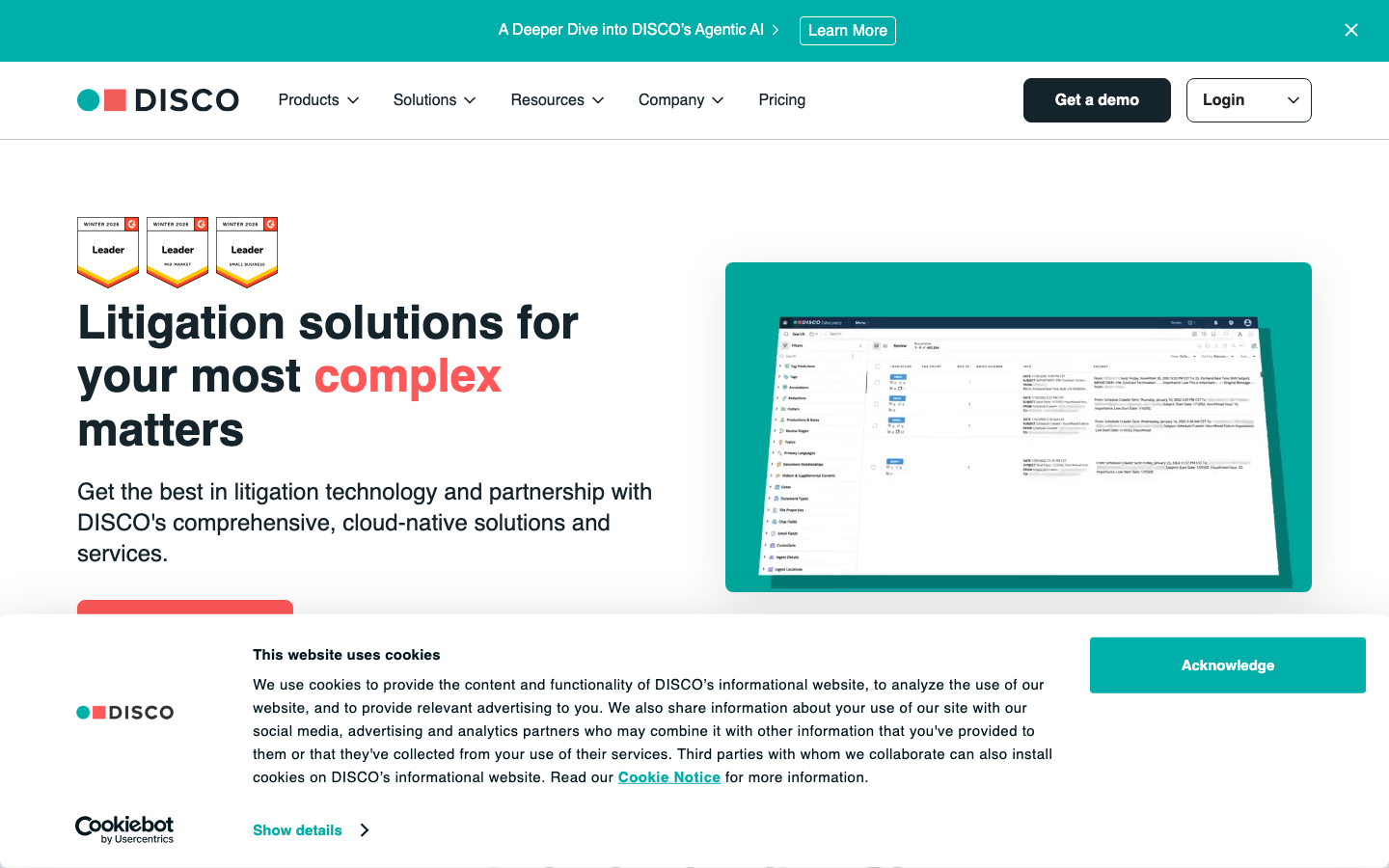
DISCO is a publicly traded legal technology company that provides an AI-powered eDiscovery platform that leverages active learning and natural language processing technology to accelerate litigation document review and evidence analysis.
DISCO
DISCO’s core parameters and statistics
DISCO (NYSE: LAW) is one of the few listed companies in the legal technology field with AI-native architecture as its core. Its product positioning is not a traditional electronic discovery (eDiscovery) tool, but an intelligent document analysis platform that embeds machine learning into the entire review process. The platform takes Continuous Active Learning (CAL) as the technical cornerstone and redefines the collaboration boundary of "machine review + human review".
| Parameter item | Value |
|---|---|
| Product positioning | AI native electronic forensics and intelligent document review platform |
| Parent Company | CS Disco, Inc. (NYSE: LAW) |
| Established | 2013 |
| Headquarters | Austin, Texas, USA |
| Product Form | SaaS Web Platform |
| Security Compliance Certification | SOC 2 Type II, FedRAMP Compliant (Medium Impact Level) |
| Number of data collection sources | 200+ (email Teams, Slack, SharePoint, OneDrive, Google Drive, etc.) |
| Latest release version | DISCO 2026 Release 2 (~2026-05) |
| Historical version node | DISCO 2026 Release 1 (~2026-02) |
| Target Clients | Am Law 200 law firms, Fortune 500 corporate legal departments, government agencies |
| Public financial indicators | ARR exceeds US$100 million (from financial reports of listed companies) |
| Ticker | NYSE: LAW |
According to public financial reports, DISCO's annual recurring revenue (ARR) has exceeded US$100 million, and its customer concentration is high - the top 25 customers contributed more than 40% of revenue, indicating the depth of product penetration in the high-end legal market. The platform is SOC 2 Type II certified and meets FedRAMP Medium Impact Level compliance requirements, making it legally qualified to undertake government investigations and government contracts. Different from the "keyword search + manual linear review" operating mode of traditional electronic evidence collection tools, DISCO starts machine learning sorting from the data ingestion stage, and flows back the lawyer's annotation feedback to the model in real time, forming a continuous optimization process of "review-learning-re-sorting". The direct effect of this architecture is that under the same case size, the proportion of documents requiring manual intensive reading is reduced from 100% to 20-30%, and the human investment curve changes from linear to logarithmic decay.
DISCO’s users and market recognition
Financial Transparency of Listed Companies: As a NYSE listed company, DISCO discloses core indicators such as ARR, customer retention rate, and net revenue retention (NRR) on a quarterly basis. According to its 2025 annual report, the customer net revenue retention rate remains above 110%, indicating that existing customers continue to expand the depth of usage and case size. This metric is healthy for the LegalTech industry and indirectly reflects the irreplaceability of the product and migration costs.
Industry Top Client Coverage: DISCO’s client list covers most law firms in the Am Law 200, as well as the legal departments of many Fortune 500 companies. In large-scale commercial litigation and government investigation scenarios, DISCO is often designated as the electronic evidence collection platform that Party B’s law firm must use, forming a certain degree of industry network effect.
Third Party Industry Recognition: DISCO is listed as a Representative Vendor in the Gartner eDiscovery Market Guide and has appeared in the IDC MarketScape Legal Technology Assessment reports for multiple years. DISCO’s CAL technology is cited as a reference example for AI-assisted examination in the electronic discovery practice guides of multiple jurisdictions (U.S. federal courts, state courts, SEC investigation proceedings).
Customer Validation Data: Multiple public cases show that case teams using DISCO saved 50-70% of review man-hours during the document review phase. For example, in a trade secret litigation involving 3 million documents, DISCO's CAL workflow was used to reduce the volume of documents requiring manual review from 3 million to approximately 600,000, and the review cycle was shortened from an estimated 8 months to 3 months. This data comes from official DISCO case studies, and actual results vary depending on case complexity, data quality, and team training.
DISCO’s cost advantage: three-tier cost structure and hidden ledger
The cost component of electronic forensics is not a simple software license fee, but a combination of "software cost + human review cost + time window opportunity cost". DISCO’s AI-native architecture has a direct impact on all three layers.
C client/individual user level: non-target market. DISCO does not offer a personal version or pay-per-use plan, and its minimum entry level is aimed at law firms and corporate legal departments. The platform’s subscription base price and data storage costs are unaffordable for solo attorneys or small teams.
Medium-sized law firm/corporate legal affairs (pay per project):
- Billing Base: Usually processing and hosting fees are charged based on data volume (GB), overlay function module subscriptions and user license fees based on seats. The total cost of an eDiscovery project for a typical medium-sized lawsuit (100-500 GB of data) ranges from $20,000 to $100,000.
- Cost structure breakdown: Data access and processing fees account for approximately 20-30%, platform hosting and access fees account for approximately 15-25%, AI review module (CAL + generative summary) accounts for approximately 30-40%, expert reporting and export fees account for approximately 10-15%. Among them, the AI review module is the core of value and the key to widening the cost gap with the traditional hourly human review model.
- HIDDEN COST: The cost of CAL training for examiners cannot be ignored. DISCO's AI effect is highly dependent on the quality of initial annotation - if the junior lawyer responsible for annotation lacks experience, the deviation in the annotation direction of the first 500 documents will cause the model learning to deviate, and more manual review will be needed to correct the deviation later, which will increase the total cost. It is recommended to arrange for a senior e-discovery consultant to conduct 1-2 days of CAL annotation strategy training at the start of the project.
Large Enterprise Tier (Annual Subscription):
- Billing model: Sign an annual contract, which includes a fixed data capacity (such as 10 TB/year) and the number of user seats. The excess will be added at a predetermined price. Large customers typically receive discounts of 15-30%, and contracts include SLA guarantees and a dedicated customer success team.
- Explicit Costs: Annual contracts typically start at $500,000 and can reach millions of dollars for large global law firms. This price excludes a large number of small and medium-sized cases.
- Hidden benefits: After adopting DISCO, legal teams can reduce their dependence on external electronic forensics suppliers - OCR, data deduplication, early case evaluation and other tasks that previously needed to be outsourced can be completed directly by internal teams on DISCO, shortening supplier communication links and project management costs. In addition, CAL-driven review efficiency improvements allow law firms to take on more cases within the same construction period, indirectly improving billable time utilization.
Cost comparison deduction with alternatives (unofficial data, estimated based on industry public cases):
| Cost dimension | Traditional manual review | DISCO (CAL + AI summary) | Other electronic evidence collection tools (keyword search + technical assistance) |
|---|---|---|---|
| Millions of manpower hours for document review | 8,000-12,000 hours | 2,000-4,000 hours | 4,000-8,000 hours |
| Project Lifetime (3 million documents) | 6-12 months | 2-4 months | 3-6 months |
| Software license cost proportion | Not applicable (pure labor) | 30-40% of total cost | 20-30% of total cost |
| Examiner training requirements | None (search by keyword) | CAL annotation strategy training required | Boolean query training required |
| Rework rate risk | High (keyword missing) | Medium (annotation deviation) | Medium-high (query missing) |
Procurement concerns: The cost advantage of DISCO is not achieved automatically. It requires the case team to have operational experience in AI-assisted review and the ability to design annotation strategies. If the team is using the CAL workflow for the first time, it is recommended to first conduct a small-scale regression test (10,000 documents) on historically closed cases, compare the overlap between DISCO's sorting results and manual review conclusions, and confirm that the effect meets expectations before committing to a formal case.
Main functions of DISCO
-
AI Document Review (CAL Core Engine): Continuous Active Learning is the technological cornerstone of DISCO. Its working mechanism is divided into three stages - ① Initial training: examiners mark "relevant/irrelevant" labels on 500-1,000 documents; ② Model iteration: the CAL algorithm calculates relevance scores for unreviewed documents based on annotation signals, dynamically rearranges the queue, and pushes high-possibility documents to the head of the queue; ③ Verification and closing: When the model determines that the relevance probability of the remaining documents is lower than the threshold, the closing condition is automatically triggered, and the review ends after the reviewer confirms. This mechanism changes the review focus from "scanning all documents" to "finding all relevant documents" and skipping irrelevant content directly. According to DISCO’s official white paper and multiple customer cases, CAL can reduce the amount of review by 50-70% in typical litigation cases.
-
Early Case Assessment (EDA): Before the formal review is started, DISCO quickly scans the entire data and outputs a case portrait report - including document size estimation, correspondent network map, key topic clustering, sensitive word hit statistics and time series distribution. The value of EDA is to help the case strategy team have a panoramic understanding of the "volume, complexity, and risk points" of the case before committing to a large-scale review, so as to reasonably plan the budget and review priorities. For example, in an antitrust investigation involving a multinational company, EDA can quickly locate 20 key correspondents and the density of their email exchanges, assisting lawyers in deciding which correspondents require full review and which ones require only sampling review.
-
Evidence correlation analysis (Communication Graph & Timeline): DISCO's communication graph module visually displays the implicit correlation between documents - who sent what to whom at what time, who appears in the CC link of which email, and the evolution of the same topic in different timelines. This is fundamentally different from the traditional "keyword search + folder classification" methodology: keywords cannot capture documents that are "related but do not hit keywords", while communication graphs can discover evidence clues from the character and temporal dimensions. For example, in an internal investigation, lawyers used a communication map to discover intensive communications between the subject of the investigation and a resigned employee who did not appear in the keyword list, thus opening a new branch of evidence.
-
Generative AI Summarization: The LLM capability introduced in the 2026 version supports three summary granularities - ① Document-level summary: Condensing the core facts of a single email or single contract into 2-3 sentences; ② Topic summary: Automatically generate a comprehensive discovery report for all relevant documents under a certain evidence topic (such as "Pricing Fraud"); ③ Review batch summary: Generate a progress summary for the documents reviewed on the day or week. The main value of generative summarization is to speed up "document understanding" - lawyers no longer need to read the entire long email chain to determine whether it is relevant, but read the summary first and then make an accurate judgment. However, it should be noted that the accuracy of generative summaries is highly dependent on the quality and domain adaptation of the underlying LLM. In scenarios where professional legal terms are intensive, factual errors (hallucination) in the summaries cannot be completely eliminated, and key references still need to be checked with the original text.
-
Data collection and multi-source integration: The platform has built-in 200+ data source connectors, covering common office collaboration systems (Microsoft 365, Google Workspace, Slack, Teams, Zoom, Box, Dropbox), social media archives and custom data sources. After data is accessed, deduplication, email thread grouping OCR (supporting text extraction from scanned PDFs and images), metadata standardization, and time zone normalization are automatically performed. The data fusion pipeline is the infrastructure layer of electronic forensics, and its quality directly affects the results of all subsequent AI analysis and review - if the deduplication algorithm fails to identify duplicate copies of the same email in the inbox and sent folder, subsequent AI sorting will be interfered with relevance judgments by duplicate data.
DISCO’s model and version evolution
DISCO's product iteration follows an annual dual-version release rhythm (Release 1 approximately in February and Release 2 approximately in May-6 months), interspersed with patch updates and security fixes. The following is the traceable public version:
| Version ID | Approximate release date | Core changes |
|---|---|---|
| DISCO 2025 Release 1 | ~2025-02 | Enhanced multi-language document support for the CAL model (non-Latin character sets such as Chinese, Japanese, Korean, Arabic, etc.); improved text extraction accuracy of the OCR pipeline for scanned PDFs |
| DISCO 2025 Release 2 | ~2025-06 | Introducing the basic version of the generative AI summary function (document level); launching an upgraded version of the evidence correlation analysis dashboard, supporting interactive communication timeline drag and drop |
| DISCO 2026 Release 1 | ~2026-02 | New multi-language intelligent summary support; advanced visual analysis dashboard upgrade, support for custom indicator panels; open API capabilities, allowing third-party systems to directly call CAL sorting results |
| DISCO 2026 Release 2 | ~2026-05 | Upgraded generative AI summary capabilities (new topic summaries and batch summaries); intelligent evidence correlation analysis introduces concept clustering, automatically aggregating semantically similar documents into evidence clusters; security and compliance modules are enhanced to support more fine-grained user permission audit logs |
The above release dates are all approximations (~YYYY-MM). There is no official precise date yet. Please refer to DISCO's official release instructions.
Technology evolution trend: Changes from 2025 to 2026 versions can be seen in three directions - ① The CAL engine moves from "single language" to "multi-language globalization" to adapt to the electronic evidence collection needs of transnational cases; ② Generative AI moves from "technical verification" to "functional productization", and the summary granularity continues to be refined; ③ The platform moves from "closed tools" to "open APIs", allowing enterprises to embed DISCO's capabilities into their own compliance workflows. These evolutionary directions directly correspond to the core pain points of the legal technology market: the complexity of processing multi-lingual data in global cases, the bottleneck of manual summarization of massive documents, and the legal department's need to integrate automated compliance processes.
DISCO’s technical advantages
Mechanism 1: Bayesian foundation of continuous active learning (CAL)
CAL is not simply "sorting documents with AI". Its underlying layer uses a statistical learning model based on Bayesian logic. The relevance prediction for each document is a probabilistic estimate—after the model outputs p(relevant|feature), the queue is sorted in descending order of probability, and each reviewer annotation (relevant/irrelevant) updates the model’s posterior distribution as new evidence. This means that the model is still "rough" when the first 100 documents are reviewed, but by the time 5,000 documents are reviewed, the model has a high level of confidence in ranking the relevance of the remaining documents. The core advantage of this progressive convergence mechanism is that the more documents are reviewed to the end, the lower the "gold content" of the queue, because high-probability documents have been cleared in advance, and the relevance probability of the remaining documents continues to decrease until the convergence threshold is reached. This explains why CAL is able to safely skip large numbers of irrelevant documents—not by guesswork, but by continued accumulation of statistical evidence.
Mechanism 2: Collaborative workflow of CAL and generative AI
DISCO concatenates the CAL ranking engine with LLM summarization capabilities into a composite workflow in the 2026 release. In the first step, CAL sorts the document queue in descending order of relevance probability; in the second step, it automatically performs LLM summary generation on the "high probability relevant documents" at the head of the queue; in the third step, the lawyer reads the summary and decides whether to review the original text in depth. This three-stage pipeline of "first sorting, then summarizing, and then reviewing" reduces at least two cognitive friction points compared to the traditional "first keyword search, then reading one by one" workflow: First, it eliminates the screening decision of "which document is worth reading" among massive documents; second, it eliminates the jump cost when quickly understanding the document content.
Mechanism Three: Engineering Optimization of Data Processing Pipelines
The importance of data ingestion in eDiscovery is often underestimated, but in real projects, data cleaning and format normalization often take up more than 30% of the project time. DISCO's data collection pipeline has built-in email thread reconstruction (automatically aggregating emails on the same topic into one conversation), metadata unification (aligning date formats, time zones, and user IDs from different data sources), and an advanced OCR engine (supporting textualization of scanned PDFs, table images, and handwritten comments). These seemingly "non-AI" engineering capabilities are actually a prerequisite for high-quality operation of AI review - if OCR incorrectly identifies "non-disclosure agreement" as "non-disciosure agreement", subsequent CAL models and LLM summaries will accumulate errors on this basis.
Key differences compared to traditional electronic discovery tools:
| Comparative dimensions | DISCO (CAL + AI) | Traditional electronic forensic tools (Relativity, etc.) |
|---|---|---|
| Review priority determination method | Algorithm dynamic sorting, continuous learning of annotation signals | Boolean keywords + manual batch allocation |
| Relevant document coverage | Statistical convergence model, quantifiable coverage | Rely on keyword completeness, high risk of omission |
| Reviewer skill requirements | Need to understand AI-assisted review workflow design | Need to be proficient in Boolean query syntax |
| Rework and omission inspection | CAL automatically marks low probability intervals, no manual omissions | Additional quality verification batches required |
| Multi-language support | 2025+ version supports non-Latin character sets | Requires separate data source configuration |
| Scalability (millions of documents) | Linear expansion to tens of millions of queues | Limited by batch size and manual sorting |
How to use DISCO
DISCO is an enterprise-level SaaS platform. The entrance is divided into a front-end review interface and a back-end management console, providing differentiated operation paths for different roles.
Platform side usage process (lawyer/examiner):
- Case Creation and Data Access: The case administrator creates a new case in the DISCO console, selects the data source type (email export, PST file, Office 365 API direct connection to Slack export package, etc.), and configures time zone and metadata mapping rules. After the data is accessed, the system automatically performs deduplication and OCR processing.
- Early Case Assessment (EDA): After the data processing is completed, the case strategy team first reviews the EDA report to understand the full picture of the data (total document volume, subject distribution, key correspondents, timeline). Determine the review strategy based on the EDA conclusions—whether full review or stratified sampling.
- CAL Review Start: The examiner opens the CAL review working group in the DISCO review interface. The system automatically allocates an initial batch of 500-1,000 "seed documents" for annotation - these documents are typically sampled through algorithmic strategies that take into account both high information content and high uncertainty to maximize initial training efficiency.
- Marking and Verification: The examiner reads the documents one by one and marks "relevant/irrelevant" (or more granular labels such as "privileged communications/trade secrets/personal information"). Each time a batch of labeling is completed, the CAL model automatically rearranges the remaining queues. Reviewers can view the "Convergence Curve" at any time - a visual indicator of the degree of convergence of model predictions to help determine when it is safe to terminate review.
- Evidence export and reporting: After the review is completed, documents marked as "relevant" can be exported in batches as evidence dossiers, or discovery reports can be generated through communication graphs and generative AI summaries for trial preparation or regulatory submission.
Configuration points on the administrator side:
- Permission role configuration: Supports four-level permissions of "case manager, examiner, reviewer, and read-only reviewer". Each role can precisely control the functional modules (such as whether to allow modification of label classifications, whether to export original data).
- Label system design: A label classification tree must be designed in advance before the case is started (such as "relevant/irrelevant" + "evidence type: contract/email/financial statement" + "confidentiality level" and other multi-dimensional labels). The quality of label design directly affects the learning direction of CAL and the final review classification granularity.
- Quality Verification (QC): DISCO has a built-in quality control module that supports random sampling review and "dispute ruling" process - when two reviewers have inconsistent annotation conclusions on the same document, it will automatically be escalated to the supervisor for the final ruling. The QC sampling rate is recommended to be 5-10%, rising to 15% in first-time CAL cases.
Technical integration portal:
- Web client: Access the DISCO instance through a browser, supporting all major browsers (Chrome, Edge, Firefox). It is recommended to use the desktop client to ensure the complete functional layout of the CAL review workspace.
- API access: REST API will be opened starting from DISCO 2026 Release 1, supporting third-party systems (such as the company's internal compliance management platform, case management system) to directly call the document retrieval, CAL sorting query and evidence export functions. API authentication uses OAuth 2.0, and specific endpoint documents must be subject to the official developer portal.
- Mobile terminal: There is currently no independent mobile app. The web terminal can be accessed through a mobile browser, but the CAL review workspace is not recommended to be operated on mobile devices due to screen size limitations.
DISCO’S PRODUCT PRICING
DISCO adopts a hybrid pricing model that does not disclose standard prices. Pricing is based on three core variables: data volume (GB/TB), functional modules (basic version vs. AI enhanced version), and number of user seats. The following is a structured analysis based on public information and industry practices:
| Pricing Tiers | Billing Dimensions | Typical Annual Contract Range | What's Included |
|---|---|---|---|
| Project type (on demand) | Processing data volume (GB/project) + number of user seats + functional modules | US$20,000 - 100,000/project | Data processing, hosting, basic review CAL sorting, evidence export |
| Enterprise Annual Subscription | Fixed data capacity (e.g. 10 TB/year) + seats + AI module | Starting from $500,000/year | Full project-based functionality + API access + Dedicated Customer Success + SLA |
| AI enhancement add-on package | Additional charges based on number of seats or data volume | 30-50% increase from base fee | Generative AI summarization, advanced communication graph, intelligent concept clustering |
Free Trial and POC: DISCO provides Proof of Concept (POC) services based on specific case data, typically covering CAL review verification of 10,000-50,000 documents, with a cycle time of 2-4 weeks. The purpose of the POC is to allow potential customers to verify the actual efficiency improvement ratio of CAL using their own historical case data. This is the most critical and most underestimated aspect before procurement - it is recommended that customers prepare at least three data sets of different case types for POC, because there may be significant differences in the performance of CAL in mail-intensive cases and document-intensive cases.
Hidden Fees and Terms of Interest:
- Data export fee: When the data is exported from the DISCO platform to local or other platforms after the case is completed, some contracts may charge an export fee based on the amount of data. The charging standards and format restrictions for data migration need to be clarified when purchasing.
- Storage Increment Fee: If the amount of case data increases significantly during the review process due to new data sources (such as the discovery of new relevant email accounts), and exceeds the upper limit of data capacity agreed in the contract, the excess portion will usually be billed at a higher unit price.
- User License Concurrency Limit: Some contracts have an upper limit on the number of online reviewers at the same time. If it exceeds the limit, additional concurrent seats must be purchased. Insufficient concurrent capacity can lead to delays in approvals during the centralized review phase of large-scale cases (where regulators require submission of evidence within 30 days).
- AI modules are billed separately: Generative AI summaries and advanced communication graphs may be additional modules beyond the basic platform pricing. You need to confirm whether they are included in the contract price when purchasing.
Application scenarios of DISCO
-
Improving document review efficiency in large-scale commercial litigation: Complex commercial litigation involving millions or even tens of millions of electronic documents (such as patent infringement, trade secret theft, shareholder class action lawsuits). Under the traditional review model, junior lawyers need to read documents one by one over several months, which is time-consuming and prone to omissions due to fatigue. DISCO's CAL model changes the review focus from "reading them all" to "finding all relevant ones" - in an antitrust case involving 5 million documents, CAL helped lawyers reduce the number of documents that needed to be read intensively to about 1 million, and the review cycle was shortened from the estimated 10 months to 4 months. Acceptance focus: Whether the downward slope of the CAL closing curve in the case is as expected; if the closing speed is significantly slower than the typical value, it is necessary to check the labeling consistency and the representativeness of the seed document.
-
Government Regulatory Investigations and Litigation Responses: Investigations by regulatory agencies such as the SEC, DOJ, FTC, etc. often have strict submission deadlines (e.g., 20 days for submission of first evidence). In the traditional electronic discovery process, the time window of 2-3 weeks is often only enough to complete data collection and basic processing, leaving almost no time for review. DISCO's EDA function can output a case portrait within 24-48 hours after data access, helping lawyers quickly determine the subset of data that needs priority review; CAL continues to improve efficiency in subsequent reviews. Acceptance Focus: Whether the EDA report's identification of key correspondents is consistent with the attorney's intuition about the case, and whether the factual accuracy of the generative AI summary meets an acceptable surrogate level for review.
-
Corporate Internal Investigation and Compliance Audit: Internal investigations conducted by corporate legal departments (such as employee misconduct, data leaks, anti-bribery compliance audits) usually require document location and evidence preservation to be completed without alerting the subject of the investigation. DISCO's permission isolation design allows investigation teams to perform reviews only of "relevant data" without granting full data permissions. The Communications Mapping module is particularly valuable in internal investigations—unlike external litigation, which has a clear trail of communications between plaintiffs and defendants, internal investigations often require identifying key person relationships from scratch. Acceptance focus: Whether the communication graph can automatically discover hidden communication links not covered by keyword searches; multi-language performance in non-English data such as Chinese and Japanese.
-
Contract review in M&A due diligence (extended scenario): In large M&A transactions, the buyer needs to review a large number of contracts of the target company (supplier contracts, customer agreements, employment agreements, etc.) to identify potential legal risks. While DISCO is not specifically designed for M&A due diligence, its combination of CAL + generative AI summarization can significantly accelerate contract classification and key clause extraction. Limitations: The time window of M&A scenarios is usually only 2-6 weeks, and the data volume is relatively "small" (thousands to tens of thousands of contracts). The efficiency improvement advantage of CAL is not as significant with small data volumes as in large-scale litigation, and the price/performance ratio may not be as good as that of dedicated M&A contract analysis tools.
Applicable groups of DISCO
-
eDiscovery teams at large law firms: These are DISCO’s core users. The law firm's partners, case lawyers and "eDiscovery Specialists" who specialize in eDiscovery are familiar with the CAL workflow and can maximize the efficiency potential of DISCO. Prerequisite: The team needs to have the internal ability to organize CAL training (annotation strategy design), or be willing to purchase DISCO’s consulting services for initial setup.
-
Corporate Legal’s Compliance and Litigation Team: Internal legal teams use DISCO to manage the enterprise’s litigation portfolio and compliance audits. Compared with law firm users, corporate legal affairs pay more attention to the budget controllability of "signing a fixed capacity at the beginning of the year to cover all cases throughout the year" and the security requirement of "data not being transmitted externally". Prerequisite: The annual document review volume of the legal department usually needs to be more than 10 TB to support the annual subscription cost, and a dedicated person is required to handle the technical implementation of DISCO.
-
Government Agencies’ Investigations and Compliance Units: Meeting FedRAMP compliance requirements allows DISCOs to enter government contract procurement lists. Government users usually have stricter data sovereignty and audit log requirements, and DISCO's SOC 2 Type II + FedRAMP dual certification is a key competitiveness in this scenario. Prerequisite: Need to pass the security assessment of the government IT procurement process, which may take up to 6-12 months.
-
Inapplicable groups (dissuade list):
- Solo Practitioners and Small Law Firms (under 5 people): Annual subscription fees and project costs for processing 10-50 GB of data far exceed a single person case budget. It is recommended that such users use pay-as-you-go eDiscovery outsourcing services instead of directly subscribing to DISCO.
- Teams handling single, small-scale cases (< 50 GB): The efficiency improvement advantage of CAL is difficult to fully unleash when the amount of data is insufficient - the model requires sufficient annotated data to complete effective training, and the convergence curve under small amounts of data may not be ideal. For cases under 50 GB, traditional keyword search + manual review or outsourced services are more cost-effective options.
- Chinese legal team that needs Chinese interface and legal terminology localization: DISCO’s product interface and documentation only support English. Although the 2025 version already supports OCR and CAL sorting of Chinese documents, the Chinese adaptation of generative AI summaries and legal terminology is not as mature as English. Chinese law firms and corporate in-house counsel should conduct POC testing with Chinese datasets before considering procurement.
Summary and Outlook of DISCO
Core Competencies: DISCO's moat is not a single AI function, but the trinity of "CAL algorithm + listed company-level product maturity + industry certification barriers". CAL is the first technology route in the legal technology field to transform active learning from an academic concept into a commercial review product and has been verified on a large scale; NYSE listing status brings financial reporting transparency and customer trust (customers can review the financial health of suppliers); SOC 2 + FedRAMP dual certification enables compliance access in government and highly regulated industry scenarios.
Current Limitations and Uncertainties:
- Price threshold excludes a large number of potential clients: Prices starting at $500,000 for an annual subscription lock it into the top 20% of the "high-end legal market", with the remaining 80% of the small and medium-sized case market being occupied by traditional tools and outsourcing services.
- AI effect is highly dependent on annotation quality: This is a structural constraint of the CAL model - if the review team's annotation consistency is poor (different reviewers give opposite conclusions for the same document), the "learning signal" of the CAL model is noise, and the sorting quality cannot be guaranteed. This is not a problem unique to DISCO, but purchasers need to face it: introducing DISCO is not just about "buying a tool", but "adopting a set of workflows that require new skills", and the costs of personnel training and process design may be underestimated.
- The legal reliability of generative AI has not yet been verified: The risk of LLM illusion is higher in legal scenarios than in other industries-an AI brief that omits a key negative sentence or misreads a conditional clause may cause lawyers to make strategic judgments based on incorrect information. DISCO's positioning of generative AI in its product documentation is to "assist understanding rather than replace original text review." Purchasers should formulate internal specifications for the use of AI summaries (for example, which types of documents are not allowed to read only summaries, and key references must be checked with the original text).
- Insufficient depth of adaptation to the Chinese market: For the Chinese legal market and Chinese electronic evidence collection needs, DISCO currently only provides basic document-level support (OCR, CAL sorting), but the semantic understanding of Chinese legal terms, communication graph analysis of the Chinese context, and compliance requirements (such as data export restrictions under the "Data Security Law") are still significant shortcomings. Foreign law firms with business in China can be one of the alternatives, but it is difficult to serve as the main platform.
Procurement and Adoption Risk Assessment (for teams planning to launch a POC):
- Do data compatibility verification first: In the POC stage, use our most representative case data sets (covering at least two types of emails and office documents) to test whether DISCO’s data access pipeline is complete—especially the OCR accuracy and metadata mapping integrity under non-English data sets.
- Quantitative Baseline Comparison: Select a historical closed case, copy the case's data set and re-run CAL review on DISCO, compare the size and nature of the difference set between the "relevant document set sorted by DISCO" and the "relevant document set that has been marked by manual review" - whether the documents in the difference set are truly irrelevant (meaning CAL successfully filtered) or contain missed relevant content (meaning sorting bias).
- Evaluate team learning costs: Arrange for 2-3 reviewers to participate in DISCO's CAL annotation strategy training, and record the time required from initial contact to independently completing a complete CAL review workflow - if you are still unable to operate proficiently for more than 2 weeks, it means that the team's AI tool adaptation foundation is weak and additional coaching resources are required.
- Contract terms verification: Before signing the procurement contract, focus on confirming the data export fee standard, whether the unit price AI module with excess annual data capacity is included in the basic contract or authorized separately, and the window period and cost of data migration after the contract is terminated. It is recommended that the above provisions be included in the scope of legal review.
DISCO represents a typical evolution path in the legal technology field from "automated tools" to "intelligent collaboration platforms". Its value proposition is not to replace lawyers, but to help lawyers focus on the most valuable evidence within a limited timeframe. For law firms and corporate legal teams that process more than 10 TB of electronic data every year and are willing to invest in training costs for AI-assisted workflows, DISCO is worthy of being included in the POC candidate list, but it must be verified with its own real case data rather than relying on benchmark case data provided by suppliers to make purchasing decisions.
Version Info
- DISCO 2026 Release 2 :No official precise date yet; enhanced generative AI summarization and intelligent evidence correlation analysis capabilities.
- DISCO 2026 Release 1 :There is no official precise date yet; multi-language document support and advanced visual analysis dashboard have been added.
User Reviews