 DoNotPay
Free
DoNotPay
Free
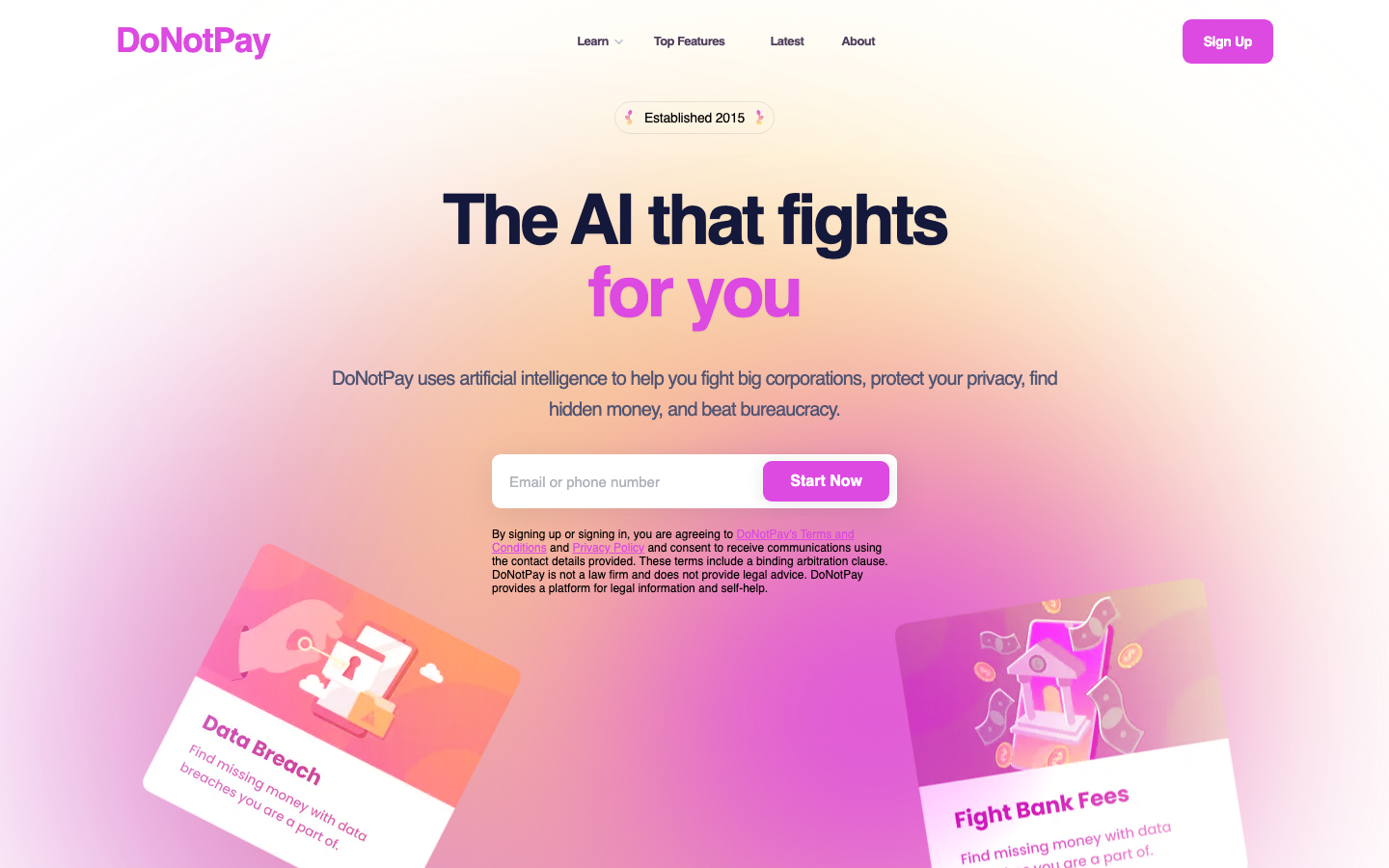
DoNotPay is the world's first AI legal robot that helps consumers automatically handle billing disputes, cancellation of subscriptions, complaint rights protection, and legal document generation through conversational interactions.
DoNotPay
Core parameters and statistics
DoNotPay is an AI legal robot for individual consumers, officially positioned as "the world's first robot lawyer" - transforming daily legal affairs from expensive lawyer services into a conversational self-service experience. It does not represent complex litigation, nor does it replace real lawyers in court. Instead, it focuses on standardized document generation, administrative appeals and consumer negotiation scenarios.
| Projects | Public Information |
|---|---|
| Official positioning | The world's first robot lawyer (the world's first AI legal robot) |
| Core coverage | Parking ticket appeals, subscription cancellations, flight compensation, bill disputes, legal document generation |
| Supported platforms | Web, iOS, Android |
| Main coverage areas | United States, United Kingdom, Canada (mainly the United States regulatory system) |
| Founder | Joshua Browder |
| Year founded | 2015 (originally a parking ticket appeals chatbot) |
| Latest version | 5.0.0 (~2026-02) |
| Pricing model | Subscription system (monthly fee is about $36/month, annual fee is about $216/year) |
| Is there a free version | There is no permanent free version, there is a trial quota for first registration |
Service Boundary: DoNotPay covers hundreds of types of consumer legal matters, but all services are based on document generation, administrative appeals and negotiation letter sending as the core delivery form. It does not provide court representation, evidence retrieval or legal opinions and other services that require practicing lawyer qualifications to complete. Users still retain the legal right to act independently, and documents generated by AI must be submitted after confirmation by the user.
User and market recognition
DoNotPay’s market recognition is mainly reflected in three dimensions: user scale, media reports and financing background. The official has not continued to disclose specific monthly active users and revenue data.
Financing and Team Background: DoNotPay has received support from well-known investment institutions such as Y Combinator and Andreessen Horowitz. According to public financing reports, the company's valuation has reached the $200-300 million level. The founder, Joshua Browder, is a serial entrepreneur who started the project while studying at Stanford University. In the early days, he relied on word-of-mouth spread in communities such as Reddit to achieve cold start growth.
User scale and reputation: DoNotPay claims to have handled more than 3 million legal matters and helped users save tens of millions of dollars in fines and fees. Its rating on the App Store and Google Play remains above 4.5, with user reviews focusing on high satisfaction with the "Parking Ticket Appeal" and "Subscription Cancellation" features. However, due to the particularity of legal services, negative reviews are mainly concentrated on the failure of appeals in some complex cases due to inaccurate matching of regulations.
Media coverage and industry impact: DoNotPay has been widely reported by mainstream technology media such as The New York Times, BBC, TechCrunch, and Wired. The "AI Lawyer Appears in Court" experimental event in 2023 triggered extensive global discussions on the boundaries of AI legal services. Although it was eventually stopped by regulatory agencies, it also brought DoNotPay's brand voice to its peak. This incident objectively prompted many state bar associations in the United States to begin to face up to the role and regulatory framework of AI in legal services.
Market comparison with competing products: In the legal AI track, DoNotPay has the highest awareness in the C-side consumer rights protection scenario, but it faces competition from professional SaaS such as Lawgeex and Ironclad in the B-side legal document automation field. In the direction of AI legal chatbots, similar products such as Ask AI Lawyer and Legal Robot have emerged in recent years, but DoNotPay still maintains first-mover advantages in terms of breadth of functional coverage and brand recognition.
Cost advantage
The cost advantage of DoNotPay is not reflected in the absolute low price, but in "replacing hourly lawyer fees with subscription fees" - lowering the cost of a single legal service from hundreds of dollars to more than ten dollars, and eliminating the long chain of "appointment-consultation-entrustment".
C client/individual user: The monthly fee is about $36/month, and the annual fee is about $216/year (equivalent to $18/month). Taking a typical parking ticket appeal as an example, traditional lawyers charge $150-$500/time, but DoNotPay users can recoup the annual fee cost even with just one use. Frequent users (such as handling 1-2 disputes per month) are extremely cost-effective. But please note: the subscription system means that users need to pay a fixed fee every month. If the frequency of use is too infrequent (less than once every 2-3 months), the single cost will be higher than the pay-per-view services of traditional lawyers.
Developer/API access: DoNotPay is currently mainly for end consumers and has not publicly provided a public API for developers or a developer plan for batch access. If enterprises and law firms need to integrate DoNotPay's legal document generation capabilities in batches, they need to negotiate customized solutions through business channels, and the price is not disclosed.
Enterprise/batch use: Property companies, law firms, insurance companies and other institutions that need to process legal documents in batches can obtain customized services through the enterprise plan. Pricing on the enterprise side has not been made public, but its cost model can be deduced: in batch usage scenarios, the cost of processing a single case will be significantly lower than that of individual subscriptions, but there are higher requirements for the degree of customization of document templates, processing timeliness, result tracking, etc. Enterprises need to confirm the fee settlement method (by case/by seat/by number of templates) and the service level agreement (SLA) details before purchasing.
| Cost Dimension | Traditional Lawyer Services | DoNotPay Personal Edition | DoNotPay Enterprise Edition (Deduction) |
|---|---|---|---|
| Single parking ticket appeal | $150-$500 | $18-$36 (split equally) | Undisclosed |
| Compensation application for a single flight | $200-$600 (based on winning the case) | $18-$36 (shared equally) | Undisclosed |
| Response time | 1-7 days | Instant generation | Unpublished |
| Manual intervention | Full lawyer participation | User self-service + AI generation | Undisclosed |
| Applicable case complexity | High (including litigation) | Low to medium (document + appeal) | Undisclosed |
Main functions of DoNotPay
DoNotPay's functional matrix is designed around the closed link of "enter facts → AI matches regulations → automatically generate documents → submit or mail", covering the most common high-frequency legal needs of individual consumers.
-
Automatic Appeal of Parking Tickets: This is the starting point function of DoNotPay, and it is also the scenario with the highest concentration of user reputation. Users upload a photo of the ticket or enter the ticket number, and AI automatically analyzes the legality of the ticket (common defense points such as unclear markings, measurement errors, time violations, etc.), generates an appeal letter in a format that complies with local traffic regulations, and sends the paper letter to the designated agency through the AI mailing service. Officials have publicly stated that the winning rate is about 60-70%, but it should be noted that this data is based on voluntary return interviews by users, and varies greatly from state to state. Synergy effect: After the ticket appeal is successful, AI will automatically ask the user whether to handle other related tickets or check violation records, forming a conversion relationship of "single demand → continuous service".
-
Automatic cancellation of subscription services: For those "stubborn subscriptions" that cannot be canceled with one click on the web (such as gym memberships, magazine renewals, software automatic renewals), DoNotPay will generate a cancellation request letter that complies with the terms of the contract and send it to the merchant via email, customer service form, or paper mail. AI will automatically track the cancellation progress, and if the merchant refuses, it will be upgraded to a complaint letter or dispute letter. Synergy effect: After canceling the subscription, AI will suggest the user to apply for a refund of the unused part of the fee, converting "cancellation" into a "refund request" to increase the value output of a single interaction.
-
Automatic application for flight compensation: According to air passenger rights and interests regulations such as EU 261 (Europe), US DOT 14 CFR Part 259 (United States), Canada APPR (Canada), automatically calculate the amount of compensation the user deserves (usually €250-600 or the equivalent in US dollars), and generate a compensation application letter with a compliant format. Users only need to enter the flight number and reason for delay, and AI completes regulation matching, amount calculation and application letter writing. Hidden function: The system will save the user's historical flight records. When the same airline is delayed again, the previous passenger information and compensation template can be reused, increasing the efficiency of secondary applications by more than 80%.
-
Bill Disputes and Negotiations: Supports various dispute scenarios such as medical bills, credit card overcharges, property fees, rent deposit returns, etc. AI not only generates dispute letters, but also has the ability to "negotiate iteration" - automatically adjust strategies and generate rebuttal letters based on the merchant's first response. Synergy: When the user wins the dispute and gets a refund, the AI will automatically check whether there are other similar bill disputes that can be handled together, or suggest the user to set automatic review rules for future bills.
-
Self-service generation of legal documents: Provides hundreds of standardized legal document templates, covering lease contracts, non-disclosure agreements (NDA), divorce agreements, wills, business contracts, etc. Users complete information collection through a question-and-answer questionnaire, and AI automatically fills in and generates documents that comply with the legal format requirements of the state. Concerns for acceptance: Although the generated documents are in legal format, users are still advised to seek professional lawyer review for complex asset division, tax planning, child custody and other scenarios to avoid subsequent disputes caused by improper terms.
-
Consumer Rights Record and Tracking: All user complaints, disputes, and compensation applications are automatically archived as a personal rights protection timeline, making it convenient for users to check progress, download documents, and forward to third parties at any time. This feature has obvious management value when it comes to cross-organizational rights protection (such as flight compensation + hotel refund + travel insurance being handled simultaneously).
DoNotPay’s model and version evolution
DoNotPay's version iteration does not follow the semantic version number rhythm of traditional software, but takes "functional coverage expansion + regulatory library update + interactive experience optimization" as the main line of evolution. The following is the minimum version context organized according to public page milestones:
| Version | Time | Core Changes |
|---|---|---|
| v1.0 | ~2015 | Initial version, only supports parking ticket appeal chatbot in London |
| v2.0 | ~2017 | Expanded to the US market, adding new functions such as ticket refunds and bill disputes |
| v3.0 | ~2019 | Web version launched, upgraded from Facebook Messenger bot to independent web application |
| v4.0 | ~2025-04 | Introducing AI lawyer dialogue function, adding legal document template library, covering more countries |
| v5.0 | ~2026-02 | Support legal process automation in more countries and regions, and reconstruct interactive experience |
Version Note: The above version time points are based on public reports and product milestone deductions. DoNotPay officially does not release the update log in the form of a structured version number. The specific release date of each version is subject to the latest official announcement.
Functional evolution: The iteration of DoNotPay follows the path of “single scenario → scenario expansion → platformization”. In the early days (v1-v2), it only dealt with the high-frequency pain point of parking tickets, and completed the cold start through Reddit and community word-of-mouth; in the mid-term (v3-v4), it copied its capabilities horizontally to adjacent scenarios such as flight compensation, bill disputes, subscription cancellations, etc., forming the positioning of an "individual consumer rights protection toolbox"; recently (v5), it began to expand into the direction of legal document generation and cross-border regulatory adaptation, trying to upgrade from a "grievance tool" to an "AI legal assistant."
Regulatory Impact on Versions: The “AI Lawyer in Court” event in 2023 was a key turning point in the development of DoNotPay. Officials had planned to use AI to guide defendants in court in real time through AirPods, but were later warned by multiple state bar associations that it might constitute "unauthorized practice of law." This incident caused the product direction to be adjusted from "AI replacing lawyers" to "AI assisting legal documents", and the version route also converged to low regulatory risk areas such as document generation and administrative appeals.
Technical advantages of DoNotPay
The technical advantage of DoNotPay does not lie in the advancement of the underlying model, but in the engineering integration of "structuring of regulatory knowledge + process standardization of document generation + automation of multi-agency delivery".
Domain specialization of regulatory knowledge graph: DoNotPay’s core technical barrier is not a general large model, but its self-built consumer regulatory knowledge base. The team structured and sorted out the traffic regulations, consumer protection laws, and air passenger rights and interests regulations in the 50 states of the United States, the United Kingdom, Canada and other regions, and established a mapping relationship of "scenario → legal basis → defense points → document template". General LLM is prone to "legal illusion" (quoting non-existent legal clauses) in legal scenarios. DoNotPay uses the Retrieval Enhanced Generation (RAG) architecture to search and match the user's case facts in its self-built legal database, and then allows the language model to generate documents based on the specific retrieved clauses, which greatly reduces the citation error rate.
Engineering Depth of Process Automation: DoNotPay is not only a document generation tool, but also a “document life cycle management platform”. From the user inputting facts → AI matching regulations → Generating documents → User confirms signature → Mail/fax/paper delivery to the target agency → Tracking processing progress → Automatically adjust the strategy based on the response, the entire set of links is automated end-to-end. Among them, paper mailing requires connecting with third-party printing and mailing service providers. DoNotPay realizes "click and mail" through API integration, eliminating the manual steps of users printing, loading envelopes, and affixing stamps.
Iterative engine for negotiation strategies: In bill disputes and consumer negotiation scenarios, DoNotPay’s AI has simple “multi-round game” capabilities. When a merchant rejects a user's dispute request for the first time, AI will not send the same content repeatedly. Instead, it will analyze the reasons for the rejection, adjust the argument structure (such as supplementing evidence references, changing legal terms, upgrading complaint wording), and generate a more convincing second-round negotiation letter. This kind of strategic iteration capability, which in traditional legal processes usually requires lawyers to make empirical judgments, is transformed by DoNotPay into a quantifiable rules engine.
Technical limitations and boundaries: DoNotPay does not develop its own language model, and its underlying AI capabilities rely on a third-party LLM (the specific model provider is not disclosed). This means that when underlying models are updated or strategies change, instrument quality may be indirectly affected. In addition, the maintenance of the regulatory knowledge base is labor-intensive work - each state's legal update and each new case need to be manually sorted and stored in the database, which constitutes a hidden cost of DoNotPay's scale.
How to use DoNotPay
The usage path of DoNotPay is designed around the three-step process of "Describe the problem → AI processing → Confirm submission", and users can complete the operation without any legal background.
| How to use | Suitable scenarios | Features | Cost |
|---|---|---|---|
| Mobile App | Daily rights protection, processing at any time | Search "DoNotPay" in the iOS/Android app store to download, support taking photos and uploading fines | Subscription required |
| Web page | Complex documents, large screen operation | Visit donotpay.com, use it directly after registration, suitable for multi-document processing | Subscription required |
Standard usage process:
-
Registration and Subscription: Visit the DoNotPay official website or download the App, create an account and select a subscription plan (monthly payment $36 or annual payment $216). Users who register for the first time can get a certain experience quota, which can be used to try the core functions for free before deciding whether to pay.
-
Select issue type: Select the type of legal issue that needs to be handled on the homepage - parking tickets, flight compensation, cancellation of subscriptions, bill disputes, legal documents, etc. The system will automatically identify the applicable regulatory system based on the user's geographical location.
-
Provide case information: Answer a few key questions according to the guidance and upload evidence (photos of tickets, flight information, contract screenshots, etc.). AI automatically extracts key information and matches relevant regulations.
-
AI generation and user confirmation: AI generates complete legal documents or appeal letters. Users can preview all content, modify areas they are not satisfied with, and authorize DoNotPay to submit on behalf of the user after confirmation.
-
Submission and Tracking: Depending on the requirements of the target institution, documents will be delivered by mail, fax or paper mail. Users can track the processing progress in real time on their personal Dashboard, and the system will automatically notify them when they receive a reply from the merchant.
Implementation Tips: When using it for the first time, it is recommended to handle a low-risk case (such as a parking ticket appeal) to familiarize yourself with the process, and at the same time verify the actual effect of the AI-generated documents in local agencies. For disputes involving larger amounts (such as medical bill disputes exceeding $1,000), it is recommended to use the AI-generated document as a reference draft, and then ask a professional lawyer to review it before submitting it to reduce the risk of losing the case due to format or clause issues.
Product Pricing for DoNotPay
DoNotPay uses subscription pricing, with a simple structure but unclear layering. Currently, it only provides individual subscription plans, and enterprise and batch use require business channels.
Personal Subscription (C-side):
- Monthly payment plan: $36/month, can be canceled at any time, unlimited use of all functions.
- Annual payment plan: $216/year (equivalent to $18/month), equivalent to 50% off the monthly payment price, suitable for long-term users.
- Free trial: There is no permanent free version, but there is a certain experience quota after first registration (usually 1-2 simple cases can be processed), which is used for users to verify the service effect before deciding to pay.
Difference between expected and actual costs: Although the nominal monthly fee is $36, some advanced features (such as paper mailing services, expedited processing, certain complex documents) may require additional payment or a pay-per-use fee. You should carefully read the "Included vs Premium" category on the function description page before subscribing to avoid unexpected deductions during use.
Enterprise/Batch Plan: For property companies, law firms, insurance companies and other institutions. Functions may include batch case processing panels, customized document templates, team collaboration permissions, branded email sending, detailed reports, etc. Pricing is not public, you need to obtain a quote through the official website business portal or contact the sales team. The key points to check before enterprise purchase: fee settlement method (by number of cases/by seats/by number of templates), data isolation and privacy protection terms (whether user case data will be used for model training), SLA response timeliness, and data migration plan when the contract is withdrawn.
| Plan | Fee | Applicable objects | Core benefits | Restrictions |
|---|---|---|---|---|
| Personal monthly payment | $36/month | Low-frequency personal use | Unlimited use of all functions | No expedited access to advanced functions |
| Personal annual payment | $216/year ($18/month) | High-frequency personal use | Unlimited use of all functions + priority support | Annual payment binding cycle |
| Enterprise plan | Undisclosed | Institutional batch use | Batch processing, customized templates, team collaboration | Business confirmation required |
Cost comparison with alternatives:
| Scenario | Traditional lawyer's fee (single) | DoNotPay monthly fee (single amortization) | Self-processing (time cost) |
|---|---|---|---|
| Parking Ticket Appeal | $150-$500 | $18-$36 | 2-5 hours to research regulations + write up |
| Flight delay claim (EU261) | Lawyer’s commission 20-30% | $18-$36 | 1-3 hours to fill out the online form |
| Cancel stubborn subscription | $50-$200 (entrust customer service) | $18-$36 | 30 minutes-2 hours on the phone |
| Medical Bill Disputes | $200-$800 | $18-$36 | 3-8 hours of research + negotiation |
DoNotPay application scenarios
Typical application scenarios of DoNotPay are concentrated in the field of consumer legal affairs with "high repetition, low case complexity, and strong process standardization". The following three types of scenarios have been verified on a large scale:
-
High-frequency and low-amount rights protection: parking tickets, speeding tickets, toll disputes. The single amount of such cases is not high (usually $25-$200), but traditional lawyers charge far more than the ticket itself, leading most people to choose to pay the fee directly. DoNotPay's "one subscription, unlimited times" pricing model fits right into this gap - after users pay a monthly fee, no additional fees will be incurred for however many fines they appeal. Implementation Tips: The time limit for ticket processing varies greatly from state to state (15-45 days). It is recommended that users use the ticket as soon as possible after receiving the ticket to avoid being disqualified due to exceeding the appeal window.
-
Travel consumption disputes: flight delay/cancellation compensation, luggage loss claims, hotel booking disputes, car rental disputes. Taking EU 261 flight compensation as an example, you can get €250-600 for a single application, and one successful application can cover several years of subscription costs. The core value of DoNotPay in this scenario is to translate complex regulatory provisions into a simple "enter flight number → get compensation" process, and support batch applications across airlines. Implementation Tips: The compensation processing cycle of different airlines ranges from 2 weeks to 3 months. The tracking function of AI is particularly important in this scenario - to prevent users from forgetting to follow up on submitted applications.
-
Consumer Negotiation and Dispute Mediation: Medical bill disputes (medical bills are the largest source of consumer debt in the United States), non-refundable gym fees, property deposit disputes, and overcharged utility bills. The characteristic of this type of scenario is that "the decision-making power lies with the merchant rather than the court." AI's negotiation iteration capability is more valuable than a single document generation. Verification Points: DoNotPay's negotiation letter is essentially a "reasonable request letter" rather than a document with mandatory legal effect. If the merchant refuses and the amount involved is large (such as thousands of dollars in overcharges for medical bills), it will ultimately still need to be resolved through formal dispute procedures or legal channels.
Unsuitable Scenarios: DoNotPay is unable to provide effective services for divorce agreements involving property division, criminal defense, immigration applications, intellectual property litigation and other scenarios that require in-depth legal expertise and court representation. When users encounter such problems, they should consult a licensed attorney directly instead of relying on AI tools.
Applicable groups of DoNotPay
DoNotPay’s target user profile is clear – it is a tool designed for individual consumers who “are willing to defend their rights but lack legal knowledge and the amount of the case is not worth hiring a lawyer.”
-
Urban middle class and white-collar workers: This group of people are the core users of DoNotPay. They face high-frequency, low-value consumer disputes such as parking tickets, flight delays, and automatic subscription renewals on a daily basis. Financially, they care about these unnecessary expenditures, but the time cost is high and they are unwilling to spend hours studying regulations or arguing with customer service. DoNotPay compresses the time for a single rights protection from hours to 5-10 minutes, which just matches the willingness to pay and usage habits of this group of people. Unfit Boundary: Users who are extremely sensitive to privacy should note that all case information and evidence materials are uploaded to the DoNotPay server. Although there is an official privacy policy, uploading sensitive medical information or identity documents still requires self-assessment of risks.
-
Frequent travelers and cross-border consumers: Frequent travelers who fly more than 10 times a year, cross-border e-commerce buyers, and digital life enthusiasts who often use subscription services. The average annual rights protection incidents for this group of people may be more than 5-10, and the accumulated flight delay compensation in one year can reach €1,000-3,000. The ROI of annual subscription is extremely high. Prerequisite: Users need to be familiar with basic online operations (photo uploading, form filling), and are not attracted to English interfaces - DoNotPay currently only supports English.
-
Small Businesses and Freelancers: Handling customer contracts, lease disputes, service provider disputes, preliminary protection of intellectual property rights, etc. Although DoNotPay does not provide commercial legal consultation, its legal document generation function (NDA, service contract, dunning letter, etc.) can provide small and micro enterprises with a low-cost legal compliance start-up solution. Not suitable for boundaries: Complex commercial contracts (such as equity agreements, merger and acquisition documents, cross-border compliance) involve legal consequences that are far beyond the scope of AI to handle. Such scenarios must be entrusted to professional lawyers.
-
Not applicable: People who need in-depth legal advice (such as criminal defense, divorce proceedings, bankruptcy filings); non-English speakers who are unfamiliar with the English interface; users who are unwilling to evaluate and confirm the accuracy of AI-generated documents on their own. DoNotPay is a self-service tool, not a substitute for lawyers - users must understand and confirm the content of each document generated by AI themselves, and the tool does not bear the legal consequences caused by errors in the content of the document.
Summary and Outlook
DoNotPay has established clear brand recognition and first-mover advantages in the vertical scenario of "automation of consumer legal affairs". It transforms the high-frequency and low-amount legal matters most commonly encountered by individuals from "expensive professional services" into "cheap digital tools". Through a structured regulatory knowledge base, automated document generation links and multi-agency delivery capabilities, ordinary people can complete effective rights protection actions without hiring a lawyer.
Current Core Advantages: In-depth coverage of a single scenario - the three core functions of parking tickets, flight compensation, and subscription cancellation have formed a word-of-mouth effect; the subscription-based cost model is extremely friendly to high-frequency users; the brand has significant recognition in the field of C-side consumer legal AI; the founding team's background in the intersection of law and technology gives the product a certain sensitivity in regulatory compliance.
Current major limitations: The service scope is mainly in the United States and the United Kingdom, and the regulatory coverage in other countries/regions is limited and the update speed is uncertain; users must confirm the accuracy of AI-generated documents by themselves, which poses a threshold for non-native users or users with low legal literacy; after the "AI lawyer" incident in 2023, the scope of product functions is subject to substantial regulatory constraints, and future expansion directions are limited; the underlying large model relies on third-party providers, and there are service quality risks caused by changes in model strategies; no free version is provided, and the user's early adopter threshold is high.
Follow-up observation points: Whether DoNotPay can expand regulatory coverage to Canada, Australia, the European Union and other regions is the key to breaking through the user ceiling; whether it launches B-side solutions for small law firms or legal clinics will determine whether it can enter the professional service market from the consumer market; the maintenance team size and technical means of the AI regulatory knowledge base will affect its long-term competitiveness - this is a continuous human-intensive investment, not a one-time technical advantage.
Purchase and Adoption Risk Assessment: For individual high-frequency users (averaging more than 1 rights protection per month), the annual payment of $216 is extremely cost-effective. It is recommended to use the experience quota to test 1-2 actual cases to confirm the effect before subscribing. For low-frequency users (less than 3 rights claims a year), the monthly payment plan is more flexible. You can subscribe for one month when needed and cancel after the case is processed. For institutions considering enterprise bulk procurement, they need to confirm before purchasing: the storage and privacy protection policy of case data on the DoNotPay platform (whether the data will be used for model training); the data export and migration plan when the contract is withdrawn; the division of maintenance responsibilities for customized document templates; and whether the SLA clauses of the enterprise plan include a compensation mechanism for document failure due to outdated regulatory databases. In scenarios with extremely high legal risks (such as large medical bill disputes and commercial contract disputes), it is recommended that the documents generated by DoNotPay be used as a first draft and be reviewed by a qualified lawyer before submission to strike a balance between cost savings and legal protection.
Version Info
- Stable :Support the automation of legal processes in more countries and regions. There is no official precise date yet.
- Major :The AI lawyer dialogue function and a wider range of legal document templates will be introduced, but there is no official precise date yet.
User Reviews