 Docker
Free
Docker
Free
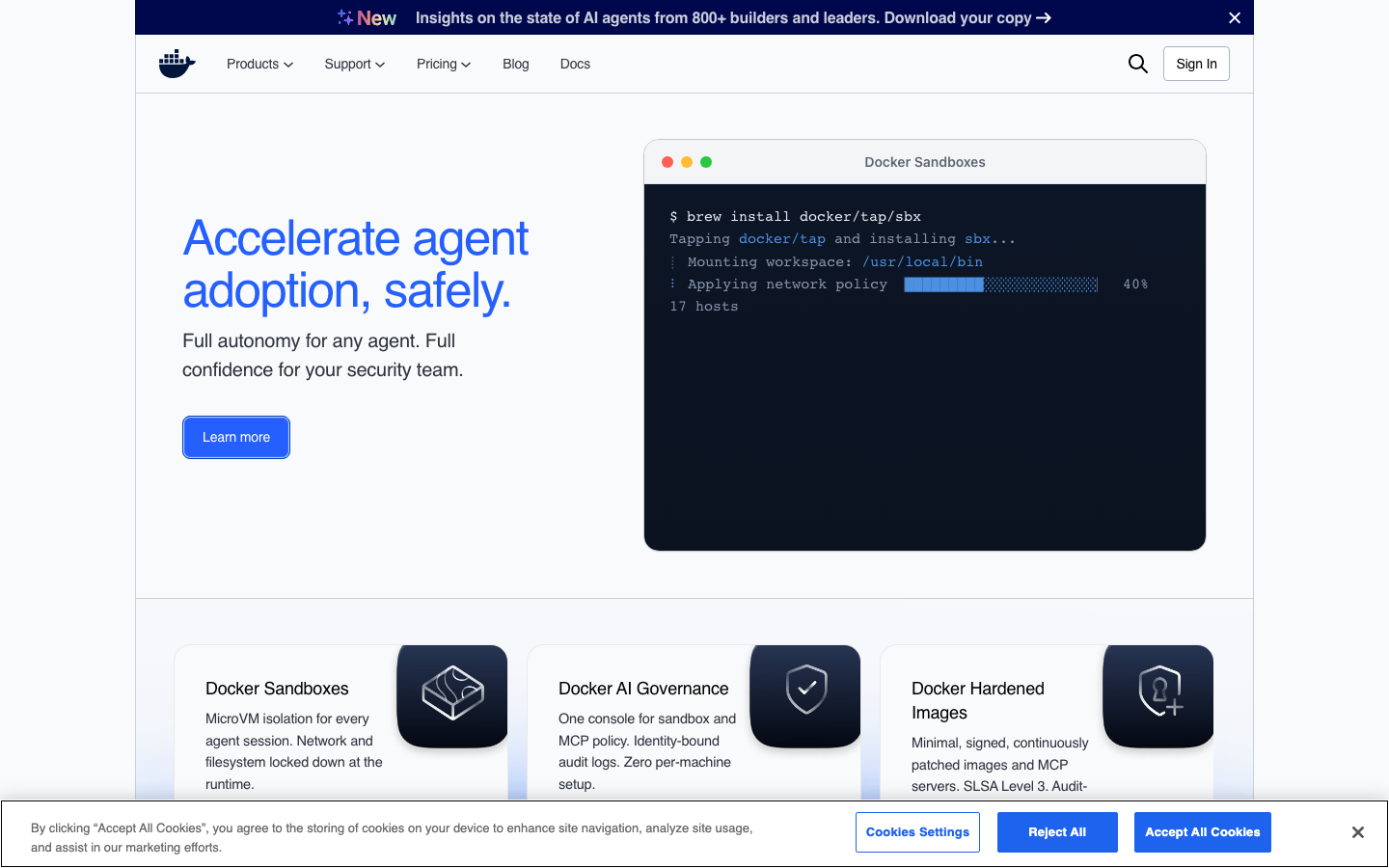
Docker is the world's leading containerization platform, providing a consistent running environment for AI applications from development environment to production deployment, and supports containerization of GPU-accelerated MCP servers and model inference services.
Docker
Core parameters and statistics
| Parameter | Value |
|---|---|
| Product Positioning | The world's leading containerization platform, AI application development and deployment infrastructure |
| Core form | Container engine + Docker Desktop + Docker Hub + Compose |
| Target users | Developers DevOps, AI/ML engineers, platform engineers |
| Core Technology | Container runtime, image layering OverlayFS, network namespace |
| License Agreement | Apache 2.0 (Docker Engine Open Source) |
| Deployment method | Docker Engine (CLI/API)/Docker Desktop |
| Ecosystem | Docker Hub (millions of images) |
| Latest version | 27.x |
The role of Docker in the field of AI is often underestimated - it essentially solves the most vexing problem of context consistency in AI development. Model training and inference often rely on specific versions of CUDA, PyTorch/TensorFlow, and system libraries. Docker packages these dependencies into repeatable images to ensure that the development environment and the production environment are completely consistent. The NVIDIA Container Toolkit gives Docker containers direct access to the GPU.
User and market recognition
Gradually build user awareness in the field, and product capabilities are used by content creators and teams to improve work efficiency. Some industry users have incorporated it into their daily workflow. It is recommended to refer to the latest official disclosures for specific user scale and industry adoption rate data.
Cost advantage
- C-side/Individual: Usually a free version is provided to experience the core functions, and high-frequency use requires a paid package subscription.
- API/Developer: Billed by call volume, suitable for development teams that can be flexibly integrated into their own systems.
- Enterprise/Privatization: Contact the business owner to obtain customized quotation and deployment plan. The specific price is subject to the official real-time pricing page.
Main functions
- Containerized application packaging: Package the application and its dependencies into lightweight container images through Dockerfile to ensure that the problem of "can run on my machine" completely disappears. The image layering mechanism allows basic images (such as Python, CUDA) to be downloaded only once, and subsequent builds only transfer incremental layers.
- Docker Compose multi-service orchestration: Use YAML files to define and run multi-container applications. Typical configuration for an AI application: one container runs the model inference service, another runs the vector database, and a third runs the front-end application, quickly started and stopped via Compose.
- GPU accelerated containers: Give containers access to the host GPU through the NVIDIA Container Toolkit. AI developers can use
nvidia-smiand CUDA toolchain directly in the container without installing complex drivers on the host. - Docker Hub Image Warehouse: The world's largest container image warehouse, providing official Python, PyTorch, TensorFlow, CUDA and other images. AI developers can directly
docker pull pytorch/pytorchto obtain pre-configured PyTorch context. - Docker Desktop Development Tools: Provides a GUI interface to manage containers, images, volumes and networks. Supports Kubernetes single-node clusters, extension plug-ins (such as Scout security scanning) and MCP connection capabilities.
Model and version evolution
Continuous iterative updates, the latest version introduces performance optimization and new features. Historical version information can be viewed on the official release page. There is no complete public version evolution timeline yet. It is recommended to pay attention to the official announcement to understand the rhythm of feature updates.
Technical advantages
- Algorithm Optimization: Special optimization at the model or algorithm level has been carried out for the corresponding scenario to achieve a balance between response speed and result quality.
- Low-latency architecture: Adopts streaming or asynchronous processing architecture to reduce user waiting time and is suitable for high-frequency interaction scenarios.
How to use
- Web client: You can use it by visiting the official website and registering an account. Most functions do not require installation.
- API access: Provides RESTful API, developers can obtain the API Key and integrate it into their own applications.
Product Pricing
Docker uses an open source core + commercial subscription model.
- C client/individual developers: Docker Engine is open source and free, and Docker Desktop is free for individual developers. Docker Hub public images and limited private repositories are available.
- Business/Team Edition: Docker Desktop requires a paid subscription for commercial organizations. Billed by developer seat, about $5-9/month/user. Includes Docker Hub private warehouse and team collaboration capabilities.
- Enterprise/Premium: Includes SSO integration, image security scanning (Docker Scout), image acceleration, audit logs, and priority support. Pricing is customized based on number of seats and additional services, please contact sales for a quote.
The core code of Docker Engine has always remained open source, and commercial subscriptions mainly cover commercial use of Docker Desktop and advanced features of Docker Hub.
Application scenarios
- AI model inference service deployment: Package the trained model (PyTorch, TensorFlow, ONNX) into a Docker image, access the GPU through NVIDIA Container Toolkit, and deploy it as a REST API service. Docker ensures that the model inference context is completely consistent on the development machine, test server, and production context.
- MLOps training pipeline run: Each model training is run in an independent Docker container to avoid dependency conflicts between different experiments. Use Docker Compose to manage the entire process of data preprocessing, model training, evaluation, and storage of training jobs.
- MCP server containerization: MCP (Model Context Protocol) server runs in the form of Docker container, and AI applications call MCP tools through standard interfaces. Docker standardizes the deployment, scaling, and updating of MCP servers.
Applicable people
- Individual Users: Content creators and knowledge workers who need AI assistance to improve their daily work efficiency.
- Developers: Technical teams who need to integrate AI capabilities into their own products or services through APIs.
- Enterprise: Organizations seeking to deploy AI at scale in their field.
Summary and Outlook
Docker has become the de facto standard infrastructure for AI development - from PyTorch's officially recommended development context to NVIDIA's AI container image library, from Hugging Face's Spaces to JetPack's Edge AI, containerization has a very high penetration rate in the AI field. The main value of Docker is to eliminate contextual inconsistencies, simplify GPU dependency management, and standardize the deployment process from development to production.
Current limitations: Docker Desktop charges for commercial organizations may increase costs; the performance overhead of containers on GPU access (about 1-3% performance loss) cannot be ignored in strict high-performance computing scenarios; large-scale container cluster management still requires the cooperation of Kubernetes.
Procurement/Adoption Risk Assessment: All core functionality is free for individual developers. Commercial teams using Docker Desktop need to purchase team subscriptions (highly cost-effective). For teams using other container runtimes (such as Podman, containerd), Docker's image standard (OCI) is still common. Docker Engine's open source license ensures the long-term availability of the core technology.
The Complete Tools Guide to Docker
Version Info
- Docker Engine 27.x :There is no official precise date yet, and the container runtime and developer tools will continue to be optimized.
- Docker Engine 24.x :There is no official precise date for the introduction of container runtime performance optimization and security enhancements.
User Reviews