 Domo AI Analytics
Free
Domo AI Analytics
Free
Domo is a cloud data operating system (Cloud Data Operating System) that integrates data integration (ETL/ELT), data warehouse AI analysis and mobile decision-making on one platform. Its core differentiation lies in the "all-in-one architecture" - users get the data pipeline, analysis engine AI assistant (Domo.AI) and mobile applications at the same time in one subscription, rather than assembling different tools. Domo is launched to the market through two paths: "self-service BI" and "embedded analysis".
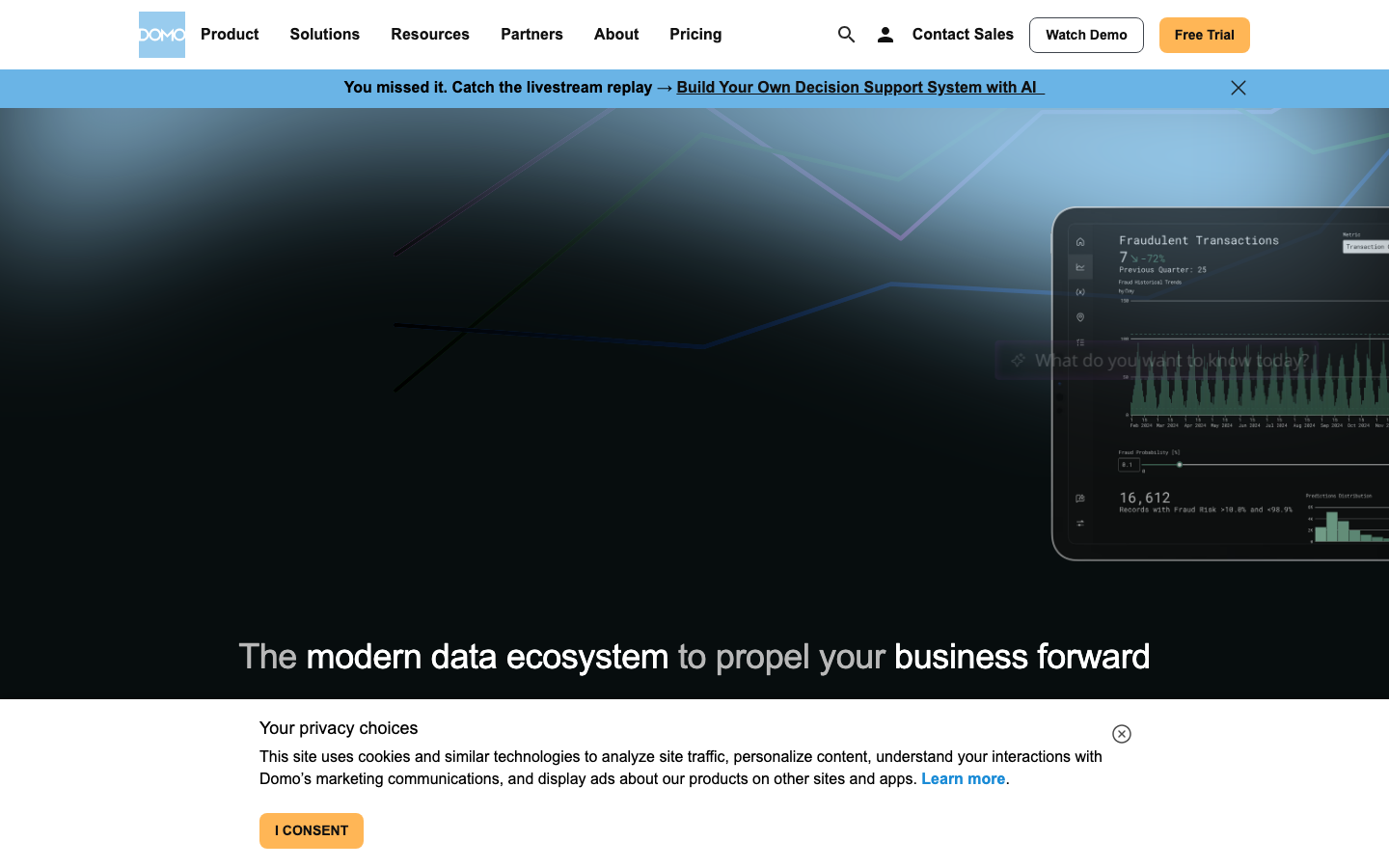
DomoAI Analytics
Core parameters and statistics
The core concept of Domo is "integration" - unlike traditional BI solutions that require users to combine ETL tools, data warehouse BI tools and mobile terminals, all these capabilities are packaged on the same cloud platform.
| Projects | Public Information |
|---|---|
| Official positioning | Cloud Data Operating System |
| Product form | Full-stack cloud BI + data integration + AI analysis |
| AI Product Line | Domo.AI (Ask Domo, AI Insights, AutoML, Doc AI) |
| Platform components | Data integration engine, data warehouse, analysis engine, mobile terminal, collaboration layer |
| Deployment method | Domo cloud (self-hosting is not supported) |
| Data Connectors | 1,000+ native connectors + custom connectors |
| AI capabilities | Natural language query, automatic insight, predictive analysis, document processing |
| Mobile terminal | Full-featured Domo Mobile (iOS/Android) |
| Listing status | Nasdaq listed companies (NASDAQ: DOMO) |
| Latest version | 2026-H1 Continuously updated |
Positioning Difference: Unlike Looker Studio (a lightweight free reporting tool) and Tableau (which focuses on visualization and analysis), Domo emphasizes that it is a "data operating system" - it covers the full range of capabilities from data integration to decision distribution, and its target customers are companies that want to replace multiple BI tools with one platform.
User and market recognition
Domo is listed on Nasdaq and has public financial data tracking its market performance.
Public customers: Customers displayed on the official website include Sunkist, eBay, Mastercard, Experian, etc., covering consumer goods, e-commerce, financial services and communications industries. At the same time, Domo has deep integration relationships with cloud platforms such as Snowflake, Databricks, AWS, and Azure.
Market Positioning: Domo is typically placed in the Visionaries or Challengers quadrant, rather than the Leaders quadrant, in the Gartner Magic Quadrant for Analytics and BI Platforms. It is clearly differentiated in the dimensions of "mobile first" and "integrated platform", but it is not as good as Tableau and Power BI in terms of analysis depth and community scale.
Financial Status: As a listed company, Domo’s revenue scale can be obtained from its financial reports. But the specific numbers will not be expanded here - what needs to be paid attention to is whether its value proposition of "one platform replacing multiple tools" continues to gain market recognition.
Cost advantage
- C-side/Individual: Usually a free version is provided to experience the core functions, and high-frequency use requires a paid package subscription.
- API/Developer: Billed by call volume, suitable for development teams that can be flexibly integrated into their own systems.
- Enterprise/Privatization: Contact the business owner to obtain customized quotation and deployment plan. The specific price is subject to the official real-time pricing page.
Main functions
The core difference of Domo is "platform completeness", and AI is the capability enhancement layer on this platform:
- Ask Domo (natural language query): Users ask questions in conversational language, and Domo.AI automatically understands the intent and generates corresponding data analysis results and visualizations. Focus on acceptance: the accuracy of multi-table correlation queries, and the ability to automatically identify industry terms (such as "monthly activity", "GMV", and "LTV").
- AI Insights (Automatic Insights and Alerts): Continuously scan data in the background, automatically discover trends, anomalies and key drivers, and push notifications to the user's desktop or mobile terminal. Acceptance focus: the accuracy of automatic insights and the feedback learning mechanism after users mark false positives.
- AutoML Predictive Analysis: Built-in automatic machine learning engine. After the user selects the target variable (such as predicted sales), the system automatically trains the best model and generates prediction results. The results can be directly embedded in the dashboard. Acceptance concerns: model interpretability and feature importance output.
- Doc AI (Document Intelligence): Use AI to extract key data from unstructured documents such as PDFs, scans, and images and incorporate it into the analysis process. Acceptance focus: OCR accuracy of Chinese documents and structured field extraction accuracy.
- Data Integration Engine: Built-in ETL/ELT functionality to extract and transform data from 1,000+ data sources without the need for external ETL tools. Acceptance concerns: support for complex conversion logic and execution efficiency under large data volumes.
- Domo Mobile: A fully functional mobile BI experience that supports offline viewing, push alerts, natural language query and card browsing. This is an important differentiating capability that sets Domo apart from most BI tools.
Model and version evolution
Continuous iterative updates, the latest version introduces performance optimization and new features. Historical version information can be viewed on the official release page. There is no complete public version evolution timeline yet. It is recommended to pay attention to the official announcement to understand the rhythm of feature updates.
Technical advantages
Domo's technical architecture is designed around "one platform, no splicing", which is in contrast to the "assembled" solution of most BI tools (users splice ETL + data warehouse + BI by themselves).
Integrated platform mechanism: Domo uniformly manages data extraction (connectors), data conversion (ETL/ELT engine), data storage (Domo data warehouse), data analysis (AI + visualization) and data distribution (mobile terminal, collaboration) in the cloud -> Users do not need to move data between multiple systems, all operations are completed within Domo -> Suitable for medium and large enterprises that do not want or have the ability to manage multiple BI components.
Domo.AI’s layered architecture: AI capabilities cover all stages of data processing - data preparation stage (Doc AI), analysis stage (Ask Domo + AI Insights), and prediction stage (AutoML). This embedded AI strategy prevents users from leaving the Domo platform in order to obtain a certain AI capability, but it also means that each AI module of Domo.AI may not be as deep as a dedicated AI tool (such as a professional AutoML platform).
Mobile first: Domo Mobile is one of the few mobile BI applications whose functions are not limited to desktop boundaries. It supports complete data browsing, natural language query and alert operations, not just a report viewer. This has obvious value for management to grasp business dynamics in real time in mobile scenarios.
How to use
The usage entrance of Domo covers all scenarios:
| How to use | Suitable for the role | Features |
|---|---|---|
| Domo Web | Data analysts, business users | Full-featured platform, data integration->analysis->publishing full link |
| Domo Mobile | Management, frontline operations | Complete BI experience, supporting offline, early warning and NLS |
| Domo API | Developer | Programmatically manage data, reports and users |
| Embedded SDK | Product Team | Embed Domo Analysis into your own applications |
| Domo collaboration | Cross-department team | Share cards, discuss data, and publish notifications within the platform |
The implementation path usually starts with the selected core business scenario: the data team establishes a data pipeline in Domo to connect 3-5 key data sources, and configures automatic refresh; the business analyst creates a core dashboard and configures AI alerts on this basis; the management receives push notifications and key indicator cards through Domo Mobile.
Product Pricing
Domo’s pricing is mainly based on enterprise subscriptions, and the complete price list is not disclosed on the official website.
- Free Trial: The official website provides a Free Trial entrance, suitable for verifying the complete capabilities of the Domo platform (including Domo.AI and data integration).
- Enterprise Subscription: Billed based on the number of users and functional level. Domo's "all-in-one" pricing is usually higher than purchasing BI tools separately, but if an enterprise needs ETL tools + BI tools + mobile terminals at the same time, Domo's turnkey contract may be more cost-effective. The specific price is subject to the official business quotation.
- Enterprise/Contract Terms: Large enterprises are required to sign an annual contract with the Domo sales team confirming minimum user commitments, Domo.AI quotas and optional data volume limits. When purchasing, it is recommended to obtain a POC of a certain period to verify the stability of the data integration pipeline and the accuracy of Domo.AI in specific business scenarios.
Application scenarios
- Full stack business intelligence (data integration + analytics integration): Enterprises replace multiple BI components with one Domo platform - from ETL (Talend/Informatica) to data warehouse (Snowflake/Redshift) to BI tools (Tableau/Power BI) and mobile reports. The benefits are reflected in reduced maintenance work of data movement and integration between systems. Key points of verification: How flexible and mature the data integration engine is in complex ETL scenarios compared to professional ETL tools.
- Mobile decision-making for management: Managers can view key indicators in real time through Domo Mobile, receive AI early warning push, and keep track of business dynamics while on business trips or meetings. Key points to verify: Whether the data pushed by AI Insights covers the indicators that managers really care about.
- Customer-facing analytics embedding: Embed Domo analytics into SaaS products through the embedded SDK, allowing end customers to gain data insights within their own applications. Key points of verification: multi-tenant isolation granularity and embedded brand customization capabilities.
Applicable people
- IT and Data Platform Team: Replace multiple BI components with Domo's integrated platform to reduce integration and maintenance work. Prerequisite: You need to evaluate the platform replacement costs of migrating from your existing BI architecture to Domo. Not fitting the boundaries: If the enterprise has made significant investments in ETL, data warehouse, and BI tools, the switching costs of "rip and start" may be greater than the benefits of integration.
- Business Management: Master business data in mobile scenarios through Domo Mobile and Ask Domo. Prerequisites: The IT team is required to complete the basic data pipeline construction and Domo.AI configuration.
- Data Analyst: Complete the entire process from data access to analysis and release within Domo. Prerequisites: You need to learn Domo's data integration engine (Domo ETL) and the unique Cardinal data structure. Not adaptable to boundaries: Analysts who are accustomed to using SQL to directly query data warehouses need to adapt to Domo's drag-and-drop data processing method.
- Industry vertical users: Domo has more industry templates and integration experience in the retail/FMCG, financial services and communications industries.
Not suitable for the crowd: Enterprises that require self-hosting/private deployment (Domo pure cloud); Enterprises that have already deeply used mature modern data stacks such as Snowflake + dbt + Tableau (the migration cost of switching to Domo is high); Teams that only need simple reports without data integration needs (Domo's integrated pricing may be on the high side).
Summary and Outlook
Domo's core competency lies in "one platform to do everything" - from connecting data sources to ETL processing for AI analysis to mobile decision distribution. This methodology is valuable when companies don't want to manage multi-tool assembly, but it also means companies need to accept the risk of being "tied to one vendor."
Current limitations: Self-hosted deployment is not supported, and enterprises with strict data sovereignty have compliance risks; Domo is not as good as Tableau in terms of analysis depth and visualization customizability; the switching cost for enterprises to migrate from existing BI architecture to Domo cannot be ignored.
Procurement/Adoption Risk Assessment: It is recommended to use a free trial to verify the entire link in 1-2 business scenarios (from data integration to AI analysis to mobile terminals), and confirm that the integrated solution can indeed reduce the maintenance cost of the current multi-tool splicing before making a purchase decision. Before purchasing, enterprises should focus on confirming: the minimum number of user commitments and data volume limitation clauses in the contract, whether each module of Domo.AI is independently authorized SLA and disaster recovery commitments, as well as data residency and compliance certification (SOC2/GDPR, etc.).
Version evolution of Domo AI Analytics
Platform foundation period (2010-2018)
In the early days of its establishment, Domo focused on "cloud BI", with the slogan "Connecting business data and decision-making". Listing on Nasdaq in 2018 marked the completion of product maturity and enterprise-level validation.
Data integration and fusion period (2019-2022)
Domo has gradually strengthened its data integration capabilities, built-in ETL/ELT engine, and upgraded its product positioning from "BI tool" to "data operating system". In 2022, the cloud native architecture will be fully implemented, focusing on multi-cloud and contextual deployment.
AI productization period (2023 to present)
The Domo.AI product line will be officially launched in 2023-2024, integrating natural language query AI insights AutoML and document intelligence into a unified AI platform. Domo’s AI strategy is to embed AI into all levels of the platform (query, insights, predictions, data extraction) rather than as a standalone feature.
Version Info
- Domo 2026-H1 Update :Enhance the Agent capabilities of Domo.AI, deepen natural language query (Ask Domo), and expand the embedded analysis SDK. There is no official precise date yet.
- Domo.AI platform upgrade :Officially launched the Domo.AI product line, including natural language query (Ask Domo), AI insight recommendation AutoML predictive analysis and document intelligence (Doc AI). There is no official precise date yet.
- Domo cloud native architecture :The cloud-native architecture is fully implemented, and the data integration engine (ETL/ELT) and multi-cloud deployment capabilities are enhanced. There is no official precise date yet.
User Reviews