 DreamGen
Free
DreamGen
Free
DreamGen is a robot learning research framework launched by NVIDIA Research. It generates synthetic robot videos by fine-tuning the video world model, extracts pseudo actions from them and trains downstream strategies, allowing robots to achieve behavioral and contextual generalization with a very small amount of real-person teleoperation data.
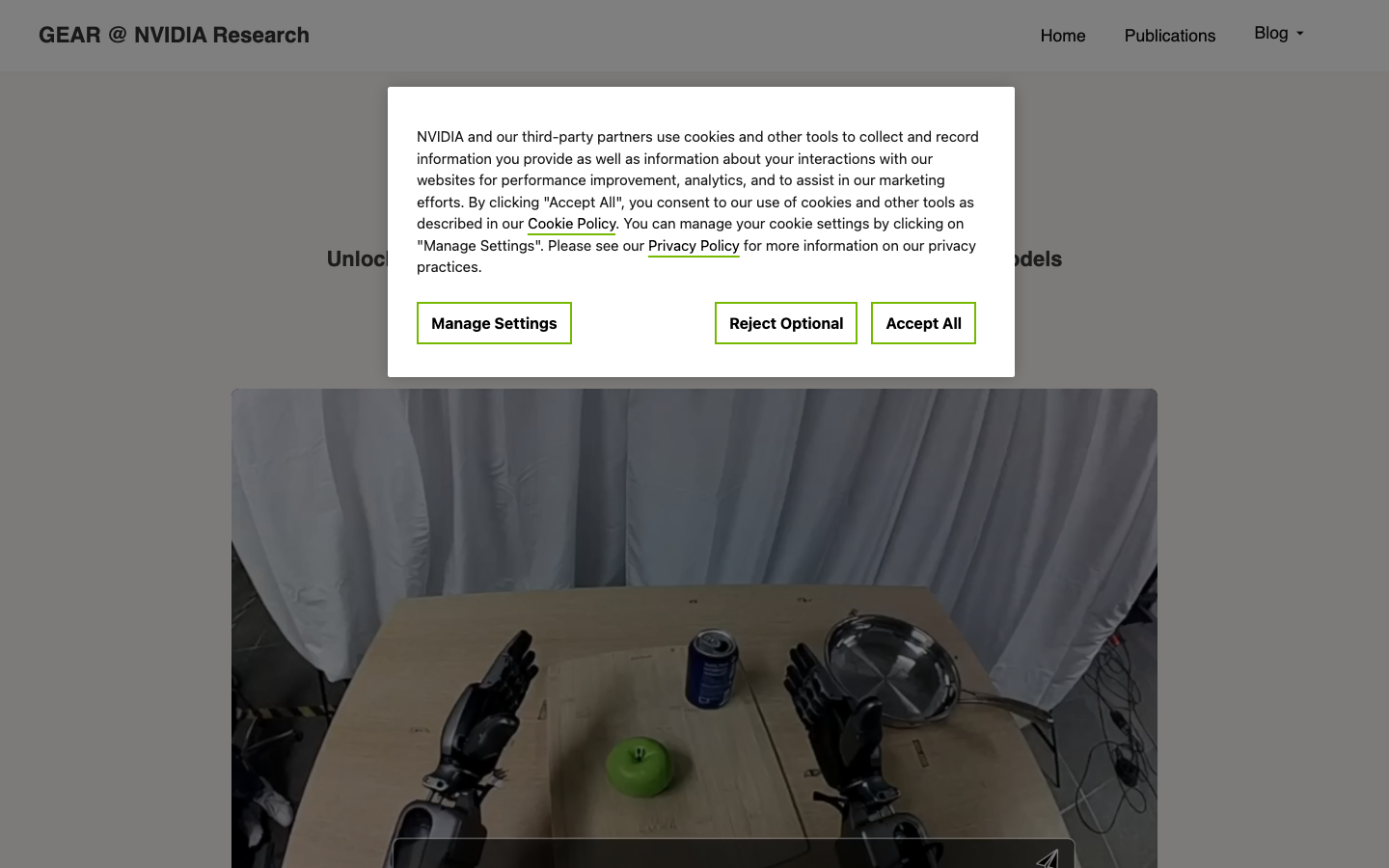
Full review of #DreamGen
Core parameters and statistics
| Project | Specifications |
|---|---|
| Product Positioning | Robot learning synthetic data generation framework |
| Development Agency | NVIDIA Research GEAR Lab |
| Open Source License | Apache-2.0 |
| Core Technology | Video world model fine-tuning + pseudo-action extraction + strategy training |
| Robots supported | GR00T N1, Franka, SO-100, RoboCasa |
| Data Starting Point | Single pick-and-place teleoperation data set |
| Generalization ability | 22 new behaviors zero-shot generalization + new contextual generalization |
User and market recognition
DreamGen is NVIDIA Research’s important open source contribution to the field of robot learning. The core problem it solves is: robot learning requires a large amount of diverse training data, but the cost of collecting data through human teleoperation is extremely high. The idea of DreamGen is to let the video world model "dream", generate a large number of synthetic robot videos, and then extract actions from them to train robot strategies.
Publicity verification: "Zero-sample generalization to 22 new behaviors" - This result was obtained in a controlled laboratory environment, and the definition of each "new behavior" has different degrees of deviation from the real world. There is a sim-to-real gap between 22 behaviors in the laboratory and real generalization in production contexts.
Cost advantage
Open source research project (Apache-2.0), code and models are free. The actual cost is mainly in GPU computing power - fine-tuning the video world model and generating large-scale synthetic data requires multi-card GPU clusters. For the research team, this cost is much lower than using human teleoperation to collect real data of the same scale.
The free truth: The Apache-2.0 open source license allows free use and modification, but the GPU cost to completely reproduce a paper experiment is about $5,000-20,000 (depending on the model size and sampling volume). The "free" thing is the code, and the "expensive" thing is the computing power.
Main functions
- 4-stage data generation pipeline: fine-tune the video world model → generate synthetic robot videos → use LAPA/IDM to extract pseudo actions → train downstream visuomotor policy. This pipeline starts from a small amount of real data and amplifies it through synthetic data to train a generalizable robot strategy.
- Zero-shot behavioral generalization: Starting from a single pick-and-place action, the model can generalize to 22 unseen behaviors (contact-intensive tasks such as folding, tapping, stacking, wiping, etc.).
- Zero-sample contextual generalization: Perform learned tasks in unseen contexts without relying on re-acquisition of data for each new context.
- DreamGen Bench: The accompanying evaluation benchmark is used to measure the adaptability and physics alignment of the video world model to the robot embodiment.
Model and version evolution
Mainline release
- ~2025-06: DreamGen is made public for the first time, releasing a complete 4-stage pipeline code benchmark and pre-trained model.
Technical advantages
- Algorithm Optimization: Special optimization at the model or algorithm level has been carried out for the corresponding scenario to achieve a balance between response speed and result quality.
- Low-latency architecture: Adopts streaming or asynchronous processing architecture to reduce user waiting time and is suitable for high-frequency interaction scenarios.
How to use
- Visit the GitHub repository (https://github.com/NVIDIA/DreamGen) to download the code
- Configure context and dependencies according to README
- Prepare a small amount of live teleoperation demonstration data as a starting point
- Run in sequence according to the 4-stage pipeline: world model fine-tuning → data generation → pseudo-action extraction → strategy training
- Use DreamGen Bench to evaluate training results
- Deploy the trained strategy to the robot platform
Product Pricing
| Project | Description |
|---|---|
| Code License | Apache-2.0 Open Source and Free |
| Pre-trained model | Public download |
| API service | Not provided |
| Enterprise Support | Contact NVIDIA Enterprise Support |
Human-machine collaboration boundary: 100% automation: execution of 4-stage data generation pipeline, synthetic data annotation, policy training and benchmark evaluation. Manual intervention is required: data quality sampling, setting the security test threshold of the strategy on real machines, and adjusting training goals. Bias analysis of synthetic data and real data also requires continuous monitoring by researchers.
Application scenarios
- New Robot Skill Learning: Use a small amount of real-person demonstration data to generate a large number of synthetic variants through DreamGen to train new skills. Traditionally, a skill requires hundreds of live demonstrations, but DreamGen can reduce the starting point to dozens.
- Sim-to-Real Data Augmentation: Generate diverse contextual variant and lighting condition data for sim-to-real migration to improve the robustness of the strategy in the real world.
- Robot basic model pre-training: In the training of basic robot models such as GR00T N1, the large-scale synthetic data generated by DreamGen is used for pre-training or data amplification.
Applicable people
- Robotic Learning Researcher: Academic and industrial researchers who study data efficiency, behavioral generalization, and contextual generalization.
- Embodied Intelligence Algorithm Engineer: The engineering team that implements and deploys learning algorithms on robotic platforms.
- NVIDIA Ecosystem Developer: Developers who use NVIDIA robot tools such as GR00T and Isaac Sim.
Summary and Outlook
DreamGen represents an important trend in the field of robot learning: using generative models to solve the problem of training data scarcity. Synthetic data is generated by "dreaming" a video world model, allowing robots to learn a wide range of behaviors and contextual adaptations from a small number of real-world demonstrations. As a research project, its value lies in providing a complete and reproducible data generation-training-evaluation pipeline. Industrial applications need to evaluate the upper bounds on the quality of synthetic data and the cost of migration from simulation to reality.
Current limitations: NVIDIA Research project, no independent product team and support channel; README clearly indicates that the code is mainly used for research reproduction, not a production-level tool; the upper limit of the quality of synthetic data is limited by the capabilities of the video world model itself.
Dissuade scenario: If your goal is to quickly deploy a robot strategy to the production line, DreamGen’s methodology is still in the research and verification stage and is still far from industrial-grade reliability. It is recommended to first use simulation to verify the feasibility of data generation and strategy training, and then evaluate whether to migrate to real machines.
Hidden benefits: For robotics laboratories, DreamGen provides a complete and reproducible baseline system, allowing the team to establish an experimental process of synthetic data generation → strategy training → evaluation within a few weeks without the need to build infrastructure from scratch.
Related tools:  Hugging Face, replicate
Version Info
- DreamGen :The first public research implementation, providing a complete 4-stage pipeline code, evaluation benchmark and pre-training model. There is no official precise date yet.
- DreamGen :Publicly available for the first time, it includes a 4-stage pipeline benchmark and pre-trained model. There is no official precise date yet.
User Reviews