 Dynatrace
Dynatrace is an AI-driven observability platform started in Austria. It uses the Davis AI engine as the core to implement full-stack automatic discovery, real-time dependency mapping and AI root cause analysis, covering applications, infrastructure, network and digital experience monitoring.
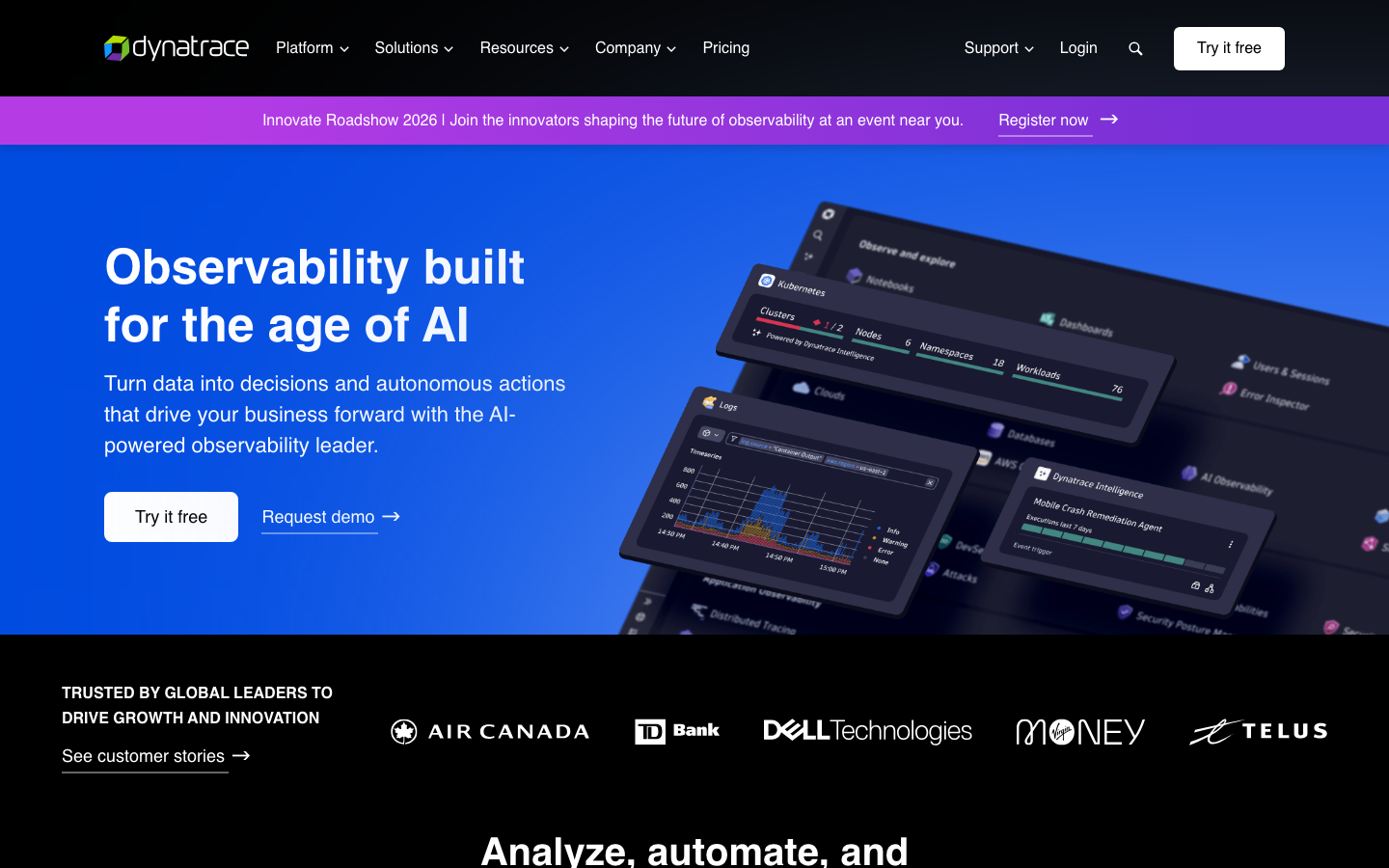
Dynatrace
Core parameters and statistics
The core difference of Dynatrace lies in the two capabilities of "automatic discovery" and "AI root cause analysis", which are unique in the observability market - it does not require manual configuration of monitoring objects and dependencies, and OneAgent automatically completes the drawing of bounded topology after deployment.
| Projects | Public Information |
|---|---|
| Official positioning | The AI-powered observability platform |
| AI engine | Davis AI (causal inference engine) |
| Product Form | SaaS Cloud + OneAgent Collection + Private Deployment |
| Core competency areas | Infrastructure, Application & Microservices, Digital Experience, Network, Security |
| Auto-discovery | Automatically discover all entities (processes, services, containers, hosts) and their dependencies |
| Integration Ecosystem | 600+ technology integrations, covering mainstream cloud platforms and open source technology stacks |
| Customer scale | 7,000+ corporate customers (officially disclosed), including many Fortune 500 companies |
| Listing Information | NYSE: DT |
The real value of automatic discovery: After installation, Dynatrace's OneAgent will automatically discover all running processes, services, network connections and external dependencies on the host, and generate a real-time updated smart topology map (Smartscape). This means that in scenarios with complex or frequent changes (such as daily rolling of Pods in a Kubernetes cluster), the operation and maintenance team does not need to manually update the monitoring configuration. It does not "reduce workload", but eliminates "configuration drift" and other blind spots that cannot be covered by manual monitoring.
Positioning differences of Davis AI: Unlike Datadog's Watchdog (based on statistical baselines) and New Relic AI (based on ML anomaly detection), Dynatrace's Davis AI is a causal inference engine - it not only knows "there are anomalies", but can also infer "why there are anomalies." The technical difference behind this is that Dynatrace maintains a complete dependency topology graph in advance, and AI can do causal deduction on the topology rather than pure statistical correlation.
User and market recognition
Dynatrace has a solid base of high-end customers in the enterprise observability market, especially in large-scale, high-complexity IT environments.
Enterprise customer base: Officially disclosed 7,000+ enterprise customers, a large number of which are Fortune 2000 companies. Dynatrace's average customer contract value is generally higher than that of Datadog and New Relic, which reflects its positioning in the enterprise market - customers are not just buying tools, but the degree of operational automation.
Industry Analyst Comments: Dynatrace has been named a leader in the Gartner Magic Quadrant for APM for multiple consecutive years and ranks high in the Forrester Wave's AIOps assessment. The Davis AI engine’s causal reasoning capabilities are viewed by analysts as a differentiator.
Listing performance: NYSE: DT is a representative listing target in the AIOps track, with a market capitalization in the range of US$15-20 billion. From 2024 to 2026, Dynatrace will continue to increase its R&D investment in AI and automatic operation and maintenance.
Cost advantage
Dynatrace’s pricing is in the high-end range among mainstream observability vendors, but this needs to be evaluated in conjunction with its degree of automation.
C client/individual: Dynatrace provides Developer Free Tier, which includes basic capabilities but limited functions. Compared with Datadog’s 14-day trial and New Relic’s permanent free tier, Dynatrace’s free tier has a weaker new customer experience and is mainly geared toward POC rather than long-term personal use.
API/Developer: APIs are billed per call, but Dynatrace doesn’t offer as rich API pricing transparency as Datadog. Developers usually need to obtain API access rights through internal enterprise contracts.
Enterprise/Private: The main deployment method of Dynatrace is the Enterprise annual contract, and the billing dimension is the number of hosts/CPU cores/workload (the specific billing unit varies depending on the contract). Enterprise-level pricing is usually the highest among the three major vendors, but its hidden benefits are: automatic discovery reduces manual configuration costs, and Davis AI reduces incident troubleshooting time (MTTR). In a large enterprise, the combination of these two items can usually cover the premium of the tool itself. The main hidden costs are: fully deploying OneAgent requires verifying compatibility on existing hosts one by one; integration with self-built operation and maintenance tools may require additional development investment.
Main functions
Dynatrace's capabilities revolve around "full-stack automatic discovery + Davis AI causal reasoning". The core modules include:
- OneAgent automatic discovery and topology mapping: One Agent covers all data types (metrics, tracking, logs, user sessions) and automatically generates entity dependency topology (Smartscape). The value lies in eliminating the hassle of manually configuring monitoring items, and Agent upgrades can be completed automatically after the new version is released.
- Davis AI Root Cause Analysis: Automatically locate the root cause of a problem based on a causal reasoning engine instead of just reporting associated metrics. The output is a structured root cause report (including abnormal entities, abnormal indicators, and causal chain paths), which is suitable for direct use in SRE duty scenarios.
- Full stack coverage: from infrastructure (host, container Kubernetes) to application layer (service API, database query) to digital experience (browser, mobile Synthetic). The same Davis AI engine covers all levels, and cross-level root cause inference does not require manual correlation of data.
- AI Operation and Maintenance Automation: Based on the root cause analysis results of Davis AI, operation and maintenance actions are automatically triggered (such as restarting faulty services, expanding the number of replicas, and creating JIRA work orders). It is recommended to start running in "suggestion mode" (AI recommendation → manual confirmation → execution), and then switch to fully automatic mode after trust verification.
- Security Analytics: Since 2025, Dynatrace has added runtime security analysis, bringing the detection of security events into the same platform. Davis AI can correlate the timeline of security events and operation and maintenance anomalies, which is suitable for DevSecOps teams to complete dual-perspective analysis of security and operation and maintenance in a unified dashboard.
Model and version evolution
The relevant information has not been made public, please refer to the official real-time page.
Technical advantages
Dynatrace's technical moat lies in the architectural combination of "OneAgent + Davis AI causal reasoning + real-time topology":
OneAgent's full-stack single probe: One Agent collects indicators, distributed tracing, logs, user sessions and network data at the same time, without relying on multi-probe splicing. This means that the collected data naturally has entity relationships (which process generated which trace, which host the trace passed through), providing a structured context for subsequent AI reasoning.
Davis AI's causal inference mechanism: Unlike traditional anomaly detection systems (which judge "there is an anomaly" based on statistical baselines), Davis AI uses real-time topological maps to make causal inferences. For example, when it detects that the error rates of five services increase at the same time, it will not report them as five independent events. Instead, it will infer that "the underlying database response is slowing down" through the dependency topology as a common cause, and then attribute the five errors to the same root cause. This mechanism directly reduces alarm storms.
Smartscape Live Topology: A dynamic topology map of entity relationships that is updated every 30 seconds. Unlike traditional static CMDB (Configuration Management Database), the topology is discovered at runtime from real traffic rather than read from configuration files. This ensures that the topology will not become outdated in containerized and serverless scenarios.
How to use
Dynatrace provides flexible usage and deployment methods:
| How to use | Suitable for the crowd | Features | Cost |
|---|---|---|---|
| Web UI | DevOps, SRE, Platform Teams | Davis AI Analytics Dashboards, Topology Views, Dashboards | Billed by Enterprise Contract |
| REST API | Automation platform CI/CD | Event query, metadata management Topology reading | Billing based on call volume |
| OneAgent CLI | Deployment Team | Agent Installation, Configuration, Diagnostics | Included in Subscription |
| Terraform Provider | IaC Team | Infrastructure as Code Management Dynatrace Configuration | No Extra Cost |
Typical usage process: Deploy OneAgent on the target platform (Linux, Windows, Kubernetes) → Agent automatically discovers context and builds topology → View automatically generated root cause analysis results in the Davis AI panel → Configure alarms and automated workflows as needed. When deploying OneAgent, pay attention to the firewall rules that need to allow the exit endpoint of the Dynatrace cluster; for Kubernetes environments, Operator mode deployment can automate Agent management.
Product Pricing
Dynatrace's pricing positions it at the highest level in the enterprise market, but the hidden cost savings from automation capabilities need to be factored into the total cost assessment.
- C-side/Individual: Developer Free Tier provides limited feature coverage and is mainly used for evaluation and POC. Not suitable for long-term production use.
- API/Developer: Developer-level API calls are typically included in an enterprise's Full Stack Monitoring contract. The independent API pricing is not disclosed and is subject to business confirmation.
- Enterprise: Full Stack Monitoring is billed per host/CPU cores/workload unit. The Enterprise contract is a fully managed model (including OneAgent, Davis AI, full-stack capabilities). Enterprise procurement recommendations require the POC to be run for 4-6 weeks to verify Davis AI's root cause analysis accuracy and automatic discovery coverage under real data volumes, and then use the actual measurement results to make budget calculations. Hidden costs: Manpower and change window for OneAgent deployment, integration and adaptation with existing alarm platforms (PagerDuty, ServiceNow), and license flexibility terms confirmation during large-scale deployment.
Application scenarios
Dynatrace’s differentiated scenarios focus on high-complexity situations that require causal reasoning:
- Large-scale microservice fault location: In an environment with 100+ microservices, a low-level fault may cause dozens of upper-level service exceptions. Davis AI’s causal reasoning can locate the root cause in seconds, rather than requiring on-call personnel to dig through it layer by layer. Deduction: In an environment with more than 50 microservices, MTTR can be reduced from 45 minutes to 10-15 minutes.
- Kubernetes contextual automatic operation and maintenance: OneAgent automatically discovers Kubernetes resources such as Pod, Service, Ingress and their dependencies. Combined with AI operation and maintenance automation, automatic detection of Pod anomalies → root cause analysis → automatic restart/rollback can be achieved.
- Cloud migration and hybrid cloud observability: In the process of migrating from the data center to the cloud, Dynatrace's automatic discovery can help sort out the dependencies of existing applications (who relies on whose database API call chain) and reduce the risk of omissions in migration planning.
Applicable people
Dynatrace's high level of automation corresponds to specific types of organizations and roles:
- SRE and operation and maintenance teams of large enterprises: manage complex and frequently changing IT environments, value automated discovery and AI root cause analysis, and can accept higher unit prices in exchange for improved operation and maintenance efficiency.
- Platform Engineering Team: It is necessary to provide a unified monitoring base for multiple internal business lines. The premise of "unification" is that there is no need to separately configure monitoring for each business line. OneAgent's auto-discovery is ideal for this scenario.
- Technical Manager (CIO/CTO): Pay attention to the efficiency bottlenecks of the operation and maintenance team. The root cause analysis report provided by Davis AI can be directly used as input material for post-incident analysis, reducing the workload of the SRE team in producing reports.
Not suitable for scenarios: For small and medium-sized teams that are budget-sensitive or have relatively stable circumstances, Dynatrace’s enterprise-level pricing does not match its automation advantages. In addition, if the team is already deeply using the open source stack of Prometheus + Grafana, the ROI of migrating to Dynatrace needs to be carefully calculated - the value of automatic discovery is only obvious in high-frequency change environments.
Summary and Outlook
Dynatrace's core competitiveness lies in the unique technology combination of "OneAgent full-stack automatic discovery + Davis AI causal reasoning". It is not the cheapest observability platform, but in high-complexity environments, the operational efficiency improvements brought by automatic discovery and root cause analysis can often cover the tool's premium.
Current limitations: OneAgent's full-stack model has limited support for old operating systems or non-mainstream architectures; Davis AI's causal inference may have low initial accuracy on new services that lack historical data; the enterprise-level pricing structure makes the adoption threshold for small and medium-sized organizations higher than competing products.
Procurement/Adoption Risk Assessment: It is recommended to first deploy OneAgent in a medium-complexity business domain and conduct a 4-6 week POC. The core acceptance items are: automatic discovery coverage (how many entities are automatically recognized), the accuracy of Davis AI root cause analysis (compared with manual post-analysis results), and the Agent's production bounded resource consumption. Before signing an enterprise contract, you need to confirm the annual flexible terms (billing method for new hosts), data retention period (default and renewable), and support strategy for data migration between platforms.
Version evolution of Dynatrace
Dynatrace uses a SaaS automatic update model, with releases on a quarterly basis, supplemented by on-demand feature releases.
Davis AI Engine Evolution
- 2024-Q4: Davis AI introduces a causal inference engine, shifting from statistical correlation to causal inference, and can output root cause analysis of "because of X so Y".
- 2025-Q3: Davis AI extends to log pattern recognition, supporting abnormal pattern extraction of unstructured data.
- 2026-Q2: Davis AI’s causal reasoning capabilities have been upgraded, adding multi-event correlation and timeline automatic synthesis capabilities.
Platform capability evolution
- 2025-Q1: The real-time update frequency of Smartscape topology is increased to adapt to high-frequency changes in Kubernetes context (Pod second-level rolling).
- 2025-Q4: Grazuated Security Analytics GA, integrating runtime risk analysis into the observability platform.
- 2026-Q2: AI operation and maintenance workflow automation (AIOps Automation) enters GA, supporting automatic repair based on Davis AI root cause analysis.
Subject to the official Release Notes (docs.dynatrace.com/docs/whats-new/release-notes). In the SaaS model, all customers automatically synchronize the latest version. However, for large-scale enterprises to accept changes to core functions, it is recommended to verify the function switch in non-production context before enabling it globally.
Version Info
- Dynatrace 2026-Q2 Release :In the platform update in the second quarter of 2026, the Davis AI engine has upgraded its causal reasoning capabilities and added AI operation and maintenance workflow automation functions.
- Dynatrace 2026-Q1 Release :Updated in the first quarter of 2026, Davis AI introduces multi-modal analysis capabilities to support joint anomaly detection of logs and events.
- Dynatrace 2025-Q4 Release :Updated in Q4 2025 to enhance Davis AI root cause analysis report generation and automatic remediation recommendations.
User Reviews