 Eightfold AI
Eightfold AI is a leading enterprise-level AI talent intelligence platform that uses deep learning and Agentic AI to analyze more than 1 billion career profiles, providing enterprises with full-link intelligent solutions for recruitment, talent development, skills mapping, internal mobility and workforce planning. Ranked as a strategic leader by Fosway, serving many Fortune 500 companies.
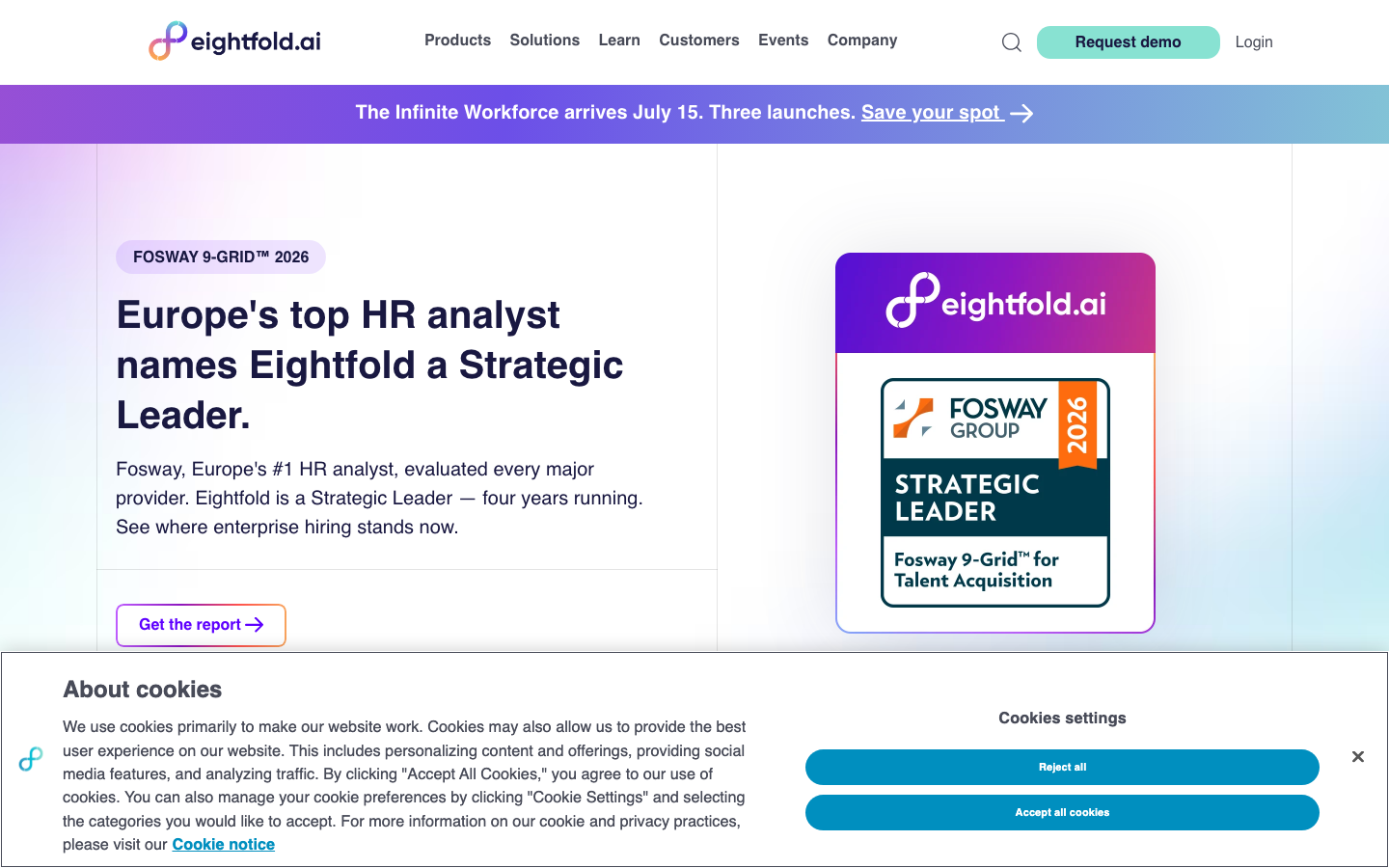
An in-depth analysis of #Eightfold AI
Core parameters and statistics
| Parameter items | Public information |
|---|---|
| Product positioning | Enterprise-level AI talent intelligence platform (Talent Intelligence Platform) |
| Core Technology | Deep Learning + Agentic AI + Skill Map Engine |
| Data foundation | Over 1 billion global professional profiles |
| Delivery form | SaaS platform / API integration / Private deployment |
| Serving customers | Fortune 500 enterprise customers |
| Latest Certification | Fosway 9-Grid™ Strategic Leader (4 consecutive years) |
| Headquarters | Santa Clara, California, USA |
| Established | 2016 |
| Total financing | Over US$400 million |
Eightfold AI’s core asset is its skill graph engine built on deep learning. Unlike traditional ATS (application tracking system), it does not rely on keyword matching, but trains models on more than 1 billion professional profiles to identify candidates' hidden potential through "skill similarity" and "career trajectory prediction". This means that skills and cross-industry transferable abilities that are not clearly stated in the resume may be automatically flagged by the model.
User and market recognition
- Enterprise-level customer base: Covers many Fortune 500 companies, and customers are concentrated in large organizations such as technology, finance, and manufacturing.
- Analyst Recognition: Fosway 9-Grid™ has been rated as a Strategic Leader for 4 consecutive years. Fosway is the number one HR analyst agency in Europe.
- Ecological cooperation: In 2026, we will reach an in-depth integration cooperation with Oracle to build the AI interviewer capabilities into the Oracle Recruiting module, covering Oracle's huge enterprise user base.
- Industry Coverage: Customers cover financial services, medical health, retail, technology and other industries. Typical scenarios are end-to-end talent management for medium and large enterprises.
Cost advantage
C-side/Individual: Eightfold AI is not for individual users, and there is no personal free version.
API/Developer: Undisclosed independent API pricing plan. Enterprise customers obtain all API capabilities (including resume analysis, skill map query, matching scoring, etc.) through platform subscription, and pay-as-you-go billing is not available to independent developers.
Enterprise/Private: Pricing is based on annual subscription, and the specific amount needs to be confirmed with the sales team. Cost components include: -Basic platform subscription fee (tiered by number of employees or recruitment volume) -Additional fees for advanced modules such as AI Interviewer
- One-time fee for data integration and implementation services
- Optional privatized deployment (involves infrastructure costs)
Hidden Costs:
- Data Migration Cost: Migrating from traditional ATS/HRIS to Eightfold requires cleaning and mapping of historical data, especially the realignment of the skill label system.
- Organizational Change Cost: AI interviewers and automated screening will impact existing recruitment processes, and teams will need to adapt to new workflows.
- Integration Complexity: Deep integration with existing HR technology stacks (Workday, SAP SuccessFactors, Oracle HCM, etc.) may require custom development.
Main functions
- Talent Intelligence (talent intelligence engine): Based on deep learning, it analyzes the skills, experience, and career trajectories of employees and candidates, automatically generates skills maps, and recommends the best job matches. The core value lies in discovering "atypical" candidates missed by traditional keyword resume screening, such as potential talents crossing over from adjacent industries.
- AI Interviewer: The Agentic AI product launched in 2026 can perform standardized interview assessments on candidates or batches of candidates, and evaluate each candidate with the same standards, known as "zero bias." It is suitable for large-scale school recruitment, batch preliminary screening and other scenarios, significantly reducing the interview workload of the HR team.
- Talent Agents: A series of autonomously running AI Agents covering all nodes of the recruitment process - resume screening, candidate communication, interview arrangement, feedback collection, etc. Each Agent can run independently and collaboratively complete end-to-end tasks, reducing manual intervention.
- Skills Intelligence: Automatically identify skill stocks and gaps within the organization and predict future changes in skill demand. Unlike LinkedIn skills data, Eightfold analyzes actual career trajectories rather than user self-labeled skills, and the data base is closer to real abilities.
- Workforce Planning: Based on talent portraits and business goals, deduce the talent supply and demand gap under different organizational plans, and support "what-if analysis" scenarios (such as the talent allocation plan required to open a new business line).
Synergy: The interview evaluation data generated by AI Interviewer automatically writes back to Skills Intelligence to update candidate skill portraits. At the same time, Talent Agents re-adjust job matching rankings based on the updated portraits - forming a chain of "Interview -> Skills Update -> Matching Optimization", reducing HR's manual data transfer between different systems.
Model and version evolution
Eightfold AI's product iterations are based on quarters and do not release "version numbers" in the traditional sense. Instead, they evolve through the gradual release of functional modules.
2016-2020: Basic platform stage
- The company was established in 2016 by former Google engineers Ashutosh Garg and Varun Kacholia
- Initially focused on resume analysis and talent matching engine based on deep learning
- Complete the training of the core skill map model around 2020 and build a professional profile data set of over 1 billion
2021-2024: Platform expansion phase
- Launching Skills Intelligence and Workforce Planning modules in 2021-2022, extending the entire link from recruitment to talent management -In 2023-2024, increase investment in Agentic AI and start the research and development of AI interviewers and Talent Agents
- Obtained Fosway 9-Grid strategic leader certification for 4 consecutive years
2025-2026: Agentic AI stage
- Officially launch the Talent Agents product line in 2025 to achieve AI-driven recruitment autonomy
- AI Interviewer will be released in 2026 and deeply integrated with Oracle Recruiting
- 2026-Q2 version: Launch of the "Infinite Workforce" concept, emphasizing the collaboration between AI Agent and human HR
Technical advantages
Causal chain: Deep learning skills embedding -> Cross-industry migration capability identification -> Candidate pool expanded by 3-5 times
Eightfold’s core technical barrier lies in the training method of its skill graph model. Traditional ATS relies on "keyword inclusion" logic - only if "Python" is included in the resume can it be marked as knowing Python. Eightfold uses deep neural networks to map positions, skills, industries, and educational backgrounds into the same vector space, and measures skill similarity through vector distance. This means that a candidate engaged in "data analysis", even if the resume does not say "machine learning", may still be marked by the model as "having machine learning potential" because the career trajectory contains related skill sets.
Causal chain: Agentic AI orchestration -> Multi-Agent collaboration -> End-to-end recruitment automation
AI Interviewer and Talent Agents are driven by large models (LLM), but the critical path is not completed by simply calling LLM once. The architecture adopts multi-Agent orchestration: one Agent is responsible for parsing resumes and generating interview questions, another Agent is responsible for conducting interviews and recording answers, and the third Agent is responsible for evaluating interview performance and generating reports. Agents pass structured intermediate results between agents instead of stuffing all context into a single prompt. This design reduces single points of failure—when an Agent fails, other Agents can still complete part of the task, rather than interrupting the entire process.
Engineering Pitfall Guide (applicable to enterprise IT assessment):
- Cold start problem of skill map: When newly deployed, if there is not enough historical talent data, the recommendation accuracy of the skill map will be low. It is recommended to preheat the model on at least 100,000 level job/resume data, or use the industry pre-training model provided by Eightfold for transfer learning.
- Imbalance in multi-language skill identification: English corpus has the most complete skill coverage, and the accuracy of non-English skill labels such as Chinese/Japanese/French may decrease. When evaluating, you need to do A/B testing in actual business language, rather than just watching English demonstrations.
- Token consumption for agent orchestration: Each interview assessment of multi-Agent collaboration will generate a large number of LLM calls. Enterprises must reserve sufficient inference computing resources when privatizing deployment, otherwise response delays may occur during peak interview periods.
How to use
- Web client: You can use it by visiting the official website and registering an account. Most functions do not require installation.
- API access: Provides RESTful API, developers can obtain the API Key and integrate it into their own applications.
Product Pricing
The pricing model is subject to the official real-time page. Usually a freemium or subscription system is adopted, basic functions can be used for free, and advanced functions or high-frequency use require payment.
Application scenarios
- Large-scale school recruitment preliminary screening: Companies process tens of thousands of school recruitment resumes every year, and AI Interviewer can automatically complete the first round of interview evaluation and evaluate each candidate with the same standards. The HR team only needs to focus on the High Potential candidates marked by AI, reducing the initial screening time from weeks to days.
- Internal talent mobility and succession planning: In large organizations with tens of thousands of employees, it is difficult for managers to understand the hidden talents across departments. Skills Intelligence automatically identifies employees’ hidden skills and promotion potential, recommends internal rotation opportunities, and reduces external recruitment costs for key positions.
- Skill Gap Analysis and Organizational Planning: When a company plans to enter new business areas (such as AI + medical care), the Workforce Planning module can compare the existing team's skill stock and target skill requirements, deduce specific plans for recruitment/training/outsourcing, and provide data support for management.
- Cross-border recruitment and diversity: The AI interviewer's language and accent adaptation capabilities can be used for standardized interviews of multinational teams, reducing the interviewer's subjective bias. The system is designed with an emphasis on fairness (Zero Bias) and is suitable for companies that have strict requirements for DEI (diversity, equity, and inclusion).
Applicable people
- Corporate HR Team (Recruitment, Talent Development HRBP): The most direct beneficiary, AI Interviewer can reduce the initial screening workload by 40-60%. Skills Intelligence provides objective data for talent inventory, replacing the "talent grid" that relied on managers' subjective judgment in the past.
- CHRO/HRVP (Chief Human Resources Officer): The workforce data output by the Workforce Planning module can be used for board reporting and organizational decision-making, replacing manpower planning methods that rely on Excel hand calculations.
- IT/HRIS Team: Responsible for the data connection and maintenance between Eightfold and existing systems. Requires certain API integration capabilities; not suitable for small and medium-sized enterprises without a dedicated HRIS team - deployment and maintenance costs may exceed its benefits.
- **Not suitable for people:
- Small and micro enterprises (<200 people): The platform functions are designed for medium and large organizations, and the subscription threshold is high. Small enterprises are more suitable for single-function recruitment tools (such as Lever, Greenhouse).
- Industries with low acceptance of AI interviews: Some countries/regions have regulatory restrictions on AI interviews (such as the Illinois AI Interview Law), and compliance needs to be confirmed before deploying AI Interviewer.
Summary and Outlook
Eightfold AI's core competitiveness lies in its deep learning skill map and Agentic AI capabilities - it is not a simple "AI resume screener", but an intelligent platform covering the entire link of recruitment, development, and planning. Deep integration with Oracle further expands its enterprise reach capabilities. Current limitations include: there are still differences in the accuracy of non-English skills; pricing is opaque, making it difficult for small and medium-sized enterprises to evaluate ROI; AI interviewers still face regional regulatory risks in terms of legal compliance.
Procurement/Adoption Risk Assessment: It is recommended that large enterprises pilot 1-2 business units for 3-6 months, use historical recruitment cycle data to compare the time reduction rate and candidate quality changes (such as interview conversion rate, employment rate) after AI intervention, and then decide whether to fully promote it. In the contract, it is necessary to focus on the data ownership clauses (attribution of interview recordings/evaluation results), the definition of intellectual property rights for model fine-tuning, and the explainability requirements of AI decision-making - especially when it comes to recruitment compliance review, whether the system can output a transparent reason for "why a certain candidate was rejected."
Related tools:
How to use Eightfold AI
| Entrance | Description |
|---|---|
| Web | Log in through eightfold.ai, for HR administrators and hiring managers |
| API integration | Provide REST API to support docking with ATS, HRIS, and OA systems |
| Oracle integration | Directly embedded in the Oracle Recruiting interface from 2026 |
| Private deployment | For large enterprises, supports VPC or local data center deployment |
Typical implementation path:
- Data docking: Import position, candidate, and employee data in existing ATS/HRIS into the Eightfold platform
- Model training: Fine-tune the skill map model based on the company's own data (about 2-4 weeks)
- Process Configuration: Configure the approval process of AI Interviewer’s interview template Talent Agents
- Pilot launch: Select 1-2 business units (such as a team’s school recruitment) to run the pilot, and verify the indicators against historical data
- Comprehensive promotion: After the pilot reaches the standard, it will be expanded to the entire organization, and matching accuracy and interview efficiency will be continuously monitored.
Version Info
- Eightfold Talent Intelligence Platform 2026-Q2 :Added new AI Interviewer product line, deeply integrated Oracle Recruiting, and upgraded Agentic AI capabilities.
- Eightfold Talent Intelligence Platform 2025-Q4 :Launched the Talent Agents product line and added Agentic AI interview assessment function. There is no official precise date yet.
- Eightfold Talent Intelligence Platform 2025-Q1 :Upgrade the skills map engine and add a new workforce planning module. There is no official precise date yet.
User Reviews