 Elements of AI
Free
Elements of AI
Free
Elements of AI is a free online artificial intelligence introductory course launched by the University of Helsinki in Finland in cooperation with MinnaLearn. It is aimed at ordinary people with non-technical backgrounds and explains the basic concepts, capabilities and limitations of AI in a popular way. Upon completion, you can obtain a certificate. The goal is to popularize AI literacy.
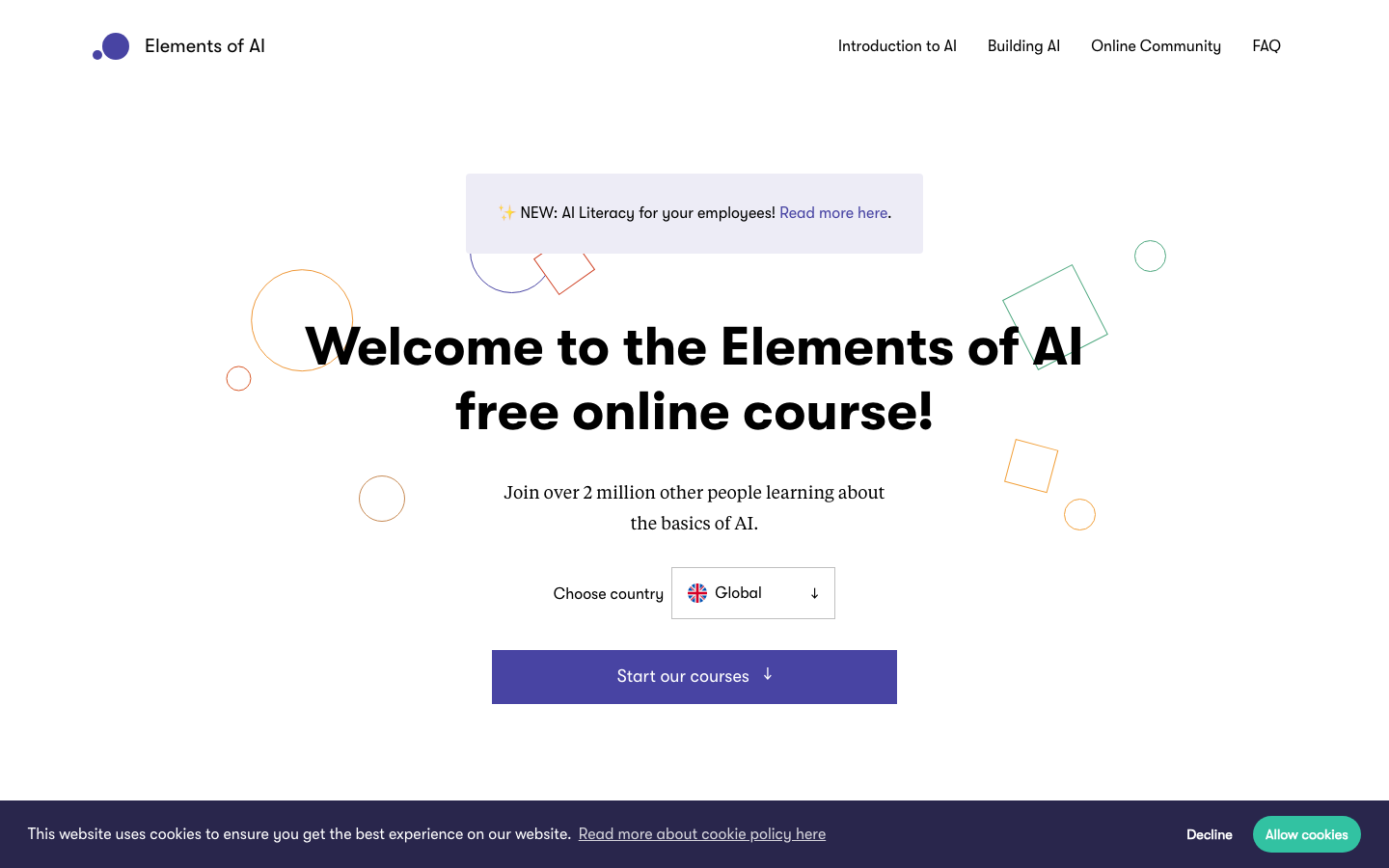
ElementsofAI
Core parameters and statistics
Elements of AI is a free online AI introductory course launched by the University of Helsinki in cooperation with MinnaLearn. The core proposition is to "make AI understandable to everyone" and is aimed at ordinary people without technical background, not engineers.
| Projects | Public Information |
|---|---|
| Positioning | AI introductory course for the public |
| Sponsor | University of Helsinki MinnaLearn |
| Object-oriented | Ordinary people with non-technical background |
| Content Highlights | Basic Concepts, Capabilities and Limitations of AI |
| Completion incentives | Course completion certificate provided |
| Language | Available in multiple languages |
| Price | Free |
Positioning Interpretation: Many people are curious and anxious about AI, but do not have a channel system to understand it. Elements of AI uses popular language and life-like examples to explain clearly what AI is, what it can do, and what it cannot do, lowering the threshold for ordinary people to understand AI.
Boundary Note: It is a literacy course for the general public. It does not teach programming or model implementation. Technical personnel may find the content shallow.
User and market recognition
Elements of AI’s recognition comes from its academic endorsement and wide dissemination.
Academic Endorsement: Produced by the University of Helsinki and promoted as an AI popularization project for the public in Finland, giving it a high reputation internationally.
Multi-language dissemination: Multi-language versions have been launched one after another, covering a large number of learners from non-English-speaking countries. It is one of the representative courses for popularizing AI literacy.
Items to be verified: Specific statistics such as the cumulative number of students and countries covered will be updated periodically and should be subject to official real-time disclosures. It is not appropriate to treat approximate numbers as fixed numbers.
Cost advantage
The cost structure of Elements of AI is very clear: the courses are free.
- C client/individual: The complete course is free to learn and you can get a certificate, which is its biggest advantage.
- Developers/Technicians: The advanced engineering content is not applicable (there is also Building AI for those who want to get started).
- Institution/Enterprise: Employees or the public can be recommended to study for free, and the hidden cost is only study time.
True Cost Structure: Explicit costs are zero and the only investment is learning time. When evaluating, you should focus on whether the depth of content matches your goals - it is suitable for building awareness, not suitable for replacing professional technical training.
Main functions
Elements of AI’s capabilities are organized around “popular AI literacy education”:
- AI Basic Concepts: Explain core concepts such as machine learning, probability, and reasoning.
- Capabilities and Limitations: Explain what AI can and cannot do, correcting common misunderstandings.
- Supporting Exercises: Consolidate understanding through exercises rather than purely passive reading.
- Certificate of Course Completion: Provide a certificate after completion to increase learning motivation.
The key to the value of content lies in “understandability”: using the least mathematical threshold to allow ordinary people to establish a correct understanding of AI.
Model and version evolution
Elements of AI operates as an online course that is continuously maintained, and the version context is mainly content expansion.
- First online (~2018): The course is open to the public and spreads quickly.
- Multi-language and advanced (subsequent): Launch multi-language version, and expand the "Building AI" advanced content for those who want to get started.
- Current Form (~2026): Continuously provided as free online courses.
The official unified version number and precise date have not been disclosed, and the version context is expressed in public milestones.
Technical advantages
As a course, its advantage lies in "instructional design" rather than technology:
Mechanism: Break down AI concepts into life-like cases and lightweight exercises to minimize the threshold for mathematics and programming.
Effect: Allow people without technical background to understand the basic principles and boundaries of AI instead of staying at the terminology level.
Applicable scenarios: Most suitable for ordinary people, managers and cross-industry practitioners who need to establish basic understanding of AI.
The price is that the content is introductory and cannot meet the needs of in-depth technical learning.
How to use
Elements of AI is available for online learning through the official website:
| Usage | Suitable objects | Features |
|---|---|---|
| Online courses | General learners | Free registration to study by chapter |
| Supporting exercises | Consolidate understanding | Practice while learning |
| Course Completion Certificate | Those who need a certificate | Obtain a certificate upon completion |
The typical process is "Register → Study by chapter and complete exercises → Obtain certificate". It does not require any prior technical knowledge and can be completed at your own pace.
Product Pricing
Elements of AI is completely free, and there are no fees for courses and certificates. The specific available range is subject to the official real-time page.
- Individual: Learn for free and get a certificate.
- Institution: can organize learning for employees or the public for free.
Application scenarios
- Popularization of AI to the Masses: Help ordinary people build AI awareness, and the focus of verification is whether the content is easy to understand.
- Managers and cross-industry practitioners: Understand the capabilities and limitations of AI to assist decision-making, focusing on practicality.
- Springboard for entry: As a cognitive foundation before in-depth learning, the focus of the verification is the connection with subsequent learning.
Applicable people
- People with non-technical background: Want to learn about AI but are worried that the threshold is too high.
- Business Managers: Need to understand the impact of AI on the business.
- Students and practitioners across industries: Building basic AI literacy.
The unsuitable situation is: technical personnel who want to learn in-depth engineering content such as programming and model training. They are more suitable for advanced courses rather than this introductory course.
Summary and Outlook
The core value of Elements of AI is to use academic endorsement to make introduction to AI a free, popular, multi-lingual literacy course. It is a representative project to popularize AI awareness. Free and low threshold are its biggest advantages.
The current limitation is that the content is introductory and does not cover in-depth technical practice; its positioning for the public also determines that it is more suitable for "building awareness" rather than "cultivating engineering capabilities." For learners, it is recommended to use it as the first step to understand AI, and then connect to more in-depth technical courses according to the goals.
Related tools:  Khanmigo, quizlet
Business process integration and ROI analysis
As a productivity tool for enterprises or professional positions, the true value of Elements of AI depends on the depth of integration with existing workflows and the quantifiable efficiency improvement effect. The following is a systematic analysis from three core dimensions.
System integration and data interoperability The ability to interoperate with existing business systems is a key prerequisite for productivity tools to be integrated into workflows. It is recommended to focus on evaluating the following integration dimensions: the openness and documentation quality of the RESTful/GraphQL API (whether a complete API reference and SDK examples are provided), the support scope of Webhook event notifications (which business event types are supported for automatic push), the number and depth of pre-built integrations with common collaboration SaaS tools (WeChat Enterprise, DingTalk, Feishu, Slack, Notion, Jira, etc.), and enterprise-level identity authentication support (SSO/SAML/OAuth and LDAP/AD directory integration). Products that lack integration capabilities are easily isolated into information islands, which in turn increases the cognitive cost and operational friction for teams to switch between different tools.
Efficiency Quantification and ROI Estimation Methodology Before purchasing decisions, it is recommended to quantify the input-output ratio through a structured method: Step 1, choose 3-5 Standardized tasks that are frequently repeated and time-consuming in each team are used as test samples; in the second step, the average time consumption of a single task before and after tool intervention, first-time pass rate or error rate, and the number of links requiring manual intervention are recorded under controlled conditions; in the third step, the saved manpower time is converted according to the comprehensive cost of the position (salary, benefits, management sharing), and soft benefits (increased employee satisfaction, standardization of work quality, and improvement in response speed to core business) are superimposed to obtain a comprehensive ROI estimate. It is recommended to continue tracking ROI trends on a monthly basis, as the value of a tool usually increases over time as team proficiency increases and workflows are optimized.
Phase-based implementation strategy and risk control It is recommended to adopt a three-stage implementation path of "pilot verification-gradual promotion-continuous optimization". In the pilot stage (1-2 weeks), a single team or a single business scenario is selected for small-scale verification. The core goal is to verify technical feasibility and user acceptance, and establish preliminary usage specifications and success standards; in the promotion stage (2-4 weeks), after the pilot verification is passed, the coverage is gradually expanded, and standardized activation processes and training materials are developed; in the optimization stage (continuous), the workflow configuration is continuously adjusted based on actual usage data and user feedback, and more high-value application scenarios are explored. Clear quantitative key result indicators should be set at each stage to avoid blindly expanding the scope of use without data support.
Version Info
- Elements of AI (current online course) :It is currently provided as a free online course, including introductory AI theory and supporting exercises, and is available in multiple languages. The official unified version number has not been disclosed, and there is no official precise date yet. It is recorded according to the current course form.
- Course online for the first time :The course was first launched online by the University of Helsinki and MinnaLearn, and was subsequently launched in multi-language versions and expanded to advanced content such as "Building AI". There is no official precise date yet, it is recorded according to public milestones.
User Reviews