 Eleven Music
Free
Eleven Music
Free
Eleven Music is an AI music generation platform built by ElevenLabs around Music v2. It provides not only a discovery and creation workbench for creators, but also an authorized music market for commercial content teams and a Music API for developers.
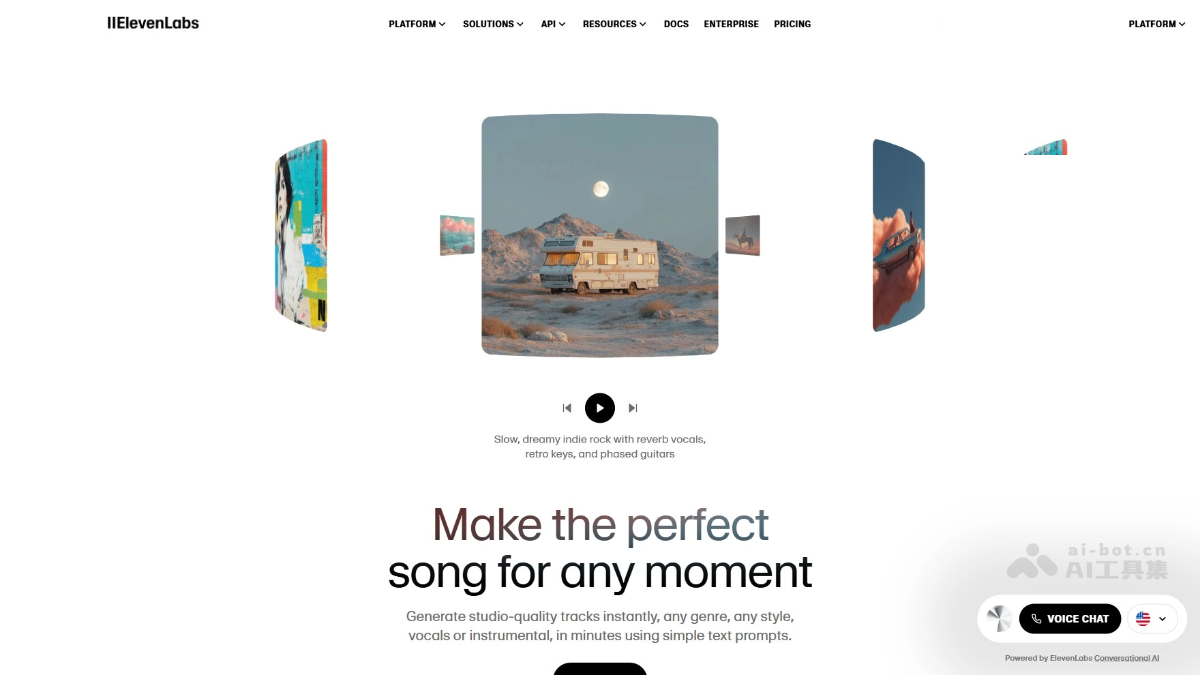
ElevenMusic
Core parameters and statistics
Eleven Music is not simply "text generates a song", but splits music generation into three product lines to operate simultaneously: the creator workbench ElevenMusic, the commercial licensing platform ElevenCreative, and the developer access layer ElevenAPI. The official now regards Music v2 as the main version, emphasizing stronger vocal complexity, more detailed local redrawing, more stable multi-language generation, and an authorization model that can be directly used for commercial content.
| Projects | Public Information |
|---|---|
| Current master model | Music v2 |
| Product form | Web creation platform + commercial licensing market + API |
| Core Competencies | Prompt composition, partial inpainting, genre switching, multi-language lyrics |
| Commercially licensed representation | Trained on licensed data only |
| Export format | MP3, WAV related download scenarios |
| Applicable content | Advertising, branded content, videos, podcasts, games, movies |
| API Capabilities | Generation, reference matching inpainting, long track composition |
| Platform entrance | Three paths: Discover, Creative, and API |
A brief review: The real selling point of Eleven Music is not "AI can write songs", but "after writing this song, can you actually use it for commercial use, then edit it, and then embed it into the product?"
Promotion verification: The official core promotion is "Designed for commercial use", which is more important than simply talking about sound quality. For advertising, video and game content teams, whether they dare to use it commercially affects purchasing decisions more than whether they can produce a melody.
User and market recognition
Eleven Music relies on the audio brand potential of ElevenLabs, so its market recognition is naturally higher than that of many independent music generation start-ups. The official website not only displays the tracks and Live Sessions that can be listened to, but also releases endorsements from partners and industry practitioners, emphasizing that it can serve both senior producers and lighter content creators.
Expert’s View: The most difficult thing about this type of product is not the first time it’s released, but convincing the business team that “I won’t step into copyright pitfalls when I use it.” Eleven Music is obviously more radical in this regard, because it puts licensing, market distribution and API together from the beginning, which shows that it does not just want to eat creative inspiration, but wants to eat commercial audio workflow.
Hidden benefits: Once the advertising team can complete generation, audition, partial redrawing, download authorization and secondary modification on the same platform, it will reduce the back-and-forth communication with external music libraries, producers and legal affairs.
Current Limitations: The public page does not disclose the quota, single limit, concurrency capacity or enterprise version price under the specific payment tier, which means that business confirmation is still required before truly large-scale purchases.
Cost advantage
- C-side/Individual: Usually a free version is provided to experience the core functions, and high-frequency use requires a paid package subscription.
- API/Developer: Billed by call volume, suitable for development teams that can be flexibly integrated into their own systems.
- Enterprise/Privatization: Contact the business owner to obtain customized quotation and deployment plan. The specific price is subject to the official real-time pricing page.
Main functions
- Text-generated music: Set style, mood, instruments and structure through prompts to quickly get a complete song or soundtrack.
- Partial inpainting: Only regenerate a certain section, without having to reinvent the entire song. It is suitable for fine-tuning the chorus and rhythm of the bridge section.
- Genre switching midway: Supports genre transition within a song, suitable for advertising and narrative content.
- Multi-language creation: Supports multi-language lyrics and singing styles in English, Spanish, French, German, Japanese, etc.
- Commercial Licensing Market: Creators can publish their works, and brands and content teams can purchase or use them directly for commercial content.
- Music API: supports programmatic generation, reference audio control and segment editing, and can be embedded in third-party products.
Expert’s perspective: The two points of partial inpainting and commercial licensing are put together, which is what separates it from many “AI music toys”. The former allows you to really do detailed repairs, and the latter allows the team to dare to use it.
Model and version evolution
The clearest evolution line of Eleven Music at present is to move from Music v1 to Music v2, and on this basis, separate product layers for different customer groups.
Model mainline: Music v1 to Music v2
The official FAQ and API pages clearly mention that Music v1 coexists with Music v2. The current key resources on the official website are all biased towards Music v2, indicating that it has become the main promotion capability.
Product main line: from generator to three-tier platform
The current platform is divided into at least three levels: ElevenMusic, ElevenCreative, and ElevenAPI, which respectively serve creator discovery and interaction, commercial authorization and team use, and developer embedded access.
Main line of commercialization: from work generation to Marketplace
The emergence of Marketplace shows that the product is not satisfied with "making a song", but manages the circulation, downloading, authorization and monetization of works. This is a more important business platform approach.
Technical advantages
Eleven Music’s technical advantages can be broken down into a three-layer causal chain.
Mechanism: The model supports prompt-level control, local inpainting, reference audio guidance, multi-language lyrics and mid-stream genre switching.
Effect: Creators do not have to regenerate the entire song every time, and it is easier for the business team to fine-tune the existing version instead of getting a fixed result of "okay but not enough".
Applicable scenarios: advertising soundtracks, brand videos, podcast packaging, game music prototypes, and music experimental content.
Publicity Verification: The official website puts "licensed data only" very front. This is not a marketing rhetoric, but an attempt to separate itself from generators whose copyrights are unclear. For corporate customers, this is a very practical positioning.
How to use
| How to use | Public entrance | Suitable for the crowd | Points to note |
|---|---|---|---|
| ElevenMusic | Music discovery and creation | Independent creators | Focus on style control and editability |
| ElevenCreative | Commercial authorization and team use | Brand, advertising, video team | Focus on the scope of authorization |
| ElevenAPI | Programmatic access | Developers, product teams | Focus on confirming the quota, stability and call cost |
API Example:
import { ElevenLabsClient } from "@elevenlabs/elevenlabs-js";

const client = new ElevenLabsClient();

const track = await client.music.compose({
  modelId: "music_v2",
  prompt: "Create an energetic electronic track for a game trailer.",
  musicLengthMs: 10000,
});
3-minute tip to get started: Don’t just write “generate an epic song” right off the bat. First clarify the purpose, whether it is an advertisement, podcast title or product demo, and then clearly state the style, rhythm, mood and whether a human voice is required, the result will be much more stable.
Product Pricing
The pricing model is subject to the official real-time page. Usually a freemium or subscription system is used, and basic functions can be used for free. Advanced functions or high-frequency use require paid subscriptions, and users are advised to evaluate the optimal solution based on actual usage.
Application scenarios
- Advertising and Branding Short Films: Quickly produce commercially available background music and brand theme song variations.
- Podcast and video content: Create openings, endings, atmosphere and theme variations.
- Game prototype and interactive experience: First use API to quickly verify different emotions and scene music.
- Indie Music Composition: for experimenting with lyrics, melodies, paragraph structures, and style.
Dimensionality reduction attack scenario: For music teams that require a large amount of content that is "easy to use, authorizable, and quick to change", it is more flexible than traditional music outsourcing.
Applicable people
- Advertising & Branded Content Team: Best fit because they care about both speed and licensing.
- Independent Creators and Musical Experimenters: Perfect for quickly experimenting with melodies, lyrics, and style mashups.
- Developers and Creation Platform Team: Music generation capabilities can be embedded via API.
Dissuaded/not applicable to people:
- A professional recording project that pursues a complete live-action production process and top-notch post-production refinement.
- Businesses that require fully transparent fixed-price procurement but are currently unable to accept the business confirmation process.
- A team that is extremely sensitive to copyright but unwilling to take model-specific terms seriously.
Summary and Outlook
The competitiveness of Eleven Music is not just that the model can sing and change styles, but that it puts creation, editing, licensing and access into the same product matrix. The hidden benefit lies in reducing the friction in cross-music libraries, outsourced production and legal communication. The hidden cost lies in the fact that aesthetic judgment, version screening and commercial use terms still need to be checked by the team themselves. To the content team, it's more like a "commercial content music infrastructure" than an a la carte creation toy.
Current Limitations: Official public pricing, enterprise limits, concurrency limits, and full SLA are still opaque. Procurement/Adoption Risk Assessment: It is suitable to pilot a specific business first, such as an advertising short or podcast title, to verify the production quality, editing flexibility and licensing clarity, and then decide whether to expand to a more core brand music workflow.
Related tools:  ElevenLabs, udio
Version Info
- Music v2 :The official currently focuses on Music v2, whose key capabilities include more complex vocals, partial inpainting, mid-stream genre switching, multi-language creation and commercial use authorization. There is no official precise date yet.
- Music Marketplace stage :The current official website has packaged creator discovery, music trading and commercial licensing as Marketplace capabilities, indicating that the product has expanded from a simple generation tool to a distribution and licensing platform.
- Music v1 :The official FAQ clearly states that both Music v1 and Music v2 can be used through ElevenAPI and can be regarded as the previous generation public model capabilities of the current platform. There is no official precise date yet.
User Reviews