 Exa
Exa
Exa is a neurosemantic search API built specifically for AI applications that performs web searches based on embedding vector similarity (rather than keyword matching) and can return complete web page text content. Compared with traditional keyword search APIs, Exa is better at understanding search intent and is the core data source tool for RAG system AI Agent and research applications.
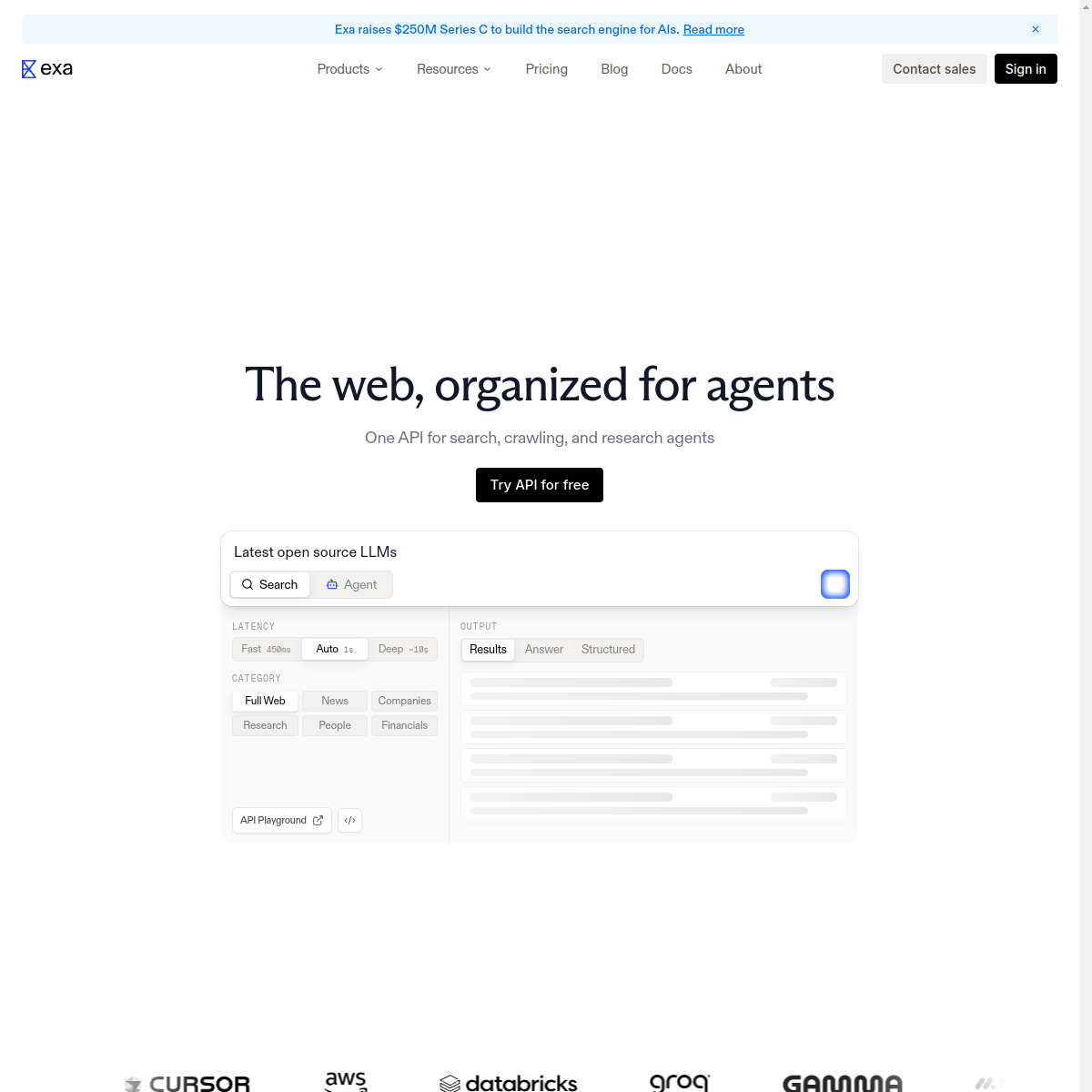
Exa — Neuro-semantic search API designed for AI applications
Core parameters and statistics
| Parameters | Details |
|---|---|
| Core Technology | Embedded Vector Similarity Search (Neural Semantic Search) |
| Search mode | Neural (semantics), Keyword (keywords), Auto (automatic mixing) |
| Contents API | Returns the complete web page text without crawling it yourself |
| Free quota | 1000 requests/month (free tier) |
| Scale Plan | Starting at $20/month, billed per request |
| Main usage scenarios | RAG system AI Agent, research tools, news aggregation |
| SDK support | Python, TypeScript (official SDK) |
| Founder | Jeff Huber, founded 2022 |
| Company predecessor | Neural.link (renamed Exa in 2023) |
| Competitive Positioning | Semantic Search Alternatives to Google Search API and Bing API |
The core innovation of Exa is to upgrade the search from "keyword matching" to "semantic intent matching" - traditional search APIs are sorted based on the frequency of occurrence of keywords in documents, while Exa trains a specialized network embedding model to find the page that is semantically closest to the query intention through vector similarity, and can accurately retrieve even if the query term does not appear in the original text.
User and market recognition
Exa has gained widespread attention in the AI developer community for its unique semantic search capabilities, and has become one of the official integrated data sources of mainstream RAG frameworks such as LangChain and LlamaIndex. With the explosive growth of AI Agent and RAG applications in 2023-2024, the user base of Exa API has rapidly expanded from early niche experimental projects to production-level AI application development teams.
On GitHub and developer blogs, Exa often appears in the recommendation lists of "AI Agent Tool Chain" and "RAG System Construction", and is evaluated as a solution that is significantly better than Google and Bing API in scenarios where "requiring understanding of search intent rather than precise keyword matching". Several AI startups use Exa as the core search data source for their products, verifying its reliability and performance in production environments.
Cost advantage
| Plan | Price | Main Features | Suitable for People |
|---|---|---|---|
| Free tier | $0 (1000 times/month) | Basic search API, development and testing purposes | Evaluation and small project developers |
| Scale | From $20/month | Higher request quota, Contents API access | Small to medium-sized AI applications |
| Enterprise | Customized quotation | High concurrency, dedicated support, custom SLA | Enterprise-level AI application |
Comparing Google Custom Search API ($5/1000 queries) and Bing Search API ($7/1000 queries), Exa usually requires fewer queries to obtain target content in semantic search scenarios (because semantic search accuracy is higher), and the overall cost of use is equivalent to or even lower than competing products. The Contents API reduces the infrastructure costs of developers building their own crawlers, further improving overall TCO competitiveness.
Main functions
- Neural (Neural Semantic) Search: Based on an embedding model trained on massive network data, it matches the most semantically relevant web pages through vector similarity. It is suitable for query scenarios such as "finding content similar to a certain description" and "finding articles of a certain type" with clear semantic intentions but unfixed keywords.
- Keyword (keyword) search: Traditional BM25 keyword matching search, suitable for precise vocabulary search, entity name search and scenarios that require precise text matching, complementary to Neural mode.
- Auto (automatic hybrid) mode: intelligently determines the query type and automatically switches between Neural and Keyword modes without the need for developers to manually select. It is suitable for general scenarios where the distribution of query types is uncertain.
- Contents API (full text content return): The search results directly include the complete text of the web page, developers do not need to crawl and parse the web page themselves, significantly simplifying the RAG system data pipeline, supporting interception based on word limit, and reducing Token consumption.
- Highlights (Key Paragraph Extraction): Intelligently extract the key paragraphs most relevant to the query from the full text of the web page, and return them as the Highlights field, which is more accurate than the complete full text, and is suitable for AI applications that require precise citations.
- Summary (intelligent summary): Generate AI summaries for the web content of each search result, complete content extraction at the API level, and directly return high-density information summaries that can be used in LLM context.
- findSimilar (similar content discovery): Given a URL, return other web pages that are semantically similar to it, suitable for scenarios such as content recommendation systems, competitive product analysis, and academic citation chain tracking.
- Python/TypeScript SDK: Officially provides Python and TypeScript SDK. Basic integration can be completed with 3 lines of code. It is natively compatible with mainstream AI frameworks such as LangChain and LlamaIndex and can be used out of the box.
Model and version evolution
| Milestone | Time | Description |
|---|---|---|
| Exa was founded (Neural.link) | 2022 | Jeff Huber was founded and began to build neural search technology infrastructure |
| Neural.link API released | ~2023-02 | The first public neural search API, attracting early AI developer users |
| Brand renamed to Exa | ~2023-09 | Renamed and released simultaneously to upgrade the API, introducing findSimilar and Auto modes |
| Python/TS SDK released | ~2023-10 | Official SDK launched, significantly lowering the integration threshold |
| LangChain/LlamaIndex integration | ~2024-01 | Become the official integrated data source of the mainstream RAG framework |
| Contents API endpoint released | ~2024-09 | Full-text content return capability released, becoming a one-stop solution for RAG data pipeline |
Technical advantages
Semantic search optimized for AI applications: Traditional search APIs return optimized results for the usage scenario of "users entering keywords in the search box"; Exa's training data and model design focus on scenarios where "AI applications perform programmatic queries on behalf of users", and its embedded model understands "what is this text saying" rather than "what words does this text contain". This essential difference gives it a significant advantage in AI application integration.
Contents API solves the core pain point of the RAG data pipeline: When building a RAG system, "searching for relevant web pages" is only half of the work. Developers also need to handle tedious steps such as web page crawling, HTML parsing, and text extraction. Exa Contents API encapsulates this complete process in a single API call and directly returns structured plain text, which greatly simplifies the RAG data pipeline and is a major improvement in development efficiency.
Complementary advantages of Neural + Keyword hybrid architecture: Pure semantic search is not as accurate as keyword matching in precise entity search (such as person names, product models) scenarios; Exa's Auto mode automatically selects the optimal search strategy by intelligently judging query intentions, while maintaining the advantages of semantic search while taking into account precise keyword matching scenarios, covering a wider range of real application needs.
Rich ecosystem integration: Exa is deeply integrated with mainstream AI development frameworks such as LangChain, LlamaIndex, CrewAI, and AutoGen. It is directly available as an official search tool plug-in. AI developers do not need to write custom integration code and can quickly enable Exa's semantic search capabilities in existing AI Agent frameworks.
How to use
| Entrance | Description |
|---|---|
| API registration | Visit https://exa.ai to register an account and obtain API Key. The free tier provides 1000 times/month |
| Python SDK | pip install exa-py installation, 3 lines of code to complete basic search integration |
| TypeScript SDK | npm install exa-js installation, for Node.js and Next.js apps |
| LangChain integration | Use the ExaSearchRetriever tool to use Exa search directly in the LangChain chain |
| API Playground | Visit https://exa.ai/api-playground to test search results online without writing code |
Typical usage steps (Python RAG integration):
- Visit https://exa.ai to register an account and create an API Key in Dashboard.
- Install SDK:
pip install exa-py. - Initialize the client:
from exa_py import Exa; exa = Exa("YOUR_API_KEY"). - Perform a semantic search and get the full text:
results = exa.search_and_contents("your query", type="neural", num_results=5). - Inject the returned
results.results[i].textas context into LLM Prompt to complete the RAG process. - Based on usage requirements, upgrade to a suitable paid plan in the Dashboard.
Product Pricing
Exa uses a pay-per-use API pricing model:
- Free Tier: 1,000 search requests per month, includes basic search functionality and limited Contents API access, suitable for development testing and small-scale projects, no credit card required.
- Scale Plan (from $20/mo): Higher request quotas, full Contents API access (full text Highlights, Summary), pay-as-you-go billing, suitable for medium-sized AI applications.
- Enterprise: Customized high-concurrency solution, dedicated customer support SLA guarantee and compliance requirements are met, suitable for enterprise customers who use Exa on a large scale in production environments.
- Contents API (full text content) additional billing: The unit price of a request to obtain complete web content is slightly higher than that of a pure search request, and is billed based on the volume of returned content (number of words). The specific unit price is subject to the latest official price list.
Application scenarios
-
RAG (Retrieval Augmented Generation) system core data source: When building LLM-based Q&A systems, knowledge base assistants, and research tools, Exa is used to search real-time network information as the contextual basis for LLM answers. The Contents API directly returns the complete text, eliminating the need for web page crawling. This is currently the most common Exa usage scenario.
-
AI Agent's network search tool: AI Agent built for LangChain, CrewAI, AutoGen and other frameworks integrates Exa search tools, allowing the Agent to actively search for relevant network information when performing tasks. Neural semantic search allows the Agent to find "conceptually relevant" content rather than just keyword matching results.
-
Competitive product and market research automation: Use the findSimilar function to discover content that is semantically similar to specific competing product websites or articles, build automated competitive product monitoring and market research tools, and track the latest developments in a certain subject area.
-
Personalized content recommendation engine: Based on the URL of the content the user has read, use findSimilar to discover other articles or resources with similar semantics, and build a recommendation system for "content you may be interested in after reading this". Semantic similarity can capture the deep meaning of the content better than traditional recommendations based on tags.
-
Academic and professional research assistance: Provides semantic search capabilities for academic search tools and professional research assistants, helping researchers find documents, reports and analyzes that do not exactly match the keywords but are highly relevant to the subject, and improve the recall rate of information discovery in professional fields.
Applicable people
- AI application developers: Engineers who build RAG system AI Agents and intelligent dialogue products, developers who need to inject real-time network information into LLM.
- LLM Application Architect: Architect designing data pipelines for AI applications, looking for a one-stop search data API that can simplify the search-crawl-parse process.
- AI Startup: AI startup teams that use web search capabilities as the core function of their products need scalable search infrastructure.
- Research Tool Developers: Developers who build academic search, market research and competitive product analysis tools, benefiting from the high accuracy of semantic search in professional fields.
- Unsuitable Scenarios: Daily search needs of ordinary Internet users (Exa is an API product and does not have a search interface for end users); applications that require localized search (maps, business information, local news) (Exa focuses on semantic web search); individual developers with extremely limited budgets (the free quota of 1,000 times/month may not be enough for production).
Summary and Outlook
Exa accurately addresses the core requirement of "AI applications need to access real-time network knowledge" brought about by the explosive growth of AI applications. With the combination of neurosemantic search and Contents API, Exa upgrades the "keyword index" paradigm of traditional search APIs to the AI native search paradigm of "semantic understanding + content delivery". In the context of RAG and AI Agent becoming the standard architecture for AI applications, Exa's market timing and product positioning are highly consistent.
Current limitations: The language and content covered by the search tend to be in English; for very new hot content, the search coverage may not be as good as Google; semantic search still needs to rely on Keyword mode supplementation in precise entity query scenarios; pricing is costly for high-frequency production applications, and request efficiency needs to be carefully optimized.
Follow-up focus: Continuous iteration of neural search models (higher recall, lower latency), expansion of multi-language semantic search capabilities, deep integration with more AI development frameworks, and the construction of enterprise-level product capabilities (private deployment, internal document search, etc.) will determine whether Exa can expand from an AI developer tool to a broader enterprise search infrastructure market.
Related tools: perplexity, you-com
Version Info
- Exa Contents API Full Text Content Endpoint :Launched the Contents API endpoint, which supports the direct return of complete web page text in search results, eliminating the need for developers to crawl and parse web page content by themselves, greatly simplifying the RAG system construction process. At the same time, it supports Highlights summary extraction and Summary intelligent summary options, making the Exa API a one-stop solution from search to content acquisition, and a core search component in the AI Agent tool chain.
- Rebranded to Exa :The brand was renamed from Neural.link to Exa, and the upgraded search API was simultaneously released, introducing new features such as findSimilar (similar content discovery), neural search and keyword search hybrid mode (Auto mode), and the Python and TypeScript SDKs were officially released, further lowering the integration threshold for developers and accelerating user growth.
- Neural.link brand launch :The neural search API product was launched under the Neural.link brand, providing external developers with semantic search API access based on embedding vector similarity for the first time. It attracted a large number of early developers who were building RAG systems and AI applications, began to build a reputation in the AI development community, and received seed round financing support.
User Reviews