 Exa AI
Exa AI (formerly Metaphor) is a search engine and retrieval API designed specifically for AI models. It uses meaning-based neural search to provide high-quality, programmable web content retrieval for AI agents and RAG applications.
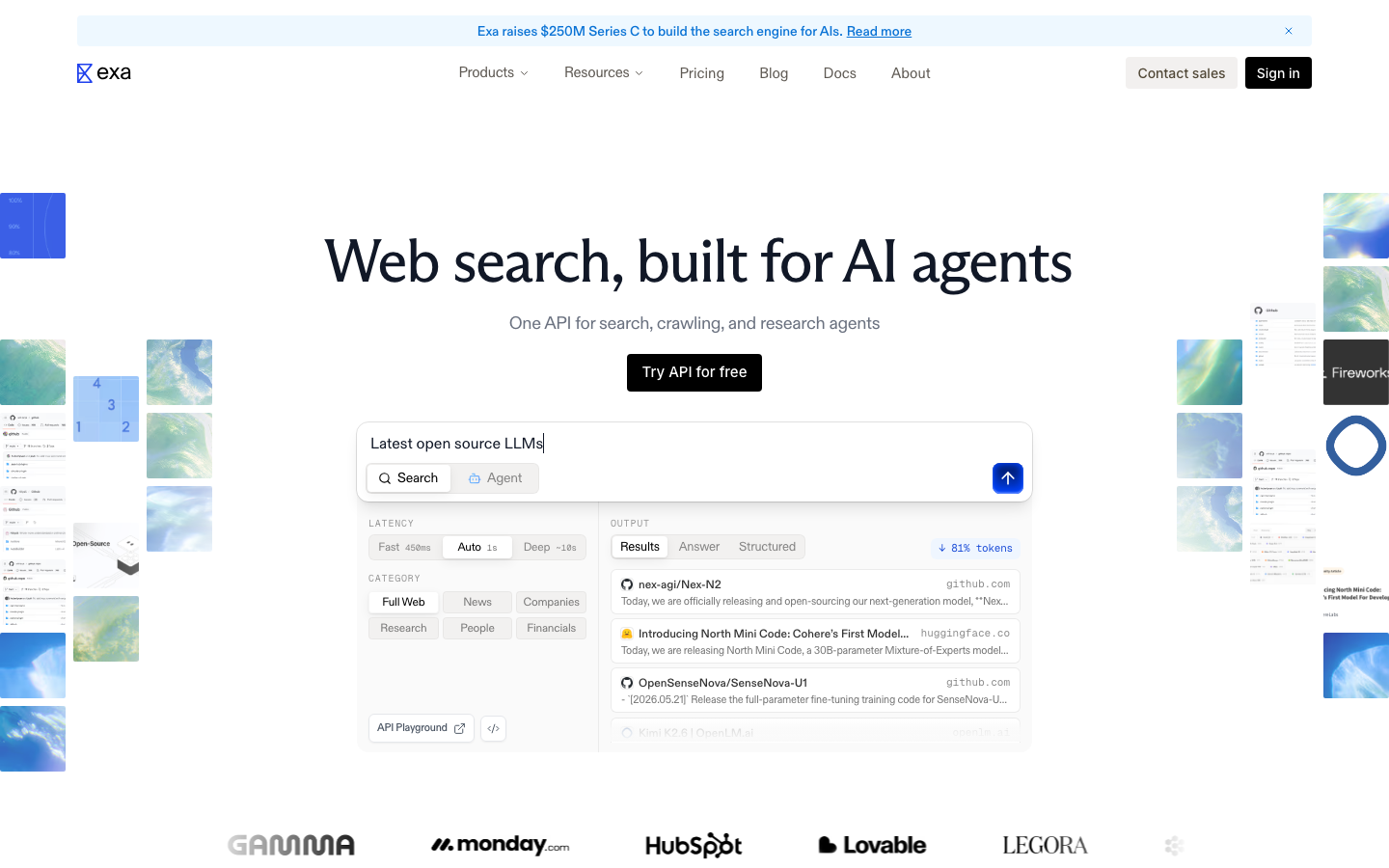
ExaAI
Core parameters and statistics
Exa AI is not a search engine that allows people to "use a browser to search for things", but a search infrastructure for AI models. Its core positioning is: when large models need to obtain accurate and relevant content from the Internet, Exa uses "meaning-based neural search" to return results and text suitable for feeding LLM, thus solving the problem of traditional keyword search results being noisy and unfavorable to RAG.
| Projects | Public Information |
|---|---|
| Product Form | Neural Search Engine + Search API |
| Developer | Exa (formerly Metaphor Systems) |
| Core Technology | Semantic/vector-based neural search |
| Main capabilities | Neural search, similar retrieval, content and highlight extraction |
| Target Scenario | RAG, AI Agent, Research and Data Collection |
| Support Platform | Web, API |
Machine-oriented: The results of Exa are not optimized for human eye typesetting, but optimized for model consumption - directly returning structured relevant links and text, reducing the cost of the Agent crawling and cleaning web pages on its own.
Semantic retrieval: Compared with keyword matching, neural search recalls by "meaning" and is more suitable for common demands of AI applications such as "finding pages similar to this content" and "finding resources that match a certain description".
API first: Its value is mainly reflected through the API, and developers regard it as the "networked search layer" of LLM rather than the end user's search website.
User and market recognition
Exa’s recognition mainly comes from developers and the AI application ecosystem, rather than the mass consumer market. The official unified number of users has not been disclosed, but its positioning accurately meets the rigid needs of RAG and Agent for "high-quality network search".
Clear ecological niche: In the AI application stack, Exa occupies the "retrieval layer" and cooperates with the vector database LLM orchestration framework. It is a common component for building networked agents and research tools.
Discussion Focus: Developers focus on the quality of their recall, the cleanliness of text extraction, and the cost and stability advantages over self-built crawler + cleaning pipelines.
Prerequisites: The value of Exa is most obvious in "AI applications that require reliable network information"; if the application itself does not rely on real-time web content, its necessity will decrease.
Cost advantage
The cost advantage of Exa is not that it is "cheaper than Google", but that it saves developers the engineering and maintenance costs of building their own web crawling, cleaning and semantic retrieval systems.
- Developer/API: Billed based on the amount of calls, and a certain free quota is provided for trial use. The specific unit price and quota are subject to the official pricing page.
- Team/Enterprise: Can be purchased according to higher usage and stability requirements, with speed and concurrency terms, subject to business confirmation.
Real Cost: The hidden cost of building a self-built "crawling-denoising-vectorization-retrieval" pipeline is extremely high (engineering, compliance, maintenance). Exa turns this part into measurable API fees. Whether it is cost-effective depends on the frequency of retrieval calls and the requirements for result quality.
Main functions
Exa's capabilities are designed around "providing clean, relevant web information to models":
- Neural Search: Recall pages based on semantics rather than keywords, suitable for vague or descriptive queries.
- Find Similar: Given a link, return other pages with similar content to facilitate expansion of information sources.
- Content and Highlight Extraction: Directly return the page text or highlighted fragments related to the query, eliminating the need for the Agent to crawl and clean by itself.
- Structured results: Returned in a format suitable for LLM consumption, making it easy to splice directly into RAG prompt words.
The synergy of these functions is that it compresses "search-crawl-cleaning-extraction" into a single API call, allowing the Agent to obtain available network knowledge with lower engineering complexity.
Model and version evolution
The evolution of Exa is a route "from search website to retrieval infrastructure":
Backbone node
- Metaphor (~2023): Started as a "search engine designed for AI".
- Renamed to Exa (~2024): Strengthen the retrieval API and content extraction capabilities, and clarify the infrastructure positioning for RAG/Agent.
Since Exa is delivered in the form of a continuously iterative API instead of being released according to a fixed version number, the capability boundaries (such as retrieval types, content extraction options, rates) will be updated with the official documents, and the official real-time API documents should be used for evaluation.
Technical advantages
Exa’s technical advantages focus on “retrieval quality” and “model optimization”:
Semantic Recall: Meaning-based neural search is more suitable for descriptive queries of AI applications and reduces the noise of keyword searches.
Text Friendly: Directly return the cleaned content and highlights, eliminating the fragile hassle of Agent capture and denoising.
Simple integration: As an API layer, it can quickly connect to mainstream LLM orchestration frameworks and become the retrieval backend of networked Agents.
The price is: it is a hosting service, developers need to accept pay-as-you-go billing and rate constraints, and search coverage and timeliness depend on Exa’s indexing strategy, which cannot be fully customized like a self-built system.
How to use
| How to use | Suitable for the crowd | Features | Cost |
|---|---|---|---|
| Search API | Developer | Programmed neural search and content extraction | Pay-as-you-go billing, including free quota |
| RAG Integration | AI Application Team | Networked Retrieval Layer as LLM | Random Call Volume |
| Research/Data Collection | Data and Research Team | Batch Expand Information Sources with Similar Search | Volume of Calls |
Suggestions for actual use: First use the free quota to test the recall quality and text extraction effect on real queries, and compare the cost and stability of the self-built crawling solution; after confirming that the demand is met, evaluate the monthly cost based on the expected call volume and connect to production.
Product Pricing
Exa is mainly billed based on API usage:
- Developer/Individual: Provide free quota for trial and small-scale integration.
- Paid amount: Billed based on search calls and content extraction volume. The unit price is subject to the official pricing page.
- Enterprise: High usage, higher speed and stability guarantee require business confirmation.
Since pricing adjusts with usage tiers and product iterations, the actual quota and unit price are subject to the real-time page of the Exa official website.
Application scenarios
- RAG App: Provides real-time, relevant online content for Q&A and knowledge assistants.
- AI Agent: As the Internet search backend of Agent, it supports research, investigation and information aggregation tasks.
- Data collection and research: Use similar search to discover similar pages in batches and build a collection of information sources.
Not suitable for: Generic web search experiences for end users, or offline applications that don’t require live networked content.
Applicable people
- AI application developers: Need to provide LLM with reliable network retrieval capabilities.
- RAG/Agent Team: Hope to reduce the engineering burden of self-built grabbing and cleaning pipelines.
- Research and Data Team: Need to discover and extract web content in batches based on semantics.
Not suitable for: ordinary users who only need personal browsing search, and teams that require complete customization of search logic and prefer to build their own systems.
Summary and Outlook
The core value of Exa AI is to be the "retrieval layer of AI" - using neural search and text extraction to turn the messy Internet into a high-quality information source that can be directly consumed by models. It is not a search website for humans, but an infrastructure component in the RAG and Agent application stack.
As the demand for "reliable networked knowledge" from Agent applications increases, the value of these specialized search APIs will continue to increase. Implementation suggestions: First use the free quota to verify the recall quality and text cleanliness, and then calculate the cost based on the actual call volume; before scaling up, you need to confirm the rate limit, content coverage, and enterprise-level SLA terms.
Related tools: perplexity, you-com
Version Info
- Exa Search and Retrieval API :Exa uses search and content retrieval API as its core product form to provide services to the outside world. It supports neural search, similar retrieval and content/highlight extraction, and is oriented to RAG and Agent applications. There is currently no official unified version number release rhythm, and specific capabilities are subject to official real-time documents.
- Metaphor Systems (before name change) :Exa's predecessor was Metaphor Systems, which was also positioned as a "search engine designed for AI." It was later renamed Exa and strengthened its search API capabilities. There is no official precise date yet.
User Reviews