 FakeYou
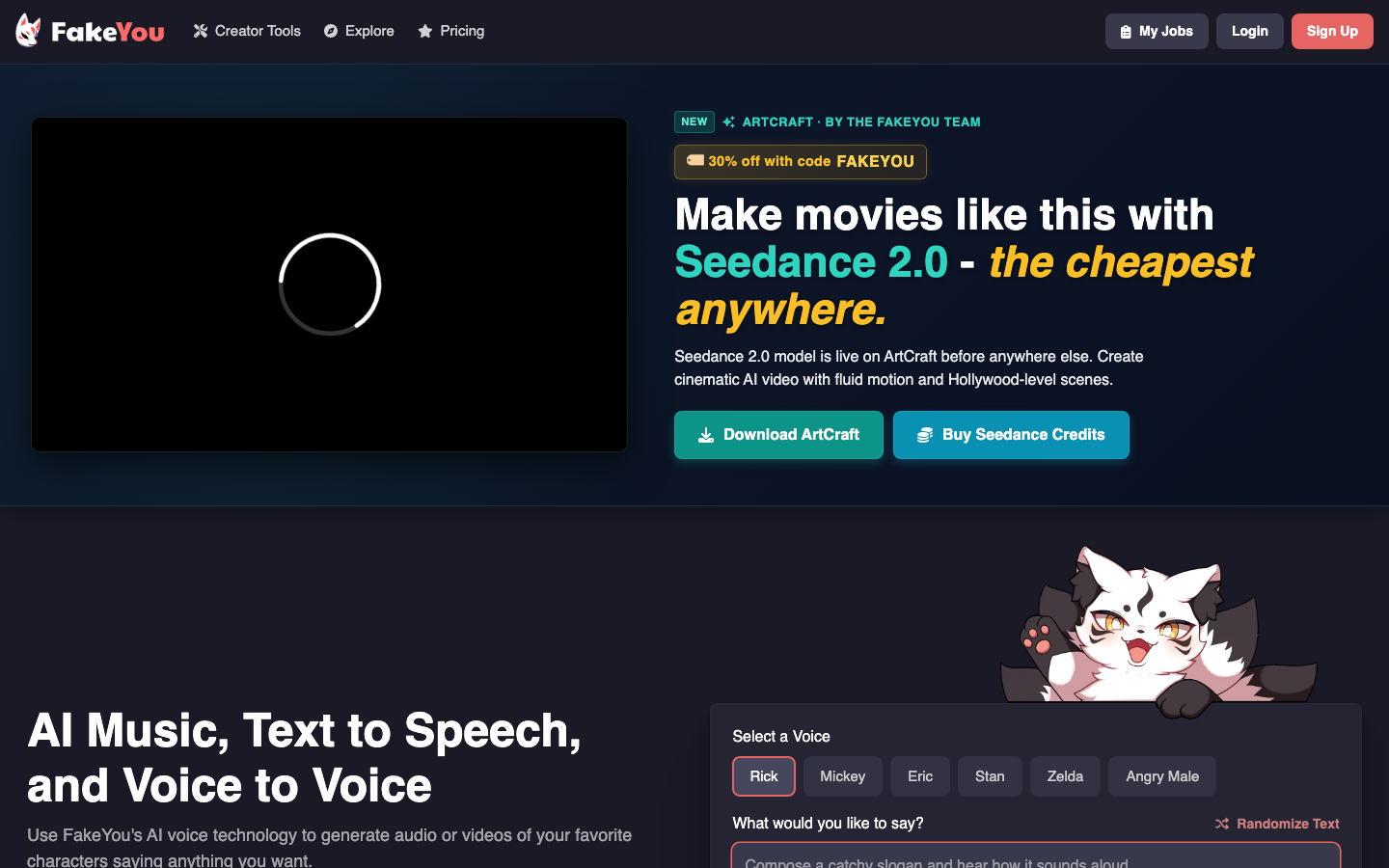
FakeYou provides speech synthesis and character voice cloning based on deep learning, supporting thousands of film and television characters and celebrity voices. Users can input text to let the characters "speak".
FakeYou
Core parameters and statistics
FakeYou's unique positioning lies in "entertainment-oriented voice cloning" - its voice library is not standard broadcasting timbres, but film and television characters and celebrity voices. This constitutes a segmented track in the AI speech synthesis market that has almost no direct competition.
| Projects | Public Information |
|---|---|
| Official positioning | Cartoon and Celebrity Text to Speech |
| Core capabilities | Character voice TTS, voice-to-speech, custom voice cloning |
| Voice library size | Thousands of character/celebrity voices (animation, film and television, games, celebrities) |
| Input method | Text input + sound model selection + recording upload |
| Output format | WAV, MP3 |
| How to use | Web client + API access |
| Public user count | More than 10 million users (official website statement) |
| Investment Background | Techstars Incubator Support |
| Community Operations | Discord, Reddit (r/StoryTeller), Twitter, TikTok, Twitch |
| Latest version | 2026.1 (~2026-01, no official precise date yet) |
| Support Platform | Web, API |
Core Difference: FakeYou has one of the largest character voice libraries in the industry, covering everything from Dragon Ball's Son Goku to Christopher Lee's classic voices, which is almost non-existent in other TTS tools (such as ElevenLabs, PlayHT). It is not a tool designed for podcast dubbing or customer service voice, but for the entertainment needs of "letting the characters say what you want to say."
Technical Roadmap: The product page publicly provides five AI voice pipelines including Text to Speech, Voice to Voice, Voice Designer (BETA), F5-TTS zero-sample cloning and Seed-VC zero-sample voice conversion, covering all input modes from text-driven to voice-driven. Users can choose different pipelines based on different requirements for sound quality, similarity and delay.
Output limit: Each package has a clear upper limit on the duration of a single generation - about 30 seconds for the free version, 30 seconds for the Plus version, 1 minute for the Pro version, 2 minutes for the Elite version (TTS), and voice-to-speech is refined to minute-level quotas. This means that for long dialogue generation, it needs to be segmented and then spliced.
User and market recognition
FakeYou's market position is mainly established in the entertainment content creator community, and its user structure is significantly different from professional TTS tools (such as voice actors or podcast producers).
C-side user scale: The official website clearly states "Trusted by over 10 million users around the world". Considering its entertainment orientation (rather than productivity orientation), this number of users reflects the rigid demand for character voice synthesis in the fan community-users are not doing it to complete work tasks, but to create interesting content.
Media and Industry Recognition: The product page displays positive reviews from technology media such as Gigazine, TheNextWeb, Shots, La República, Input, and more. Input magazine described a typical case in which a digital artist used FakeYou to simulate the voice of the late actor Christopher Lee while reciting poetry, so realistic that editors thought it was an original recording. Media coverage of this "artistic creation" scene constitutes FakeYou's reputation asset that distinguishes it from pure tool evaluation.
Community Activity: Product operations cover five platforms: Discord (main community), Reddit (r/StoryTeller), Twitter, TikTok and Twitch, which is a relatively complete community matrix among AI voice tools. A large amount of user-generated content has emerged in the community - including second-generation dubbing, role-playing voice packs and funny short videos - forming a flywheel of "user creation to attract new users".
B-side adoption: The official website does not disclose the list of enterprise customers or the number of API calls. The existence of the API endpoint (the product page displays API: 0003cad1) indicates that there is a certain scale of developer integration, but the specific coverage scenarios and industry distribution are subject to official real-time information.
Cost advantage of FakeYou
FakeYou's pricing strategy is designed around "free experience of core functions + paid unlocking length and speed", aligning with its target scenario of entertainment creation - most users do not need to generate hours of voice every day, but are extremely sensitive to "whether they can play for free."
C client/individual users: The core functions of the free plan are fully available, and there is no paywall blocking the experience. Users can try out thousands of character voices, generate short voices and export them without paying. From the product page information, the core differences between free and paid are the maximum generation time (30 seconds vs 2 minutes), processing priority and the ability to upload private models. For users who occasionally play, the free plan covers 80% of typical usage scenarios; but for creators who need long dialogues and high-frequency generation, payment is almost a must.
Three-tier structure of paid tiers (subject to real-time information on the official pricing page):
- Plus - $12/month: Unlimited TTS generation, maximum 30 seconds at a time, speech-to-speech up to 4 minutes, normal processing priority.
- Pro - $25/month: TTS up to 1 minute per session, speech-to-speech up to 5 minutes, private models can be uploaded, and priority processing is faster.
- Elite - $40/month: TTS up to 2 minutes per session, unlimited voice-to-voice duration, private models can be uploaded and shared, fastest processing priority.
Developer/API level: The API independent pricing tier is not officially disclosed on the pricing page. Developer integrations may require obtaining an API key through the Pro or Elite plans, or contacting Business to obtain a standalone API contract. This is different from competing products such as ElevenLabs, which have clear API pay-per-use pages. It means that for teams with large API calls, the cost structure needs to be directly confirmed with the official rather than self-service assessment.
Enterprise/Private Level: Enterprise, self-hosted, or private deployment options do not appear on the public page. FakeYou currently only provides SaaS cloud services, which means that enterprise needs for data sovereignty and model privatization may not be met. In addition, character voices involve copyright licensing, and licensing terms in corporate commercial scenarios need to be discussed on a case-by-case basis.
The truth about hidden costs: Although the free plan has zero entry, the single 30-second upper limit, normal queue priority, and potential watermark strategy mean that true "free productivity" is only true in low-intensity usage scenarios. The three-level price jump from Plus to Elite is about 2 times ($12→$25→$40). For high-frequency creators, Elite's "unlimited voice-to-speech duration" and "model sharing" may be the key points of difference worth jumping two levels.
Main functions of FakeYou
FakeYou's functional system revolves around the core appeal of "expressing with character voices". The five AI pipelines cover different input-output combinations:
-
Text to Speech: core functionality. Choose from thousands of preset character voices and enter text to generate the voice "spoken" by that character. Covering animated characters (such as "Dragon Ball" and "One Piece"), movie characters (such as Darth Vader, Gandalf), and celebrity voices (such as Bill Gates, Neil DeGrasse Tyson, Judi Dench). Value Point: This is the entry with the lowest threshold - no recording samples are required, just enter text to get the character's voice, which is suitable for rapid content creation.
-
Voice to Voice: Users upload their own recordings, which are converted into the target character's voice while retaining the tone, emotion, and rhythm of the original recording. Value Point: Compared with TTS, Voice to Voice can express richer emotional levels - you can use performative intonation in the recording, and the character's voice will retain this performance after conversion. Suitable for scenes that require "characters to speak with specific emotions".
-
Voice Designer (BETA): Users create new AI sounds by adjusting acoustic parameters (such as pitch, formants, breathiness, etc.) instead of selecting from a library of preset sounds. Value Point: This is the entrance to original sound design - without relying on existing characters or celebrity voices, users can create a unique voice identity from scratch, suitable for original IP characters, virtual anchors and other scenarios.
-
F5-TTS zero-sample voice cloning: Based on the latest F5-TTS model, users only need to provide a few seconds of reference audio to achieve zero-sample voice cloning without uploading a large amount of training data. Value Point: Significantly lowers the threshold for customizing sounds - it is no longer necessary to collect several minutes of training samples, and a few seconds of voice clips can complete the sound reproduction.
-
Seed-VC zero-sample speech conversion: Use the Seed-VC model for zero-sample speech conversion. The difference from the standard Voice to Voice pipeline is that it is based on a more advanced generative model architecture, which is theoretically better in terms of sound quality and naturalness. Value Point: When the standard Voice to Voice pipeline is not satisfactory for a specific role, Seed-VC provides another technical route as an alternative.
Function linkage effect: FakeYou's pipeline matrix forms a workflow with obvious gradients - from the lightest TTS (input text, select sound, output) to the most serious custom sound design (Voice Designer → Training → Share), users can choose the entrance according to their creative needs without having to force themselves on a single pipeline. This "multi-pipeline parallel" design also brings an implicit cost: users need to spend time understanding the performance differences of each pipeline in different roles in order to choose the optimal solution.
FakeYou’s model and version evolution
The iteration of FakeYou's core capabilities is mainly reflected in the update of the AI voice model, rather than the evolution of semantic version numbers of traditional software. The current trackable milestone nodes are as follows:
- 2023.1 (~2023-01): The first version is released, providing basic character voice TTS synthesis service and establishing an initial sound library. There is no official precise date yet.
- Mid-2024: Introducing Voice to Voice functionality, extending from plain text-driven to speech-driven, preserving the emotional characteristics of input speech.
- End 2024: Launch of Wav2Lip integration capability, allowing generated speech to be lip-synchronized with video, entering the field of video dubbing.
- 2025: Launch of Voice Designer (BETA) - users can customize sound parameters to create new voices, marking a transition from "selecting existing sounds" to "creating new sounds".
- End of 2025 to early 2026: F5-TTS zero-sample speech cloning and Seed-VC zero-sample speech conversion will be integrated successively, and the latest generative speech model technology route will be introduced. The official website states that a user-defined voice training tool will be added at this stage.
- 2026.1 (~2026-01): As the latest version milestone (no official precise date yet), it integrates the above-mentioned multiple AI pipelines and continues to optimize the UI and generation quality.
Model strategy review: FakeYou's model evolution follows the path of "first covering basic capabilities (TTS), then enriching the interaction dimension (V2V), and then introducing customization and zero-sample solutions". A noteworthy trend is: Since 2025, FakeYou has begun to follow the latest speech models in academia (F5-TTS, Seed-VC) and transform them into product-level functions. This means that its technical route is evolving from "self-developed models" to "model integration platforms". The advantage is that cutting-edge capabilities can be introduced faster, but the risk lies in the increased reliance on third-party model quality control and service stability.
Version Information Description: FakeYou is a continuously iterative SaaS service with no semantic version number. The above milestones are based on the estimated launch time of the official website's capabilities. The specific and precise dates are subject to the official real-time page and announcements.
FakeYou’s technical advantages
FakeYou's technical competitiveness does not lie in the parameter scale of a single model, but in the combination of "multi-model pipeline orchestration + large-scale character voice data + real-time generation engineering".
Multi-pipeline parallel architecture: FakeYou does not rely on a single TTS model to serve all scenarios, but configures independent pipelines for different input types (text/speech), different similarity requirements (standard/zero sample), and different creative processes (quick generation/fine parameter adjustment). The cost of this architecture on the engineering side is the cost of maintaining multiple inference pipelines and the complexity of model version management, but in exchange, users can choose the highest quality or lowest latency solution in specific scenarios. For example, when standard TTS doesn't work well for an unpopular character, users can switch to F5-TTS or Seed-VC to try different voice reconstruction algorithms.
Data Barriers of Character Voice Library: Thousands of character/celebrity voices accumulated over many years form FakeYou’s core competitive barrier. These sound models not only need to be trained on raw voice data, but also need to be fine-tuned or adapted to the acoustic characteristics of each character. New entrants, even with better TTS models, will need time to accumulate character voice coverage of the same scale. This is a typical "data flywheel" - more sounds attract more users, and more users' usage data helps optimize sound quality.
Real-time generation project: The product page does not disclose the specific inference architecture (GPU model, model size, latency index), but it can be inferred from the difference in "processing priority" between free and paid packages that FakeYou adopts a queue scheduling mechanism - free users share the resource pool, and paid users receive higher priority inference resource allocation. This means that during periods of high concurrency, the waiting time to generate free users may increase significantly, but the experience of paid users will be less affected by free traffic.
Integration with Video Tools: Wav2Lip integration expands FakeYou from an audio-only tool to a video dubbing tool - generating speech that can be lip-synced to the characters in the video. This ability has a leverage effect in the creator ecosystem: a dubbing can be quickly converted into a short video, and short video is the most efficient content form on social media platforms.
How to use FakeYou
The usage process of FakeYou takes the Web end as the core entrance, and each pipeline entrance is presented independently on the product page:
Text to Speech usage path: Visit fakeyou.com/tts → Search or browse the target character in the sound library → Enter text → Adjust parameters (if necessary) → Click Generate → Preview and download MP3/WAV. The entire process does not require registration to experience basic functions.
Voice to Voice usage path: Visit fakeyou.com/voice-conversion → Upload or record a voice → Select the target character voice → Perform conversion → Export the result. The length and quality of the input voice directly affect the output effect - it is recommended to use clear human voice recording with low background noise.
Voice Designer (BETA): Visit fakeyou.com/voice-designer → Create a new voice by adjusting parameters such as pitch, formants, breathiness, hoarseness, etc. → Listen → Save as a personal voice model → Use in TTS or V2V.
F5-TTS Zero Sample Clone: Visit fakeyou.com/f5-tts → Upload a few seconds of reference audio → Enter text → Generate. Compared with the standard voice training process, the zero-sample mode does not need to wait for the training to be completed and is available immediately, but the sound quality stability may not be as good as the fully trained voice model.
Wav2Lip video dubbing: You need to first generate the target voice through TTS or V2V, and then use the Wav2Lip tool to lip synchronize the voice and video.
Community and material acquisition: FakeYou’s community ecology is most active in Discord and Reddit. Users can find custom sound models shared by other creators (model sharing is supported on the Elite plan), generation tips, and creative inspiration in the community. The product page also provides an Explore Videos entry, where you can browse dubbing videos generated by other users.
API access: Developers can integrate FakeYou's capabilities into their own workflows through API endpoints. The method of obtaining API documents and keys is subject to the official real-time page. You usually need to subscribe to a paid package or contact the business.
Product Pricing
FakeYou's pricing is based on the model of "monthly subscription + functional level progression". The free version serves as the experience entrance, and the paid version differentiates value through the upper generation limit and processing priority.
| Plan | Price | TTS Single Cap | V2V Quota | Private Model | Processing Priority |
|---|---|---|---|---|---|
| Free version | $0 | About 30 seconds | Limited time | Not supported | Normal |
| Plus | $12/month | 30 seconds | Maximum 4 minutes/time | Not supported | Normal |
| Pro | $25/month | 1 minute | Up to 5 minutes/time | Supports uploading | Faster |
| Elite | $40/month | 2 minutes | Unlimited | Supports uploading + sharing | Fastest |
C-side/individual users: The free version can meet the needs of "occasionally playing", but for real content creators (such as Bilibili UP main TikTok creators), the Pro version's 1-minute TTS limit and private model support are usually the starting threshold. The unlimited V2V duration of the Elite version has its own reasonable pricing logic for high-frequency dubbing scenarios.
Developer/API level: The independent API billing plan does not appear on the pricing page. This means that API integrators may only obtain API credits by subscribing to Elite or contacting Business. For enterprises that require large-scale API calls, it is recommended to directly communicate with the official about the pay-as-you-go billing plan instead of overlaying through individual subscriptions.
Enterprise level: The public page does not show enterprise edition, private deployment or SLA guarantee. If commercial licensing is required (especially commercial scenes involving copyrighted character voices), a special licensing agreement must be signed with the official. There are legal risks in freely using character voices for commercial realization, and companies must clarify the scope of authorization before purchasing.
Hidden benefits/costs: The core value of the paid version is not only "longer generation time", but also "faster processing speed" and "private model support". For a creator who needs to generate 20+ short video dubbings every day, the Elite version’s unlimited V2V and fastest priority may increase average daily output by 2-3 times. This is the price-performance calculation of "going from a monthly fee of $40 to a few hours of waiting time."
Application scenarios of FakeYou
FakeYou's scene adaptation is highly focused on the broad field of "user-generated content (UGC) creation". The entertainment attributes of its sound library determine that it is not suitable for serious commercial voice scenarios:
-
Fan secondary creation and social media short video: This is the core landing scene of FakeYou. Users use animation or game character voices to dub existing materials, create funny skits, character interactions or "character singing" content, and publish them to platforms such as TikTok, Bilibili, and YouTube Shorts. Cost reduction and efficiency enhancement: Traditional voice actors need to record 15-30 minutes to imitate a 30-second dubbing. Using FakeYou TTS can compress the time to 1-2 minutes (including voice selection + generation + export), improving efficiency by about 15 times. Boundary of Human-Computer Collaboration: Generated speech can be published directly, but it is recommended to conduct manual review for content involving character copyright, especially the use of copyrighted character voices for commercial monetization.
-
Early prototype testing of game development: Independent game developers and MOD authors use FakeYou to quickly generate voice demos for characters to test dubbing effects and narrative rhythm before formal voice actor recording. The traditional process requires contacting voice actors or using in-house colleagues for temporary recording. FakeYou can compress the "conception → audition" cycle from days to minutes. Cost reduction and efficiency enhancement: A demo voice for a 5-character RPG. Traditionally, it takes about 2-3 days to coordinate and record. Using FakeYou, the first version of dubbing can be completed in 1-2 hours. Boundary of Human-Computer Collaboration: When the final product is released, it is recommended to use professional voice actors to record the official version of the voice, and FakeYou output is suitable as early verification and Kickstarter demonstration materials.
-
Virtual Anchor/VTuber Content Production: Use fictional characters or custom voices (via Voice Designer) for live or recorded content creation. FakeYou’s Voice Designer and private model sharing capabilities allow VTubers to build unique audio IP. Cost reduction and efficiency improvement: Traditional VTuber relies on real voice actors or pre-recorded voice packages. FakeYou allows the generation of diverse voice content in real-time or near real-time, increasing content density by 3-5 times.
-
Audio Story and Podcast Production: One person uses multiple character voices to dub the story, achieving the effect of "one person playing multiple roles". Suitable for audio book previews, fan radio dramas, and character interviews. Implementation Tips: The limit on the duration of a single generation (up to 2 minutes) means that long conversations need to be synthesized in segments and then spliced using audio editing software, which is more friendly to the unlimited V2V duration of the Elite package in high-output scenarios.
Not suitable for scenes: Not suitable for professional-level commercial dubbing (advertisements, corporate videos), because the similarity and sound quality stability of character voices do not meet commercial broadcast-level standards; not suitable for narrative audiobooks that require extremely high emotional delicacy (AI voices still have an AI feel in details such as dramatic pauses and breaths); not suitable for real-time communication scenarios (latency is not optimized for low latency).
Applicable people
FakeYou's user base is dominated by "entertainment creation-oriented individuals", with developers and enterprise users taking a secondary position:
-
Fan community creators and social media bloggers: the core user group. Use the voices of animation, film and television, and game characters to produce secondary content and publish it to short video platforms. Adaptation value: Thousands of character voice libraries cover mainstream IPs, and content such as "characters speaking specified lines" can be produced without the need for professional dubbing skills. Unsuitable Boundary: If the creative content involves commercial realization (such as advertising cooperation, brand endorsement), you must evaluate the copyright risks of the character's voice yourself. FakeYou's official terms may not necessarily cover such use.
-
Indie Game Developers and Mod Authors: Use FakeYou to quickly generate character voice prototypes and validate narrative and character design in the early stages of development. Adaptation value: Shorten "dubbing audition" from days to minutes, greatly speeding up iteration. Not suitable for the boundary: If the officially released game requires commercially licensed character voices, separate negotiations with the IP rights holder are required; using custom voices (Voice Designer) can circumvent this problem but requires additional design investment.
-
Virtual Anchor and Character IP Operator: Use custom sound design (Voice Designer) to create unique VTuber voices, or use classic character voices to create linked content. Adaptation value: Voice Designer provides the ability to create voice identities from scratch, and the model sharing function of the Elite package is suitable for virtual anchor groups to share voice assets. Unfit Boundary: The real-time dubbing delay in live broadcast scenarios may not be ideal and is more suitable for pre-recorded content; the stability and consistency of the sound model may require repeated adjustments in long-term use.
-
Ordinary Entertainment Consumers: The largest user group, but may have the lowest payment conversion rate. Out of curiosity or fun, they left after generating a few voices. FakeYou's free plan is sufficient for this type of users, but if you want to become a paid user, you need stronger content creation guidance (such as templates, challenges, community incentives).
Summary and Outlook
FakeYou has established a clear product moat in the segment of "entertainment-oriented character voice synthesis" - it does not compete head-on with ElevenLabs or PlayHT on general TTS, but covers the full spectrum of entertainment voice needs from "casual play" to "professional creation" through a huge character voice library and five differentiated AI pipelines.
Current core advantages: product-market fit verified by more than 10 million users; pre-release data barriers composed of thousands of characters/celebrity voices; brand endorsement from Techstars incubator; complete pipeline matrix from TTS to zero-sample cloning; active multi-platform community ecology.
Current major limitations: The similarity of character voices is affected by the quality of training data, and some characters have obvious gaps with user expectations; the generation time and queue priority of the free version limit the experience of high-frequency creators in the free tier; the limit of up to 2 minutes for a single output is not friendly to long content production; there is a significant gray area in copyright compliance - using copyrighted character voices for commercial creation may involve infringement, FakeYou The official terms lack transparency in commercial authorization; the lack of enterprise-level features (SSO, audit logs, privatized deployment) limits deep adoption in commercial projects.
Follow-up observation points: Whether copyright compliance measures will become stricter (such as the introduction of a sound copyright declaration system or cooperation with IP parties); whether the maturity of new model pipelines such as F5-TTS and Seed-VC can continue to improve; whether Voice Designer can develop into a powerful enough original sound design tool to help users get rid of dependence on copyright roles; whether the video generation integration of ArtCraft/Seedance 2.0 can open up new "voice + video" creation scenarios.
Procurement and Adoption Risk Assessment: For individual content creators, the Pro version ($25/month) is the most cost-effective starting point - the 1-minute TTS limit covers most short video scenarios, and private model support allows creators to build their own sound assets. It is recommended to use the free version to test whether the sound quality of the target character meets expectations before deciding to pay. For commercial projects, always seek legal advice before using any copyrighted character sounds - don't assume "just because the tool provides this sound means I can make money with it". For teams that require large-scale API integration, it is recommended to first test the POC through the Elite package, and then communicate with the official about a separate API business contract. At the same time, pay attention to the maturity of competing products such as ElevenLabs in terms of API pricing transparency and commercial authorization as a reference for negotiation.
Related tools:  ElevenLabs, udio
Version Info
- FakeYou 2026 Update :There is no official precise date yet. A new voice model training tool is added, allowing users to upload samples to train custom character voices.
- FakeYou Initial Release :There is no official precise date yet. The first version provides character voice synthesis services.
User Reviews