 law.love
Free
law.love
Free
fal.ai is a generative media infrastructure platform for developers and product teams, providing image, video, audio 3D, real-time streaming, fine-tuned training and private model deployment capabilities. It puts public models such as FLUX, Kling, Hailuo, Seedance, Krea, Ideogram, Sora and fal's own endpoints into a unified API, model market and console. It is suitable for connecting AI training model to creative applications, e-commerce materials, video production, design automation and enterprise content pipelines.
fal.ai
Core parameters and statistics
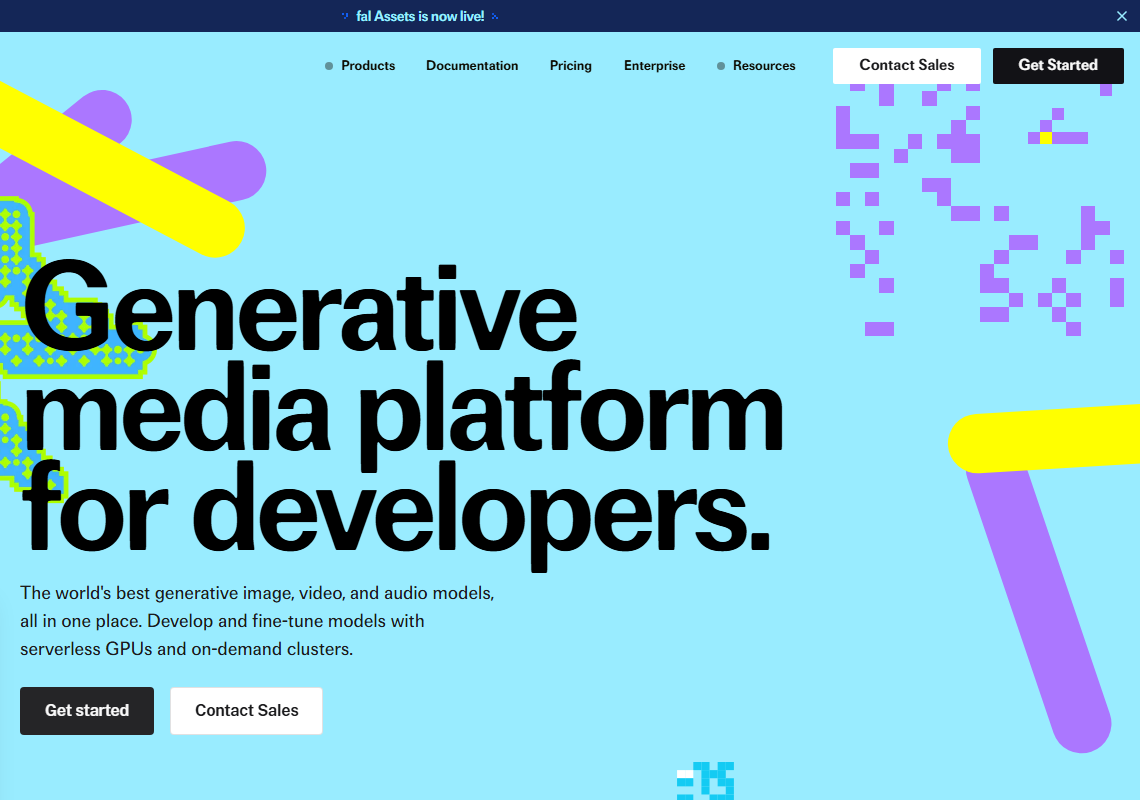
The core value of fal.ai is not a single image or video generation model, but the encapsulation of generative media models into an API infrastructure that can be stably called in products. The title of the official website directly positions it as a generative media platform for developers, covering image, video, 3D, audio and other models, and emphasizes that developers can integrate FLUX, Kling, Hailuo and 1000+ models in one place.
| Projects | Public Information |
|---|---|
| product name | fal.ai / fal |
| Company Entity | Features & Labels Inc. |
| Official positioning | Generative media platform for developers |
| Core capabilities | Image, video, audio 3D, real-time streaming, training, private model Serverless GPU |
| Model scale | The official website publicly describes it as +1000 generative media models |
| Representative models | FLUX, Kling, Hailuo, Seedance, Krea, Ideogram, Sora, Stable Diffusion, etc. |
| Development portal | Web console, model market REST API, JavaScript SDK, Python SDK |
| Billing method | Billed based on usage, different models have different endpoint unit prices |
| Official support email | [email protected] |
Platform Boundary: fal.ai is more suitable as a generative media reasoning layer on the backend of a product, rather than a one-stop creation software for ordinary users. It offers playground and web experiences, but the real focus is on the API, model selection, queues, callbacks, file handling, training, and scalability.
Applicable objects: If the team already has an App, SaaS, content production system, e-commerce material system or design workflow, fal.ai can connect multi-model capabilities through a unified interface; if you only occasionally generate a few pictures, ordinary creation tools will be more direct.
User and market recognition
fal.ai's market recognition mainly comes from the developer ecosystem and the demand for high-throughput inference in generative media applications. The official page clearly states the target group: developers, rather than the general “all creators”. This means that its product design is more concerned with endpoint stability, latency, billing transparency SDK, model update speed and maintainability after going online.
The organizational structured data of public sites lists official community portals such as GitHub, Discord, Twitter/X, LinkedIn, YouTube, Instagram, TikTok, and Reddit, indicating that fal.ai adopts a parallel growth approach of developer community, model market, and content cases. For catalog users, these types of signals are more important than mere marketing copy, because the true value of an API platform lies in documentation, community, model coverage, and endpoint maintenance over the long term.
| Market Signals | Interpretation |
|---|---|
| Official website model library | Covers multiple types of generative media endpoints such as images, videos, audio 3D, training, etc. |
| 1000+ model representations | Description fal.ai is more like a model distribution and inference infrastructure than a single-model product |
| Developer documentation | Provides engineering entrances such as subscriptions, queue Webhooks, and file SDKs |
| Official community | Discord, GitHub, X, LinkedIn and other portals help developers follow up on questions and updates |
| Enterprise portal | The official website provides Enterprise, Contact Sales and compliance/scale-related portals |
Purchasing Judgment: The recognition of fal.ai cannot only depend on the number of models, but also whether the target model is stable, whether the price is predictable, whether the output quality meets the business, and whether it can withstand the traffic peak after going online.
Cost advantage
The cost advantage of fal.ai lies in leaving GPU operation and maintenance, model deployment, queues, expansion and contraction, and endpoint management to the platform. Developers pay based on actual endpoint usage, and do not need to build separate inference services for each model, nor do they need to reserve GPU resources for a long time.
The official website pricing page uses GenAI API Pricing and Pay-Per-Use expressions, and different model endpoints display different prices. For example, some video models are billed based on the number of seconds generated, resolution, and whether audio is included, and some image models are billed based on request, training, or output specifications. Since the price of generative media models changes rapidly, the official real-time price page and specific model page in the catalog should prevail.
| Usage Tiers | Cost Characteristics | Suitable for Teams |
|---|---|---|
| Personal/Prototype | Verify model effects through Playground, free quota or low-frequency API calls | Independent developers, early products, design verification |
| Growth stage products | Call multiple model endpoints according to volume, and control costs by combining queues, callbacks and logs | Creative tools, e-commerce materials, marketing automation, video applications |
| High concurrency business | Focus on throughput, latency, failure retry, cache, model fallback and budget alarm | Commercial SaaS, content platform, internal enterprise production system |
| Enterprise Solutions | Communicate scaling, compliance, private models, support and commercial terms through sales | Large accounts, regulated industries, stable SLA requirements team |
Cost Judgment: fal.ai may not be the lowest price on every endpoint, but it compresses the cost of multi-model access and inference operation and maintenance into the same set of APIs. For teams that need to switch models frequently or quickly follow up with new models, this integration efficiency is often more critical than the price per call.
Main functions
The function of fal.ai revolves around "the ability to turn generative media models into launchable products." It provides both a model marketplace and APIs, SDKs, queued webhooks, file uploads, training, private models, and real-time capabilities.
- Model Market: Centrally displays endpoints such as image generation, image editing, graphic videos, text videos, audio 3D, amplification and enhancement, and training.
- Unified API call: Developers can call models through REST API, JavaScript SDK, Python SDK, etc., reducing the workload of encapsulating interfaces for different model suppliers.
- Serverless GPU: Leave the GPU resource scheduling of model inference to the platform, which is suitable for applications with unstable traffic or that need to be launched quickly.
- Queue vs. Asynchronous Tasks: Generative video and high-resolution images often take a long time, and queues, subscriptions, and webhooks are important for production integration.
- Real-time and streaming output: For interactive experience, real-time image generation and low-latency scenarios, reducing users’ sense of waiting.
- Training and private models: Supports custom model training or exclusive endpoints, suitable for brand materials, character styles, product images and vertical scenarios.
- Enterprise Portal: Provides an Enterprise communication path for teams that require higher stability, support, compliance, and large-scale deployment.
Model and version evolution
The version evolution of fal.ai is more like "the continuous expansion of model ecology and infrastructure capabilities" rather than the version number iteration of traditional desktop software. Each endpoint in the model market has its own release time, price, status and capability boundaries, and developers need to manage upgrades according to the endpoint dimension.
Public evolution context
- Developer API Foundation Stage: Establishing generative media calling capabilities through SDK, documentation, and inference endpoints.
- Model Market Expansion Phase: Put more third-party and own endpoints into a unified directory to reduce the trial and error cost of product teams accessing new models.
- Serverless GPU and training phase: Strengthen the infrastructure capabilities required for volume-based inference, model training, private models, and high-concurrency applications.
- Real-time and multimedia stage: Expanding from pictures to video, audio 3D and real-time interaction, bringing fal.ai closer to a complete generative media infrastructure.
Version Management Suggestions: Online products should not just hardcode a certain popular model. A more prudent approach is to configure endpoints, parameters, prices and output acceptance standards to leave room for model replacement, downgrade and grayscale.
Technical advantages
fal.ai’s technical advantages focus on engineering, not just the model itself. Popular generative media models change quickly, and the leading window of a single model may be very short; the value of the platform comes from who can put these models into real applications faster, more stably, and at lower cost.
Low access cost: Unified API and SDK allow developers to call different models in a similar way, suitable for rapid A/B testing of image, video and audio models.
Elastic Inference: Serverless GPU and on-demand clusters reduce the fixed cost of self-built inference services, which is especially suitable for creative applications with obvious request peaks and valleys.
Multi-model strategy: fal.ai connects to multiple model suppliers and its own endpoints at the same time, and the product team can make combinations based on quality, speed, price and availability.
Production integration capabilities: Queue Webhooks, file processing, asynchronous tasks, and model page pricing information are the most underestimated parts of integrating generative media capabilities into formal products.
How to use
fal.ai is suitable to be placed in the "generative media engine" position of a product or workflow, rather than just as a web page experience. Typical scenarios include content production, design automation, video materials, e-commerce marketing, avatars, game assets, and internal creative pipelines.
| Scenario | Value of fal.ai |
|---|---|
| AI picture application | Quickly access FLUX, Krea, Ideogram, Stable Diffusion and other models, and support multi-style generation and editing |
| AI video products | Call Kling, Hailuo, Seedance, Vidu, Sora and other Tusheng video or Wensheng video endpoints |
| E-commerce material production | Batch generation of product main images, scene images, short videos, background replacement and marketing materials |
| Creative SaaS | Wrapping multi-model capabilities into end-user-facing templates, workflows and automation capabilities |
| Enterprise content pipeline | Connect production tasks to CMS, DAM, review and publishing systems through APIs, webhooks and queues |
| Custom model | Train brand, character, product or style models to form more stable private output capabilities |
Implementation Reminder: Generative media projects often encounter problems with failed retries, waiting times, cost caps, copyright review, content security, and output consistency. fal.ai can solve the inference and access layer problems, but the business acceptance and compliance processes still need to be designed by the team themselves.
Product Pricing
fal.ai overlaps with tools such as Replicate, Together AI, Modal, RunPod, Hugging Face Inference Endpoints, OpenAI, Stability AI, Runway, etc., but the positioning is not exactly the same. It focuses more on generative media APIs and developer integration, especially the combination of images, videos, audio 3D and training endpoints.
| Comparison objects | Differences in fal.ai |
|---|---|
| Replicate | Both provide model APIs and model markets; fal.ai emphasizes generative media, speed Serverless GPU and new media model coverage |
| OpenAI API | OpenAI prefers general models and multi-modal basic models; fal.ai is more like a multi-vendor generative media model aggregation and inference platform |
| Runway | Runway is more focused on creator products and video editing experience; fal.ai is more focused on developer APIs and product integration |
| Hugging Face | Hugging Face has a wider ecosystem, covering model hosting, data sets and communities; fal.ai focuses more on productized calls of media generation endpoints |
| RunPod/Modal | These are more general calculation and deployment; fal.ai encapsulates model markets, endpoints, prices and generative media scenarios more directly |
Selection Suggestion: If the focus is on the terminal creation experience, you can give priority to tools such as Runway, Krea, and Canva; if the focus is on embedding generative media models into your own products, fal.ai's API platform positioning is more suitable.
Application scenarios
The integration process of fal.ai usually starts from the model page or playground verification effect, and then proceeds to API integration, budget control and production online. For the team, the most important thing is to separate "model effect verification" and "project online verification".
- Select Model: Filter candidate models in the model market by category, quality, price, speed and output examples.
- Run the sample: Use the playground or sample code to test the prompt words, input file, resolution, duration and output format.
- Connect API: Connect to queues, subscriptions, file uploads and Webhooks through REST, JavaScript SDK or Python SDK.
- Set budget: Estimate the cost based on model unit price, call volume, failure rate, retry strategy and peak traffic.
- Do acceptance: Establish output quality, content security, copyright risk, failure handling and manual review standards.
- Online monitoring: Track latency, error rate, unit cost, user conversion and model change impact.
Collaborative division of labor: The product is responsible for scenarios and acceptance, the design/content team is responsible for samples and quality standards, engineering is responsible for interfaces and stability, and operations or legal affairs are responsible for content risks. fal.ai enables these types of roles to collaborate around the same set of endpoints and result data.
Applicable people
The limitations of fal.ai mainly come from the generative media model itself and the multi-vendor aggregation model. The more models there are, the more flexible the choice, but the more careful management of price, parameters, output quality, availability and terms is also required.
- Price Fluctuation: Video and high-specification production costs may be higher, and the price dimensions of different models are inconsistent.
- Model Change: Third-party model upgrades, removals, current restrictions or price adjustments will affect product stability.
- Output Uncertainty: Image and video models may still be unstable in character consistency, text rendering, complex actions, and long videos.
- Compliance Risk: Branding, portraits, copyrighted materials, ad review and sensitive content require additional processes.
- Latency Management: Video, training and high-resolution tasks cannot be designed according to ordinary synchronous interfaces and require asynchronous queues and front-end waiting experiences.
- Supplier dependency: Hosting core generation capabilities to external platforms requires attention to SLA, data processing terms and fallback plans.
Risk Control Suggestions: Important businesses should prepare for model downgrade, result caching, queue timeout, budget thresholds, manual review and supplier alternatives at the same time.
Summary and Outlook
fal.ai is a generative media infrastructure platform for developers. Its strengths lie in multi-model coverage, unified API, Serverless GPU, volume-based inference and production integration. It is particularly suitable for product teams that need quick access to images, videos, audio and 3D generation capabilities, and for developers who want to constantly try out new models but do not want to repeatedly build inference services.
Taken together, the value of fal.ai is not in "a certain model is the best", but in "continuously turning new models into callable, billable, and online APIs." For AI Tools Catalog users, it should be classified as a developer tool and generative media API platform, rather than a general image generator or video editor.
| Evaluation Dimensions | Conclusion |
|---|---|
| Difficulty to get started | Friendly to developers, not the lowest threshold for no-code users |
| Model coverage | Wide coverage, especially suitable for image, video and generative media scenarios |
| Engineering Value | API, SDK, Queue Webhooks and Serverless GPU are core strengths |
| Cost control | Pay-as-you-go billing is flexible, but video and training tasks require strict budget management |
| Recommended for | AI application developers, creative SaaS, e-commerce material teams, content platforms, enterprise automation teams |
Final judgment: If the goal is to "integrate generative media capabilities into products", fal.ai is a high-priority candidate platform; if the goal is only occasional personal creation, it will be lighter to use a more C-side creation tool.
Related tools:  Hugging Face, replicate
Version Info
- fal.ai current public platform :The current public site shows fal.ai as a generative media platform for developers, providing 1000+ generative media models, unified API, model market, model training, private models, real-time streaming Serverless GPU and pay-as-you-go billing capabilities; the homepage and model pages continue to display Krea 2 Turbo, Happy Horse, Kling v3, Seedance 2 and other endpoints released in 2026.
- Model Marketplace and Unified API Platform :fal.ai's public model market continues to expand, covering text-to-image, image-to-video, text-to-video, image editing, audio, 3D, upscaling, training and other categories, and provides call entrances through fal.run, document SDK and console.
- Serverless GPU and volume-based inference platform :The platform openly emphasizes serverless GPUs, on-demand clusters, queues, webhooks and usage-based pricing, reducing developers’ costs of directly operating and maintaining GPUs, model services and elastic scaling.
- SDK and developer documentation basic capabilities :fal.ai provides basic access methods through SDKs and API documents such as JavaScript and Python. Developers can complete product integration through subscriptions, queues, file uploads, result callbacks and inference endpoints.
User Reviews