 Falkonry
Falkonry is a time-series AI operation improvement data platform for industrial scenarios. It automatically discovers anomalies and patterns in multi-variable time series through PatternIQ™ patented technology, supports deployment architecture from edge to cloud, and helps manufacturing, energy, national defense and other fields achieve the leap from manual monitoring to automated decision-making.
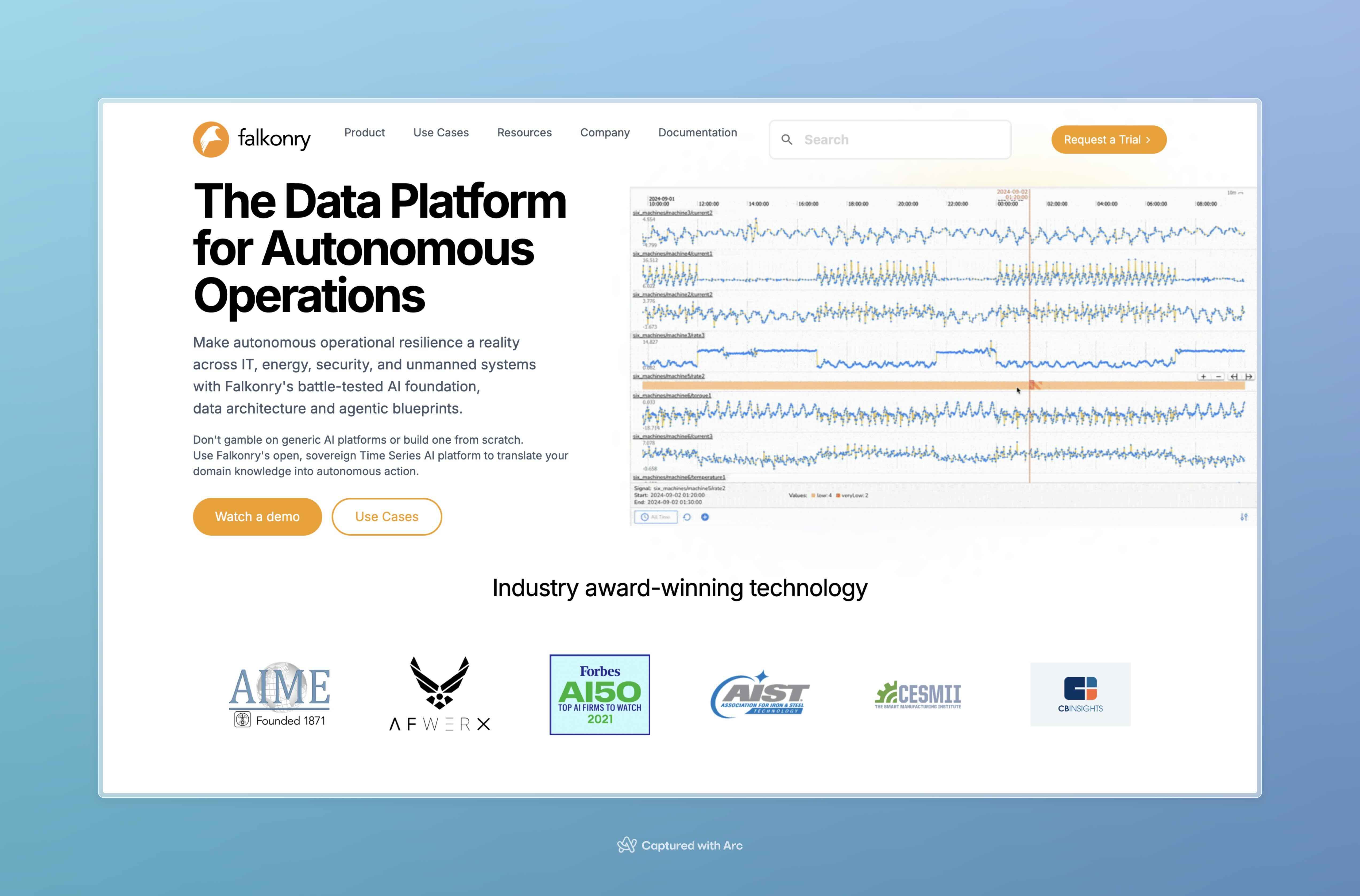
Falkonry’s in-depth review: How Industrial Sequential AI’s “Falcon” transforms sensor noise into decision-making signals
Core parameters and statistics
| Project | Specifications |
|---|---|
| Product Positioning | Industrial Operation Improvement Data Platform (Operational Improvement Data Platform) |
| Core Technology | PatternIQ™ — Convolutional variational autoencoder multi-time scale embedding |
| Target Industries | Manufacturing, Energy, Defense & Intelligence IT Observability, Facilities Management |
| Deployment Mode | Public cloud, private resource pool cloud, US government cloud, air-gapped deployment, edge hardware all-in-one |
| Compliance Certification | SOC2 (Public Cloud Deployment) |
| Number of patents | 14+ US patents, patents in Canada, Europe, Japan and other countries |
| Typical Customers | U.S. Navy, U.S. Air Force, U.S. Department of Energy Nucor, Stelco, Toyota, Western Digital, Chesapeake Energy |
| Latest version | Time Series AI Platform (TSI) — 2026.07 |
| Pricing model | Contact Business to get a quote (Trial trial can be applied for) |
| Support Form | Cloud SaaS, private deployment, edge hardware, air gap independent deployment |
Falkonry is not an "AI conversation tool" or "content generation tool" in the traditional sense, but an end-to-end sequential AI analysis platform for industrial operation scenarios. Its core differentiation is that it can automatically discover anomalies and patterns from raw sensor streams without a team of data scientists, annotated data, or preset thresholds.
User and market recognition
- In-depth adoption of the U.S. Department of Defense system: Falkonry received the SBIR Phase II contract from the U.S. Air Force, and its products were directly adopted by the U.S. Navy, Air Force Life Cycle Management Command (AFLCMC), and Naval Sea Systems Command (NSWC), indicating that it has passed extremely strict military-level technical verification.
- Forbes AI Top 50 (2021): Selected as Forbes "America's Most Promising AI Companies", and many well-known AI companies were also selected in the same period.
- CB Insights AI Top 100 (2022): Continuously recognized by market analysts, standing out from hundreds of candidate AI companies.
- Top Venture Capital Endorsement: Backing investors include Zetta Venture Partners, Polaris Partners and In-Q-Tel (IQT), a subsidiary of the U.S. intelligence system, which focuses on investing in cutting-edge technologies that serve national security.
- Verification by leading industrial customers: Nucor (the largest steel producer in the United States), Stelco, Ternium, Toyota Material Handling, Western Digital, Chesapeake Energy, Civitas Resources and other manufacturing and energy companies have actually deployed it.
- Analyst Comments: Justin Isaacs, Vice President of Sumitomo Corporation, publicly commented that "Falkonry's highly automated digital system has increased analyst productivity several times, allowing it to autonomously make more complex analytical decisions and discover new types of insights."
Cost advantage
C-side/individual
Falkonry is not for individual users and does not provide a personal version subscription. Interested engineers can submit data samples through the official website to apply for trial trial, but formal commercial use needs to be tied to the purchase of the enterprise version.
Developer/API
The platform provides a REST API interface (documentation covers Signal Metadata, Raw Signal Data, Rules & Alerts, Anomaly Detection, Assessments, etc.), but API access is not sold independently by token or call volume, but is provided as part of the enterprise platform. Developers need to obtain enterprise account permissions before they can call the API. The price has not been disclosed, and the official business quotation shall prevail.
Enterprise/Privatization
Falkonry's pricing model is a typical enterprise-level private/subscription model, please contact the sales team for a quote. The following dimensions influence the final pricing:
- Deployment form: Public cloud SaaS vs private resource pool vs government cloud vs air gap deployment vs edge hardware. Architecture complexity directly affects infrastructure costs.
- Data scale: The number of accessed signals, sampling frequency, and storage period affect computing and storage resources.
- Functional Modules: Core PatternIQ™ anomaly detection, rules engine, reporting system, edge federation and other modules may be authorized on demand.
- Procurement Suggestion: Since there is no public price list, enterprises should at least require before purchasing: (1) Clarify the authorization method of each module (named users/concurrency/data volume); (2) Confirm whether the SOC2 compliance scope covers the expected deployment form; (3) Air-gapped deployment requires separate confirmation of operation and maintenance support terms.
Hidden Costs:
- Edge hardware all-in-one machines require physical procurement and transportation and are not suitable for pure cloud agile experiments.
- Model updates and data synchronization under air-gapped deployment require manual media transfer, and the operation and maintenance complexity is higher than that of conventional cloud deployment.
- From trial to formal purchase, it may take several weeks of PoC (proof of concept) cycle, which is not suitable for the short-term and fast scenario of "buy and use".
Main functions
- PatternIQ™ Automatic Anomaly Detection: Based on the Convolutional Variational Autoencoder, it automatically learns multi-time scale embeddings and identifies anomalies at the shape, waveform and value distribution levels. Users do not need to label data or preset thresholds. The platform automatically discovers "never-before-seen anomalies" from the original signals.
- Multi-source data fusion and orchestration: Natively supports access to multiple data sources such as MQTT, OTel, S3, etc., and can process numerical and categorical data without resampling or compression. Supports organizing data into a multi-level hierarchical structure to facilitate filtering by asset dimensions.
- High-density visualization and interactive analysis: Provides views such as time series lists, distribution charts, heat maps, and bucket charts, supporting seamless zooming from a monthly overview of 100Hz high-frequency data to second-level details, helping engineers quickly locate pattern deviations.
- Rule engine and high-confidence alarm: Superimpose spatial and temporal denoising logic on the AI output to transform the continuous correlation conditions of multiple signals into actionable discrete events. Supports debouncing and window condition evaluation, significantly reducing "alarm fatigue".
- Edge to Cloud Federation Architecture: The edge hardware all-in-one machine can run independently under disconnected/low bandwidth/denied conditions, and automatically synchronizes with the cloud to aggregate insights and receive model updates when online. Edge devices support real-time data verification to prevent "empty data collection".
- Digital twins and one-time development and multiple deployments: Engineers can build model templates (digital twins) for asset types and apply them to multiple assets of the same type in batches after one verification to maintain enterprise-level consistency.
Expert point of view
The real value of Falkonry does not lie in a single function, but in the closure formed by "no labeling + no threshold + edge to cloud": traditional industrial AI solutions require data scientists to first label abnormal samples, train models, deploy to the edge, and then manually analyze the results - each step is a waterfall-style break. Falkonry's PatternIQ™ eliminates the need for annotation and feature engineering. The rules engine digests the noise of AI output. The edge architecture allows data to be cleaned and contextualized at the source, and ultimately flows back to the cloud to form an "analytic flywheel" for continuous model improvement. This effectively compresses a data science cycle of months into weeks or even days.
Model and version evolution
Mainline release
- 2020.0 — Operational AI product line release (February 2020): Launched two new Operational AI products, focusing on lower TCO and shorter time to value. At the same time, it received additional AI development funding from the U.S. Air Force.
- 2022.0 — TSI Platform Integration (2022): Strengthen edge AI capabilities, launch the Time Series AI platform concept, integrate PatternIQ™ engine and multiple deployment modes. In the same year, it entered Oracle OCI Marketplace.
- 2024.0 — New architecture (2024): Reconstruct data clock scheduling and model management, introduce the concept of "Common Workspace", and support the construction of digital twins in the asset dimension. The API is iterated to v1.2, adding more fine-grained data operation capabilities.
- 2026.07 — Latest iteration: Continuing improvements to the PatternIQ™ engine, edge federation synchronization mechanism, and SOC2 compliance coverage. A total of 14+ US patents have been granted.
Version features
Falkonry's version evolution path reflects a clear rhythm of "military industry verification → industrial generalization → platformization": in the early stage, it used military industry projects as the technology polishing scenario, in the mid-term, it expanded commercialization through leading customers in the steel and energy industries, and in the near future, it covers a wider range of regulated industries through multiple deployment models (government cloud, air gap, edge).
Technical advantages
PatternIQ™: Why "Learning Without Annotation"
Falkonry's core patent PatternIQ™ is a convolutional variational autoencoder (Convolutional VAE). Its key design lies in multi-time scale embedding: traditional timing anomaly detection methods (such as threshold rules, statistical process control) can only capture deviations at a single time granularity, while PatternIQ™ simultaneously learns waveform patterns at the millisecond, second, minute or even day level through data clock scheduling. This means that it can distinguish between "normal equipment start-stop jitter" and "real degradation trends" without the need to manually preset thresholds for each working condition.
Data clock engine: solving the pain point of "out of order arrival"
Industrial sensor data often suffers from problems such as out-of-order arrival, uneven sampling rate, and multi-source dependency. Falkonry's Data-Clock engine performs model calculations independently of data arrival order, automatically handling window alignment and dependency tracking. This enables the platform to uniformly handle historical replays, online streaming data, and simulation scenarios without the need for additional ETL coding.
Space + time denoising: Say goodbye to alarm fatigue
The output of pure AI models often contains a large number of false positives. Falkonry superimposes a layer of rule-based "spatial + time denoiser" after the AI reasoning layer: only when anomalies are confirmed simultaneously on multiple related signals (spatial correlation) and last for a sufficient time window (time persistence), an alarm will be generated. This greatly improves the signal-to-noise ratio of alarms, allowing field engineers to focus only on events that truly require intervention.
Edge Federation: Data Sovereignty under DDIL Context
For defense and remote facility scenarios, unreliable network connections are the norm. Falkonry's edge hardware all-in-one machine can run independently in a completely disconnected (air gap) environment, with built-in data verification (to prevent empty mining), automatic metadata annotation and local reasoning capabilities. Automatically synchronizes with the cloud after reconnecting to the Internet, realizing a workflow of "leaving the scene with answers" instead of "bringing the hard drive back to the laboratory for analysis."
How to use
Deployment entry
Falkonry does not provide a public self-service registration entrance. The usage path is usually divided into the following steps:
- Apply for Trial: Submit the data sample description (sampling rate, data format, source, etc.) on the official website. The Falkonry team will evaluate and open the trial.
- Data access: Access historical or real-time time series data through MQTT, OTel, S3 and other protocols, and the platform automatically completes contextualization and metadata annotation.
- Model Initialization: Select the target signal set, and PatternIQ™ automatically initializes the anomaly detection model without manually configuring parameters.
- Evaluation and Tuning: Use the back-test capability to verify the model effect on historical data, and superimpose the rule engine for alarm denoising.
- Online monitoring: Push the model to the online environment (cloud or edge), and view real-time alarms and asset health status through the unified monitoring panel.
- Continuous iteration: Based on newly generated operating data, the platform supports incremental updates of the model without re-training from scratch.
API access
Falkonry provides complete REST API coverage, including:
- Signal Metadata: Manage metadata such as signal names, units, labels, etc.
- Raw Signal Data: Read and write raw time series data points
- Rules & Alerts: Create and manage rules and alert configurations
- Anomaly Detection: Initialize and run the anomaly detection model
- Assessments: Manage online assessments and monitoring
- Calculations: Perform custom calculation transformations
All API access must be used within the context of an opened corporate account, and the authentication method shall be subject to official documents.
Key integrations
The platform supports integration with third-party systems such as Zapier and MaintainX, and can realize workflow automation such as alarm notifications and work order creation through Webhooks and REST APIs.
Product Pricing
Falkonry’s pricing is an enterprise-level non-public model. The following is a structure based on public information:
| Dimensions | Description |
|---|---|
| Free Trial | Trial application available, but no permanent free version |
| Public Cloud SaaS | Pricing based on data volume and functional modules, business communication required |
| Private Resource Pool | Increase the cost of isolated resources based on public cloud |
| US Government Cloud | Dedicated compliance deployment for federal government customers |
| Air Gap Deployment | Fully isolated, including edge hardware costs |
| Edge Hardware | Independent hardware all-in-one machine (recommended configuration: 4 CPU/64 cores/256GB RAM + removable NVMe 100TB) |
Corporate procurement recommendations are detailed in "Summary and Outlook."
Application scenarios
- Predictive Maintenance (Manufacturing/Energy): Production equipment in industries such as steel, oil and gas, and chemicals typically have hundreds to thousands of sensor signals. Falkonry automatically learns the multi-variable pattern of normal operating conditions and issues an early warning when degradation trends first appear, rather than waiting to analyze the cause after shutdown. Typical benefits: Convert unplanned downtime into planned maintenance and reduce production downtime losses.
- Defense sensor data analysis: Military systems such as drones, radars, and sonar generate massive amounts of high-frequency telemetry data. Falkonry's edge hardware can perform independent analysis in battlefield denial situations, generating intelligence insights on-site without the need for backhaul to a data center. Typical benefits: From "bringing the hard drive back to the base for analysis" to "getting answers on site".
- IT Observability and SRE: Automatically assess the blast radius of SLO events to help the SRE team quickly locate the incident epicenter and accelerate root cause analysis through historical pattern matching. Typical benefits: Reduce the mean time to repair (MTTR) and reduce engineers’ manual investment in alarm troubleshooting.
- Vehicle and Facility Management: For scenarios such as Toyota Material Handling with a large number of mobile devices, Falkonry can access vehicle sensor data and detect early fault signals such as abnormal vibrations and temperature excursions in real time. Typical benefits: Extended equipment life and optimized spare parts inventory.
Applicable people
- Process and Reliability Engineer: The most direct beneficiary. No programming or data science background is required, and data access, model initialization, and alarm configuration can be completed through the no-code interface, allowing you to focus on engineering judgment rather than code debugging.
- IT Operations and SRE Team: Suitable for scenarios where root causes need to be quickly located from massive amounts of observability data. The platform’s rules engine and blast radius evaluation capabilities significantly reduce alarm noise, allowing on-call engineers to prioritize the truly important events.
- Defense and Intelligence Analyst: Air-gapped deployment + edge federation capabilities make it qualified for data analysis tasks at the tactical edge, suitable for military scenarios that require on-site analysis of telemetry data and cannot rely on network connectivity.
- Industrial Digital Transformation Leader: Falkonry's "3 weeks to go live" commitment (compared to the months of traditional data science projects) makes it a fast-implemented AI analytics layer choice in Industry 4.0 and digital twin strategies.
Not suitable for the crowd:
- Small teams or independent developers who want pure cloud SaaS out-of-the-box and pay per API call (Falkonry’s enterprise business model is not suitable for lightweight exploration).
- Research teams that need to deeply customize the deep learning model architecture (PatternIQ™ is a closed core and does not support custom network structures).
- Traditional operation and maintenance teams that only need simple threshold alarms rather than AI analysis (the threshold and cost of rule engines are higher than traditional monitoring tools).
Summary and Outlook
Falkonry's core competitiveness lies in its industrial sequential AI capabilities that are "label-free, self-learning, and can run independently at the edge." It bypasses the reliance of traditional industrial AI solutions on a team of data scientists, allowing field engineers to directly possess anomaly detection and pattern recognition capabilities. 14 U.S. patents, military-grade customer validation (U.S. Air Force/Navy), and third-party endorsement of the Forbes AI 50/CB Insights AI 100 add to the credibility of its technology.
Current Limitations and Uncertainties:
- Pricing is completely opaque, and enterprise procurement needs to go through a complete chain of sales communication-POC-business negotiation, which is not suitable for short-cycle evaluation.
- The scope of ecological integration is limited, mainly through connection with a few platforms such as Zapier/MaintainX to achieve alarm and work order related, and lacks native embedding in large-scale industrial Internet platforms like Siemens MindSphere or PTC ThingWorx.
- Non-English market support has not been disclosed, and there is uncertainty about support capabilities and channels in the Asia-Pacific region.
- IFS has announced an acquisition but ultimately did not complete it. The company's independent operating status and financing pace may affect the stability of the mid- to long-term product roadmap.
Procurement/Adoption Risk Assessment: For enterprises considering introducing Falkonry, it is recommended to adopt a "pilot first and gradually expand" strategy: (1) Select a production line or a facility as a PoC to verify the anomaly detection rate and false alarm rate of PatternIQ™ under this specific working condition; (2) Clarify the business terms of each deployment form (public cloud/private/air gap) during the PoC stage, especially data export, model IP ownership and SLA; (3) Confirm the procurement delivery cycle and operation and maintenance support system of edge hardware to avoid promotion delays due to hardware bottlenecks; (4) Pay attention to the corporate governance status after the IFS acquisition failed, and recommend adding product roadmap commitment clauses to the contract. Overall, Falkonry has irreplaceable technical advantages in military and heavy industry scenarios, but for small and medium-sized manufacturing companies that require lightweight, standardized SaaS pricing, the total cost of ownership may need to be evaluated more carefully.
Related tools:  Hugging Face, replicate
Version Info
- Time Series AI Platform (TSI) :The continuously iterative industrial sequential AI platform supports a complete capability chain such as PatternIQ™ anomaly detection, rule engine, and edge computing. There is no official precise date yet.
- Falkonry TSI Platform :Released a new generation of Time Series AI platform architecture to reconstruct data clock scheduling and model management capabilities. There is no official precise date yet.
- Falkonry Operational AI :Launched the Operational AI product line to strengthen edge AI and multi-deployment model support. There is no official precise date yet.
- Falkonry Prediction Engine :Launched two new Operational AI products to reduce TCO and shorten time to value. There is no official precise date yet.
User Reviews