 fast. love
Free
fast. love
Free
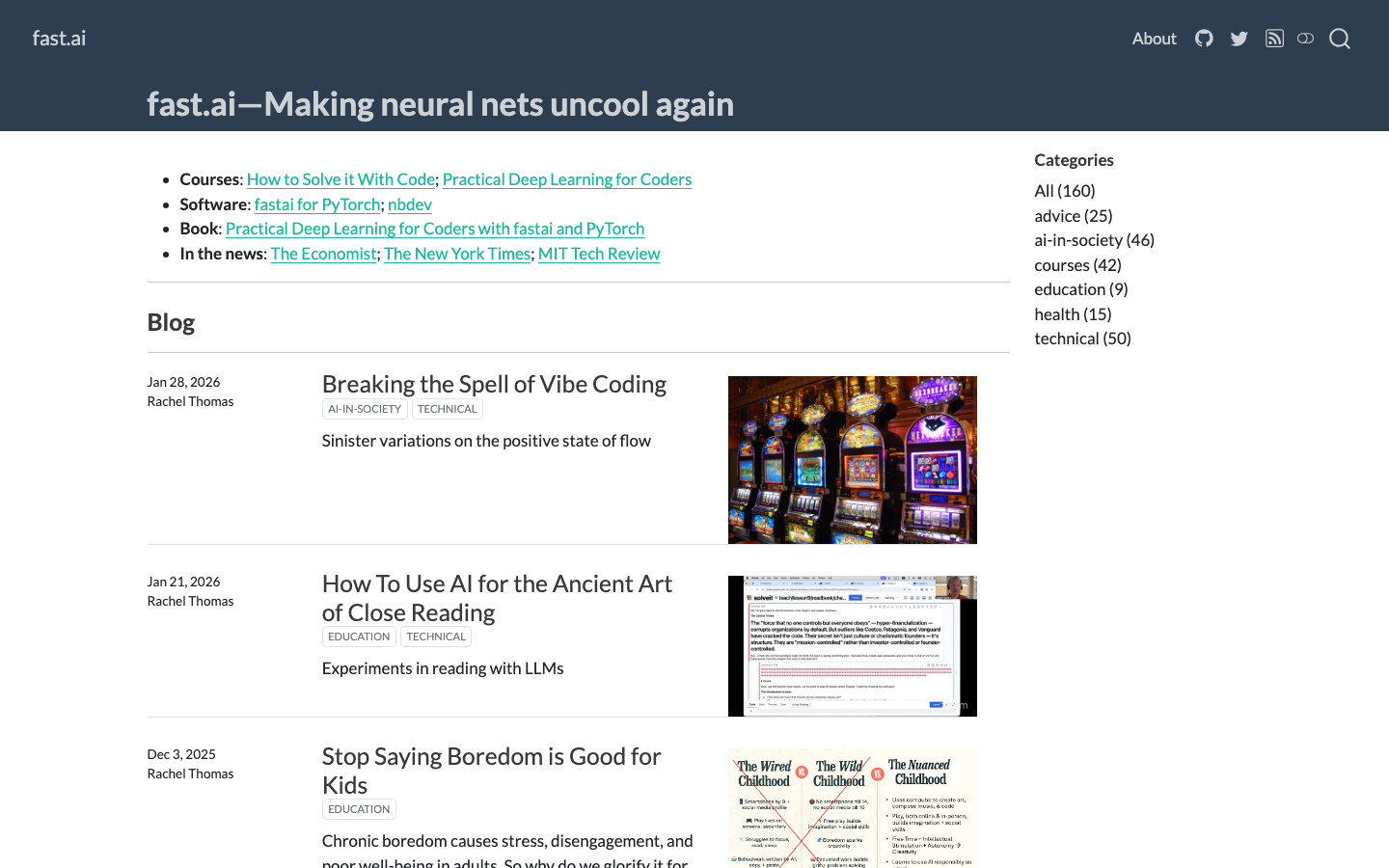
fast.ai is a non-profit deep learning education project founded by Jeremy Howard and Rachel Thomas. It provides free practical courses of "Practical Deep Learning for Coders", fastai open source library and supporting books based on PyTorch, and advocates a top-down practical approach to let more people master deep learning.
fast.ai
Core parameters and statistics
fast.ai is not a software, but a non-profit deep learning education project. Its most distinctive concept is "top-down" teaching: let learners train a usable model first, and then go back to explain the principles. This is contrary to the traditional "mathematics first, code later" path. The purpose is to lower the entry barrier so that people without a deep mathematics background can start as soon as possible.
| Projects | Public Information |
|---|---|
| Project type | Non-profit deep learning education project |
| Founders | Jeremy Howard, Rachel Thomas |
| Core output | Free course fastai library, supporting books |
| Technology stack | Fastai library based on PyTorch |
| Teaching philosophy | Top-down, practice first and then theory |
| Cost | Courses and libraries are free and open source |
Practical first: fast.ai's courses start from "training the first model", allowing learners to gain a sense of accomplishment and intuition first, and then gradually deepen the principles, significantly lowering the psychological threshold of deep learning.
Tool collaboration: The course is deeply bound to the fastai library - the library encapsulates the training process very concisely, allowing learners to reproduce the course effect with very little code and focus on understanding rather than boilerplate code.
Completely Free: Courses, libraries, and books are all free and open source, making it a zero-cost entry point for many people to get into deep learning.
User and market recognition
fast.ai's recognition comes from its long-term reputation and broad learner base. It is the first stop for many self-learners and career changers to enter deep learning, and the founder, Jeremy Howard, has a high reputation in the data science community.
Community reputation: It is widely praised for "enabling people without a PhD background to train usable models" and is regarded as one of the most pragmatic introductory resources for deep learning.
Open Source Impact: The fastai library has a stable usage and contribution ecosystem on GitHub, and the course supporting books are open in Notebook form, making it easy to read and run.
Prerequisites for implementation: Its value is greatest for learners who are "willing to run code"; for those who only want to see concepts and are unwilling to configure context and practical operations, the benefits will be reduced.
Cost advantage
The cost advantage of fast.ai is very direct - all core resources are free and open source, and there is almost no explicit tuition fee.
- C client/individual: The course fastai library and supporting books are free, and learners only need to bear the computing power (you can use the free cloud Notebook to get started).
- Education/Institution: Free courses can be directly incorporated into teaching without licensing fees. The specific use shall be subject to its open source license.
Real Cost: The biggest hidden costs are computing power and time - training the model requires a GPU, but the course provides a path to get started with free or low-cost cloud environments; the time investment depends on the learner's programming foundation.
Main functions
The "function" of fast.ai is embodied in a complete set of learning resources:
- Practical Deep Learning Course: Free top-down practical course, covering computer vision NLP, tables and collaborative filtering, etc.
- fastai library: A high-level library based on PyTorch that uses concise code to complete data processing and training.
- Companion Book: Open in Jupyter Notebook, easy to read and run at the same time.
- Advanced content: From application to underlying implementation, satisfying learners who want to go deeper.
The synergy of these resources lies in: course teaching methods, library threshold reduction, and book supplement system. The combination of the three allows learners to get started quickly and has a path to continue to deepen.
Model and version evolution
The current public version information has been covered in the previous article. If the official does not fully disclose the historical version milestones and precise dates, it is recommended to refer to the official real-time page and complete the version nodes in subsequent iterations.
Technical advantages
As an educational project, fast.ai’s advantages lie in teaching methods and tool design:
Top-down teaching method: A path of practice first and theory later, allowing learners to build intuition faster and reduce the abandonment rate.
Abstraction of the fastai library: Use very little code to reproduce the complete training process, allowing learners to focus on understanding rather than boilerplate.
Open and reproducible: All content is disclosed in Notebook, and learners can run, modify, and verify line by line.
The price is: while high-level encapsulation brings convenience, it may also prevent beginners from understanding the underlying details deeply enough; the course is in English, which has a certain threshold for non-English learners.
How to use
| How to use | Suitable for the crowd | Features | Cost |
|---|---|---|---|
| Online courses | Learners who want to get started | Top-down practice, supporting Notebook | Free |
| fastai library | Developer | Complete the training process with a small amount of code | Free and open source |
| Supporting books | Learners who want to be systematic | Notebook format for reading and running | Free |
Suggestions for practical use: first train the first model in the order of the courses to build confidence, and then combine the principles of book completion; when starting, give priority to using the free cloud Notebook to avoid being stuck by the local GPU configuration at the beginning.
Product Pricing
The core resources of fast.ai are free:
- C client/individual: Courses, libraries, and books are all free, and the main costs are computing power and time.
- Institution: Free for teaching use, subject to the terms of its open source license.
Since the course is constantly updated, the latest learnable content is subject to the real-time page of the official website and GitHub warehouse.
Application scenarios
- Introduction to Deep Learning: Those with zero foundation or career change can use the lowest cost to train the model.
- Rapid Prototyping: Developers use the fastai library to quickly build visual/NLP prototypes.
- Teaching Resources: Universities and training institutions incorporate free courses into their teaching systems.
What is not suitable is: those who require industrial-level model deployment, high degree of customization of the underlying framework, or those who are unwilling to do hands-on operations and only want to quickly understand the concepts.
Applicable people
- Deep Learning Beginners: I hope to get started with a low threshold through practical methods.
- Career changer with programming background: Want to quickly transfer coding capabilities to AI.
- Educator: Find high-quality, free, reproducible teaching resources.
Not suitable for: researchers who pursue in-depth customization of the underlying framework, and learners who have greater barriers to English teaching.
Summary and Outlook
The core value of fast.ai is to use the teaching method of "practical first, then theory" and highly encapsulated open source libraries to lower the entry threshold for deep learning to the lowest level, allowing more people without mathematics or scientific research background to train models. It is completely free and open source and is one of the most pragmatic entrances to the field of deep learning.
As the deep learning tool chain matures, fast.ai's positioning of "allowing more people to participate in AI" still has continued value. Implementation suggestions: Individuals can start directly with free courses and cloud notebooks, and then run through them before deepening; educational institutions can incorporate them into teaching, but please note that the courses are in English and used under an open source license.
Related tools:  Khanmigo, quizlet
Version evolution of fast.ai
The evolution of fast.ai is reflected in the continuous updates of courses and libraries:
Backbone node
- fastai library (~2018): Highly encapsulates the PyTorch training process and lays the practical foundation for the course.
- Companion Book (~2020): Systematizes course content in the form of an open source Notebook.
- Practical Deep Learning continues to be updated (~2022 onwards): The course iterates with the development of technology and incorporates more modern models and practices.
Since it is continuously updated in the form of free courses and open source libraries, the latest content should be found on the official course page and GitHub repository.
Business process integration and ROI analysis
As a productivity tool for enterprises or professional positions, the real value of fast.ai depends on the depth of integration with existing workflows and the quantifiable efficiency improvement effect. The following is a systematic analysis from three core dimensions.
System integration and data interoperability The ability to interoperate with existing business systems is a key prerequisite for productivity tools to be integrated into workflows. It is recommended to focus on evaluating the following integration dimensions: the openness and documentation quality of the RESTful/GraphQL API (whether a complete API reference and SDK examples are provided), the support scope of Webhook event notifications (which business event types are supported for automatic push), the number and depth of pre-built integrations with common collaboration SaaS tools (WeChat Enterprise, DingTalk, Feishu, Slack, Notion, Jira, etc.), and enterprise-level identity authentication support (SSO/SAML/OAuth and LDAP/AD directory integration). Products that lack integration capabilities are easily isolated into information islands, which in turn increases the cognitive cost and operational friction for teams to switch between different tools.
Efficiency Quantification and ROI Estimation Methodology Before purchasing decisions, it is recommended to quantify the input-output ratio through a structured method: Step 1, choose 3-5 Standardized tasks that are frequently repeated and time-consuming in each team are used as test samples; in the second step, the average time consumption of a single task before and after tool intervention, first-time pass rate or error rate, and the number of links requiring manual intervention are recorded under controlled conditions; in the third step, the saved manpower time is converted according to the comprehensive cost of the position (salary, benefits, management sharing), and soft benefits (increased employee satisfaction, standardization of work quality, and improvement in response speed to core business) are superimposed to obtain a comprehensive ROI estimate. It is recommended to continue tracking ROI trends on a monthly basis, as the value of a tool usually increases over time as team proficiency increases and workflows are optimized.
Phase-based implementation strategy and risk control It is recommended to adopt a three-stage implementation path of "pilot verification-gradual promotion-continuous optimization". In the pilot stage (1-2 weeks), a single team or a single business scenario is selected for small-scale verification. The core goal is to verify technical feasibility and user acceptance, and establish preliminary usage specifications and success standards; in the promotion stage (2-4 weeks), after the pilot verification is passed, the coverage is gradually expanded, and standardized activation processes and training materials are developed; in the optimization stage (continuous), the workflow configuration is continuously adjusted based on actual usage data and user feedback, and more high-value application scenarios are explored. Clear quantitative key result indicators should be set at each stage to avoid blindly expanding the scope of use without data support.
Version Info
- Practical Deep Learning for Coders :fast.ai's continuously updated flagship free course adopts a top-down, practice first and then theory teaching method, and cooperates with the fastai library to guide learners to start deep learning from training the first model. There is no official unified version number yet. Please refer to the official website for the latest courses.
- "Deep Learning for Coders" book :The supporting books are available for free in the form of Jupyter Notebook and present the course content systematically. There is no official precise date yet.
- fastai open source library :Based on the high-level deep learning library of PyTorch, the training process can be completed with less code, which is the practical basis of the course. There is no official precise date yet.
User Reviews