 FastGPT
Free
FastGPT
Free
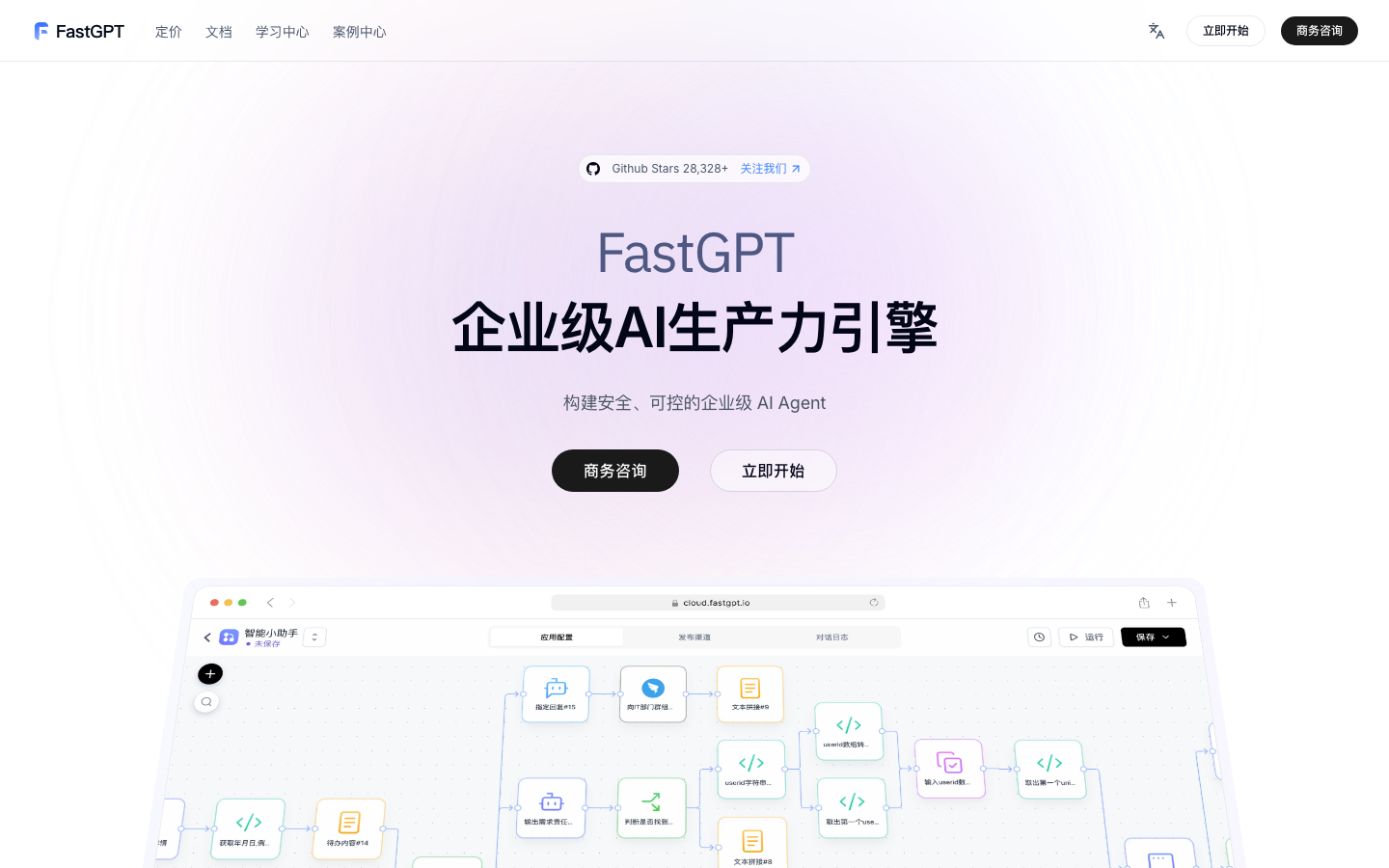
FastGPT is a knowledge base platform based on large language models and is officially positioned as an "enterprise-level AI productivity engine". It provides out-of-the-box capabilities such as data processing RAG retrieval and visual AI workflow orchestration, allowing teams to develop and deploy complex question and answer systems and AI agents without extensive configuration.
FastGPT
Core parameters and statistics
FastGPT is a knowledge base platform based on large language models. The official website homepage positions it as an "enterprise-level AI productivity engine" and emphasizes "building a safe and controllable enterprise-level AI Agent." It integrates data processing RAG retrieval and visual AI workflow orchestration into one platform, allowing teams to develop and deploy complex question and answer systems without extensive configuration.
| Projects | Public Information |
|---|---|
| Official positioning | Enterprise-level AI productivity engine/knowledge base platform |
| Core Competencies | Data processing RAG retrieval, visual AI workflow orchestration |
| Capability Combination | AI Workflow + AI Knowledge Base + Template System + Agentic RAG |
| Deployment form | Cloud (cloud.fastgpt.io), private deployment |
| Open source situation | GitHub public warehouse, self-hosting (license is subject to the warehouse) |
| Community size | GitHub about 28,328 stars, 7,140 forks |
| User scale | Officially, 500,000+ users worldwide |
| Latest version | v4.14.23 (2026-06-03, GitHub Releases) |
| Support platform | Web, API, private deployment |
Deployment form: FastGPT provides both cloud version and private self-hosting. Enterprises with high data compliance requirements can complete the deployment on the intranet and keep the knowledge base and conversation data in their own environment. This is the basis for its emphasis on "security and controllability".
Capability Density: The value of FastGPT is not only in “question and answer”, but also in connecting knowledge base construction RAG retrieval and workflow orchestration - from document import, segmentation, vectorization, to retrieval enhancement, node orchestration, and then to external exposure as API, forming a complete link.
Iteration rhythm: GitHub Releases shows that the 4.14.x stable version and the 4.15.0-beta candidate version are advanced in parallel, indicating that the project maintains an intensive rhythm between stable delivery and new feature verification.
User and market recognition
FastGPT’s recognition comes from the size of the open source community and enterprise adoption, rather than public revenue figures (the latter is not disclosed).
Community and Users: The GitHub warehouse labring/FastGPT has about 28,328 stars and 7,140 forks publicly available; the official website OG information states that it is "Trusted by 500,000+ users worldwide." Among the Chinese open source AI application platforms, FastGPT is a well-known and active project.
Positioning Crowd: The official website points the target scenario directly to the "enterprise-level AI Agent" and provides a business consultation entrance, indicating that its design goal is for enterprise knowledge base and business Q&A, not just a personal toy.
Prerequisites for implementation: The actual effect of knowledge base products depends on the quality and structure of the company's own documents, the optimization of segmentation and retrieval strategies, and the ability of the underlying large model to be connected. When the data is messy or lacks maintenance, the effectiveness of RAG will be significantly reduced.
Cost advantage
The cost advantage of FastGPT lies in the coexistence of two paths: "open source self-hosting" and "cloud on-demand", leaving room for enterprises to move from low-cost verification to large-scale deployment.
Open source and self-hosted: FastGPT code is public on GitHub and can be deployed privately. For teams with existing operation and maintenance and computing power, self-hosting can reduce explicit subscription costs to a very low level, and the cost is converted into investment in servers, vector libraries, and operation and maintenance.
Cloud on demand: The official cloud version of cloud.fastgpt.io is provided, which is suitable for teams that do not want to build their own to get started quickly. It is billed according to its official package.
Model calling cost: FastGPT itself is a platform layer, and the calling costs of underlying large models (such as various LLMs and vector models) are billed by the selected model service provider and need to be included in the budget separately.
Real Cost Structure: For enterprises, platform deployment is just the starting point, and ongoing costs come more from document processing, vector storage, and model invocation. When evaluating revenue, you should measure the construction time, retrieval accuracy and manual ratio of a single question and answer scenario.
Main functions
- Knowledge Base and Data Processing: Import documents and complete preprocessing such as segmentation and vectorization to build a searchable knowledge base.
- Agentic RAG Search: Introduce search enhancements in Q&A, so that answers are based on the company's own data rather than model guesses.
- Visual workflow orchestration: Use node-based canvas to orchestrate dialogue logic, retrieval, judgment and external calls. Non-pure R&D roles can also participate.
- Template System: Provides reusable templates to speed up the construction of FAQs and business scenarios.
- API and Integration: Expose the built application as an API to facilitate access to the website, customer service or internal systems.
- Private deployment: Supports self-hosting and meets compliance requirements that data does not leave the intranet.
The actual benefits of these functions depend on three key points: whether the enterprise documents have been structured, whether the retrieval strategy has been optimized, and whether the workflow can cover abnormal branches of the real business.
Model and version evolution
The main version of FastGPT has entered the 4.14/4.15 stage, with the stable version and candidate version running in parallel.
- v4.14.23 (2026-06-03): The latest stable version.
- v4.15.0-beta3 (2026-05-28): Candidate test version of 4.15, used for new feature verification.
- v4.14.22 (2026-05-22): 4.14.x iteration version.
From the early days of focusing on "knowledge base Q&A" to the introduction of visual workflow, template systems and Agentic RAG, the evolution direction of FastGPT is "from single-point Q&A to an orchestrated enterprise-level AI Agent platform." As a platform layer, FastGPT can connect to a variety of underlying large models and vector models. The model capabilities vary with the selected service provider.
Technical advantages
- Complete RAG link: String document processing, vector retrieval and generation into a configurable link to reduce the engineering workload of self-built RAG.
- Visual Orchestration: Node-based workflow makes business logic visible and maintainable, reducing hard coding.
- Privatizable: Open source self-hosting meets data sovereignty and compliance requirements, which is its key selling point for enterprises.
- Extensible Integration: Connect with external systems through API, making it easy to embed into existing business processes.
These designs together explain "why it is more controllable": data can stay in its own context, logic can be reviewed on the canvas, and retrieval can be based on enterprise data to constrain model output.
How to use
| Entrance | Applicable Scenarios | Description |
|---|---|---|
| Cloud version | Get started quickly | Visit cloud.fastgpt.io to create knowledge base and applications online |
| Private deployment | Data compliance | Self-hosted based on GitHub warehouse, deployed to own server |
| Workflow Canvas | Business Orchestration | Arrange retrieval, judgment and external calls in the visual canvas |
| API | System integration | Expose the application as an API to connect to the website or internal system |
Typical steps: Choose cloud or private deployment → Import documents to build a knowledge base and complete segmentation/vectorization → Arrange Q&A and retrieval workflows in the canvas → Configure the underlying large model → Connect to actual business through API.
Product Pricing
FastGPT provides two paths: open source self-hosting and cloud.
- Open source and self-hosted: The code is open source and can be deployed by yourself. There is no licensing fee at the software level. The costs are mainly servers, vector libraries and operation and maintenance.
- Cloud version: cloud.fastgpt.io provides hosting services and is billed according to the official package. The specific price is subject to the official website pricing page.
- Model Call: The cost of the underlying large model and vector model is billed by the selected service provider and needs to be included in the budget separately.
- Enterprise Services: The official website provides a business consultation entrance, and the terms of enterprise-level plans are subject to official communication.
Application scenarios
- Enterprise Knowledge Base Q&A: Construct product manuals and system document FAQs into a searchable knowledge base to support internal Q&A and customer service.
- Intelligent customer service and after-sales: Build a conversation robot based on corporate data to reduce repeated manual responses.
- Business process orchestration: Use workflow to connect retrieval, judgment and external system calls, and implement automatic question and answer with logic.
- Privatization Compliance Scenario: In industries that are sensitive to data sovereignty, such as finance and government affairs, knowledge base applications are deployed in a self-hosted manner.
Applicable people
- Enterprises and Institutions: core users who need a secure, controllable, privatizable knowledge base and AI Agent platform.
- Developers and Technical Team: Hope to quickly build a question and answer system based on the open source RAG framework to avoid self-development from scratch.
- Business/Operation Role: Can participate in the construction and maintenance of Q&A logic on the visual canvas.
- Boundary Tip: The effect of the knowledge base is highly dependent on document quality and retrieval optimization; teams with scattered data and lack of maintenance need to do content management first to achieve ideal results.
Summary and Outlook
The core competitiveness of FastGPT is to turn the "data processing - RAG retrieval - workflow orchestration" of the enterprise-level knowledge base into an out-of-box, privatizable open source platform, and to address the core concerns of enterprises in implementing AI Agents with "safety and controllability". Approximately 28,328 GitHub stars and the official 500,000+ users indicate that it has a solid community and adoption foundation in the Chinese open source AI application platform.
The current limitation is that the platform effect depends on enterprise document management and retrieval optimization, and the cost of the underlying model needs to be borne separately. In the future, it is worth paying attention to the maturity of Agentic RAG's capabilities in implementing the new features of 4.15, as well as the depth of support in enterprise privatization scenarios. For teams planning to implement knowledge base Q&A, it is recommended to first use the cloud version to run through a Q&A scenario with a small number of core documents to verify the effect, and then decide whether to privatize the expansion; when it comes to compliance deployment, it is necessary to confirm the data storage, model docking and licensing terms in advance.
Related tools:  Hugging Face, replicate
Technical advantages and capability boundaries
As an AI model and API product, FastGPT’s core capabilities can be deeply understood through the following dimensions, which directly affect technology selection and implementation effects.
Inference Performance and Benchmark Performance The model’s reasoning performance is reflected in its performance on standard NLP tasks (text generation, code completion, semantic understanding, multi-turn dialogue, information extraction, etc.). It is recommended to conduct horizontal comparison through public benchmark test lists (such as MMLU, HumanEval, GSM8K, etc.), but please note that there may be a gap between benchmark test scores and actual business scenario performance. Key indicators that affect the actual user experience include: inference speed (Token/s or response delay, which directly determines the smoothness of the user experience), context window length (which determines the input size that can be processed at a time, affecting the complexity of the tasks that can be processed), and consistency of output quality (the stability of the results of multiple outputs of the same input, which affects the perception of reliability).
API Compatibility and Development Ecosystem The depth of API compatibility with mainstream development frameworks (LangChain, LlamaIndex, Semantic Kernel, etc.) directly affects the cost and cycle of integrated development. It is recommended to pay attention to the following integration dimensions: the coverage of language types supported by the SDK (whether mainstream languages such as Python, JavaScript, Go, and Java have official SDKs), streaming output support (SSE/WebSocket protocol compatibility), function calling and tool usage capabilities (whether it supports mapping model output to structured function calls), the flexibility of structured output (JSON mode), and the ability to integrate with enterprise-level infrastructure (VPC deployment, Private Link, unified identity authentication). Complete API documentation and rich code examples can significantly lower the entry barrier to development and reduce integration time and costs.
Deployment Flexibility vs. Cost Tradeoff Depending on data privacy requirements, latency sensitivity and usage scale, FastGPT can choose cloud API calls or on-premises deployment solutions. The advantages of cloud deployment are zero operation and maintenance costs and elastic scalability, which is suitable for scenarios with large fluctuations in usage and rapid prototype development; local deployment provides complete data sovereignty and low latency (no network round-trip overhead), but you need to bear the cost of purchasing hardware such as GPUs and operation and maintenance manpower. It is recommended to use a monthly API call volume of 1 million times or a monthly fee of US$1,000 as a reference dividing line: below this threshold, the cloud API has better cost-effectiveness and flexibility. After exceeding this threshold, the total cost of ownership of the self-deployment solution should be comprehensively evaluated, taking into account factors such as hardware depreciation, electricity, operation and maintenance manpower, etc.
Model selection and version strategy
For the selection of FastGPT series models, it is recommended to match the model capabilities of different versions according to specific usage scenarios. The large-parameter version performs better on complex reasoning and multi-step tasks, but has higher costs and longer delays; the small-parameter version can already provide satisfactory output quality in scenarios such as daily conversations and simple question and answer, and the cost is only a fraction of the large version. The recommended selection strategy is: use small and medium versions in standard scenarios to reduce costs, and only call large version models when complex inference tasks need to be processed. This hierarchical calling strategy can reduce the overall API cost by 40-60% without significantly affecting the output quality.
Version Info
- FastGPT v4.14.23 :The latest stable version released by GitHub Releases continues the main line capabilities of knowledge base RAG retrieval and visual workflow orchestration, and is oriented towards continuous iteration of enterprise-level AI Agent construction.
- FastGPT v4.15.0-beta3 :Test candidate version of 4.15.0, used to verify new features and regression fixes before official release.
- FastGPT v4.14.22 :The iterative version of the 4.14.x series continues to improve knowledge base processing and workflow capabilities.
User Reviews