 FinChat
Free
FinChat
Free
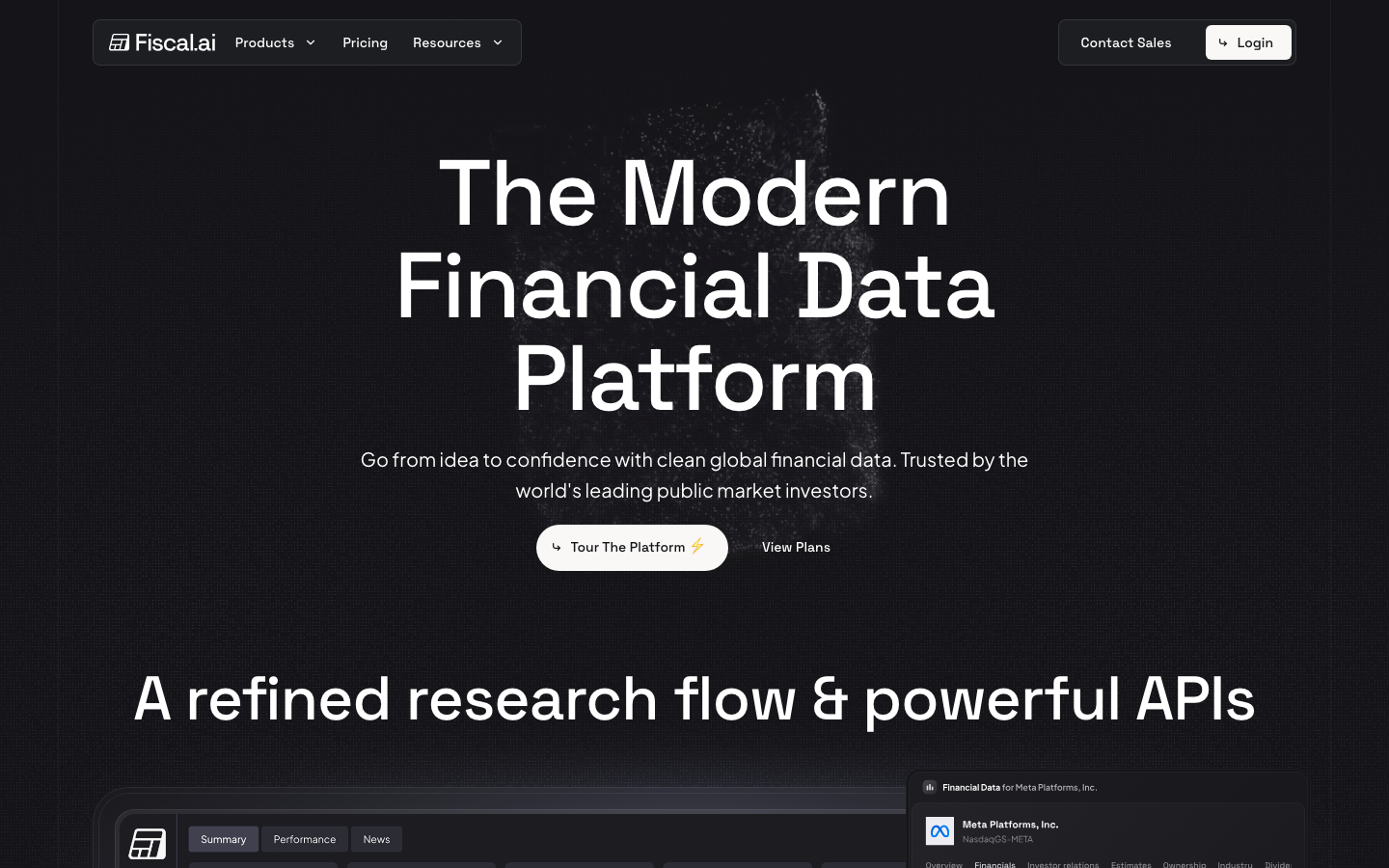
FinChat is an AI conversational AI search engine and stock research platform launched by Fiscal.ai. It combines institutional-level financial data, quantitative analysis and conversational AI to allow individual investors to complete investment research tasks such as stock selection, financial report interpretation, and valuation comparison in natural language.
FinChat
FinChat’s core parameters and statistics
Specific technical parameters (such as model size, context length, supported file formats, input and output restrictions, etc.) are subject to the official product page. It is recommended that users verify the latest technical specifications and system requirements before choosing to ensure that they match their own usage scenarios.
FinChat’s users and market recognition
Gradually build user awareness in the field, and product capabilities are used by content creators and teams to improve work efficiency. Some industry users have incorporated it into their daily workflow. It is recommended to refer to the latest official disclosures for specific user scale and industry adoption rate data.
Cost Advantages of FinChat
- C-side/Individual: Usually a free version is provided to experience the core functions, and high-frequency use requires a paid package subscription.
- API/Developer: Billed by call volume, suitable for development teams that can be flexibly integrated into their own systems.
- Enterprise/Privatized: Contact the business owner for customized quotation and deployment plan. The specific price is subject to the official real-time pricing page.
Main functions of FinChat
- Conversational Stock Screening: Use natural language to describe the filter criteria (such as "SaaS companies with revenue growth > 20%, gross margin > 50%, market capitalization above 10B"), and FinChat parses the criteria into a structured query and returns a list of matches.
- Intelligent Q&A on financial data: Conduct multiple rounds of Q&A on historical financial reports and key indicators of individual stocks, and support common investment research questions such as year-on-year changes and trend analysis.
- Valuation comparison and visualization: Compare the PE, PS, EV/EBITDA and other valuation multiples of companies in the same industry and generate comparison charts.
- Comprehensive Company Information Query: Covers quick retrieval of fundamental information such as business description, management, shareholder structure, and industry positioning.
- Market and Industry Scanning: Scan the market by industry, theme, factor and other dimensions to discover investment opportunities.
Expert View: There are several key synergies in FinChat’s feature design. First, conversational screening + financial Q&A are combined - users find the candidate pool through screening, and then conduct in-depth questioning on each stock in the pool. The two processes are completed with a unified conversational interface, which avoids the friction of repeated switching between the filter and analysis page of traditional tools. Second, when valuation comparison is used in conjunction with industry scanning, "top-down" industry stock selection can be completed within a few minutes - first scanning popular industries, and then comparing the valuation levels of companies in the industry, without leaving the dialogue interface during the entire process. Third, this interaction model is naturally suitable for mobile terminals and fragmented research scenarios. Users can complete a round of basic screening during commuting or between meetings, but its ability is limited in scenarios that require long text output such as writing in-depth research reports.
FinChat model and version evolution
Current main line
- Web Latest (~2026-06): The currently publicly available version, with conversational financial search as its core capability. The official version number has not been disclosed, and the online capabilities will continue to be iteratively updated later.
Historical Milestones
- Public Milestone (~2025-01): The product enters the publicly available stage and gradually establishes a baseline of data coverage and dialogue capabilities. The exact date has not been officially announced.
Version management tips
Since FinChat is delivered in SaaS form, version iterations are transparent to users, and there are no significant version change prompts on the front end. Users should follow the official update log or blog (if available) to learn about new market coverage, data source access and dialogue capability improvements. For users whose research processes rely on specific functional states, it is recommended to perform regression verification after sensing changes in a major version.
FinChat’s technical advantages
Mechanism: The core technical link of FinChat is the three-layer superposition of LLM (Large Language Model) + financial data API + semantic parsing. The user's natural language query is first mapped into a structured data query instruction through the semantic parsing layer, and then the precise value is obtained from the structured database through the financial data API, and finally it is organized into a natural language answer by LLM. The difference between this and a pure RAG (Retrieval Augmented Generation) approach is that the key financial data is not retrieved fragmentally from the document, but directly queried from a structured database - with theoretically higher accuracy.
Effect: For users, the feeling is "Ask a stock question and get not links or paragraphs, but precise numbers and comparisons." This is much more reliable in financial metric query scenarios than general AI search, which may pull conflicting data from documents from different sources. FinChat’s closed-source data pipeline ensures there is a single version of the truth for the same metric across the platform.
Project specificity: Financial data has strict requirements on timeliness - key data such as EPS and revenue should be available for query within minutes after the financial report is released. This means that the back-end data pipeline must support real-time or near-real-time updates, and has high requirements for data cleaning, standardization, and latency control. This is also an important technical watershed between financial vertical AI search and general search.
Limitations: Its conversational capabilities are limited by the coverage and update frequency of the underlying financial data. When the questions asked by users exceed the coverage of its data sources (such as in-depth data on non-North American markets, financial information on unlisted companies), the quality of AI's answers will significantly decrease. In addition, for questions that require "opinions" rather than "facts" (such as "What is the quality of this company's management"), AI lacks the ability to judge and can only aggregate public information.
How to use FinChat
- Visit https://finchat.io/ to experience basic conversation query without registration.
- Describe the research needs in natural language in the dialog input box, such as "Show me tech stocks with PE < 25 and revenue growth > 15%".
- View the structured results (lists, charts, comparison data) returned by FinChat.
- Conduct multiple rounds of questioning based on the results to narrow the scope or conduct in-depth analysis of specific targets.
- Satisfactory results can be shared or exported (specific export capabilities are subject to the official page).
Getting started: It is recommended that new users start with "Describe a stock you are familiar with", first verify FinChat's accuracy of known data, and establish a baseline for judging the reliability of AI output. Later, it will be gradually expanded to complex scenarios such as cross-company comparison and industry scanning.
Product Pricing for FinChat
The pricing model is subject to the official real-time page. Usually a freemium or subscription system is used, and basic functions can be used for free. Advanced functions or high-frequency use require paid subscriptions, and users are advised to evaluate the optimal solution based on actual usage.
Application scenarios of FinChat
- Quick Research on Individual Stocks: Enter the stock code or company name to get a financial panorama, valuation comparison, and business overview. It is suitable for smooth initial screening when covering a large number of targets, changing from "checking financial reports one by one" to "conversational batch acquisition".
- Industry Scanning and Screening: Use natural language to describe screening conditions, compare key indicators across companies, and quickly locate candidates that meet specific conditions. Deduction effect: For an industry scan covering 50 technology stocks, traditional methods may take 2-3 hours to read financial reports. FinChat can shorten the initial screening to 10-15 minutes.
- Post-investment tracking and monitoring: Regularly query the latest financial data of held stocks and learn about key changes. While FinChat doesn’t currently expose automated alerts, conversational querying is inherently more efficient than manually opening each stock’s page.
- Investment Learning and Verification: Novice investors can use FinChat to query real-life data on unfamiliar financial concepts, such as "Which company's ROE exceeds 20% in the long term", combining learning with actual research.
Unsuitable Scenarios: Compliance scenarios that require in-depth original buyer research reports, analysis of non-public data, or precise audit requirements for data timestamps, FinChat does not have the ability to replace professional terminals.
Applicable groups of FinChat
- Active individual investors: Have higher frequency research needs on US stocks/Canadian stocks and hope to cover more targets in less time. FinChat's conversational interaction can significantly reduce the time cost of the "screening-comparison-verification" cycle.
- Financial Content Creators and Analysts: Need to quickly obtain financial data and industry comparison data as content material, FinChat's conversational query is much faster than manually reading financial reports.
- Investment Educators and Learners: Use FinChat to query real-life case data and map abstract financial concepts to specific companies.
Does not fit boundaries:
- Professional institutional investors: require Bloomberg, FactSet-level data depth, real-time quotes, trade execution and compliance audit functions, FinChat does not have these capabilities.
- Non-North American market researchers: Users whose main research scope is A-shares, Hong Kong stocks, and European stocks need to confirm the data coverage before purchasing.
- High-frequency trading and quantitative strategies: FinChat is not a corresponding tool for scenarios that require backtesting of historical tick data and order book data.
Summary and Outlook
The value of FinChat lies in using AI conversational interaction to compress the stock research workflow that used to require professional terminals and a lot of manual review into a conversational interface. For individual investors, it lowers the threshold for using "institutional-level" financial data - there is no need to learn complex filtering syntax, and there is no need to switch back and forth between various financial report pages. The basic cycle from filtering to in-depth analysis can be completed using natural language. Its technology selection (structured data + LLM dialogue) is more reliable than the pure RAG solution in financial vertical search, but the capability boundary is limited by the market scope of data coverage.
Current limitations: Data coverage is mainly in North America, lacks real-time quotation and trading functions, and financial data output by AI of undisclosed enterprise-level solutions still needs to be cross-checked.
Procurement/Adoption Risk Assessment: Individual investors can first use the free version to evaluate whether the data coverage meets the actual target range, focusing on verifying the accuracy of the financial data of the AI's holding stocks. If the research scope focuses on U.S. stocks/Canadian stocks and falls into a mid- to low-frequency research scenario, FinChat may be more cost-effective than traditional information terminals. However, before paying for a subscription, be sure to confirm whether the required data fields (such as segmented business line revenue, cash flow details, etc.) are within the free/paid range, and whether the time difference in data update is within an acceptable range. For any conclusion involving actual investment decisions, AI output should be used as a clue rather than a basis, and the final judgment still needs to return to the original financial report and public disclosure documents.
Related tools: perplexity, you-com
How to use FinChat
- Web client: You can use it by visiting the official website and registering an account. Most functions do not require installation.
- API access: Provides RESTful API, developers can obtain the API Key and integrate it into their own applications.
Version Info
- FinChat Web Latest :The official semantic version number has not been disclosed. It is recorded according to the public page status. There is no official precise date yet.
- FinChat Public Milestone :There is currently no official precise date for historical nodes, and the minimum version context is established based on public milestones.
User Reviews