 Firecrawl
Free
Firecrawl
Free
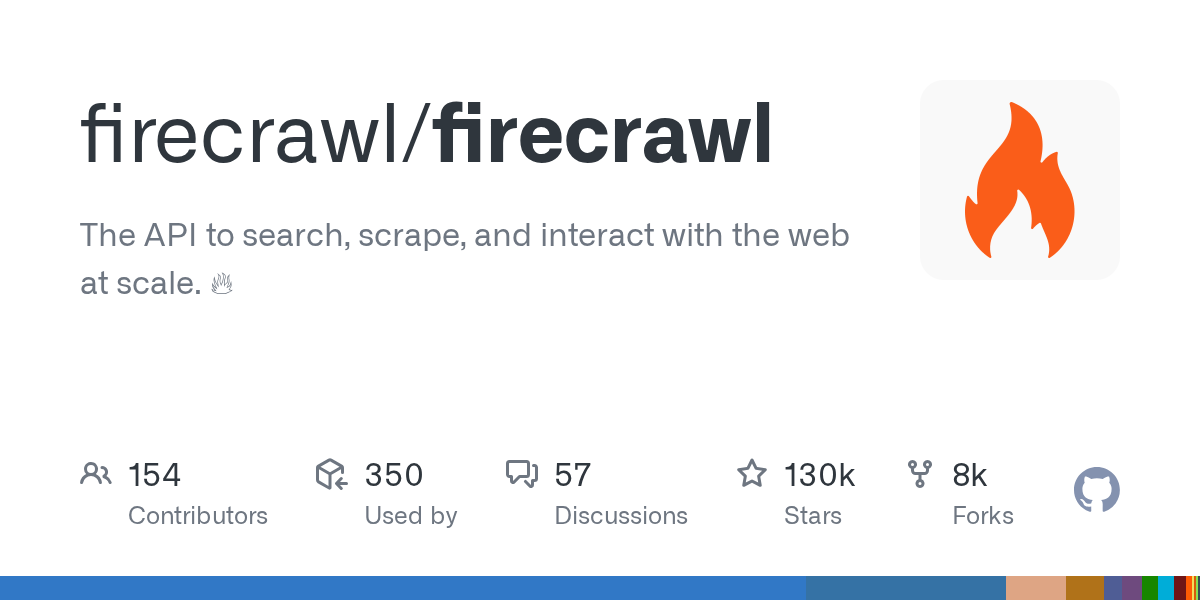
Firecrawl is an open source web data infrastructure project. The official warehouse describes it as "an API for large-scale search, crawling, and web interaction." It is suitable for providing structured web data for retrieval enhancement generation and automation processes.
Firecrawl
Core parameters and statistics
Firecrawl's official warehouse positioning is "an API for large-scale search, crawling and web page interaction", and its capability boundaries focus on web page data acquisition and structuring, rather than general model training or a complete BI platform.
| Projects | Public Information |
|---|---|
| Product Positioning | Search / Scrape / Interact API for web data |
| Code repository | firecrawl/firecrawl |
| License Type | AGPL-3.0 (Repository Public) |
| Main languages | TypeScript |
| Community size | 130k+ stars, 7k+ forks (GitHub) |
| Latest version | v2.10 (2026-05-15) |
| Delivery form | Open source code + cloud API |
| Target scenario | RAG data preparation, automatic collection of web pages |
Positioning boundaries: Firecrawl is strong in web page collection and structuring, and does not directly replace vector databases, workflow engines or business systems themselves.
User and market recognition
Firecrawl's market recognition is mainly reflected in the popularity of the developer community and project activity, rather than the number of publicly disclosed corporate customers.
Community indicators: The GitHub warehouse shows 130k+ stars, 7k+ forks, and 500+ contributors at the time of collection. These indicators reflect ecological attention and reuse scale.
Adoption Characteristics: This type of tool is usually first used in the AI application team for data entry standardization, and then expanded to content operations, public opinion monitoring and knowledge base update links.
Undisclosed items: Officially undisclosed business data such as the number of paying customers, ARR, and industry distribution.
Cost advantage
Firecrawl's cost advantage comes from the dual path of "open source and self-buildable + cloud API for flexible use" rather than a single fixed package price.
C-side/Individual: The open source warehouse can be tried directly, and the explicit cost is low, but it requires deployment and maintenance time.
Developer/API: Cloud API is suitable for rapid launch, and the cost is coupled with the request volume, crawling depth and data cleaning process; the real-time price is subject to the official page.
Enterprise/privatization: Self-built or enterprise solutions are available. Explicit costs are controllable, but hidden costs lie in compliance auditing, stability management, and operation and maintenance team capabilities.
Main functions
- Web Search and Discovery: Locate available pages first, then enter the crawling and extraction process.
- Page crawling and cleaning: Convert web page content into structured text to reduce the burden of subsequent RAG processing.
- Interactive web page processing: Supports page collection with interactive steps, covering more complex web page structures.
- Developer API access: Suitable for direct embedding into application backends and automation tasks.
- Open source and extensible: The extraction strategy and processing process can be expanded according to business rules.
Model and version evolution
Mainline release
- v2.10 (2026-05-15): The latest version is currently publicly available.
Nearly two stable nodes
- v2.9.0 (2026-04-10): Continue the iteration of mainline capabilities.
- v2.8.0 (2026-02-03): Important version node in early 2026.
Version relationship description
The Firecrawl version evolution follows the release rhythm of the open source warehouse. It is recommended that the production environment use a fixed version and upgrade after the grayscale environment verifies the crawling stability.
Technical advantages
Mechanism: Integrate "search, crawling, interaction, and extraction" into the same API capability.
Effect: Reduce the team’s engineering costs of switching between multiple tools and secondary assembly.
Scenario: In projects that need to continuously update the web knowledge base and have requirements for the stability of data entry, it is easier to form reusable collection standards.
How to use
Entrance 1: Use the official warehouse code directly, suitable for teams that need to deeply customize the collection strategy.
Entrance 2: Access to cloud API, suitable for quick verification of business value and launch rhythm.
Implementation steps: First determine the collection target site and frequency, then define the extraction fields and cleaning rules, and finally connect the results to the vector library or business database.
Product Pricing
The pricing model is subject to the official real-time page. Usually a freemium or subscription system is used, and basic functions can be used for free. Advanced functions or high-frequency use require paid subscriptions, and users are advised to evaluate the optimal solution based on actual usage.
Application scenarios
- RAG Knowledge Base Update: Convert web pages into searchable documents to improve the timeliness of answers.
- Competitive Product and Market Monitoring: Capture public pages regularly and generate structured change records.
- Content Operation Automation: Integrate external web page data into the internal content production or review process.
Applicable people
- AI Application R&D Team: An engineering team that needs stable web data entry.
- Data Engineering and Platform Team: The webpage collection process must be integrated into a unified data pipeline.
- Automated Operation Team: There are fixed collection tasks and need to reduce manual processing.
The unsuitable boundary is: small-volume requirements that have no technical operation and maintenance capabilities and only require one-time manual capture.
Summary and Outlook
It provides competitive solutions in its field, and its core value lies in lowering the threshold for AI use in this field.
Current limitations: Some advanced features require paid subscription, and the free version has function or usage restrictions; specific technical details and performance benchmarks have not yet been fully disclosed.
Version Info
- Firecrawl v2.10 :The latest public version of GitHub Releases continues to iterate along the main line of web crawling, extraction and stability fixes.
- Firecrawl v2.9.0 :The mainline version is updated to continue to improve the crawling and extraction capabilities.
- Firecrawl v2.8.0 :The public version node is used to observe the evolution of functionality and stability in the first half of 2026.
User Reviews