 fireflies.love
Free
fireflies.love
Free
Fireflies.ai is a AI office and efficiency tool for meeting recording, meeting search and sales insights. It supports Zoom, Google Meet, Microsoft Teams, desktop, mobile and API. It puts transcription AI summary, post-meeting tasks and session analysis on the same product.
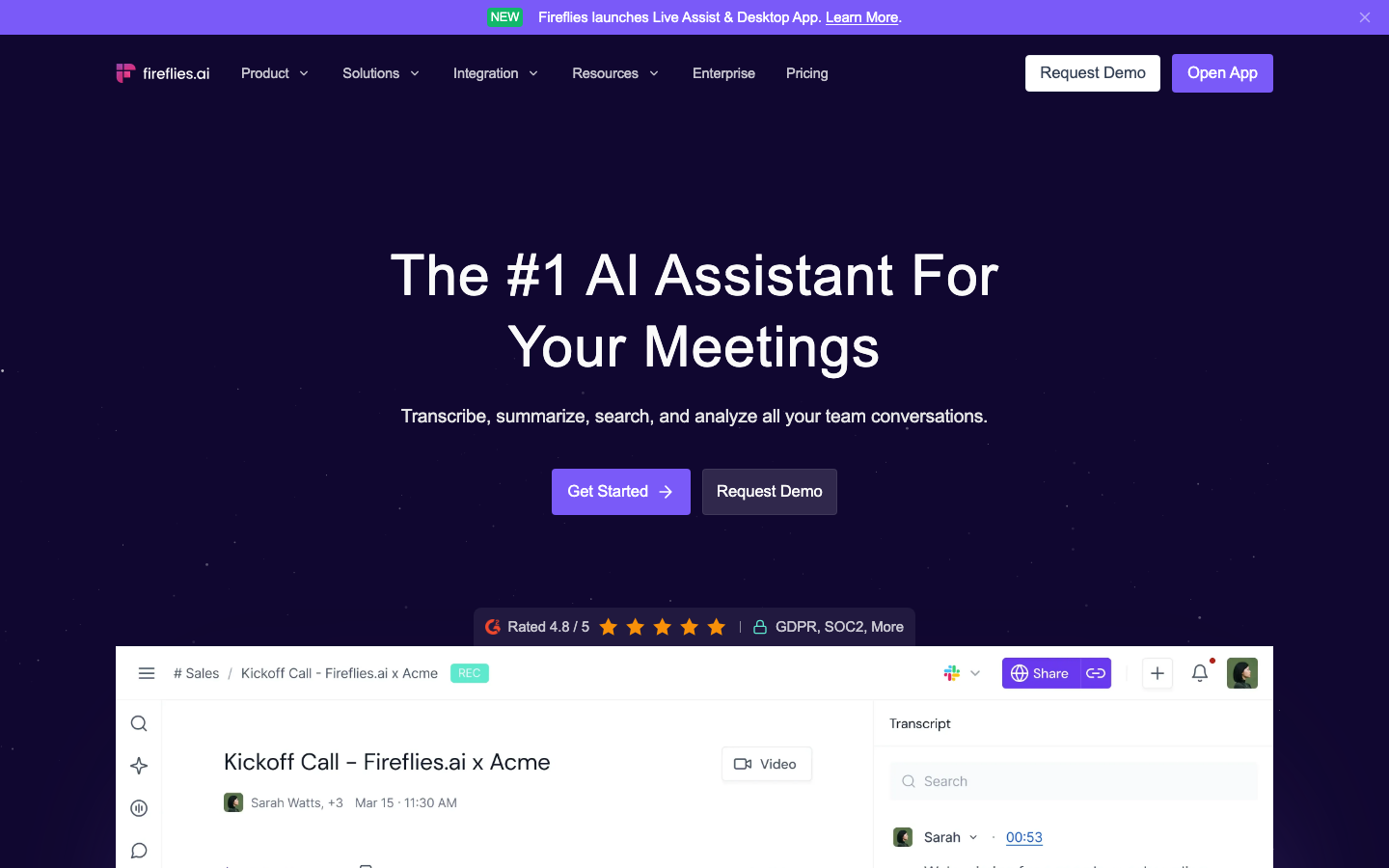
In-depth analysis of Fireflies.ai: AI meeting recording and conversation analysis platform
Core parameters and statistics of Fireflies.ai
| Projects | Public Information |
|---|---|
| Official Positioning | The #1 AI Assistant for Your Meetings |
| Product Form | Conference Transcription AI Summary, Conversation Search Conversation Intelligence, Voice Agents |
| Collection entrance | Web, iOS, Android, Desktop App, Chrome Extension, API, MCP Server |
| Transcription language | Official annotation 100+ language transcription |
| Market coverage | Official website display Used across 1 million+ companies |
| Community Rating | G2 Rating 4.8/5 (Official Website Quote) |
| Security Certification | SOC 2 Type II, GDPR, HIPAA, BAA, SSO/SCIM, Audit Logs, Private Storage |
| Pricing Tiers | Free / Pro / Business / Enterprise |
Brief review in one sentence: Fireflies.ai is not a transcriber that "records it and gives you a copy of the minutes", but a platform-level product that transforms meeting conversations into a collaborative data layer that is searchable, replayable, and accountable.
Publicity Verification: The official takes "integration of transcription, summary, search, and analysis" as the core selling point. This positioning can withstand scrutiny - it connects automatic meeting entry before the meeting, real-time suggestions during the meeting, CRM synchronization of post-meeting summary generation, task logging and management backend into a complete link, rather than just a single point of transcription. The real difference is "what comes after the ingestion": summary quality, search hit rate, analysis dimensions, and depth of downstream integration.
Type determination: Fireflies.ai's main delivery form is Productivity/Business-side Application (Type D), which is oriented to organizations and teams with high-frequency meetings; its MCP Server capability makes it also have the sub-type characteristics of Agent/MCP Automation Tool (Type A), which is especially suitable for scenarios of accessing agent workflows such as Claude, Devin, ChatGPT, etc. The following is based on type D as the main framework, and the relevant in-depth content of type A is supplemented in the technical advantages and usage chapters.
User and market recognition of Fireflies.ai
Market Penetration Signal: Fireflies.ai official website directly gives "1 million+ companies" and G2 4.8/5. This magnitude means it has moved beyond the early adopter stage and into the standardized pool of mainstream enterprise evaluation and procurement. In G2's Meeting Assistants category, it has long been at the forefront of the Leader Quadrant, alongside established competitors such as Gong and Chorus (now Zoom IQ).
Industry use case differentiation: Officially, sales, recruitment, marketing, user research, engineering, medical care, podcasting, and real estate are developed as independent use case pages one by one, rather than a general "suitable for everyone". This strategy of building templates by role is a sign of product maturity—it shows that it has polished preset summary templates, analysis dimensions, and integration lists for each role. The analysis logic required for "objection detection" that the sales team cares about and "candidate highlight extraction" that the recruiting team cares about are different. Fireflies handles them respectively through AI Skills and Conversation Intelligence modules.
Intensive enterprise signals: Keywords such as CIO, Fortune 500, Security Management Private Storage, Audit Logs, SSO/SCIM, etc. appear simultaneously on the public page, implying that the proportion of enterprise-level customers in its customer structure is constantly increasing. Fireflies has also opened a separate Security & Trust page, detailing compliance certification, data encryption (AES-256 at rest, TLS 1.3 in transit), data retention policy and privacy compliance terms, which is a relatively transparent level among similar SaaS.
Third Party Endorsement Quality: In addition to G2 ratings, Fireflies also has a large number of enterprise user reviews on platforms such as Capterra and TrustRadius. Positive comments are concentrated in two areas: first, the summary accuracy is highly usable for English meetings (most users reported 90%+), and second, the CRM/project management two-way synchronization effectively helps reduce manual entry. Negative feedback mainly pointed to non-English accent transcription accuracy, the stability of the Chrome Extension in long meetings, and the learning curve of advanced analysis functions.
Hidden benefits: For sales, customer service, recruitment and research teams, the biggest benefit is not the minutes themselves, but the reduction of low-quality collaboration friction such as "who made what decision" and "what was discussed last time". Once the conference knowledge base is established, the cost of information retrieval for onboarding new members, customer handovers, and quarterly reviews will be reduced from "looking through mailboxes and notes" to "one search statement."
Cost Advantages of Fireflies.ai
| Package | Public price (annual payment/seat/month) | Core differences |
|---|---|---|
| Free | $0 | Unlimited transcription with AI summarization 400 minutes Team storage 20 AI credits/month |
| Pro | $10 | 8,000 minutes/seat storage, downloads and video recording Voice Agents, AI Skills |
| Business | $19 | Unlimited storage 30 AI credits, multi-language mode Conversation Intelligence, team analytics |
| Enterprise | $39 | 50 AI credits, SSO/SCIM, Audit Logs, HIPAA, Private Storage |
Cost judgment for C-side/individual users: The Free version already provides the core capabilities of "unlimited transcription + unlimited AI summarization". 400 minutes of team storage is more than enough for individual users or small teams of three to five people to verify the effect. The real limit is AI credits (20/month), which determine how many advanced analysis or AI Skills calls you can run. If you just "record it + read the summary", the Free version basically has no expenditure pressure.
API/Developer Cost Structure: Fireflies exposes the meeting data layer to external systems via API and MCP Server. For developers, the cost shifts from "buying seats" to "engineering budget to embed conferencing capabilities into internal systems." Scenarios that require a self-built integration layer include: sending transcribed data to the BI dashboard, docking self-developed CRM field mapping, and using MCP to let internal agents retrieve historical meetings. This part of the hidden cost is much higher than the seat subscription fee because of the need to continuously maintain the data pipeline and permission mapping.
Cost Characteristics of Enterprise/Regulated Organizations: The real value of Enterprise is not cheap, but at the compliance boundary - directory management of SSO/SCIM, operational traceability of Audit Logs, data residency of Private Storage, and medical compliance of HIPAA. For regulated industries, Fireflies' compliance certifications (SOC 2 Type II, HIPAA, BAA) can save the cycle cost of independent vendor security assessments. However, from a procurement perspective, Enterprise's AI credits (50/month) may become a secondary procurement touchpoint in high-frequency analysis scenarios, and the credit consumption upper limit and extended unit price need to be confirmed at the contract level.
Hidden costs are inevitable: When the team connects Fireflies to CRM, ATS, project management tools and Slack, the real hidden cost is not the seat fee, but permission management (who can join which meetings, who can view which transcripts), retention period (how long meeting recordings are stored, who can delete them), and automatic joining policies (which meetings on the calendar allow Bots to enter). These governance costs increase exponentially when the deployment scale exceeds 50 people, requiring an internal "meeting data governance role" to continuously maintain the rules.
Main features of Fireflies.ai
-
AI Note Taker Bot: Automatically join calendar meetings on Zoom, Google Meet, and Teams, record and output transcripts in real time. Supports multiple membership strategies - full automatic membership, selective membership based on tags, or manual activation only. When a Bot joins a meeting, a clear prompt will be displayed in the meeting, and participants can see the existence of the Bot, reducing privacy disputes.
-
Chrome Extension and Desktop App: In scenarios where it is inconvenient to use bots (such as customer external meetings, meeting situations where third-party bots are not welcome), meeting participants can directly record their own audio through browser extensions or desktop applications. Desktop App also supports local audio file upload and transcription, opening up offline scenarios.
-
AI Summaries and AskFred: Automatically generate bullet-point summary action items, key topic timeline, and full search index after the meeting. The built-in AskFred chat interface allows users to perform natural language queries on historical meetings (for example, "What objections did the last customer we had about pricing have?") without having to page through transcripts one by one.
-
Conversation Intelligence: Goes beyond the transcription layer to provide talk time distribution, sentiment curves, hashtags, issue identification, objection detection, tracking metrics (such as Talk-to-Listen Ratio), and team-level comparison dashboards. These analytical dimensions have independent value to sales coaches, hiring managers, user researchers, and product managers: Sales uses it for call coaching, and recruiting uses it for standardized interview review.
-
Voice Agents and 200+ AI Skills: Transform meeting output into downstream actions. Preset AI Skills cover automatically creating Notion/Asana tasks, publishing summaries in Slack, updating contact records in Salesforce/HubSpot, generating candidate ratings based on criteria, etc. Voice Agents goes a step further - allowing users to define agents that automatically make or answer calls, extending conference analysis capabilities to the field of telephone communication.
-
MCP Server integration: Exposes the Fireflies conference knowledge base as a standard MCP (Model Context Protocol) interface, allowing AI agents such as Claude, Devin, and ChatGPT to directly retrieve, query, and reference conference data. This means that meeting notes are no longer enclosed within the Fireflies interface, but become callable context within a larger AI workflow—for example, letting Devin automatically review historical decisions from a requirements meeting before writing code.
Hidden linkage: Fireflies' strongest product strength is not in the single quality of "recording + transcription", but in the complete data chain of "transcription → topic classification → CRM synchronization → task logging → MCP Agent call". Once this chain runs through, the meeting is no longer a one-time communication, but a data source that can be continuously queried, analyzed, and triggered to action. In actual implementation, most teams will focus on verifying the transcription accuracy in the first three weeks, but the real ROI is after the fourth week - when the meeting data is accumulated enough to support cross-conference trend analysis and topic tracking.
Model and version evolution of Fireflies.ai
The version release of Fireflies is not based on the model number like the basic model manufacturers, but is based on the "product capability stage" as the anchor point. Three main lines can be sorted out from the public pages and historical milestones:
Main line 1: From transcription tool to analysis platform
The earliest positioning of Fireflies was "meeting transcription + summary generation". Between 2023 and 2024, the product focus will shift from "good recording" to "deep analysis" - the Conversation Intelligence module will be introduced, and capabilities such as speaking duration analysis, emotion detection, and topic extraction will be added. The core selling point of the product at this stage has changed from "taking notes for you" to "helping you review conversations."
Main Line 2: From single entrance to multi-channel collection
In the early days, it mainly relied on Bot to join the meeting, and then gradually expanded to Chrome Extension, Desktop App (macOS/Windows) and mobile terminals. After 2025, the Desktop App will be pushed to the main promotion position on the homepage, and the Live Assist capability will be added—displaying suggestions, related content, and speaker annotations in real time during the meeting. At the same time, the file upload and transcription function was launched, supporting the direct import of offline audio files.
Main line three: From closed products to open ecology
From the end of 2025 to the first half of 2026, Fireflies intensively released three important open capabilities: AI Skills ecosystem (200+ preset integration templates), Voice Agents (definable automatic call agents), and Fireflies MCP Server (exposes the conference library to Claude/Devin/ChatGPT). This marks the upgrade of product positioning from "independent conferencing tool" to "conference data infrastructure".
Current capability labels (arranged by public page display priority): Desktop App + Live Assist + MCP Server + Voice Agents + AI Skills. This means that the core narrative of the current phase of Fireflies is "making meeting data accessible and actionable in any tool."
Recommendations for version evaluation by the production team: Since Fireflies does not release version-by-version release notes to the outside world (only updated through changelog and new feature blog), it is recommended that the production team evaluate upgrades based on "functional threshold" rather than "version number" - the focus is to confirm whether the required functions (such as HIPAA compliance Private Storage, MCP Server) are available in the current subscription, rather than pursuing the latest version number.
Technical Advantages of Fireflies.ai
Multi-channel collection architecture: Fireflies also supports five collection methods: Bot joining Chrome extension, desktop independent recording, mobile recording and file upload. The actual effect of this multi-channel design is that the collection link will not be interrupted due to changes in the security policy of a single conference platform. When Zoom tightens its policies on third-party bots, Desktop App and Chrome Extension can seamlessly replace bots as the main entrance. For hybrid office organizations, this redundant design means a more robust collection layer.
Structured Analysis Pipeline: Fireflies does not simply output full-text transcripts, but overlays multiple layers of analysis on top of the transcripts - speaker separation (diarization), topic clustering, key segment extraction, sentiment curves, and issue/objection identification. Mechanically, it is a three-level pipeline of "speech → text → structured events". Effectively, users can quickly locate key discussion passages through topic tags and timelines without having to read through the entire 1-hour transcript. This has substantial efficiency improvements for scenarios such as sales review, user research coding, and recruitment scoring.
Enterprise Security Architecture: SOC 2 Type II, GDPR compliance HIPAA and BAA, SSO/SCIM directory synchronization Audit Logs, Private Storage, AES-256 encryption at rest and TLS 1.3 encryption in transit - these are not "plus points" at the functional level, but the entry threshold that determines whether Fireflies can enter compliance-sensitive industries. Private Storage allows enterprises to store transcribed data in designated AWS Regions, addressing data residency needs. Audit logs provide traceability of "who viewed which meeting at what time" and are suitable for financial, medical and government scenarios.
Architectural location of MCP Server: Fireflies MCP Server is in the link LLM Agent ↔ Fireflies MCP ↔ Fireflies API → Conference Database. The MCP layer encapsulates Tool behaviors such as search_meetings, get_transcript, get_summary, query_askfred, etc., allowing external agents to retrieve meeting data through standard interfaces. This means that the meeting knowledge base is no longer enclosed within the Fireflies product interface, but can be directly called as an "external memory layer" in the agent workflow. Specific scenarios include: Devin automatically reviews the discussion conclusions of relevant requirements meetings before coding; the internal Chatbot quotes policy statements from HR meetings when answering employee questions.
Engineering Pitfall Guide (MCP/Agent Scenario):
- Token consumption and context window control: When the agent retrieves long transcripts of multiple meetings through MCP, the token consumption of a single conversation can balloon rapidly. It is recommended to set the
max_resultsandmax_tokens_per_meetingparameters on the agent side to give priority to returning the summary rather than the full text to avoid exceeding the context window. - Conference data permission leakage risk: The MCP interface exposes the conference list accessible to the current authorized user by default. In a multi-user agent scenario, you must ensure that the agent's OAuth scope is accurately mapped to the minimum meeting set to prevent one team's meeting data from being retrieved by cross-team agents.
- Real-time vs. Cache Consistency: Transcription takes several minutes to process after the meeting ends. If the agent initiates an MCP query immediately after the meeting ends, it may obtain incomplete or in-process data. It is recommended to set a delay window of 5-10 minutes on the agent side, or include the conference status (
processing/completed) into the query filter conditions.
How to use Fireflies.ai
Quick start link
-
Bind Calendar and Meeting Platform: Associate Google Calendar, Outlook or Office 365 in Fireflies settings and authorize Fireflies to read calendar events. At this step you can choose to "Automatically join all meetings" or "Only join meetings with specific labels", the latter is suitable for users who don't want the bot to appear in all conversations.
-
Select the collection entrance: Select the appropriate joining method according to the organizational policy. Give priority to using Bot for internal meetings (automatic, non-sensitive, full recording); use Chrome Extension or Desktop App for customer meetings or third-party meetings (only record local audio to avoid Bot from being accepted by external participants). The Desktop App also supports drag-and-drop upload of offline audio files, which is suitable for non-standard formats such as phone recordings and on-site meeting recordings.
-
Configure sync targets and AI Skills: Authorize tools such as Slack, Salesforce, HubSpot, Notion, Asana, Jira, etc. in Settings > Integrations. Once configured, summary, task and contact updates will be automatically synchronized at the end of each meeting. AI Skills can be preset here - for example, "Automatically create a Salesforce follow-up task for every meeting that contains the pricing keyword."
-
Start Conversation Intelligence: For core teams such as sales and recruitment CS, enable the CI module in Team Settings. After turning it on, team administrators can see analysis dashboards such as speaking proportion trends, mood changes, frequency of objections, and keyword clouds. These data need to be accumulated over at least 5-10 sessions to render statistical significance.
-
Connect to MCP Server (Advanced): Generate API Key in the API settings of Fireflies, and then point to the Fireflies endpoint in the MCP configuration of Claude Desktop / Devin / ChatGPT. Taking Claude Desktop as an example, add the following configuration in
mcpServersofclaude_desktop_config.json(subject to the latest official document):
{
  "mcpServers": {
    "fireflies": {
      "command": "npx",
      "args": ["@fireflies-ai/mcp-server"],
      "env": {
        "FIREFLIES_API_KEY": "<YOUR_API_KEY>"
      }
    }
  }
}
Quantitative cost reduction and efficiency improvement (workflow deduction, unofficial commitment)
- High Frequency Sales Team: For a one-hour customer call, it turns out that the sales staff needs to spend an extra 15-25 minutes sorting out minutes and updating the CRM. After using Fireflies automatic transcription + AI Summary + CRM synchronization, the review and supplement time can be compressed to 3-8 minutes, which can free up about 1-2 hours per person of recording work per week.
- Recruiting Team: A 45-minute candidate interview, with 10-15 minutes for the Recruiting Coordinator to manually compile feedback. Fireflies Automated Transcription + Candidate Scoring AI Skill reduces collation time to 2-5 minutes and is more standardized.
- User Research Team: A 90-minute interview, 45-60 minutes for the researcher to code the transcript. Fireflies' topic tagging + search capabilities reduce review and coding time by approximately 50%.
Boundary of human-machine collaboration
- 100% automated segmentation: Transcription generation, summary generation, keyword annotation, CRM field updates, Slack/email notification sending, and task creation. These procedures can be completed without manual intervention, and errors are controllable.
- There are sections where manual confirmation points must be set: Sending summary content as a formal report (requires manual review for accuracy and compliance), making performance judgments based on meeting content (such as sales scores), and citing contract terms and commitments (requires manual cross-checking of the original transcript). The "manual review mode" provided by Fireflies can pause automatic publishing in such scenarios and wait for manual confirmation before pushing to downstream systems.
Product Pricing for Fireflies.ai
Fireflies’ public pricing structure is already relatively transparent, with clear boundaries between the four packages. The key constraint in determining purchasing tiers is not the seat fee itself, but the following three limiting factors:
Consumption mechanism of AI credits: AI credits are the "tokens" of Fireflies' high-end functions - each call to advanced analysis (Conversation Intelligence in-depth reporting, custom AI Skills to perform Voice Agents call analysis) consumes a certain number of credits. The 20 credits per month for the Free version are just enough for experience; the 30 credits for the Business version are acceptable for medium and low-frequency analysis teams; the 50 credits for the Enterprise version still need to be evaluated according to the actual consumption rate according to the team size. It is recommended to measure actual credit consumption through a 14-day trial before purchasing, and then decide whether to upgrade the package or purchase additional credit packages.
Storage and Retention Policy: The Free version has a team storage limit of 400 minutes, the Pro version has 8,000 minutes per person, and Business and Enterprise have unlimited storage. For teams with high-frequency meetings (10+ meetings per week), per-seat storage on the Pro version may be capped in the first 3 months. Business rollout to unlimited storage eliminates the management headache of "when do you want to delete old meetings?" Additionally, Enterprise offers customizable data retention periods (settable to 30/60/90 days or forever), a critical requirement in regulated industries.
Distribution of enterprise governance functions: SSO/SCIM, Audit Logs, HIPAA compliance Private Storage, all four capabilities are locked in the Enterprise package. For regulated organizations above 300 people, there is no alternative path to these capabilities, Enterprise is the only option. For unregulated, medium-sized teams, the Business package already provides most of the management value (unlimited storage, team analysis CI module), and the cost of $19/seat/month is in the middle of the industry in the conference assistant category.
Application scenarios of Fireflies.ai
-
Sales Team and Customer Success: Automatically extract customer objections, mentions of competing products, purchase signals and next actions, and use it with voice ratio analysis to help sales coaches provide targeted coaching. Managers no longer need to sit in on every call, but can view their team’s communication patterns and areas for improvement in bulk through Conversation Intelligence dashboards. Two-way sync with Salesforce/HubSpot ensures customer records always contain the latest meeting context.
-
Recruitment Team: Automatically generate standardized transcripts and highlight summaries during the candidate interview process, and AI Skills can automatically score candidates according to preset dimensions (communication skills, technical depth, cultural match). The hiring manager can quickly locate the "candidate's answer to XXX question" paragraph through search without replaying the entire interview, which greatly shortens the horizontal comparison time after multiple rounds of interviews.
-
User Research & Product Team: Thematic coding of long interviews (60-90 minutes) is one of the most time-consuming aspects. Fireflies' topic clustering and search capabilities can reduce coding time from 45-60 minutes to 20-30 minutes. Researchers only need to search for "user feedback on pricing" through AskFred, and the system will return the timestamps and context of all relevant segments, eliminating the need to manually annotate each segment.
-
Cross-department weekly meetings and decision tracking: The biggest pain point of cross-department regular meetings is the lack of recording and tracking of "who promised what." Fireflies automatically precipitates action items and owners and pushes them through Slack/email. Combined with project management integration (Asana/Jira/Notion), each decision automatically generates a trackable task, reducing the friction of "the decision of the last meeting was not claimed".
Dissuade Scenarios: Strong privacy situations (attorney-client confidential communication, board meetings, pre-compliance audit preparation meetings) are not suitable for turning on Fireflies by default, because even if the Bot clearly identifies the presence, participants may still relax their cognitive vigilance. In these scenarios, you should use Manual Recording mode and pause recording during sensitive periods. In addition, if the team has no more than 5 meetings per week and there are no unified requirements for minute format and follow-up tracking, the advantages of Fireflies' analysis layer cannot be reflected, and the free version will be enough to cover the needs.
Who is Fireflies.ai suitable for?
-
Sales and Customer Success Leaders: The people who most directly benefit from the linkage dividends of search, analysis, tasks and CRM. The typical portrait is a medium to large sales team that participates in 8+ customer meetings per week and needs to do call coaching regularly. Entry requirements: A team of at least 3 people, a CRM (Salesforce/HubSpot) and willingness to tie meeting data to the sales process.
-
Recruitment Team and HR Operations: Organizations that need to standardize interview records, conduct cross-candidate comparisons, and reduce the manual sorting time of recruitment coordinators. Prerequisites: Have a formal experience using ATS (Greenhouse/Lever) and are willing to incorporate interview transcription into the hiring process.
-
User Research and Product Manager: Organizations that need to frequently perform qualitative interview coding and need to share interview insights within the team. Applicable prerequisite: at least 5 user interviews per month, and the team has a unified insight management tool (such as Notion/Confluence/Dovetail).
-
Operations and Engineering Managers: Organizations that need to unify meeting asset accumulation across teams, retain meeting records for compliance audits, or need to connect the meeting knowledge base to internal AI Agents. Applicable premise: The organization has or plans to establish an internal knowledge management system. The output of Fireflies is not stored in isolation but integrated into the existing information flow.
Not suitable for the boundary: The following three types of organizations are not recommended to directly purchase Fireflies - (1) Teams with less than 10 weekly meetings and no need to output formal minutes (the free version is sufficient, and there are lighter alternatives); (2) Scenarios where the meeting language is mainly non-English and the transcription accuracy is required to be higher than 95% (Fireflies' multi-language transcription accuracy is lower than English medium and high, so you need to verify it with the trial version yourself); (3) Any legal or compliance constraints that do not allow third-party systems to access meeting audio (e.g., financial trading rooms, military project meetings).
Summary and Outlook of Fireflies.ai
The core value of Fireflies.ai is not only "automatic recording", but also transforming meetings from one-time communication events into manageable, retrievable, and triggerable structured data assets. Its efficiency gains for high-frequency meeting teams are real and measurable—sales teams can save 1-2 hours of record-keeping work per week, and recruiting and research teams can compress retrospective coding time by around 50%. The biggest competitive barrier for products at present is not the accuracy of transcription (the track has tended to be homogenized), but the system-level synergy composed of "acquisition channel density + analysis depth + CRM/ATS/project management integration + MCP open ecology".
Current clear limitations: Transcription accuracy still fluctuates in support of non-English accents. It is recommended that non-English teams do blind testing of accuracy during the trial period; AI credits consumption rate may exceed expectations in high-order analysis scenarios, and the actual consumption pattern needs to be counted during the trial period; MCP Server and Voice Agents are still in the rapid iteration stage, and functional boundaries and stability may change with versions.
Purchase and Adoption Risk Assessment: The three most important things to check before purchasing - (1) Whether the automatic enrollment policy conflicts with the organization's meeting confidentiality regulations (whether the Bot enrollment range can be finely controlled by calendar tags); (2) whether the data retention and export rules match compliance requirements (especially Enterprise customers need to confirm the retention period of the Private Storage area and Audit Log); (3) whether the actual consumption rate and extended unit price of AI credits need to be included in the annual budget. In addition, it is recommended to use "a 10-15-person sales/recruiting team + two-week trial" as a pilot unit to first verify the transcription accuracy, summary quality, and CRM integration experience, and then expand horizontally across departments. Once permissions are loosely designed, the meeting knowledge base will quickly degenerate from a productivity asset into a compliance risk exposure - whether each participant has the right to view the transcripts of all meetings, who can delete historical records, and whether a bot appears in highly sensitive meetings that should not appear. These governance details need to be locked in advance through whitelisting and labeling policies before going online.
Related tools:  Notion AI, google-workspace
Version Info
- Desktop App and Live Assist stages :The homepage of the official website has listed Desktop App and Live Assist as the current main recommended capabilities, and there is no official precise release date yet.
- Fireflies MCP Server Stage :The official website has listed Fireflies MCP Server as the capability portal for Claude, Devin, and ChatGPT. There is no official precise date yet.
- Voice Agents and AI Skills Expansion Phase :The public page has shown the ecosystem of Voice Agents and 200+ AI Skills, but there is no official precise date yet.
User Reviews