 Fireworks AI
Fireworks AI is an AI training model infrastructure platform for developers and enterprise teams, covering Serverless model API, On-Demand/Reserved GPU deployment, model fine-tuning OpenAI compatible calls and enterprise-level capacity management.
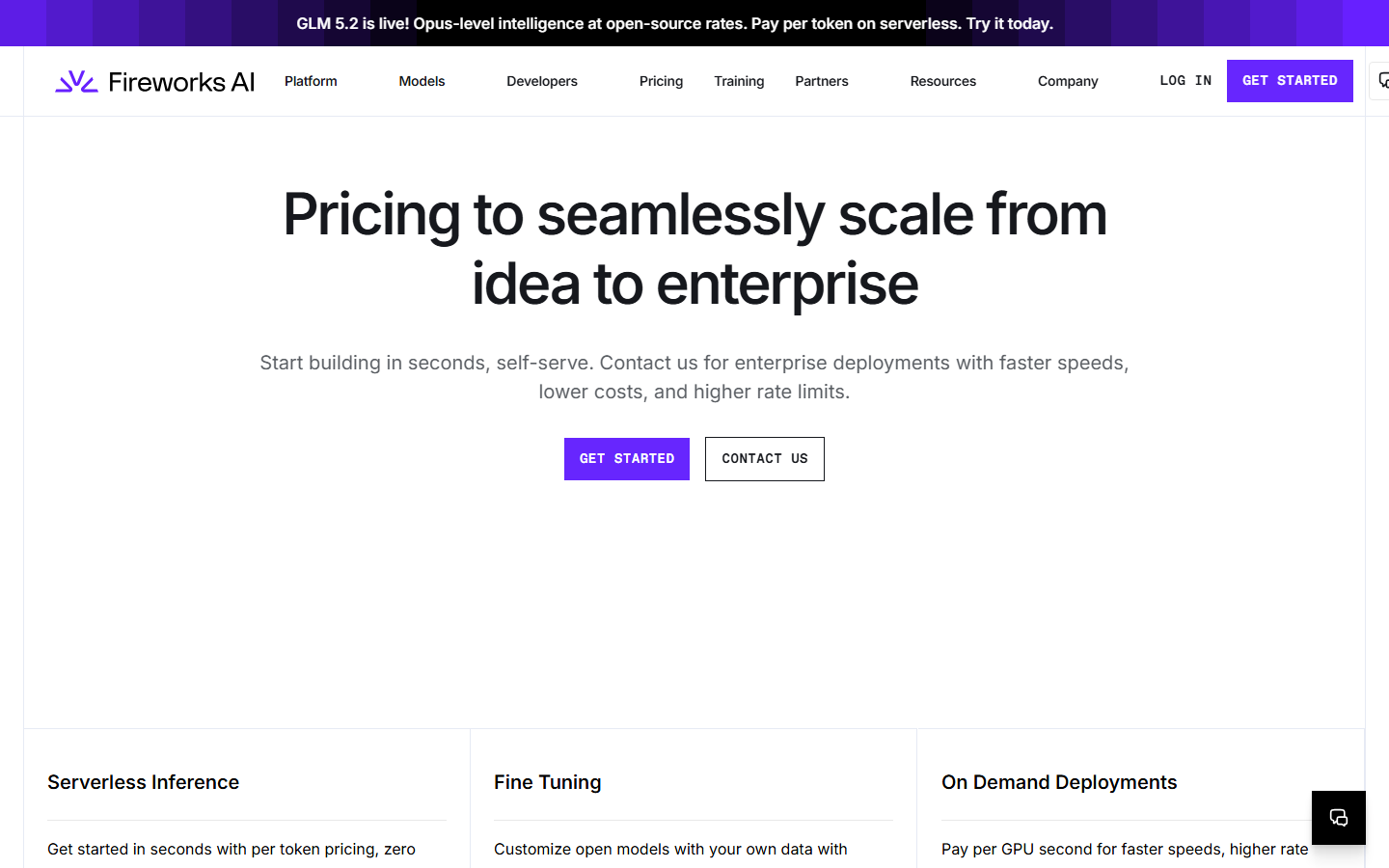
Fireworks AI’s generative AI inference, hosting and fine-tuning platform in-depth analysis
Core parameters and statistics
| Project | Current Public Information |
|---|---|
| Product positioning | Generative AI inference, model hosting GPU deployment and model training infrastructure platform |
| Official website | https://fireworks.ai/ |
| Main deployment forms | Serverless (billed by token), On-Demand (billed by GPU hour), Reserved (capacity reservation), Training (training and fine-tuning) |
| API compatibility | Supports OpenAI compatible interfaces (/v1/chat/completions, /v1/embeddings, etc.) and Anthropic compatible calling methods |
| Model Coverage | Open Source LLM (Llama, DeepSeek, GLM, Kimi, Mistral, Qwen, etc.), Code Model (CodeLlama, DeepSeek Coder), Multimodal Model Fireworks Hosted Model |
| Training methods | LoRA SFT, LoRA DPO, Full Param SFT, Full Param DPO, RFT (Reinforcement Fine-Tuning) |
| Service level | Standard (shared queue), Priority (priority queue, suitable for production load) |
| Billing dimensions | Serverless is billed by input/output token, On-Demand/Reserved is billed by GPU resources and time, and training is billed by token or GPU hour |
| Enterprise capabilities | Dedicated deployments, multi-region deployment guaranteed capacity, higher rate limits, Trust Center compliance review |
| The first batch of token delays (TTFT) | The specific value has not been disclosed; the official promotion is "fastest inference" positioning, the actual TTFT varies depending on the model and deployment form, it is recommended to refer to the official real-time page and actual measurement |
| Throughput limit (TPM/RPM) | Undisclosed unified value; Standard and Priority levels have different rate limits, and enterprise Reserved capacity can negotiate higher quotas |
The core value of Fireworks AI is not to provide a single chat interface, but to centralize model inference, hosting, fine-tuning, and capacity procurement into an infrastructure layer that developers can call. For the engineering team, it is more like a "model running platform": you can use the Serverless API to quickly test models, and after the traffic stabilizes, you can switch to On-Demand or Reserved resources to obtain more controllable throughput, latency, and capacity. Compared with directly building your own inference cluster, Fireworks' goal is to provide an operational choice system between model launch speed, operation and maintenance complexity, and cost flexibility.
Positioning boundaries: Fireworks AI is not a RAG framework agent orchestration tool or terminal writing tool. It is suitable for teams that already have AI products, code assistants, data analysis assistants or enterprise model applications to solve the problems of inference speed, capacity, cost, fine-tuning and model selection after the model goes online. It is not recommended for pure prompt word users or teams without API integration capabilities to use it directly.
User and market recognition
Developer Adoption Signal: Fireworks provides model catalog API documentation, price pages, and blog updates, and developers can directly access model IDs, deployment forms, and API compatible interfaces. Its model page and blog continue to show that models such as GLM 5.2, Kimi K2.7 Code, and DeepSeek series were launched on the platform within the same week or day of launch, indicating that Fireworks has a clear product rhythm in terms of new model launches or rapid launches. This "Day-0 support" strategy is attractive to AI teams that need to keep up with model iterations.
Enterprise adoption signals: The official page displays enterprise-level capabilities such as Dedicated deployments, reserved capacity, multi-region, and Trust Center. These capabilities usually correspond to the production environment's requirements for stable capacity, availability, data boundaries, and compliance reviews. They also mean that the commercialization focus of Fireworks AI is not simply low-priced APIs, but "operation guarantee after the model goes online." The existence of enterprise-level functions also implies that a considerable proportion of its customer base already has production-level deployment needs, rather than staying in the prototype verification stage.
Ecological Comparative Positioning: On the fast inference API track, Fireworks’ direct competitors include Groq (known for its LPU hardware acceleration), Together AI (emphasis on open source model hosting and training) and Replicate (known for its community and ease of use). Fireworks' differentiation lies in providing four-tier deployment forms from Serverless to Reserved, and investing resources in the speed of model launch. However, hard data such as the specific market share of API calls and the number of paying customers have not been made public. The market position needs to be comprehensively judged based on the popularity of GitHub discussions, the frequency of third-party list inclusion and community reputation.
| Compare Dimensions | Fireworks AI | Groq | Together AI | Replicate |
|---|---|---|---|---|
| Core differentiation | Four-layer deployment form + Day-0 model support | LPU customized hardware, extremely low TTFT | Open source model training + inference platform | Community ecology + one-click deployment |
| Serverless API | ✅ Standard / Priority two levels | ✅ Single queue | ✅ Standard / Premium | ✅ Billed by second |
| Model fine-tuning | ✅ LoRA / Full Param / RFT | ❌ Unpublished | ✅ LoRA / Full Param | ✅ LoRA (limited) |
| Reserved Capacity | ✅ Dedicated / Reserved | ❌ | ✅ Reserved | ❌ |
| Query limit per second | Undisclosed, changes according to level | Publicly declared higher throughput (hardware advantage) | Undisclosed | Undisclosed |
| New model launch speed | Day-0 / current week | Selective support | From the current week to the current month | Community uploads, but official screening |
| Corporate Compliance (Trust Center) | ✅ | ❌ Undisclosed | ✅ SOC2 | ❌ Undisclosed |
Cost advantage
The essential meaning of multi-layer cost structure: The cost control logic of Fireworks AI is not "everything is cheap", but "use different cost forms at different stages". When comparing with competing products, you should not only look at the unit price of Serverless token, but also at which stage the team is at and what level of service guarantee is required.
| Usage Tiers | Public Billing | Cost Implications | Typical Monthly Costs (Derivation) |
|---|---|---|---|
| Personal/prototype verification | Serverless Standard, billed by token | No need to reserve GPU, suitable for experimental scenarios with an average of less than a thousand calls per day | $10–$200/month (depending on model size and call volume) |
| Developer/API integration | Serverless Priority, billed by token | Priority queue reduces tail latency, suitable for B-side online applications | $200–$2,000/month |
| Model fine-tuning (lightweight) | LoRA SFT/DPO, billed by training token | Business data adaptation, cost depends on data set size and training rounds | $500–$5,000/time (deduction) |
| Model fine-tuning (depth) | Full Param SFT/DPO / RFT, billed by GPU hour | Larger parameter updates, requiring more GPU resources | $2,000–$20,000/time (deduction) |
| Production deployment (stable load) | On-Demand GPU, billed by GPU hour | Dedicated instance, suitable for online services with millions of token calls per day | $2,000–$20,000/month (deduction) |
| Enterprise level (high throughput + SLA) | Reserved capacity + Dedicated deployment | Capacity locked, multi-region, dedicated support, contract quotation required | Subject to contract |
The cost advantage of Fireworks AI comes from "selecting different resource forms according to stages": Serverless is used to reduce GPU management costs during the prototype period; On-Demand is used to handle stable traffic during the growth period; Reserved or Dedicated deployment is used for critical production links to obtain capacity certainty. Compared with directly building your own inference cluster, it can reduce the engineering burden of model online, expansion, billing and maintenance.
Note: The low unit price of Serverless token does not mean that the total cost must be low. Long contexts (32K–128K+ tokens), code generation (lots of output tokens), multiple rounds of conversations (accumulating contexts), retry strategies, and log retention can all significantly impact the final bill. Before actual procurement, stress testing should be conducted based on the actual request volume, input-output token ratio, peak concurrency, and target latency, and the TCO (total cost of ownership) under different deployment forms should be compared.
Main functions
-
Serverless Model API: Call dozens of open source LLM and multi-modal models through OpenAI compatible interfaces such as
/v1/chat/completions, supporting two service levels: Standard (shared queue) and Priority (priority queue). Priority mode is suitable for production scenarios that are sensitive to tail delays, but the unit price of the token is higher than Standard. -
OpenAI / Anthropic Compatible Interface: Fireworks' Serverless API is designed to align with OpenAI's message formats (
messages,role,content,tools/functions) while providing Anthropic-compatible calling paths. This means that applications that have integrated OpenAI SDK can point the model backend to Fireworks while retaining most of the calling code. The migration cost is concentrated on API key replacement and a small number of parameter adaptations. -
On-Demand GPU deployment: Deploy dedicated GPU instances for model services that require stable inference resources, and support billing by GPU hour or GPU second. It is suitable for online applications, batch processing tasks and fixed business links to avoid resource contention and cold start delays that may occur in serverless mode.
-
Reserved Capacity Management: For sustained high throughput scenarios (average daily millions + token calls), it helps enterprises lock specific GPU capacity and obtain more deterministic latency performance and throughput upper limits. Reserved purchases typically require advance communication of capacity specifications and contract periods with the sales team.
-
Model fine-tuning and training: Covers LoRA SFT, LoRA DPO, Full Param SFT, Full Param DPO and RFT (Reinforcement Fine-Tuning) routes. The LoRA route is suitable for lightweight adaptation (data volume is from thousands to 10,000 levels), the Full Param route is suitable for more in-depth model transformation (data volume is from 10,000 to 100,000 levels), and RFT is suitable for optimizing the model's performance on specific tasks through reinforcement learning.
-
Training Preview Training Capabilities: The official Training Preview page showcases the ability to train and customize cutting-edge models on the Fireworks platform. Its value lies in putting training, fine-tuning and inference at the same management entrance, reducing multi-platform data flow and engineering adaptation costs.
-
Enterprise-level governance and compliance: Provide security review and compliance documents through Trust Center Dedicated deployments ensure resource isolation multi-region support regional data residency higher quotas to meet large capacity needs. These capabilities are key evaluation items in corporate purchasing decisions.
Functional Synergies: The above features do not exist in isolation. A typical workflow is: Use Serverless API to compare multiple models → Select the basic model and use Training or fine-tuning capabilities for business adaptation → Use On-Demand to deploy the fine-tuned model → Upgrade to the Reserved capacity guarantee SLA after the traffic increases. Fireworks concentrates these three structured entrances on the same platform and the same billing system, reducing the hidden engineering costs caused by cross-platform switching, data migration, and permission management.
Model and version evolution
| Node | Date | Major changes | Scope of impact |
|---|---|---|---|
| Training Preview | ~2026 | Official introduction Fireworks Training Preview, used to train and customize cutting-edge models on the platform | Platform capabilities extend from inference to training |
| Kimi K2.7 Code | 2026-06-12 | Official blog introduces Kimi K2.7 Code on Fireworks, emphasizing the use of inference tokens and Serverless calling methods of code models | Add code-specific models to the model directory |
| GLM 5.2 | 2026-06 | Fireworks model page display GLM 5.2 enters the Serverless call entrance, providing long context and coding scenario capabilities | The model directory is expanded to the Chinese ecological model |
| Prepaid billing | 2026-07-01 | The official billing migration announcement explains that the platform has entered the prepaid billing and balance management mode | The billing system migrates to prepaid, affecting balance management and usage control |
| DeepSeek series launched | ~2025–2026 | Fireworks continues to track the launch of various versions of DeepSeek models | Model directory covers code and inference open source models |
The main line of evolution of Fireworks AI is from "inference API" to "model running platform". Early value is focused on Serverless inference and model catalogs; later, production capacity is expanded through On-Demand, Reserved, and Dedicated deployments; and model customization is incorporated into the same platform through Training Preview and fine-tuning pricing pages. From the perspective of version rhythm, Fireworks presents a clear two-line parallel strategy of "model launch follow-up + infrastructure improvement".
Version Caliber: Fireworks AI is a continuously iterative cloud service and does not have a fixed version number like desktop software. This article uses the official blog, model page and billing migration announcement as historical node records. The specific function online status is subject to the official real-time page.
Technical advantages
Inference infrastructure and latency optimization: The technical advantages of Fireworks are first reflected in the layered design of the model service layer. The Serverless portal adopts an automatic expansion and contraction architecture, which is suitable for scenarios with obvious traffic fluctuations; the On-Demand/Reserved form uses a fixed resource pool, which is suitable for production loads and capacity certainty. The advantage of this layered design is that teams can use different deployment strategies for applications with different traffic characteristics on the same platform without the need to switch suppliers or build their own scheduling middle layer.
The engineering value of OpenAI compatibility: The official emphasizes that OpenAI and Anthropic are compatible with the calling method. This is not only a list of functions, but more importantly, it reduces the risk of vendor lock-in. Applications that already have OpenAI SDK integration can switch base_url to the Fireworks endpoint, and the rest of the code remains almost unchanged. This compatibility is a key prerequisite for "zero migration costs" for multi-model evaluations and vendor switching.
Closed link between training and inference: Fireworks not only provides model calling, but also provides fine-tuning and training billing entrances. The team can first use Serverless to compare the basic model, then use the training capabilities for business adaptation, and finally deploy it to a stable production form through On-Demand or Reserved. This connection reduces the engineering friction between training results and inference deployment - the trained model weights do not need to be downloaded and then uploaded, but are converted and online within the platform.
Adaptation Boundary (Rule B mandatory):
- Best in: structured output (JSON mode), code generation, multi-round dialogue, batch classification and annotation, production-level inference services that require OpenAI compatible interfaces.
- Not good at/high cost: role-playing conversations with very long contexts (128K+) (Token consumption is uncontrollable), high concurrency real-time speech reasoning (non-dedicated speech model), scenarios that require completely offline or private VPC deployment (Fireworks is a multi-tenant SaaS architecture, and although it supports Dedicated deployments, it is still different from completely isolated privatized deployments).
Performance & Throughput (Rule B mandatory): Fireworks does not publish unified TTFT and TPM/RPM benchmark numbers. From the perspective of product positioning, the tail latency of the Priority queue should be significantly lower than the Standard queue, but the specific number needs to be determined from the official real-time page or self-stress testing. Enterprise Reserved customers can negotiate higher rate limits and capacity guarantees.
How to use
| Entrance | Suitable objects | Key actions |
|---|---|---|
| Official website and model catalog | Product managers, technical evaluators | Browse available models, pricing pages, capability descriptions, and determine the scope of evaluation |
| Serverless API | Backend engineer AI application developer | Register account → Obtain API key → Call model through OpenAI compatible SDK |
| On-Demand deployment | Platform Engineering MLOps team | Create deployment in the console → Specify model and GPU specifications → Get dedicated endpoints |
| Training / Fine-tuning | ML Engineer | Prepare training data set → Select training route (LoRA/Full Param/RFT) → Start training task |
| Enterprise / Reserved | Enterprise Procurement and Platforms Team | Contact Sales → Confirm capacity, regional SLAs, compliance and support levels |
Typical access path: Register a Fireworks account → Select the target model in the model directory → Call the Serverless API through curl or OpenAI Python SDK to verify the effect → Test the delay, quality and cost with real traffic → Evaluate the On-Demand or Reserved deployment after the service is stable → If the basic model does not meet the needs, enter the fine-tuning and training process.
API call example (Rule B mandatory - OpenAI compatible method):
curl https://api.fireworks.ai/inference/v1/chat/completions \
  -H "Authorization: Bearer <YOUR_FIREWORKS_API_KEY>" \
  -H "Content-Type: application/json" \
  -d '{
    "model": "accounts/fireworks/models/llama-v3p3-70b-instruct",
    "messages": [{"role": "user", "content": "What is model inference optimization?"}],
    "temperature": 0.7,
    "max_tokens": 1024,
    "stream": true,
    "response_format": {"type": "text"}
  }'
import openai
client = openai.OpenAI(
base_url="https://api.fireworks.ai/inference/v1",
api_key="<YOUR_FIREWORKS_API_KEY>"
)
response = client.chat.completions.create(
model="accounts/fireworks/models/llama-v3p3-70b-instruct",
messages=[{"role": "user", "content": "What is model inference optimization?"}],
temperature=0.7,
max_tokens=1024,
stream=True
)
for chunk in response:
if chunk.choices[0].delta.content:
print(chunk.choices[0].delta.content, end="")The model ID is subject to the official model directory. The above accounts/fireworks/models/llama-v3p3-70b-instruct is an example ID. API Keys are generated in the Fireworks console.
Implementation Suggestions: Before incorporating Fireworks AI into the production link, it is recommended to establish a fixed evaluation set covering latency (TTFT and TPOT), output quality, failure retry strategy, cost monitoring, and security strategy. Only in this way can we determine whether to continue using Serverless or switch to On-Demand or Reserved mode.
Product Pricing
| Billing items | Billing caliber | Service level | Applicable scale |
|---|---|---|---|
| Serverless Inference Standard | Billed by input/output token | Shared queue, no capacity guarantee | Prototype verification, low-traffic application |
| Serverless inference Priority | Billed by input/output token (unit price is higher than Standard) | Priority queue, reducing tail delay | B-side online application |
| Fine-tuned model serving | Billing based on the inference token or deployment resources of the fine-tuned model | Requires fine-tuned model | Business custom model online |
| LoRA SFT / LoRA DPO | Billing by training token | GPU sharing | Lightweight adaptation, preference optimization |
| Full Param SFT / Full Param DPO | Billing by training token | GPU shared or exclusive | Deep model transformation |
| RFT (Reinforcement Fine-Tuning) | Billed by GPU hour | GPU exclusive | Reinforcement learning task optimization |
| On-Demand GPU deployment | Billing by GPU hour or GPU second | Dedicated instance | Stable online service, batch processing |
| Reserved capacity | Quote based on contract | Capacity locked + SLA | High throughput, enterprise production is bounded |
The price of Fireworks AI needs to be evaluated based on the four dimensions of "model + request volume + deployment form + training route". Serverless is suitable for uncertain traffic and early verification; On-Demand is suitable for stable load; Reserved is suitable for high throughput and strict SLA scenarios; training cost depends on data size, training route and GPU usage time. After the prepaid billing migration (2026-07), balance management and usage monitoring will be more unified.
Procurement Reminder: If the team has fixed peaks, clear SLA or regional compliance requirements, it should not only look at the token unit price, but also include capacity guarantee, error rate, retry cost, log audit and supplier support into the TCO. It is recommended to conduct stress testing for at least 2 weeks using real business traffic, while observing delay distribution, error rate, billing trends, and development and migration costs.
Application scenarios
-
AI application back-end reasoning: Provides model reasoning API for chat assistants, knowledge Q&A, code assistants, and data analysis assistants. Guarantee tail latency through Priority service level, and carry stable traffic through On-Demand or Reserved deployment.
-
Multi-model evaluation and project switching: Compare the quality, latency and cost of Llama, DeepSeek, GLM, Kimi and other models under the same OpenAPI compatible interface system. Fireworks' model directory supports fast switching of model IDs, reducing the engineering overhead of multi-model evaluation.
-
Enterprise model deployment and capacity management: Deploy stable model services through On-Demand or Reserved resources to reduce the burden of hardware procurement, operation and maintenance, and capacity expansion planning caused by self-built GPU clusters. Dedicated deployments meet data isolation and compliance review requirements.
-
Business model fine-tuning and customization: Use LoRA SFT to adapt customer service skills to LoRA DPO, perform style alignment Full Param SFT, inject professional domain knowledge into RFT, and perform enhanced optimization of specific tasks (such as summary, classification, routing). The trained model can be directly launched on the same platform as an inference endpoint.
-
Open source model first follow-up: For teams that need to quickly follow up on the latest open source model capabilities, Fireworks' Day-0 or new launch strategy of the week can reduce the time and cost of compiling, quantifying, and deploying new models by themselves.
Not applicable scenarios: If the team only needs simple web chat, has no API development capabilities, and no model evaluation process, the infrastructure capabilities of Fireworks AI may be too heavy. For scenarios that require complete offline deployment, private VPC, or localized deployment, Fireworks' multi-tenant SaaS architecture may not be able to meet the requirements. It is recommended to evaluate Ollama, vLLM, self-built or private inference platforms.
Applicable people
-
AI application developers: require stable model API, compatibility with OpenAI calling methods, and want to quickly access new models. Fireworks' Serverless Priority level and OpenAI-compatible interface are core value points.
-
ML Engineer: Needs to establish a connection between training, fine-tuning, deployment and evaluation. Fireworks' integrated training-to-deployment link reduces engineering friction in model output.
-
Platform Engineering/MLOps Team: Need to manage model deployment, capacity, monitoring, budgeting, and multi-region go-lives. Fireworks' On-Demand, Reserved, and Dedicated deployments provide a complete resource management path from prototype to production.
-
Enterprise Technology Lead/Procurement Decision Maker: Focus on model service SLAs, supplier reliability, compliance reviews and cost control. Fireworks' Trust Center, multi-region, and capacity governance capabilities were the focus of the evaluation.
-
Entrepreneurial Team: Hope to quickly launch AI functions with less infrastructure investment. Starting with Serverless and gradually switching to On-Demand or Reserved based on traffic growth can reduce early GPU sunk costs.
Prerequisites: Using Fireworks AI requires basic API integration capabilities, model evaluation awareness, and cost monitoring habits. For enterprise users, it is also necessary to clarify data retention policies, regional compliance requirements, access control granularity, support levels and procurement contract boundaries in advance. It is not recommended for individual users with no technical background to use it directly.
Summary and Outlook
The core competency of Fireworks AI is to put model inference, model hosting, model training and GPU capacity management on the same platform, and thus build a four-level deployment ladder from experiment to production (Serverless → On-Demand → Reserved → Dedicated). It is suitable for teams that need to truly put AI models into production situations, especially scenarios that need to take into account the speed of new model follow-up, optimization of inference costs, stable capacity guarantee, and business fine-tuning and adaptation.
Current main limitations and uncertainties:
- Insufficient performance transparency - key indicators such as TTFT and TPM/RPM are not disclosed, and the team lacks pre-calculated latency and throughput references when selecting deployment forms.
- Training capabilities are still in Training Preview - availability, stability, and final pricing models for Full Param training and RFT are yet to be verified upon official release.
- Risk of vendor lock-in - Although the API interface is compatible with OpenAI, the model ID system, deployment management and billing model are all bound to the Fireworks platform, and the migration cost still needs to be evaluated.
- Limited compliance certification information - The existence of Trust Center shows that it attaches great importance to corporate compliance, but the specific certification scope (SOC 2 Type II, HIPAA, GDPR, etc.) and audit depth need to be verified by the enterprise before purchasing.
Procurement and technology selection risk assessment:
For procurement and technology selection, it is recommended to conduct a 2-4 week pilot with real business traffic. During the pilot period, observe simultaneously: the delay distribution (P50/P95/P99) under each deployment form, the correspondence between token consumption and billing, the correlation between training effect and data quality, fault recovery time and the development team's start-up cost. Don’t make purchasing decisions based solely on the serverless token unit price. Be sure to include training overhead, deployment idle costs, and migration costs into the total cost of ownership calculation. For irreversible operations (such as switching production traffic to Reserved deployment, starting large-scale training tasks), it is recommended to set up manual confirmation points and dry-run verification mechanisms.
Directions worthy of attention in the future include: the launch speed and model breadth expansion of more new models, the official version of Training Preview, functional boundaries, enterprise adoption cases and SLA achievement rates of Reserved capacity, further improvements in multi-region deployment and compliance certification of Fireworks, and the actual user experience of balance management and usage alarms under the prepaid billing system.
Related tools:  Hugging Face, replicate
Version Info
- Prepaid billing migration :The official Fireworks billing migration announcement explains that the platform will migrate to prepaid billing for unified balance, limit, and usage control.
- Kimi K2.7 Code Day-0 is online :Fireworks official blog introduces Kimi K2.7 Code on Fireworks, emphasizing code tasks, reasoning token usage and Serverless standard/priority call entry.
- GLM 5.2 Serverless is online :The Fireworks model page shows that GLM 5.2 has entered the Fireworks Serverless call entrance and provides the long context and coding scenario capabilities of GLM-5.2; the exact release date is subject to the official model page and announcement.
- Fireworks Training Preview :The official Training Preview page introduces the ability to train and customize frontier models with Fireworks. The specific available range is subject to the official real-time page.
User Reviews