 Firmos
Free
Firmos
Free
Firmos is an AI-driven enterprise business automation platform that helps enterprises use AI to automate business processes, optimize operational efficiency, and integrate system data. It is aimed at medium and large enterprises that want to use AI to improve operational efficiency.
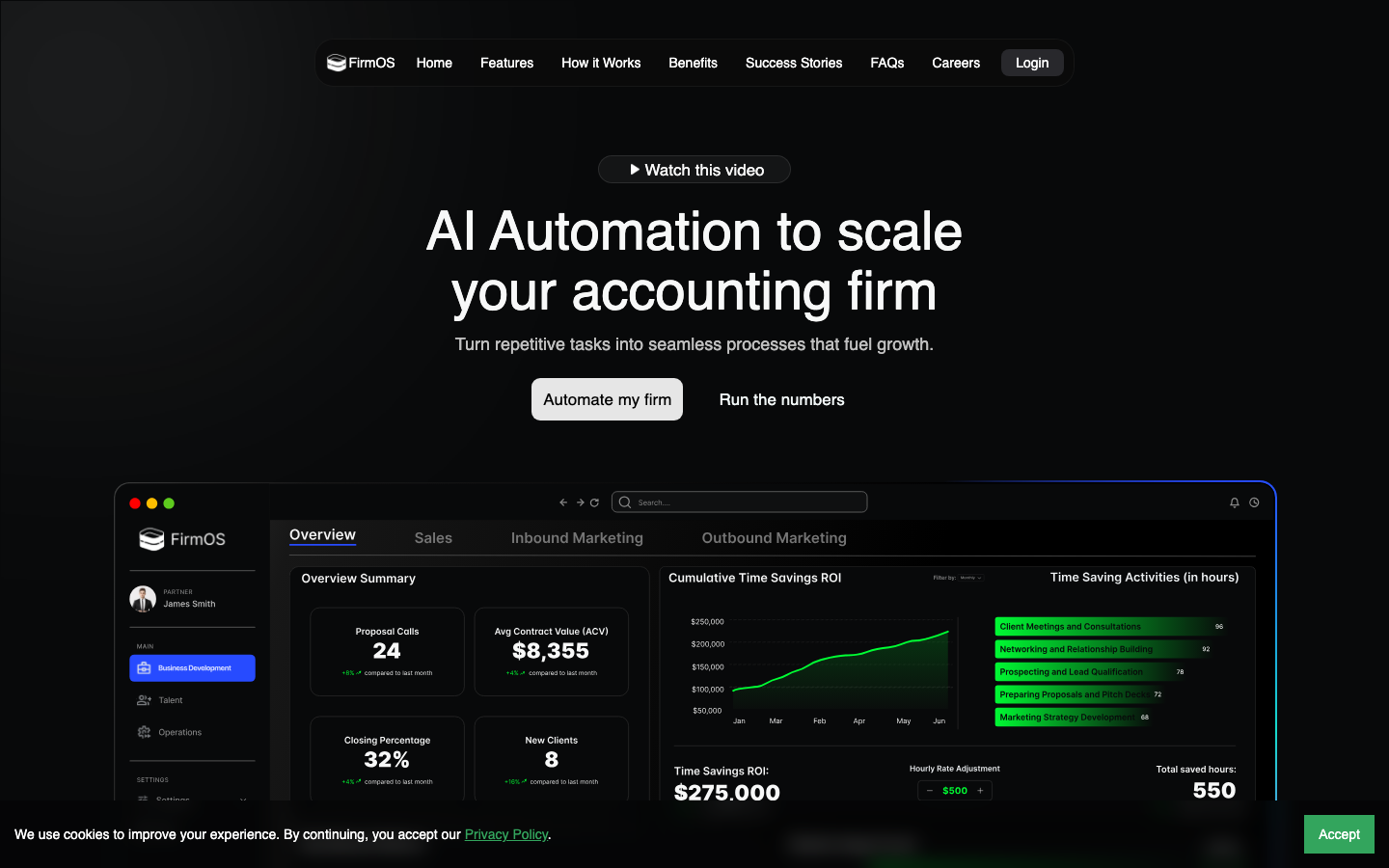
Firmos
Core parameters and statistics of Firmos
Firmos is an AI business automation platform (Type D - productivity/business-side application) for medium and large enterprises. Its core value lies in using AI to replace the knots that require human judgment in traditional business processes, rather than just performing rule-based operations. It is in the middle ground between traditional RPA (execution by rules) and AI Agent (completely autonomous decision-making) - the process boundaries are defined by the enterprise, and the judgment points in the process are processed by AI, but the judgment results still fall within the preset business rules framework. This design is particularly critical in regulated industries (financial, medical, legal).
| Projects | Public Information |
|---|---|
| Product Positioning | AI Enterprise Business Automation Platform |
| Core capabilities | AI process automation LLM integrated decision-making, multi-system data interconnection |
| Technical Roadmap | Process Engine + LLM Decision Node Hybrid Architecture |
| Deployment form | SaaS cloud |
| Platform Support | Web |
| Home | US |
| Target customer group | Medium and large enterprises |
| Business Model | SaaS Subscription |
| Latest version | 1.0 (~2025-09) |
| First version | 0.1 launch (~2024-06) |
| Supported languages | en-US |
Brief review in one sentence: Firmos is not another RPA tool, but an "AI-driven enterprise process brain" - it can not only execute according to rules, but also use AI judgment and decision-making, but its boundary is: it is more suitable for semi-automated scenarios that "require judgment but do not require complete autonomy."
Positioning Analysis: From the perspective of product design, Firmos has chosen a path that is narrower than AI Agent but wider than traditional RPA. Traditional RPA can only process structured data and deterministic rules, and will be thrown to humans when encountering exceptions. Although AI Agents can reason autonomously, the decision-making process lacks enterprise-level auditing and control. Firmos is positioned somewhere in between - the process boundaries are defined by the enterprise, and the judgment points in the process are processed by AI, but the judgment results still fall within the preset business rules framework. This design philosophy of "AI making judgments within the framework" has practical significance in regulated industries such as finance, medical care, and law.
User and market recognition of Firmos
The enterprise automation market currently presents a clear three-layer differentiation: the bottom layer is the lightweight SaaS connector represented by Zapier/Make (for individuals and small teams), the middle layer is the enterprise iPaaS represented by Workato/Boomi (for IT integration teams), and the upper layer is the traditional RPA represented by UiPath/Automation Anywhere (for large-scale process outsourcing scenarios). Firmos attempts to open up a new "AI native" track between the middle layer and the upper layer.
Differentiation in market positioning: Compared with UiPath, Firmos's advantage lies in its native AI design - UiPath's AI capabilities are added later (through the AI Center module), while Firmos' process engine has built-in LLM decision nodes from the beginning of the design. Compared with Workato, Firmos emphasizes "intelligent decision-making" rather than pure data integration - the core of Workato is event-driven system integration, while the core of Firmos is the AI judgment capability embedded in the process. Compared with Zapier, Firmos is oriented towards enterprise-level process governance rather than personal efficiency tools - Firmos' audit logs, permission management and AI decision traceback are basic requirements for enterprise-level deployment, and these are usually not core requirements in Zapier's scenarios.
Enterprise-level features: As an enterprise-level SaaS product, Firmos' core competitiveness comes from the combination of the following enterprise-level features: ① Full-link audit logs of AI decisions - every judgment made by AI is well-documented; ② Pre-built connectors with mainstream enterprise systems (Salesforce, SAP, Oracle, HubSpot, etc.); ③ Enterprise-level permission management and SSO integration; ④ Configurable Human-in-the-loop - This is a fundamental threshold for regulated industries. Together, these features are a key differentiator between Firmos and traditional RPA and lightweight automation tools.
Community and Ecology: Currently, Firmos’s public community data (GitHub stars, third-party reviews, user cases) is relatively limited, which is consistent with its business model that focuses on enterprise direct sales—many similar enterprise automation products do not use the open source community as the core customer acquisition channel. Specific customer cases, partner ecosystem, industry certification and third-party evaluation data are subject to real-time disclosure on the official product page and official website. In the enterprise automation track, enterprise customers' purchasing decisions rely more on PoC (proof of concept) results and industry reputation rather than public community data.
Cost Advantages of Firmos
Firmos' cost structure needs to be dismantled from a three-layer perspective, with each layer having different cost components and evaluation priorities. Compared with competing products, Firmos's cost is mainly focused on "integration and governance of AI capabilities" rather than basic process execution.
C-side/Individual: Firmos is not for individual users, nor does it provide a free version or a lightweight version. This means that individuals or small teams cannot verify product experience at zero cost, and decisions must be made after business communication and trial evaluation.
API/Developer: The official API interface is provided, suitable for developers to embed Firmos’ automation capabilities into their own systems. The cost of the API layer depends on the pricing structure of call volume and process complexity. The specific API fee standards, frequency control limits (Rate Limit), concurrency upper limit and SLA commitment are subject to the official real-time pricing page. When developers evaluate, it is recommended to focus on: API authentication methods, data format compatibility, and whether there is a development sandbox environment for integration testing.
Enterprise/Private: Firmos focuses on enterprise-level SaaS subscriptions, and pricing dimensions usually include the number of processes, API calls, user seats, and dedicated deployment requirements. Since pricing is not public, corporate customers need to obtain accurate quotes through business communication. When connecting with the business team, it is recommended to clarify the following four billing elements: ① Whether there is a limit on the number of processes and the billing method after exceeding it; ② Whether the LLM fees called by the AI node are unified packaged or billed by volume; ③ Whether the user seats are divided into viewer, editor and administrator roles and their price differences; ④ Whether there is a long-term contract discount.
The free truth: Firmos does not provide a free package, but mainly enterprise trials (Pilot). This means that enterprises need to invest in manpower to complete trial evaluations - including process configuration, connector testing and AI node accuracy verification - before committing to a formal subscription. Compared with Zapier's free plan entry path, Firmos's evaluation threshold is higher; but compared with UiPath's Community Edition licensing restrictions, Firmos' trial path can better simulate a real production situation.
Hidden costs: The hidden costs of Firmos are mainly reflected in the following three aspects -
- Initial configuration cost of AI nodes: Business experts need to convert tacit knowledge into trainable judgment standards (such as "what kind of invoice is considered abnormal"), and AI engineers need to design appropriate Prompt templates and verification logic. This process of knowledge transfer and engineering implementation typically takes 2 to 4 weeks, depending on process complexity.
- Continuous tuning costs: The decision-making of AI nodes is not permanent - business rules will change (such as company policy updates), data distribution will shift (such as customer type changes), and the LLM model itself will also iterate. Enterprises need to establish a regular review mechanism for AI accuracy (monthly or quarterly is recommended) and reserve manpower for this purpose.
- Integration joint debugging cost: Interface certification, data mapping, exception handling and retry logic configuration with the core system (ERP, CRM) may require the IT team to invest additional development and testing man-hours in the initial stage. Especially for legacy systems without standard APIs, integration costs can rise significantly.
Hidden benefits: The long-term value of Firmos lies in its ability to continuously optimize processes - traditional RPA can only passively execute fixed rules, and process efficiency is already determined when it goes online. Firmos's AI engine can analyze historical data of process execution, automatically identify bottlenecks (such as a certain AI node causing the process to frequently switch to manual work), high-frequency abnormal patterns (such as the accuracy of classifying specific types of work orders that continues to be low), and proactively recommend process improvement plans to the operations team. The compound benefits generated by this "process intelligence" capability in the long-term operation of an enterprise often exceed the initial deployment investment.
Cost comparison with alternatives (enterprise-level annual TCO deduction):
| Cost Dimensions | Firmos | UiPath (including AI Center) | Zapier Enterprise | Workato |
|---|---|---|---|---|
| Basic annual fee | Business confirmation required (no public price) | Enterprise version starts from about $15,000+/year | Starting from about $2,000+/month | Starting from about $10,000/year |
| AI capability cost | Built-in AI decision node | AI Center requires additional subscription | No built-in AI, external API required | LLM connector metered by call volume |
| Initial configuration manpower | 2-4 weeks (business + AI team) | 2-6 weeks (IT-led rule definition) | 1-2 days (no AI nodes) | 2-4 weeks (integrated configuration) |
| Ongoing maintenance costs | Regular tuning of AI nodes | Rule maintenance + AI model management | Low (depends on connector stability) | Medium (integrated link monitoring) |
| Scale boundary | Medium and large enterprises (more than 100 people) | Large enterprises (more than 1,000 people) | Small teams to department level | Medium and large enterprises |
Main functions of Firmos
The functional system of Firmos is centered around the core goal of "enhancing enterprise business processes with AI". The five core functions form a complete relationship from "perception → judgment → execution → insight → governance" rather than an isolated stack of capabilities.
- Intelligent Process Automation Engine: The core is a process engine that supports AI decision-making nodes. Unlike traditional if-then rule engines, Firmos' process nodes can directly call LLM to make semantic judgments, and then decide subsequent process branches based on the AI output. Applicable tasks: Repetitive business processes that require judgment, such as customer work order classification, invoice preliminary review, and compliance screening. Acceptance concerns: The accuracy and confidence distribution of AI nodes under different input conditions, and the degradation strategy when AI decision-making times out or fails.
- LLM integration node: supports embedding mainstream large language models such as GPT and Claude in the process. Business personnel can define Prompt templates, pass process variables into LLM nodes, and then map LLM output back to process fields. AI is no longer a stand-alone conversational window, but an orchestratable component in a business process. Applicable tasks: Text generation (automatically reply to customer emails), data extraction (extract fields from unstructured documents), content review (check marketing copy for compliance risks). Acceptance concerns: Maintainability of Prompt templates - when business rules change, can business personnel independently modify Prompt without relying on the development team.
- Cross-system connector: Provides pre-built connectors with mainstream enterprise systems (CRM, ERP, HRM, ticketing systems), supporting two-way reading and writing of data and Webhook event triggering. Applicable tasks: Break down data silos and realize cross-system process automation - such as automatic flow of orders from CRM to ERP, automatic updates of customer support from work orders to knowledge base. Acceptance concerns: Connector compatibility with target system API changes - if the connected target system upgrades the API version, when will Firmos' connector be updated and who is responsible for the update.
- Process Analysis and Insight Dashboard: The AI engine continuously collects execution data during the execution of business processes.
Data - including process time consumption, exception rate AI decision distribution, bottleneck nodes, etc., and is presented on a visual dashboard. Applicable tasks: Process optimization decision support, helping the operations team discover efficiency bottlenecks and AI accuracy degradation trends. Acceptance concerns: Data refresh latency – real-time monitoring or T+1 analysis, and whether the data export format supports integration with existing BI tools.
- AI Decision Log and Audit: Every process decision involving AI is fully recorded, including input data LLM return judgment, confidence score and final business results. Applicable tasks: Compliance audit AI decision review, regulatory requirements of regulated industries. Acceptance concerns: Log retention period, export format and human-machine readability - whether to support structured export (JSON/CSV) for integration with internal audit systems.
[Expert Perspective] Functional Synergy: The above five functions form a complete "AI process management system"——
- Connector (perception layer) obtains original data from the business system;
- LLM node (judgment layer) performs semantic analysis and judgment on data;
- Process engine (execution layer) executes business actions based on the judgment results;
- Analysis Dashboard (Insight Layer) Monitor execution effects and discover room for optimization;
- Audit log (governance layer) ensures full-link traceability of AI decisions.
This closed design means that the value of Firmos lies not only in "replacing labor", but also in "continuously optimizing the process." After traditional RPA goes online, the process efficiency is fixed (and may even degrade due to changes in business rules), while Firmos can make the process more efficient as time goes by - because AI can learn from execution data, the operations team can continuously improve prompts and process design based on insights.
Firmos model and version evolution
Firmos uses cloud SaaS as its main delivery form, and its version evolution reflects the product's process from initial proof of concept to commercialization. Unlike open source projects, the version numbers of enterprise-level SaaS products correspond more to business milestones rather than strict feature change nodes.
Initial release phase
- 0.1/launch (~2024-06): The initial launch version of the product, core verification of the feasibility of AI process automation technology. The functions cover the basic process engine LLM integration node and a small number of connectors. The goal of this stage is to prove the product concept and accumulate seed customer feedback. There is no official precise date yet.
Commercialization stage
- 1.0/current (~2025-09): The latest verifiable version, marking the product entering the commercialization stage from technical verification. Core changes include: enterprise-grade permission management and SSO integration, complete audit logs for AI decisions, more pre-built connectors (CRM/ERP areas), a more stable process execution engine and enterprise-grade SLA support. This version is the primary reference baseline for enterprise evaluation and procurement. There is no official precise date yet.
Iteration Note: Since Firmos continuously delivers products to the cloud, actual function iterations are mainly based on continuous releases and may not have a clear semantic version number. The official has not disclosed the complete version release timeline and detailed Changelog. It is recommended to refer to the official product update log and announcement channels for the latest information. During enterprise evaluation, it is recommended to ask the business team for function release records in the last 6-12 months to determine whether the product iteration speed and direction meet its own needs.
Technical advantages of Firmos
The technical advantage of Firmos does not lie in the performance of the basic model (it relies on third-party LLM), but in the engineering implementation of "how to embed LLM into enterprise business processes in a safe, controllable, and auditable manner." The following are the four core mechanisms and their corresponding business effects.
Mechanism 1: Hybrid architecture of process engine + LLM The process engine of traditional RPA uses deterministic rules (if-then-else) and can only cover the boundaries of known scenarios; although AI Agent can handle unknown scenarios, the decision-making process lacks enterprise-level constraints. Firmos allows embedding LLM calls in process nodes, allowing the process to handle edge scenarios that require judgment but do not require full human participation. Effect: The same process can cover a wider range of business variants, reducing the proportion of manual work due to rules that cannot be covered. Applicable scenarios: Customer work order classification - Traditional rules cannot cover all abnormal situations (such as customers using non-standard wording to describe problems), while LLM can complete classification based on semantic understanding.
Mechanism 2: Preset decision-making framework Unlike directly letting the AI Agent make autonomous decisions, Firmos' AI nodes operate within a preset business rule framework - the enterprise first defines the process boundaries ("what can be done and what must be done manually"), and the AI nodes only make judgments within the boundaries, and scenarios that exceed the boundaries are automatically converted to manual processes. Effectiveness: Gain the flexibility of AI while retaining enterprise-level controllability and auditability—any AI decision can be traced back to the boundary conditions within which it was allowed to make judgments. Applicable scenarios: Transaction review in the financial industry - AI can mark abnormal transactions and provide analysis basis, but the final decision to release or reject is still controlled by preset business rules and manual approval.
Mechanism Three: Integrity of Decision Log Firmos's audit log not only records "which branch the process executed", but also records "why the AI chose this branch" (including input data LLM return results and confidence scores). Effect: Meet the requirements of regulated industries for explainability of AI decisions - when regulators or auditors require an explanation of the basis for an automated decision, the audit log can provide a complete traceability link. Applicable scenarios: Medical reimbursement review - it is necessary to explain why a certain reimbursement was marked as abnormal by AI, and what characteristics the AI based its judgment on.
Mechanism 4: Mixed configuration of no-code and low-code Business personnel can define process topology, configure prompt templates of AI nodes, and map business fields through the visual interface without writing code; APIs and Webhooks are also provided for the development team for in-depth integration. Effectiveness: Lower the threshold for business departments to participate in process automation (no need to rely on development scheduling), while retaining the expansion capabilities of the IT department. Applicable scenarios: Cross-department process automation - the business team configures "judgment logic" and the IT team configures "system integration", each working at the level they are good at.
Technical comparison with competing products:
| Technical Dimension | Firmos | UiPath | Zapier | Workato |
|---|---|---|---|---|
| Process engine core | AI node + rule hybrid | Pure rule engine | Event triggering + action chain | Event-driven integration |
| AI integration method | Native LLM node (built-in) | AI Center plug-in (plug-in) | External API call (no native) | LLM connector |
| Unstructured data processing | Supported (LLM semantic understanding) | Limited (requires AI Center) | Not supported | Limited |
| Audit granularity | Process + AI decision-making full link | Rule execution log | Step execution log | Integration link log |
| Operability for business personnel | Visual process + Prompt configuration | Requires IT participation (rule definition) | Simple and direct (no AI) | Requires some learning |
| Manual confirmation points | Native support (in-process) | Support (via manual steps) | Limited | Support |
| Decision explainability | Complete (input + output + confidence) | Limited (only execution results) | None | Limited |
How to use Firmos
The usage path of Firmos is mainly based on the web interface. Enterprise-level deployment usually requires the following stages to complete the end-to-end process automation.
Standard usage process
- Register a business account: Visit firmos.ai to complete business information registration and domain name verification. Since Firmos does not provide a personal version, corporate email and company information are usually required at this stage. It is recommended to prepare the DNS configuration required for corporate domain name verification in advance.
- Connect business systems: Configure connectors with existing systems (CRM, ERP, ticketing systems, etc.) in the Firmos platform. Supports three integration methods: OAuth authentication API Key and Webhook. It is recommended to prioritize connecting to the system with the most complete data and the most standardized processes as a starting point.
- Define business process: Use the visual editor to draw the process topology - including triggers (such as "receive customer email"), data nodes (such as "get customer information from CRM"), AI nodes (such as "determine email intent"), execution nodes (such as "create work order") and branch conditions.
- Configure AI decision nodes: Select the nodes that require AI participation in the process, configure the LLM model type Prompt template, and input and output field mapping. Key Suggestion: Use at least 100 pieces of historical data to verify the accuracy of the AI node in a testing environment, and confirm that it meets the threshold of business requirements (such as classification accuracy ≥ 90%) before going online.
- Set up manual confirmation points (Human-in-the-loop): For decision-making nodes involving significant amounts or legal liabilities, insert manual confirmation steps into the process - AI will make a judgment first, and the results will be pushed to the human approver. After the manual approval is passed, subsequent operations will be performed. It is recommended to set up manual confirmation for all AI decisions in the early stage, and then gradually release them after accumulating enough confidence.
- Sandbox Test: First run the test process in a sandbox context, and use real historical data to verify the accuracy of AI decision-making and the stability of the end-to-end process. The test period is recommended to be no less than 1 week, covering normal scenarios and edge abnormal scenarios.
- Production online and continuous monitoring: After the confirmation is passed, start the production execution and utilize the process
The analysis dashboard continuously monitors AI node accuracy, process exception rate, and execution efficiency, and regularly adjusts prompt templates and process configurations.
Phased implementation suggestions
| Phases | Proposal Cycle | Goals | Key Acceptance Indicators |
|---|---|---|---|
| Pilot | 2-4 weeks | Select 1-2 highly repetitive and low-risk processes (such as work order classification, data synchronization) and run them through the sandbox | AI node accuracy ≥ 90%, end-to-end execution time shortened by ≥ 50% compared to manual work |
| Comparative verification | 2-4 weeks | The pilot process and the manual process run in parallel, and the AI results are compared with the manual results | The manual intervention rate is reduced by ≥ 60%, and the exception handling response time is shortened by ≥ 40% |
| Expanded deployment | 4-8 weeks | Access more core processes and systems, establish process governance and AI monitoring mechanisms | Process coverage ≥ 5 business lines, audit logs are fully traceable |
| Continuous optimization | Continuous | Continuous optimization of AI node accuracy and process efficiency based on execution data | AI accuracy quarterly improvement ≥ 5%, quarterly process efficiency improvement ≥ 10% |
Human-machine collaboration boundary:
- 100% Automable: standardized data processing, deterministic rule execution, classification and routing of known patterns.
- Human confirmation required: Decisions involving significant amounts or legal liabilities (such as contract signing, large payments), scenarios where AI judgment confidence is lower than the threshold, initial configuration and debugging stages of new business processes.
- It is recommended to retain manual review: Compliance approval in regulated industries, interactions that have a significant impact on customer experience (such as sending AI-generated content directly to customers), and scenarios where AI judgment may lead to irreversible operations.
Product Pricing for Firmos
Firmos adopts an enterprise-level SaaS subscription model and does not provide public self-service pricing pages and standardized package plans. This means that every potential customer needs to receive a customized quote through business communication. The following are common dimensions of fee structures:
- Basic platform subscription fee: Pricing is based on the number of processes and the combination of user seats. The larger the enterprise, the greater the room for unit price negotiation. The specific rates are subject to the official real-time pricing page and business communications.
- AI call fee: LLM API call fee, which may be included in the subscription fee or billed based on volume. The calling costs of different models vary greatly (for example, advanced inference models cost more than lightweight models). It is recommended that the billing benchmark and capping strategy for AI calling fees be clearly stated in the contract.
- Connector and Integration Fees: Standard connectors may be included with the base subscription, but some advanced connectors or custom integrations may require additional fees. During the pilot phase, it is recommended to prioritize the use of standard connectors to control costs.
- Enterprise Premium: Enterprise-level features and services such as SSO, dedicated SLA, private deployments, dedicated Customer Success Manager require additional negotiation.
C-side/Individual: Not for individuals, no free version, no pay-as-you-go option.
Developer/API: The official API interface is provided for expansion and integration, but the public API pricing and current limiting strategy have not been made public yet. Developers need to contact the business for details of the developer support plan, including API call limits, authentication mechanisms, and developer community resources.
Enterprise users: Need to obtain customized quotations through business communication. It is recommended to pay attention to the following three negotiation points during the Pilot stage: ① Whether there are limits on the number of processes and calls and overage billing standards - to avoid unexpected costs due to process growth after going online; ② Whether the AI call fees are unified packaged or billed on a pay-as-you-go basis - under the pay-as-you-go billing model, the average monthly calls of the AI nodes need to be estimated; ③ Whether the contract includes an SLA commitment (availability ≥ 99.9%) and an AI accuracy baseline.
Pricing comparison with competing enterprise-level solutions:
| Pricing Dimensions | Firmos | UiPath Enterprise | Zapier Enterprise | Workato Enterprise |
|---|---|---|---|---|
| Pricing Transparency | Undisclosed, business communication required | Public Enterprise Edition price range | Public Enterprise Edition is billed by seat | Public package starting price |
| AI add-on billing method | Undisclosed | AI Center standalone subscription | No built-in AI, external API is self-pay | Per LLM connector call volume |
| Minimum annual investment (estimate) | Business confirmation required | Starting from about $15,000/year | Starting from about $24,000/year (2 seats) | Starting from about $10,000/year |
| Enterprise contract model | Customized quotation | Annual subscription + number of users | Customized quotation + seats | Annual subscription + process volume |
Firmos application scenarios
The value of Firmos is most significant in "highly repetitive processes that require judgment," especially those business processes where manual processing takes a lot of time but the judgment complexity is not extremely high. The following are four typical implementation scenarios and their quantitative deductions (the deduction values are subject to actual deployment results).
Intelligent processing of customer work orders
Traditional model: The average processing time of each order by the customer service team is 5-10 minutes - reading the customer description, determining the type of problem (technical/billing/account/consulting), assessing the urgency, generating a preliminary response, and assigning it to the corresponding processing team. The daily processing volume is about 50-100 orders/person, and about 60% of the time is spent on classification and preliminary reply.
Firmos Mode: The AI node completes classification, urgency assessment and preliminary response draft generation within 30 seconds after the ticket is entered. Humans only need to review the AI responses and make fine adjustments before sending them out.
Quantitative deduction: From "manual processing of 80% of repetitive work orders" to "AI processing of 80% of work order classification and preliminary responses, manual focus on 20% of complex work orders", the daily processing capacity of a single customer service staff has increased from 80 orders to more than 150 orders, and the response time of the customer service team has been shortened from "hours" to "minutes".
Key points for implementation verification: AI classification accuracy (recommended baseline ≥ 95%), sensitivity of emergency assessment (to avoid low-urgency work orders being mislabeled as urgent), and manual review proportion trend (should decrease month by month).
Financial invoice and reimbursement review
Traditional model: Financial personnel check the integrity of invoice information one by one (amount, date, supplier, tax ID, invoice number), determine compliance against company policies and accounting standards, and manually mark abnormal orders - the average review time for each order is 10-20 minutes, and large enterprises process thousands of orders per month. The core pain points are: incomplete rule coverage (continuously updated expense policies) and human negligence caused by frequent repetition.
Firmos Mode: The AI node automatically extracts key invoice information, makes compliance judgments against preset financial compliance rules and policy documents, marks abnormal items (amount exceeding limits, repeated reimbursements, suppliers not in the whitelist, and incomplete invoice information) and recommends approval conclusions. Only abnormal orders and documents exceeding the preset threshold are transferred to manual review.
Quantitative deduction: From "financial personnel review each order one by one" to "AI initially reviews about 85% of the standard orders, and manually handles 15% of the abnormal orders", the financial review efficiency is increased by 3-5 times, and the missed detection rate of compliance violations is reduced by about 60% (the deduction is based on the comparison of the stability of AI rules and the fatigue factors of manual review).
Focus of implementation verification: AI initial review accuracy rate (recommended baseline ≥ 95%), abnormal single miss rate (recommended < 1%), frequency of consistency verification between AI and manual review results (weekly sampling comparison recommended).
Contract clause review and risk marking
Traditional model: Legal personnel read the full text of the contract one by one, manually mark key clauses (liability for breach of contract, maximum compensation, confidentiality clauses, renewal conditions, dispute resolution), assess the risk level and write review opinions - each contract review takes 30-90 minutes, and large enterprises review hundreds of contracts every month. The core pain points are: insufficient review depth caused by high manpower consumption (key clauses may be missed in a quick glance) and inconsistent review standards (different legal personnel may have different risk judgments on the same clause).
Firmos Mode: The AI node automatically extracts the location, amount data and risk clauses of the contract's key clauses based on the preset review rule library, and outputs risk level labels (high/medium/low), summary of risk clauses and modification suggestions.
Quantitative deduction: From "legal review one by one" to "AI preliminary screening of about 70% of standard contracts (risk level is "low"), legal focus on 30% of high-risk contracts", the per capita contract review capacity of the legal team has increased by 2-3 times, and the review cycle of standard contracts has been shortened from "days" to "hours".
Focus of implementation verification: Risk clause detection rate (recommended baseline ≥ 95%), false positive rate (recommended baseline ≤ 15%, too high will cause legal affairs to lose trust in AI results), consistency of AI review opinions (whether the risk assessment of the same clause is consistent in different contracts).
Other typical scenarios
- Human resources process: Resume initial screening - AI automatically evaluates resume matching based on job descriptions and marks high-potential candidates; employee onboarding process automation - automatic cross-system flow from offer issuance to account creation; resignation process processing - automatically triggers permission recovery, asset return notification and exit interview arrangements.
- Sales business process: Lead scoring and allocation - AI automatically scores and assigns to the most appropriate sales representative based on lead source, behavioral data and historical conversion rate; Contract approval automation - end-to-end automatic flow from quotation generation to contract signing; Customer renewal reminder - AI automatically identifies expiring contracts and triggers the renewal process.
- Supply chain management: Automatic review of purchase orders - AI verifies the consistency of the order price with the framework contract, supplier qualifications and inventory availability; logistics exception handling - AI identifies abnormal logistics status (delay, loss, damage) and automatically triggers the investigation and processing process.
Applicable groups of Firmos
The value of Firmos manifests itself differently in different character perspectives. There are three core roles with different focuses and benefits:
- Enterprise Operations Management Team: Operations managers focus on process efficiency, exception rates and manual intervention costs. The process analysis dashboard provided by Firmos can help the operations team quantify the actual benefits of AI automation—monthly processing volume changes, AI node accuracy trends, and manual intervention rate reductions. Core Value: Let operational optimization be based on data, and shift from "optimization by feeling" to "decision-making based on data". Operations teams need to have basic process analysis and AI cognitive capabilities to interpret AI accuracy reports and drive process improvements.
- Enterprise IT and Architecture Team: The IT team focuses on the integrability, security, and maintainability of the platform. Firmos's API, Webhooks, SSO support and audit log system meet the basic requirements of an enterprise-level platform. Core Value: Don’t let IT become the bottleneck for AI implementation - business teams can configure processes independently, and IT only needs to maintain connectors and permission systems instead of developing automation scripts from scratch. The IT team needs to have API integration experience and basic AI service operation and maintenance capabilities.
- Business department process leader: Business leaders (such as customer service supervisors, financial managers, and legal personnel) who directly use Firmos to configure processes are concerned about "whether the process can run according to my business logic." Firmos's visual process editor and AI node configuration interface lower the threshold of use, and business leaders can configure standard processes without relying on the R&D team. Core Value: Return the configuration rights of business processes to the business and reduce cross-department communication costs.
Does not fit boundaries:
- Pure rule-based process: If the business process is completely covered by deterministic if-then rules (such as "If the order amount > 1,000 yuan, trigger manager approval"), traditional RPA or Zapier is cheaper and does not need to introduce the additional complexity and cost caused by AI judgment. The value of Firmos lies in handling scenarios that "require judgment" rather than "run with rules" scenarios.
- Complex scenarios requiring completely autonomous decision-making: If the business process requires AI to make completely autonomous decisions, dynamically plan task sequences, and creatively respond to unknown scenarios (such as multi-step business negotiations, open strategic planning), AI Agent tools (such as AutoGen, CrewAI) may be more suitable. The advantage of Firmos lies in controllability rather than autonomy - its AI nodes operate within a preset framework and are not suitable for innovative scenarios that require breaking through the framework.
- Individual or Small Team Scenario: Firmos' pricing and deployment model for medium to large enterprises does not support low-cost verification for individual users or micro teams. If you are a one-person team or a small company of less than 10 people, the investment-output ratio of Firmos may not be as good as self-service tools like Zapier or Make.
- High-frequency, low-value pure execution tasks: Such as batch file renaming, scheduled data export, log rotation and other pure execution tasks that do not require any judgment. Using scripts (Python, Shell) or traditional task scheduling tools (Cron, Jenkins) is cheaper and more efficient.
Summary and Outlook
Firmos represents the evolution direction of enterprise automation from "rule-driven" to "AI-driven" - processes can not only be executed according to preset rules, but also make judgments and decisions based on business semantics. Its core advantage is to embed the semantic understanding capabilities of LLM into an enterprise-level process engine, while retaining the certainty and controllability of the business rules framework. This design philosophy of "AI making judgments within the framework" has practical significance in regulated industries (finance, medical, legal) and enterprise scenarios that require strong auditing.
Current limitations and uncertainties:
- The community ecosystem is not yet mature: Compared to UiPath’s huge community connector market (thousands of pre-built connectors) and Zapier’s thousands of app integrations, Firmos’ connector ecosystem and community contributions are still in the early stages. Enterprises may need to develop some custom connectors themselves, or evaluate the connector's compatibility with target systems at deployment time.
- The reliability of AI decision-making needs long-term verification: There is inherent uncertainty in the output of LLM - the same Prompt, the same input, called at different times may produce different judgment results. When enterprises use AI nodes in key business processes, they need to establish a real-time monitoring and consistency verification mechanism for AI output, and set up an automatic manual conversion policy for results whose confidence is lower than the threshold.
- Untransparent pricing increases evaluation costs: No public pricing page means that every potential customer needs to go through a complete business communication to understand the cost structure. This is an implicit threshold for companies in the early evaluation stage - the time cost of business communication and trial evaluation needs to be included in the total procurement cost.
- Long-term supplier risk: As a relatively early AI automation vendor, Firmos’ long-term sustainability, product iteration direction and customer support capabilities still need time to be verified. For enterprises planning to run core business processes on the Firmos platform, it is recommended that data portability guarantees (export formats for process definitions, connector configurations) and minimum technical support commitments be specified in the contract.
Procurement/Adoption Risk Assessment: It is recommended to follow the progressive strategy of "pilot first, then expand, then core" - start the Pilot with 1-2 non-core processes (such as customer work order classification, preliminary invoice review), use 2-4 weeks to verify the AI node accuracy and process stability, and then expand to more business lines after confirming that it reaches an acceptable level for the business. When negotiating with the business, it is recommended to focus on: ① Whether the LLM fee for AI node calls is packaged or by volume, and estimate the average monthly call volume and peak cost; ② Whether the retention period and export format of the audit log meet industry compliance requirements (such as the 5-year log retention requirement in the financial industry); ③ The data portability clause in the contract - if the platform needs to be switched in the future, can the process definition, connector configuration and AI node configuration be fully exported; ④ The platform's compliance with SOC2, GDPR For support for industry compliance certification, please refer to official certification information. For regulated industries (finance, medical, insurance), it is also necessary to clarify the attribution clauses for AI decisions in the contract - how to divide the boundaries of responsibility when AI nodes cause business losses due to errors in judgment.
Related tools:  Notion AI, google-workspace
Version evolution of Firmos
Firmos focuses on cloud SaaS continuous delivery, and the public version data is limited. The following is a version based on verifiable public information.
Initial version
- 0.1/launch (~2024-06): The initial launch version of the product, core verification of the feasibility of AI process automation technology. The functions cover the basic process engine LLM integration node and a small number of connectors. The goal of this stage is to prove the product concept and accumulate seed customer feedback. There is no official precise date yet.
Current version
- 1.0/current (~2025-09): The first commercial version, with key improvements in product maturity and enterprise-level capabilities. Added enterprise-level permission management, complete AI decision audit log SSO integration, more pre-built connectors, and a more stable process execution engine. This version is the reference baseline for enterprise evaluation and procurement. There is no official precise date yet.
Version Note: The above version date is subject to official public information. Since Firmos is a cloud SaaS product, actual functional iterations may be continuous releases (Continuous Delivery) rather than large version releases with clear semantic version numbers. If an enterprise needs to evaluate the vitality of product iterations, it is recommended to ask the sales team for recent product update records and roadmaps during business communication to determine whether the product evolution direction is aligned with its own business needs.
Version Info
- current :Current version.
- launch :Product goes online.
User Reviews