 Fixie
Free
Fixie
Free
Fixie is an enterprise-grade conversational AI agent platform that provides full-stack capabilities to build, host and deploy AI agents, supporting natural language interaction and enterprise system integration.
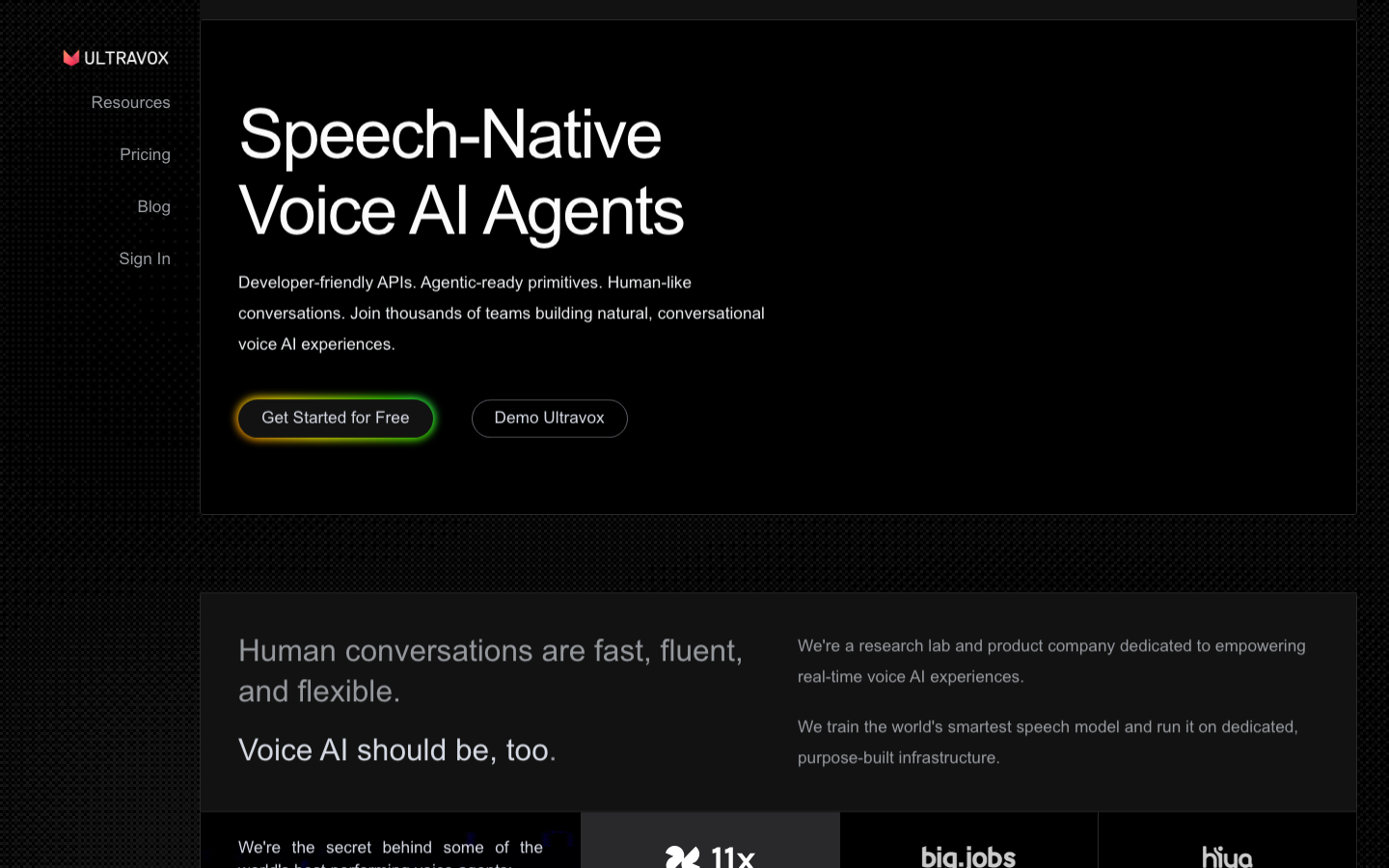
Fixie(Ultravox)
Fixie’s core parameters and statistics
| Parameters | Data |
|---|---|
| Product positioning | Real-time voice AI infrastructure layer + voice native multi-modal large model |
| Core technology roadmap | Voice-native multi-modal LLM (end-to-end audio understanding, no independent ASR stage) |
| Latest model version | Ultravox v0.7 (2025-12) |
| Base LLM | Llama 3.3 70B / 8B, can be adapted to any open source weight model |
| Open source license | MIT (GitHub), Apache-2.0 and custom (part SDK) |
| Model weight hosting | Hugging Face (fixie-ai organization, 24 models, 37 datasets) |
| GitHub Stars | 4,500+ (ultravox main repository) |
| GitHub Forks | 381 |
| SDK Language Support | JavaScript / Python / Android (Kotlin) |
| Product form | Hosted API (Ultravox Realtime Platform) + open source model weight |
| Concurrency limit for calls | Pay-as-you-go 5-way concurrency, no hard limit for Pro |
| Price model | $0.05/minute (TTS included), first 30 minutes free |
| Compliance Certification | SOC 2 (via Delve Trust Platform) |
Fixie initially started as a "conversational AI agent platform" and later underwent a major strategic transformation. It completely shifted its product focus to real-time voice AI and launched Ultravox voice native multi-modal large model and supporting real-time voice agent platform. The original fixie.ai domain is now redirected to ultravox.ai. The company's legal entity remains Fixie.AI, and its product brand is unified as Ultravox.
Fixie’s users and market recognition
Gradually build user awareness in the field, and product capabilities are used by content creators and teams to improve work efficiency. Specific user scale and industry adoption data are subject to the official real-time page.
Fixie’s cost advantage
The cost structure of Fixie (Ultravox) covers a three-tier user model, and the pricing strategy is significantly cost-effective in the real-time voice AI track.
C client/individual developer layer:
- Pay-as-you-go plan: $0/month, including 30 minutes of free call quota, excess $0.05/minute (including TTS fee), 5-way concurrent hard limit, unlimited playground calls.
- This is one of the lowest free entry barriers for real-time speech AI APIs on the market today. Compared with OpenAI Realtime API ($0.06/minute audio input + $0.24/minute audio output), Ultravox’s all-inclusive price of $0.05/minute has a clear cost advantage.
API calling layer:
- Threads Pricing (text/tool call): $2.00/million input tokens (non-cached), $15.00/million output tokens, cached input tokens are free.
- SIP Trunking: 0.5¢/minute (Pay-as-you-go), 0.48¢/minute (Pro).
- The Pro plan is $100/month, lifts the hard concurrency limit, and includes 5 custom sounds, 20 RAG corpora, and an outbound dial scheduler.
Enterprise/Private Deployment Tier:
- The enterprise version can be customized on demand, including priority SLA, organizational management support, and all function customization. The price is not disclosed, please contact the sales team for confirmation.
- Model weights are open source (MIT license). Enterprises can deploy inference by themselves without incurring API fees, but they need to manage their own GPU infrastructure. Training the adapter can be completed in 2-3 hours on the 8xH100, with a moderate hardware threshold.
Implicit cost considerations: The true cost of voice AI is not only the unit price of the API, but also includes conversation quality (rework/labor transfer rate), delay (impacting user experience), and customized development investment. Ultravox's end-to-end voice native architecture is 30-50% lower in latency than the "ASR + LLM + TTS" pipeline solution, which indirectly reduces the cost of user churn due to latency.
Main functions of Fixie
-
Speech-Native Inference: The Ultravox model performs semantic understanding directly in the audio space without going through a separate ASR (speech to text) stage. The audio is directly mapped to the high-dimensional semantic space of the LLM through the multi-modal projector, and the model simultaneously understands the semantic content and paralinguistic signals (intonation, rhythm, emotion), which is an essential difference from the traditional cascade architecture.
-
Realtime Conversation Management: Provides real-time voice dialogue capabilities through two access methods: WebSocket and REST API. The platform manages the call life cycle (establishment, maintenance, termination), conversation status tracking VAD (Voice Activity Detection) and endpoint detection (Endpointing), and developers do not need to deal with underlying signaling.
-
UltraVAD Voice Activity Detection: Self-developed neural VAD model (UltraVAD v0.1), based on the distinction between speaking completion probability, pause mode, reflective pause and end of turn, achieving more natural dialogue rhythm control, reducing interruptions and awkward silences.
-
Multi-platform SDK and Telephony integration: Provides JavaScript, Python, Android three-terminal SDK, built-in integration capabilities with mainstream telecom operators (Twilio, etc.), and supports SIP trunks to make and receive PSTN calls.
-
RAG knowledge base access: The Pro plan supports up to 20 corpora, and the voice agent can retrieve corporate knowledge base content during the conversation to support complex business question and answer scenarios.
-
Outbound Call Scheduler: Pro and above plans provide automatic outbound call management, suitable for customer return visits, appointment reminders, batch notifications and other scenarios.
-
Playground Sandbox Testing: Provides a free online Playground, allowing developers to test the dialogue effects of voice agents without writing code, reducing debugging costs.
[Expert View]: The core synergy of Ultravox lies in the trinity of "voice native model + managed inference platform + telecom integration". Unlike traditional solutions that require independent selection of each node (STT model → LLM → TTS engine → telecom provider), Ultravox provides a fully managed link from audio input to audio output, reducing system integration failure points and allowing latency optimization to be performed across the entire stack rather than being limited to a single component.
Fixie’s model and version evolution
Fixie's model evolution has a clear trajectory, all released under the Ultravox brand, and each version provides open source weights.
Mainline release
| Version | Date | Base Model | Key Changes |
|---|---|---|---|
| Ultravox v0.3 | 2024-08 | Initial version | First version public preview, supporting audio-to-text streaming reasoning |
| Ultravox v0.4 | 2024-08 | Llama 3 | First production-ready version, 14K steps training in 2-3 hours on 8xH100 |
| Ultravox v0.4.1 | 2024-11 | Llama 3 | Stability and performance improvements |
| Ultravox v0.5 | 2025-02 | Llama 3.2 1B | Lightweight variant, HF downloads 1.18 million |
| Ultravox v0.6 | 2025-06 | Llama 3.3 70B / Gemma 3 27B / Qwen 3 32B | Multi-base variants to support larger-scale inference capabilities |
| Ultravox v0.7 | 2025-12 | GLM-4 6B | Big Bench Audio SOTA (91.8% / 97% with thinking) |
Product platform evolution
- 2023-2024: Fixie operates as a universal conversational AI agent platform, providing enterprise-level agent construction, tool integration, and multi-channel deployment capabilities. The product positioning at this stage is similar to platforms such as Dify and Coze currently on the market.
- 2024-08: Turning to the voice AI track, releasing the preview version of Ultravox v0.3, and opening internal testing applications for Ultravox Realtime API.
- 2025 to present: Product focus has completely shifted to the Ultravox brand. The original fixie.ai domain name was redirected to ultravox.ai, and the related functions of the original dialogue agent platform were gradually faded. The company currently uses Ultravox Realtime Platform as its core product delivery form.
Fixie’s technical advantages
Architecture design: Voice native multi-modal LLM
Ultravox's core technology choice is to use audio as a first input modality rather than as a secondary component. The model architecture is: audio encoder → multi-modal projector (Adapter) → pre-trained LLM (frozen) → text Token output. This design brings three key effects:
- Eliminate cascading delay: Traditional voice AI systems need to go through a four-stage pipeline of "Voice Activity Detection → ASR Recognition → LLM Inference → TTS Synthesis", each stage introducing hundreds of milliseconds of delay. Ultravox's end-to-end architecture maps audio directly into semantic space with significantly lower latency to first word (TTFT) than cascaded solutions.
- Preserve paralinguistic information: Paralinguistic signals such as intonation, stress, speaking speed, pauses, etc. are lost in the text conversion process, and Ultravox directly processes this information in the audio representation, allowing the model to perceive the user's emotions and implication.
- Flexible base adaptation: The Adater architecture allows Ultravox to access any open source weighted LLM (Llama, Mistral, Gemma, Qwen, GLM) without being bound to a single model ecosystem. 6 base variants have been released, covering parameter sizes from 1B to 70B.
Training efficiency: Only the Adapter layer is updated during training, the LLM and audio encoder remain frozen. v0.4 takes only 2-3 hours to train for 14K steps on 8xH100. This low training cost means companies can use their own data to fine-tune speech models on an affordable budget.
Inference infrastructure: Ultravox builds its own inference stack and does not rely on external LLM providers or shared inference pools, ensuring controllable latency and no queuing jitter. The platform supports 5 to unlimited concurrent calls, and the fully managed architecture eliminates the burden of operation and maintenance.
Core evaluation advantages: Big Bench Audio is the industry-recognized speech AI evaluation benchmark, and Ultravox v0.7’s 91.8% (without inference) and 97% (with inference) are both the best in the industry. Compared with GPT-4 Realtime (OpenAI's end-to-end speech solution), Ultravox achieves higher understanding accuracy at the same or lower latency.
How to use Fixie
Fixie (Ultravox) provides four access levels, covering the complete path from experimentation to production.
| Entrance | Applicable people | Main uses | Cost |
|---|---|---|---|
| Ultravox Realtime API | Developer / ISV | Production-grade voice agent integration | Starting at $0.05/minute |
| Playground (app.ultravox.ai) | Non-technical staff / product evaluation | Conversational testing and experience | Free (unlimited) |
| Open Source Model Weights (Hugging Face) | ML Engineer/Researcher | Self-hosted inference, fine-tuning, academic research | Free (MIT License) |
| SDK (JS / Python / Android) | Front-end / Back-end / Mobile Developer | Client Integration | Free (Open Source) |
Typical access process:
- Register an account: Visit app.ultravox.ai to create an account and automatically get 30 minutes of free calling.
- Playground Test: Configure system prompts, select sounds, set up RAG corpus in the Playground, and test the dialogue effect in real time.
- Get API Key: Get the API Key from the console for REST API or WebSocket interface authentication.
- SDK integration: Select the corresponding SDK according to the application platform (JS for Web, Python for backend Kotlin for Android), and refer to the official documentation for access.
- Configure Telephony (optional): If you need PSTN calling capabilities, configure a SIP trunk or connect to telecom providers such as Twilio.
- Production deployment: Choose the Pay-as-you-go (low concurrency) or Pro (high concurrency) plan to go online for production.
Self-hosted inference (advanced): Download the model weights from Hugging Face, and use the docker image or Poetry to start the inference service. Officially, it provides managed deployment options for the BaseTen platform and also supports custom GPU infrastructure.
Product Pricing for Fixie
Ultravox adopts a "usage + subscription" hybrid pricing model, and the pricing page is open and transparent.
| Billing dimensions | Pay-as-you-go | Pro (annual payment) | Enterprise |
|---|---|---|---|
| Monthly fee | $0 | $100/month | Custom quote |
| Call cost | $0.05/minute | $0.05/minute | Customized |
| SIP Trunking | 0.5¢/minute | 0.48¢/minute | Customized |
| Threads Input Token | $2.00/million (non-cached) | $2.00/million (non-cached) | Customization |
| Threads output Token | $15.00/million | $15.00/million | Customization |
| Cache Input Token | Free | Free | Free |
| Free duration | 30 minutes | 30 minutes | Customized |
| Playground calls | Unlimited | Unlimited | Unlimited |
| Concurrency cap | 5-way | No hard cap | Customization |
| Custom sounds | 1 | 5 | Customized |
| RAG Corpus | 2 | 20 | Customized |
| Outbound Call Scheduler | ❌ | ✅ | ✅ |
| Priority SLA | ❌ | ❌ | ✅ |
| Organization Management | ❌ | ❌ | ✅ |
Free quota strategy: The first 30 minutes are completely free (including TTS fees), there is no limit on the number of playground calls, and it is suitable for proof of concept and small traffic trial operation. Compared with competing products, OpenAI Realtime API does not provide free quota, and Gemini Live has a similar pricing model but a different ecology.
Cost structure deduction: Taking a customer service scenario with 1,000 daily calls and an average call duration of 3 minutes as an example, the monthly call volume is about 90,000 minutes, and the cost is about $4,500/month (excluding Pro subscription fee). Using the traditional ASR + LLM + TTS solution on the same scale, only the ASR cost (Deepgram, etc. is about $0.0059/minute) plus LLM inference (about $0.01-0.03/time) plus TTS, the total cost is about $5,000-8,000/month. Ultravox’s all-inclusive price of $0.05/minute is competitive in the current market (based on public data deductions, unofficial commitment).
Fixie application scenarios
-
Customer Service Voice Agent: Enterprises connect Ultravox to customer service hotlines to replace or assist manual agents in handling common inquiries (order status, returns and exchanges, appointment confirmations). The natural interactive experience of voice-native architecture reduces users' resistance to "machine customer service". After the call is completed, a summary can be automatically generated and written to CRM. Key points of verification: First time resolution rate (FCR) and manual transfer rate of single-channel conversations.
-
Outbound Marketing and Return Visits: Use Outbound Call Scheduler to perform outbound call tasks such as customer return visits, satisfaction surveys, and renewal reminders in batches. Agents can adjust their words in real time based on the conversation and seamlessly transfer interested customers to manual sales. Key points of verification: Comparison of connection rate, conversion rate, and hang-up rate with traditional AI outbound call solutions.
-
Medical health appointment and pre-consultation: Clinics or hospitals connect to Ultravox to handle appointment registration, rescheduling, examination reminders and other matters. The agent collects patient symptom information (pre-consultation) through natural dialogue, reducing the transactional workload of medical staff. Verification Key: Comply with HIPAA level data security requirements.
-
Internal employee services: Large enterprises deploy voice agents to employee hotlines to handle internal affairs such as IT support, HR consultation, and travel applications. Employees can describe problems naturally through speech, and agents call back-end systems (ServiceNow, Workday, etc.) to perform actions. Key points to check: Depth of integration with existing SSO and enterprise systems.
-
Voice-driven AI education companion: In scenarios such as language learning, knowledge tests, and interview simulations, Ultravox's real-time conversation capabilities can provide learners with an immersive speaking practice experience, and the retention of paralinguistic information makes it possible to correct pronunciation and intonation. Verification focus: Recognition accuracy of non-English languages.
Fixie is suitable for people
-
Voice AI Application Developer: Independent developers or startup teams who need to quickly build voice agents. Ultravox’s fully managed API reduces voice AI integration time from weeks to days. No need to build your own ASR/TTS pipeline, just call the API and embed the SDK. Not suitable for boundaries: In scenarios that require deep customization of ASR or TTS parameters (such as special optimization for specific accents and dialects), the hosting platform based on Ultravox may not be as flexible as a self-built solution.
-
Medium and large enterprise AI teams: Enterprises with AI infrastructure teams can integrate Ultravox as a voice AI layer into existing customer service, marketing, and human resources systems. The Pro plan has no concurrency limits and enterprise-level SLA to meet the needs of scale. Not suitable for the boundary: Enterprises that need to achieve high-precision semantic understanding in non-English languages (especially Chinese, Japanese, Arabic, etc.) should give priority to testing Ultravox's performance in the current language through the Playground before making purchasing decisions.
-
AI Research Institutions and Academic Users: Ultravox’s open source weights and MIT license, as well as public training code (based on MosaicML / PyTorch), provide a reproducible baseline for speech multi-modal research. 24 models and 37 data sets build a complete research ecosystem. Unfit Boundary: Research scenarios that require complete end-to-end speech generation (audio output) - Ultravox currently only outputs text tokens, and speech synthesis needs to rely on external TTS components.
-
AI Product Managers and Decision Makers: Technology selection team that evaluates real-time voice AI technology. Ultravox offers free testing in the Playground to validate product concepts without development costs. Transparent, pay-as-you-go pricing for phased adoption from pilot to expansion. Unsuitable boundary: For real-time interaction scenarios with extremely high latency requirements (<200ms end-to-end), it is recommended to conduct actual load testing for verification.
Summary and Outlook
The core competitiveness of Fixie (Ultravox) lies in the dual advantages of latency and quality brought by the voice-native multi-modal architecture, as well as the reduced integration complexity of the fully managed platform. In the rapidly growing market of real-time speech AI, Ultravox is currently one of the few end-to-end solutions that provides both open source model weights and production-grade managed APIs. Its Big Bench Audio SOTA score and open source ecosystem (4,500+ Stars, 24 models, millions of downloads) verify the feasibility of the technical route.
Current Limitations and Uncertainties:
- Blurred positioning during the product transformation period: In the process of transforming from a general dialogue agent platform to a voice AI-specific platform, there is a disconnect between the original Fixie brand assets (documents, cases, community awareness) and the new brand Ultravox. Visitors jump directly to ultravox.ai after entering from fixie.ai, and new users may be confused about the relationship between the two companies.
- Only supports text output: The current model output is text Token, speech synthesis needs to rely on external TTS, and true end-to-end speech output (i.e. audio Token → audio decoding) has not yet been implemented. The official roadmap mentions "Speech Generation Coming Soon", but there is no specific timetable yet.
- Maturity of non-English support: Evaluation data (Big Bench Audio) and model training are based on English, and the depth of support for non-English languages such as Chinese and Japanese has not been publicly verified. Businesses targeting Asian markets require additional assessment.
- Commercial sustainability of the open source strategy: While maintaining the two lines of open source model weight and commercial hosting API, you may face the pressure of functional differentiation between the open source version and the commercial version in the long term.
Procurement/Adoption Risk Assessment: For enterprises that plan to launch real-time voice AI capabilities in 2026-2027, it is recommended to first verify the performance of Ultravox in specific business languages and scenarios through the Playground. After confirming satisfaction, use the Pay-as-you-go plan for a small traffic pilot (1-3 months), and then decide whether to upgrade to the Pro or Enterprise plan based on actual call quality, delay, and labor transfer rate. SLA terms (especially concurrency caps, availability guarantees) and data training usage policies (whether the model will use corporate call data for secondary training) need to be clearly stated in the contract. For scenarios that require end-to-end speech output (audio to audio), it is recommended to pay attention to Ultravox’s official progress in speech generation functions, or to simultaneously evaluate the complementary integration of pure TTS solutions such as ElevenLabs and Cartesia.
Related tools:  LangChain
How to use Fixie
- Web client: You can use it by visiting the official website and registering an account. Most functions do not require installation.
- API Access: Provides RESTful API, developers can obtain the API Key and integrate it into their own applications.
Version Info
- Stable :Supports custom Agent tool sets and deeper third-party system integration. There is no official precise date yet.
- Initial Release :The first public version supports the construction and deployment of conversational AI agents. There is no official precise date yet.
User Reviews