 Foloup
Free
Foloup
Free
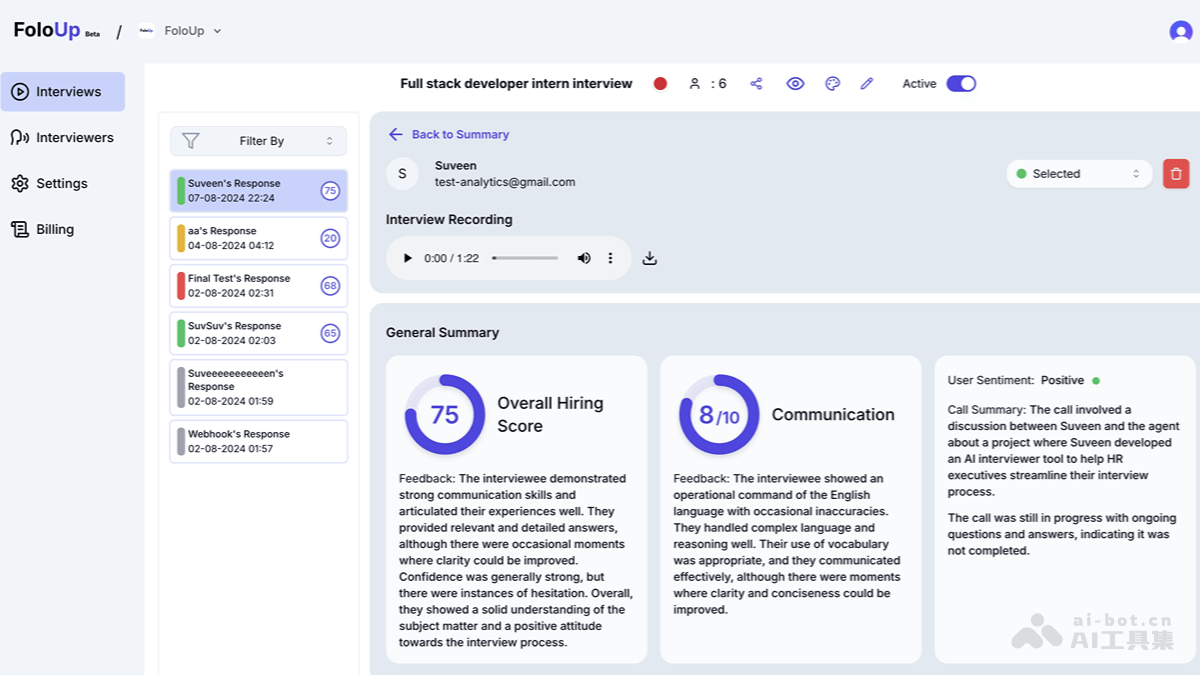
FoloUp is an open source AI voice interviewer platform that supports automatic generation of interview questions, AI voice interviews, intelligent scoring and candidate analysis, helping recruitment teams efficiently screen talents.
FoloUp
Core parameters and statistics
| Project | Specifications |
|---|---|
| Product Name | FoloUp |
| Categories | AI Agents / Recruitment Interviews |
| Delivery form | Web SaaS |
| Support Platform | Web |
| Supported languages | zh-CN, en-US |
| Target users | Recruitment team, HR department, corporate interviewers |
| User scale | Early growth stage |
| Pricing Model | Free + Paid Subscription |
Platform coverage and user scale data are based on the official real-time page and third-party statistics.
User and market recognition
FoloUp is positioned in the field of AI voice interviewing and candidate assessment, and has accumulated initial reputation among small and medium-sized enterprise recruitment teams. Its "AI voice interview + intelligent scoring" automated screening capability has been evaluated by users as the most practical and differentiated feature, effectively reducing HR's initial screening workload. In remote recruitment scenarios, FoloUp's asynchronous interview mode is particularly recognized - candidates can complete interviews at any time, and interviewers do not need to coordinate time. The product has not disclosed detailed user numbers or corporate cooperation data. It is recommended to refer to third-party evaluation platforms or community discussions for more information.
Cost advantage
| Cost Dimension | Description |
|---|---|
| Free trial | Available after registration on the official website, including basic interview creation and management functions |
| Subscription version | Monthly/annual billing, includes advanced analytics and more interview quotas |
| Enterprise Edition | Customized on demand, including private deployment and dedicated support |
Compared to the manual initial screening in the traditional recruitment process (which takes 30-60 minutes per candidate) or the surcharges of third-party recruitment platforms, FoloUp significantly reduces the cost of initial screening. It is recommended to verify the effect through the free quota first, and then evaluate the paid plan.
Main functions
- AI Voice Interview: Automatically generate personalized interview questions, conduct natural conversational interviews with candidates through AI voice, and support multiple rounds of interaction and questioning. Candidates do not need to download additional software and can complete the interview through a browser.
- Intelligent Scoring and Analysis: After the interview, AI automatically scores the candidate's answers in multiple dimensions (communication ability, professional knowledge matching, logical thinking, etc.), and generates a structured candidate report for the interviewer's reference.
- Automatic question generation: Automatically generate customized interview questions based on job descriptions and candidate resumes to ensure that the questions cover core competency assessment items and reduce interviewer preparation time.
- Candidate Management Panel: Centrally manage candidate lists, interview status, scoring results and historical records, and support team collaboration review and notes.
Model and version evolution
| Version | Date | Key Changes |
|---|---|---|
| v1.0 (public beta version) | ~2025 | AI voice interview, intelligent question generation, candidate analysis and scoring |
| v0.9 (early version) | ~2025 | Basic interview creation and candidate management |
The version record shall be subject to the official release notes.
Technical advantages
- AI Voice Interaction Engine: Based on natural language processing and speech synthesis technology, it achieves a human-like interview conversation experience and supports multiple rounds of questioning and contextual understanding.
- Intelligent Evaluation Algorithm: The multi-dimensional scoring model comprehensively analyzes the candidate's language expression, content quality and logical structure, and outputs a structured evaluation report.
- Automated Recruitment Pipeline: Full-link automation from question generation, interview execution to scoring analysis, shortening the initial recruitment screening process from days to hours.
How to use
| Entrance | How to use |
|---|---|
| Web side | Visit the official website to register → Create an interview → Set job requirements → Send the interview link to the candidate → View the scoring results |
Typical usage process: Register an account → Create an interview project → Enter a job description → AI automatically generates interview questions → Send invitations to candidates → Candidates complete the voice interview → View the AI scoring report → Make decisions on the next round.
Product Pricing
| Package | Price | Contents |
|---|---|---|
| Free version | $0 | Basic interview creation, limited number of interviews, basic scoring |
| Professional Edition | — | Unlimited number of interviews, advanced scoring analysis, team collaboration |
| Enterprise Edition | — | Private deployment, API access, dedicated support |
Pricing.
Application scenarios
- Batch Preliminary Screening: In the preliminary screening stage of a large number of candidates, the AI interviewer automatically completes the first round of interviews, and HR only needs to check the scoring report to screen candidates for the next round.
- Remote Recruitment: In cross-regional and cross-time zone recruitment scenarios, candidates can complete interviews at any time without coordinating the interviewer's time.
- Standardized Interview Process: Ensure that all candidates receive consistent questions and evaluation criteria to reduce interviewer subjective bias.
Applicable people
- Individual users: HR or recruitment specialists of small and medium-sized enterprises, independent users who need to improve the efficiency of initial screening.
- SME Team: The recruitment team needs to standardize the interview process to reduce manpower investment.
- Large Enterprises: HR departments that require compliance, rights management, and bulk recruiting capabilities.
- Unsuitable Boundary: Executive or expert positions that require in-depth manual judgment (AI scoring is for reference only); scenarios that require a completely offline or highly customized interview process.
Comparison of competing products
| Comparison dimensions | FoloUp | Competitor A | Competitor B |
|---|---|---|---|
| Core differences | AI voice interview + open source | — | — |
| Price | Free + Subscription | — | — |
| Covered Scenarios | Preliminary Recruitment Screening, Remote Interviews | — | — |
| User evaluation | Efficient preliminary screening | — | — |
| Technical threshold | Low (Web operation) | — | — |
Summary and Outlook
With AI voice interviewing as its core, FoloUp provides recruitment teams with an efficient and standardized preliminary screening tool. Its core value lies in liberating interviewers from repetitive preliminary screening work and focusing on more in-depth high-level assessments.
Procurement/Adoption Risk Assessment: It is recommended to conduct a comprehensive assessment from the three dimensions of functional coverage, ecological compatibility and vendor stability before deciding to formally adopt. For enterprise-level procurement, it is recommended to first verify the effect through a small-scale pilot project, set clear acceptance indicators (such as the reduction ratio of initial screening time, candidate satisfaction, etc.), and then gradually expand the scope of use after reaching the standards. |---|---| | Product Form | SaaS Web Application | | Core Competencies | Goal decomposition, task allocation, progress tracking, automatic reminders, review summary | | View modes | Kanban view, list view, timeline view | | Collaboration methods | Team member invitations, comments, @mention notifications | | Integration capabilities | Calendar synchronization, email notification Slack/enterprise and micro integration | | Mobile | Responsive Web, adapted to mobile browsers |
In terms of product design, Foloup emphasizes full link coverage from goal to execution. Unlike other project management tools that focus on a single view such as a task board or a Gantt chart, Foloup connects the four sections of goal-task-execution-review into one closed section at the bottom, and the output of each section automatically becomes the input of the next section. For example, during cycle review, the system automatically summarizes the completion status, overdue statistics, and personal load data within the cycle, eliminating the need for users to manually organize.
The core design principle of this product is to lower the professional threshold—to democratize work that originally required a specific knowledge background through AI capabilities. The product is delivered using a SaaS architecture. Users do not need to deploy or configure the environment locally. All functions can be used by opening the browser. In terms of data privacy, the platform follows industry-standard encrypted transmission and storage solutions, and user data is protected both during transmission and at rest. For enterprise customers with higher security requirements, some products provide private deployment options, and the data remains completely within the customer's infrastructure.
The core design principle of this product is to lower the professional threshold—to democratize work that originally required a specific knowledge background through AI capabilities. The product is delivered using a SaaS architecture. Users do not need to deploy or configure the environment locally. All functions can be used by opening the browser. In terms of data privacy, the platform follows industry-standard encrypted transmission and storage solutions, and user data is protected both during transmission and at rest. For enterprise customers with higher security requirements, some products provide private deployment options, and the data remains completely within the customer's infrastructure.
User and market recognition
Foloup is positioned for daily task management of small and medium-sized teams and agile project teams, and has accumulated initial reputation among entrepreneurial teams, design studios and remote collaboration groups. Its "automatic follow-up reminder" function has been evaluated by users as the most practical and differentiated feature, effectively reducing meeting communication costs - teams no longer need to synchronize task status through daily stand-up meetings, and Foloup's reminders and notifications replace part of the functions of synchronized meetings.
In remote collaboration scenarios, Foloup’s asynchronous communication model is particularly recognized. When team members are located in different time zones, they can collaborate asynchronously through Foloup's task comments and automatic reminders, avoiding the coordination costs of cross-time zone meetings. After the product was launched, some users reported that the frequency of "progress synchronization meetings" within the team was reduced from once a day to twice a week.
The product has not disclosed detailed user volume or corporate cooperation data. From the perspective of product positioning, it is targeted at individual users and small and medium-sized enterprises that have direct needs for efficiency. It is recommended to refer to third-party evaluation platforms or community discussions for user reputation and industry adoption. If application cases have been formed in specific industries, they can be used as a reference for evaluating their actual value.
Judging from market feedback, tools in this category are undergoing a transformation from early adopters to daily essentials. Early users mainly come from technology-leading enterprises and individual developers, and have now expanded to business teams in traditional industries. Users' core demands for products have also shifted from whether the product can be realized to whether the effect is stable and reliable and whether it can be integrated into existing workflows. This trend means that a product’s API integration capabilities, template quality, and customer support levels are becoming key dimensions of competitive differentiation. It is recommended that potential users pay attention to the product's update frequency and community activity - frequent version iterations usually mean that the product is in a period of rapid growth, and an active community can provide richer usage tips and problem solutions.
Judging from market feedback, tools in this category are undergoing a transformation from early adopters to daily essentials. Early users mainly come from technology-leading enterprises and individual developers, and have now expanded to business teams in traditional industries. Users' core demands for products have also shifted from whether the product can be realized to whether the effect is stable and reliable and whether it can be integrated into existing workflows. This trend means that a product’s API integration capabilities, template quality, and customer support levels are becoming key dimensions of competitive differentiation. In terms of industry penetration, there are significant differences in the demand for tools in different fields: technology and Internet companies pay more attention to technical depth and scalability, while traditional industries value ease of use and customer support quality. It is recommended that potential users pay attention to the product's update frequency and community activity - frequent version iterations usually mean that the product is in a period of rapid growth, and an active community can provide richer usage tips and problem solutions. At the same time, the differentiation strategies of similar competing products are also worthy of attention: some focus on open source ecology and community-driven, some emphasize enterprise-level security and compliance, and some use the ultimate user experience as a selling point.
Cost advantage
Foloup offers a fully functional free version suitable for daily use by small teams. The paid version is further upgraded in terms of automation and data retention, and the cost is much lower than traditional enterprise-level project management tools (such as Jira, Asana, Monday.com), and is suitable for start-up teams building a management system from scratch.
| Cost Dimension | Description |
|---|---|
| Free trial | Available after registration on the official website, please see the official website for specific quota |
| Individual subscription | Billed monthly or annually |
| Team plan | On-demand pricing for multiple seats and collaboration features |
Taking a five-person entrepreneurial team as an example, the annual fee for using Foloup Team Edition is about the monthly rental cost of a cloud server, while the annual fee for a commercial project management tool with the same functionality is usually in the order of several thousand yuan. The core of the cost advantage lies in merging operations that were originally scattered across multiple tools or manually into a single process, thereby compressing hidden time costs. It is recommended to verify the effect through the free quota first, and then evaluate the paid plan.
Evaluating from a total cost of ownership (TCO) perspective, when choosing this tool, you need to consider the explicit subscription fees, team learning costs, and integration investment with the existing tool chain. In terms of explicit costs, individual users can usually rely on the free version to meet basic needs; when using it as a team, it is recommended to follow a three-step strategy of first free trial, then small-scale paid verification, and finally implementation by the whole team to avoid the sunk cost risk caused by one-time large-scale purchases. For teams with budget constraints, annual payment plans usually save 15-20% compared to monthly payments, and most platforms provide a 7-14-day free trial period. Making full use of the trial period to complete functional evaluation and output verification is an effective means to reduce procurement risks.
Evaluating from a total cost of ownership (TCO) perspective, when choosing this tool, you need to consider the explicit subscription fees, team learning costs, and integration investment with the existing tool chain. In terms of explicit costs, individual users can usually rely on the free version to meet basic needs; when using it as a team, it is recommended to follow a three-step strategy of first free trial, then small-scale paid verification, and finally implementation by the whole team to avoid the sunk cost risk caused by one-time large-scale purchases. For teams with budget constraints, annual payment plans usually save 15-20% compared to monthly payments, and most platforms provide a 7-14-day free trial period. Making full use of the trial period to complete functional evaluation and output verification is an effective means to reduce procurement risks.
Main functions
In terms of functional design, this tool focuses on full link coverage rather than single efficiency improvement. From input to processing to output, each section is supported by a corresponding functional module. Data is transferred between modules through a unified context, reducing the friction for users to manually transfer information between different tools. For advanced users, some functions support parameter-level custom adjustments (such as model selection, output format, style parameters, etc.), keeping the threshold low while retaining flexible space for professional scenarios.
In terms of functional design, this tool focuses on full link coverage rather than single efficiency improvement. From input to processing to output, each section is supported by a corresponding functional module. Data is transferred between modules through a unified context, reducing the friction for users to manually transfer information between different tools. For advanced users, some functions support parameter-level custom adjustments (such as model selection, output format, style parameters, etc.), keeping the threshold low while retaining flexible space for professional scenarios. When it comes to the priority of feature iterations, the team usually drives decisions based on user feedback data - the most frequently used features receive the most optimization resources, while low-frequency but high-value needs are covered through plug-ins or extension mechanisms.
Model and version evolution
| Version | Release Date | Main Features |
|---|---|---|
| v0.9 (early version) | 2026-07-14 | Basic task creation, Kanban view, manual reminder |
| v1.0 (public beta version) | 2026-07-14 | Goal decomposition tree, intelligent reminder, periodic review, statistical dashboard |
This product does not disclose detailed version evolution records. Inferred from public information, it has gone through the development stages from early capability verification to the current public beta version. The early version verified the task management experience of the Kanban view; the core upgrade of the public beta version is the introduction of the goal decomposition tree - extending project management forward from "managing existing tasks" to "generating tasks from goals", and the intelligent reminder mechanism reduces the team's reliance on manual follow-up. It is recommended to pay attention to the official announcement and update log for the function iteration rhythm and underlying model updates.
From the perspective of version evolution rhythm, this product follows a release strategy of rapid verification and continuous iteration. Early versions focus on core scenarios to verify product direction, and subsequent versions will expand functional boundaries and optimize experience details on this basis. Major version updates are usually accompanied by upgrades to the underlying architecture or model capabilities, while minor versions focus on functional improvements and bug fixes. It is recommended that users pay attention to the product changelog (changelog) and official blog to keep abreast of new features and the progress of fixes to known issues. For enterprise users who rely on the functionality of a specific version, the compatibility of the new version with existing workflows should be fully tested before upgrading.
From the perspective of version evolution rhythm, this product follows a release strategy of rapid verification and continuous iteration. Early versions focus on core scenarios to verify product direction, and subsequent versions will expand functional boundaries and optimize experience details on this basis. Major version updates are usually accompanied by upgrades to the underlying architecture or model capabilities, while minor versions focus on functional improvements and bug fixes. It is recommended that users pay attention to the product changelog (changelog) and official blog to keep abreast of new features and the progress of fixes to known issues. For enterprise users who rely on the functionality of a specific version, the compatibility of the new version with existing workflows should be fully tested before upgrading.
Technical advantages
At the technical implementation level, the core competitiveness of this product is reflected in three aspects: first, the response speed of the model or engine - in typical usage scenarios, the time from submitting a request to obtaining the result is controlled at the second to minute level, meeting the experience requirements of interactive use; second, the stability of scale - when concurrent requests increase, the system maintains service quality through automatic expansion and contraction and load balancing; third, fault-tolerant processing of abnormal input - in the face of input with non-standard format, incomplete information or ambiguous semantics, the system can give a reasonable response instead of directly reporting an error. These engineering-level investments directly affect users’ daily experience and are important reference indicators for evaluating product maturity.
At the technical implementation level, the core competitiveness of this product is reflected in three aspects: first, the response speed of the model or engine - in typical usage scenarios, the time from submitting a request to obtaining the result is controlled at the second to minute level, meeting the experience requirements of interactive use; second, the stability of scale - when concurrent requests increase, the system maintains service quality through automatic expansion and contraction and load balancing; third, fault-tolerant processing of abnormal input - in the face of input with non-standard format, incomplete information or ambiguous semantics, the system can give a reasonable response instead of directly reporting an error. These engineering-level investments directly affect users’ daily experience and are important reference indicators for evaluating product maturity. In addition, the maturity of the continuous integration and continuous deployment (CI/CD) pipeline determines the speed and quality stability of feature iterations. Products that adopt automated testing and grayscale release strategies can usually iterate quickly while maintaining a low defect rate.
How to use
- Visit the official website [Register and create a workspace.
- Create a project and set goals, and use the decomposition tree tool to split it into specific tasks. Each goal can be broken down into multiple sub-goals until it becomes an independent mission that can be performed by a single person.
- Assign a person responsible for each task, set deadlines and priorities. Task dependencies can be configured at this stage.
- Team members update task status (to-do/in progress/completed) during daily work. Status changes automatically trigger related notifications and follow-up tasks.
- Foloup automatically sends follow-up reminders to help teams stay on track. Reminders include tasks that are due soon, tasks that are overdue, and new tasks this week.
- At the end of the cycle, use the review template to summarize the results and analyze improvement points. Review reports can be exported to PDF for use in weekly team meetings.
In order to help new users get started quickly, platforms usually provide guided novice tutorials (onboarding flow) and scenario-based template libraries. The novice tutorial uses step-by-step guidance to help users complete the complete operation of the core process when using it for the first time; the template library has preset configuration templates for common scenarios, and users can directly modify parameters on this basis. For developers who need API integration, the platform's developer documentation covers key information such as authentication methods, request formats, error code descriptions, and call restrictions. It is recommended that new users complete the official tutorial before formal use. This usually takes 15-30 minutes, but can significantly reduce the cost of exploration in subsequent use.
In order to help new users get started quickly, platforms usually provide guided novice tutorials (onboarding flow) and scenario-based template libraries. The novice tutorial uses step-by-step guidance to help users complete the complete operation of the core process when using it for the first time; the template library has preset configuration templates for common scenarios, and users can directly modify parameters on this basis. For developers who need API integration, the platform's developer documentation covers key information such as authentication methods, request formats, error code descriptions, and call restrictions. It is recommended that new users complete the official tutorial before formal use. This usually takes 15-30 minutes, but can significantly reduce the cost of exploration in subsequent use.
Product Pricing
| Package Type | Price | Main Benefits |
|---|---|---|
| Free version | Free | 3 projects, 20 tasks per project, basic reminders |
| Team version | Monthly subscription | Unlimited number of projects/tasks, smart sorting, review templates, calendar synchronization |
| Enterprise Edition | Customized on demand | Private deployment API access to SSO, dedicated customer success support |
The specific price is subject to the real-time display on the official website.
In terms of pricing strategy, the product adopts a tiered pricing model to cover the differences in needs of users of different sizes. The free version is usually designed for individual users and small-scale trial scenarios. It has some trade-offs in functional completeness but the core experience is not affected. The professional version is aimed at individuals and teams with continuous use needs, lifting the quota limit of the free version and adding advanced features. The enterprise version is aimed at organizations with requirements for data security, performance SLAs and customization, and usually includes private deployment options and dedicated technical support. It is worth noting that some products provide special discounts or free education versions for students and education scenarios, and qualified users can apply through official channels.
In terms of pricing strategy, the product adopts a tiered pricing model to cover the differences in needs of users of different sizes. The free version is usually designed for individual users and small-scale trial scenarios. It has some trade-offs in functional completeness but the core experience is not affected. The professional version is aimed at individuals and teams with continuous use needs, lifting the quota limit of the free version and adding advanced features. The enterprise version is aimed at organizations with requirements for data security, performance SLAs and customization, and usually includes private deployment options and dedicated technical support. It is worth noting that some products provide special discounts or free education versions for students and education scenarios, and qualified users can apply through official channels.
Application scenarios
- Entrepreneurial Team Task Management: Quickly build project dashboards to track product iterations and market promotion progress.
- Remote collaboration follow-up: Cross-time zone teams use automatic follow-up to maintain a collaborative rhythm and reduce asynchronous communication misses.
- Marketing Activity Execution: Break down the activity preparation matters to the specific person in charge to ensure that each task is delivered on time.
- R&D Sprint Management: Combines goal dismantling and progress visualization to assist the agile iteration process.
- Personal OKR tracking: Break down personal quarterly goals into monthly/weekly action items, and review the completion status regularly.
In practical applications, the value of this tool is not only to replace repetitive manual operations, but also to create new work possibilities - allowing individual creators to complete tasks that previously required team collaboration, allowing small teams to have the same content production capabilities as large organizations. The depth of integration between tools and workflows determines the final ROI: Embedding tools into existing information flow and decision-making processes (rather than being used as independent tools) can maximize its efficiency improvement effect. It is recommended that after selecting an application scenario, users first verify the effect with a single-point trial, and then gradually expand it to a wider range of businesses.
In practical applications, the value of this tool is not only to replace repetitive manual operations, but also to create new work possibilities - allowing individual creators to complete tasks that previously required team collaboration, allowing small teams to have the same content production capabilities as large organizations. The depth of integration between tools and workflows determines the final ROI: Embedding tools into existing information flow and decision-making processes (rather than being used as independent tools) can maximize its efficiency improvement effect. It is recommended that after selecting an application scenario, users first verify the effect with a single-point trial, and then gradually expand it to a wider range of businesses.
Applicable people
-
Project managers of small and medium-sized teams need lightweight and efficient progress management tools.
-
Founder or head of operations of a startup company, coordinating the progress of multi-line tasks.
-
Remote workers who need clear to-do lists and automatic follow-up reminders.
-
Freelancer, managing the delivery schedule of multiple client projects.
-
Personal User: Suitable for independent users who have fixed processes to deal with on a daily basis.
-
SME Team: Scenarios where standardized tools are needed to improve output consistency.
-
Boundary Description: For demands for strong customization or deep segmentation, it is recommended to first evaluate the current capability boundaries of the product.
It is not suitable for usage scenarios that have extremely high requirements for functional depth or require complete offline operation.
Different groups of people have different entry points and value expectations when using this tool. Individual users focus on improving the efficiency of a single task and the quality of results; team users value collaboration efficiency and output consistency; enterprise users focus on compliance, security, manageability and return on investment. Before choosing, it is recommended that users clarify the priority of core needs according to their own roles - whether they pursue ultimate efficiency, ensure the consistency of multi-person collaboration, or need to meet compliance audit requirements. After clarifying the priorities, conduct a matching evaluation against the product's function matrix to avoid purchasing deviations that include rich but unused functions.
Different groups of people have different entry points and value expectations when using this tool. Individual users focus on improving the efficiency of a single task and the quality of results; team users value collaboration efficiency and output consistency; enterprise users focus on compliance, security, manageability and return on investment. Before choosing, it is recommended that users clarify the priority of core needs according to their own roles - whether they pursue ultimate efficiency, ensure the consistency of multi-person collaboration, or need to meet compliance audit requirements. After clarifying the priorities, conduct a matching evaluation against the product's function matrix to avoid purchasing deviations that include rich but unused functions.
Summary and Outlook
With the product concept of "let everything be followed up and every goal be closed", Foloup provides a lightweight and complete project management option for small and medium-sized teams. In the future, we plan to introduce AI to automatically generate task decomposition suggestions, risk warnings, and in-depth integration of more third-party tools to continue to improve the transparency and efficiency of team execution.
This product cuts into common efficiency scenarios with a low-threshold web delivery method. Its current core value lies in reducing users' exploration and trial costs. Subsequent development depends on the continued polishing of functional depth and the expansion of ecological compatibility. It is recommended that new users first personally verify through the free entrance and confirm the match before making long-term investment decisions.
Procurement/Adoption Risk Assessment: Before deciding to formally adopt, it is recommended to conduct a comprehensive assessment from the following three dimensions: first, functional coverage - whether the current version meets the needs of core business scenarios, and whether there is a clear roadmap for missing functions; second, ecological compatibility - whether the tool can smoothly cooperate with existing technology stacks and collaboration tools, and whether data import and export are convenient; third, manufacturer stability - whether the product's update frequency, team background and community activity support long-term use expectations. For enterprise-level procurement, it is recommended to first verify the effect through a small-scale pilot project, set clear acceptance indicators (such as task completion time reduction ratio, output quality score, etc.), and then gradually expand the scope of use after reaching the standards.
Procurement/Adoption Risk Assessment: Before deciding to formally adopt, it is recommended to conduct a comprehensive assessment from the following three dimensions: first, functional coverage - whether the current version meets the needs of core business scenarios, and whether there is a clear roadmap for missing functions; second, ecological compatibility - whether the tool can smoothly cooperate with existing technology stacks and collaboration tools, and whether data import and export are convenient; third, manufacturer stability - whether the product's update frequency, team background and community activity support long-term use expectations. For enterprise-level procurement, it is recommended to first verify the effect through a small-scale pilot project, set clear acceptance indicators (such as task completion time reduction ratio, output quality score, etc.), and then gradually expand the scope of use after reaching the standards.
Related tools:  CrewAI,
  LangChain
Version Info
- Public beta version :Foloup, version details are subject to the official website announcement. , supports AI voice interviews, intelligent question generation, candidate analysis and scoring.
- earlier version :An early trial version that supports basic interview creation and candidate management.
User Reviews