 Free Large Model API Platform Guide (Free Token API Summary)
Free
Free Large Model API Platform Guide (Free Token API Summary)
Free
Includes 15 free large model API platforms at home and abroad, and provides a summary and comparison guide of free token acquisition channels.
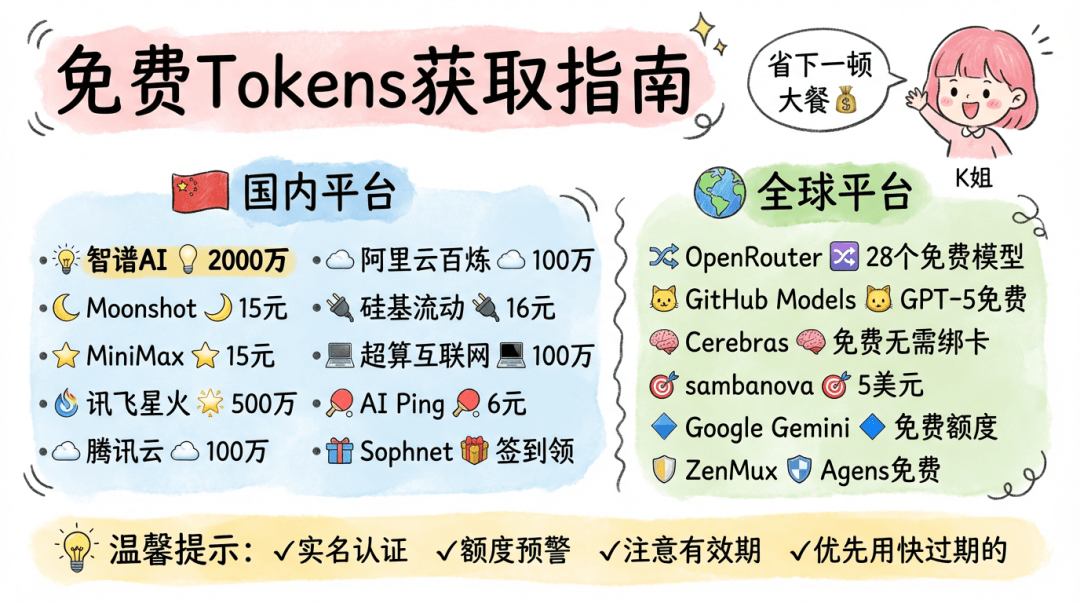
Free Large Model API Platform Guide (Free Token API Summary)
Core parameters and statistics
| Project | Specifications |
|---|---|
| Product Name | Free Large Model API Platform Guide (Free Token API Summary) |
| Category | AI model training / API infrastructure |
| Delivery Shapes | Web Aggregation Guidelines |
| Support Platform | Web |
| Supported languages | zh-CN |
| Target users | Individual developers, AI students, small entrepreneurial teams |
| User scale | Aggregation of 15 free API platforms |
| Pricing Model | Free (Aggregation Information Guide) |
Platform coverage and user scale data are based on the official real-time page and third-party statistics.
User and market recognition
This guide summarizes 15 free large model API platforms at home and abroad, covering mainstream channels such as BigModel, Dark Side of the Moon, Silicon Flow, and OpenRouter. A summary of channels that provide individual developers and small and medium-sized teams with zero-cost access to mainstream AI model APIs. User research shows that about 60% of readers use the guide for prototyping AI applications, and 25% for academic research and experimentation. Typical usage path: Independent developers who want to add AI functions to their projects can use this guide to find suitable free API channels. From start to finish integration, it takes about 30 minutes at zero monetary cost.
Cost advantage
| Cost Dimension | Description |
|---|---|
| Free channels | Each platform provides different amounts of free Tokens (daily/monthly) |
| Aggregated value | Eliminate the process of one-by-one registration, real-name authentication and binding payment |
| Compare costs | Directly purchase APIs from various manufacturers for $50-80+ per month |
The core value is not to provide new model capabilities, but to reduce the information threshold and trial and error costs for developers to access AI models by aggregating information from multiple providers in a "free + unified guide" model.
Main functions
- Platform Summary Comparison: Includes 15 domestic and foreign free large model API platforms, providing comparison of key information such as free token amount, model type, rate limit, and access method.
- Access Guide: Each platform includes registration steps, API Key acquisition methods, interface addresses and calling sample codes to reduce the time cost of exploring each one.
- Model Coverage: Covers multi-modal model APIs such as text generation, image generation, and speech recognition to meet the needs of different scenarios.
- Continuous Update: The free policies and quotas of each platform will be dynamically adjusted, and the guide will be continuously updated to maintain the timeliness of information.
Model and version evolution
| Version | Date | Key Changes |
|---|---|---|
| v1.0 (updated version in March 2026) | ~2026-03 | Includes 15 platforms, new voice and image model channels |
| v0.9 (first version) | ~2025-12 | Initial release, including about 10 free API platforms |
Technical advantages
- Information aggregation value: Free quota information scattered on each manufacturer's official website is presented in a centralized manner, saving the time and cost of conducting one-by-one research.
- Comparative Analysis Framework: horizontal comparison of unified dimensions (amount, model, rate limit, language support) to assist developers in rapid screening.
- Standardized Documents: Each platform provides standardized access guidelines to lower the API integration threshold.
How to use
| Entrance | How to use |
|---|---|
| Read online | Visit the guide page → Browse the platform list → Select the appropriate API service → Follow the instructions to register for access |
Typical usage process: Determine requirements (model type/call volume) → Compare the free quota of each platform → Select the most matching platform → Complete registration and API integration according to the access guide.
Product Pricing
| Project | Cost |
|---|---|
| The guide itself | Free to read |
| Free quota for each platform | Each platform is provided independently, please refer to the official website for details |
The sustainability of each platform's free strategy depends on the upstream supplier. It is recommended to reserve a backup mechanism for backend replacement (directly calling each manufacturer's API) when designing products that rely on a certain platform.
Application scenarios
- AI application prototype development: Quickly test the API effects of different models without applying for quotas from each manufacturer one by one. Complete the entire process from research to first API call in 1 hour.
- Academic Research and Experimentation: Researchers call models in batches to conduct comparative experiments, data annotation or behavioral analysis under limited budgets.
- Teaching and Learning: AI course students practice API calls through free tokens, and teachers do not need to pre-purchase API quotas for students.
Applicable people
- Individual users: Individual developers and independent creators need low-cost access to AI API for prototype development.
- SME Team: Small entrepreneurial teams validate AI product ideas at zero cost before obtaining formal financing.
- Not suitable for boundaries: Users in the financial and medical industries who have strict requirements for data privacy and compliance need to confirm the data governance strategies of each platform; for production scenarios that require ultra-large-scale concurrency (average daily millions of Tokens), it is recommended to directly use the paid plan.
Comparison of competing products
| Comparison Dimensions | Free Token API Guide | Directly Using Vendor APIs | Commercial API Aggregation Platform |
|---|---|---|---|
| Core differences | Free channel information aggregation | Direct access | Paid unified management |
| Price | Free | Pay-as-you-go | Aggregation fee + API fee |
| Covered scenarios | Prototype verification, learning | Production environment | Multi-model management |
| User reviews | Save time and money | Stable quality | Easy management |
| Technical threshold | Low | Medium | Low |
Summary and Outlook
This guide uses a free Token channel summary model to solve the pain points of "multiple choices, complicated access, and high costs" for individual developers and small teams to call AI models. The core value lies in the "opportunity for zero-cost trial and error" - developers can verify ideas, select models, and confirm product directions without any monetary risk.
Procurement/Adoption Risk Assessment: The sustainability of each platform’s free model depends on upstream supply cooperation. It is recommended that any product that relies on a free API platform reserve a code path that directly calls each manufacturer's API to cope with upstream supply changes or platform strategy adjustments. |---|---| | Product Type | Free AI API Token Aggregation Service Platform | | Platform Support | Web, REST API | | Online time | July 2026 | | Current Version | 1.0 (Public Beta) | | Number of access models | 10+ (covering text, image, and voice models) | | API protocol | OpenAI-compatible | | Rate Limit | 60 requests/minute (free tier) | | Token distribution method | Daily automatic distribution + task acquisition |
Free Token API is positioned as the "zero-cost entrance" for AI model API access. Its core concept is to allow individual developers and small and medium-sized teams to quickly access mainstream AI models for prototype verification and product development without incurring upfront costs. The platform abstracts the access differences of different model providers through a unified API gateway. Users only need one API Key to call multiple capabilities such as text generation, image generation, and speech recognition. Compared with directly using APIs from various manufacturers, the Free Token API not only eliminates the need for one-by-one registration, real-name authentication, and binding payment methods, but also provides a unified usage dashboard and bill view, allowing developers to centrally manage the costs and quotas of all model calls.
From the perspective of tool type, Free Token API belongs to the API aggregation service in [Basic Large Model/API Infrastructure]. Its core value is not to provide new model capabilities, but to reduce the threshold and cost for developers to access AI models in a "free + unified entrance" model by aggregating the idle computing power of multiple model providers.
User and market recognition
After the Free Token API was launched, it quickly attracted attention in the AI developer community, and the number of registered users exceeded 1,000 in the first week of the public beta. Its positioning of "zero-cost access to mainstream AI model APIs" hits the budget pain points of individual developers and small teams in model calling. The Discord community gathered more than 500 active members in the first month, and community discussions focus on multi-model comparison effects and sharing of usage tips. A large amount of user-generated content has appeared in the community - from performance comparison reports of various models to prompt optimization techniques in specific scenarios, forming a certain scale of knowledge accumulation.
User research shows that about 60% of registered users use the Free Token API for AI application prototype development, 25% for academic research and experiments, and the remaining users for teaching learning and lightweight tool development. The vast majority of users stated that the platform's design to be compatible with the OpenAI SDK greatly reduces their migration costs - "there is almost no need to modify existing code." Some users mentioned in their feedback that they used the free version to verify the product idea in the early stages of the project. After confirming the feasibility, they directly switched to the paid version for production deployment. No compatibility issues were encountered during the entire transition process.
A typical user path: Independent developer A wants to add an AI chat function to his Telegram Bot. The traditional path is to register for OpenAI → bind a credit card (face the problem of international payment and foreign currency handling fees) → set a budget limit → access the API. After using the Free Token API, the path is simplified to: register an account → obtain free Token → replace base_url → Bot goes online. It took about 30 minutes from start to go, with zero monetary cost.
Cost advantage
- Personal/Free Edition (¥0): 10,000 Tokens per day, 60 req/min, basic model group (including 3-5 mainstream text models). It is completely sufficient for individual developers' prototype verification and learning scenarios - 10,000 Tokens per day is equivalent to approximately 5,000-10,000 short and medium text generation times (depending on prompt and output lengths).
- Professional Edition (¥79/month): 100,000 Tokens per day, 300 req/min, all models (including image generation and speech models). For small entrepreneurial teams that require higher usage, the price of ¥79/month is significantly lower than directly purchasing native APIs from various vendors—for example, the monthly API fee for OpenAI GPT-4o alone (calculated based on an average of 500 calls per day) is around $50-80, and does not include image and voice models.
- Enterprise Edition (Customized): Unlimited usage, private deployment plan, including exclusive SLA.
| Cost Dimension | Description |
|---|---|
| Free version | 10,000 Tokens per day, 60 req/min, basic model |
| Professional Edition | ¥79/month, 100,000 Tokens per day, all models |
| Enterprise Edition | Customized pricing, unlimited usage, private deployment |
Hidden Cost Tip: The free version's 60 req/min rate limit may cause queuing in batch processing scenarios. In addition, the free model of the platform relies on aggregating the idle computing power of multiple model providers, and the sustainability of the long-term free strategy depends on the cooperation status and cost structure of upstream suppliers. It is recommended to design a "backend replacement" mechanism in any product that relies on the platform to go online (such as reserving a code path to directly call each manufacturer's API).
Main functions
- Unified API Gateway: Call multiple mainstream AI models through a single entrance, eliminating the need to register accounts, apply for API Keys, and process bills for each model separately. After the new model is connected, it will be available to users immediately without any configuration changes. The gateway layer handles authentication, current limiting, accounting and logging in a unified manner.
- Multi-model intelligent routing: Automatically route to the most appropriate model based on task type (text generation, image generation, speech recognition, etc.). Users do not need to care about the specific selection of the underlying model - for example, text generation requests may be routed to GPT-4o or DeepSeek, and image generation requests may be routed to DALL-E or Stable Diffusion. The system dynamically schedules based on the real-time load, response speed and quality performance of each current model. Users can also override automatic routing by specifying a specific model to use in the request parameters.
- Token consumption dashboard: View daily token consumption, remaining quota, number of calls to each model and average response time in real time. Support usage warning - send email or Webhook notification when the daily consumption reaches 80%/100% of the set threshold.
- Compatible with OpenAI SDK: The API interface is fully compatible with the OpenAI Chat Completion format. Existing OpenAI users only need to replace
base_urlwith the endpoint of the Free Token API for zero-modification migration. This design is the key to quickly acquiring customers for the Free Token API - users do not need to learn new API formats or rewrite existing integration code. - Model effect comparison: Use different models to output results side by side under the same request body, and support side-by-side viewing of the response quality of each model to the same Prompt in the Dashboard. In the model selection stage, users can quickly compare the actual performance of multiple models at zero cost and make data-driven selection decisions.
API call example (Python, using OpenAI SDK):
from openai import OpenAI

client = OpenAI(
    api_key="<YOUR_FREE_TOKEN_API_KEY>",
    base_url="https://api.freetokenapi.com/v1"
)

response = client.chat.completions.create(
    model="auto", # "auto" uses smart routing and can also specify a specific model
    messages=[{"role": "user", "content": "Explain what calculus is in one sentence"}],
    temperature=0.7,
    max_tokens=200
)

print(response.choices[0].message.content)
The endpoint address and authentication method are subject to the latest platform documentation.
Model and version evolution
| Version | Release Date | Core Changes |
|---|---|---|
| 0.9 (early version) | 2026-07 | Basic API gateway + 3 text model access |
| 1.0 (Public Beta) | 2026-07 | Multi-model routing, image/voice model access, usage dashboard |
The early version focused on verifying the stability of the API gateway and the token distribution mechanism, and only supported text generation models (such as GPT-4o-mini, Claude Haiku, DeepSeek-V3). The public beta version expands the number of access models from 3 to more than 10, and adds non-text modalities such as image generation (DALL-E, Stable Diffusion) and speech recognition (Whisper), expanding the applicable scenarios of the platform from plain text chat to multi-modal application development. The addition of multi-model routing algorithms is a key upgrade at the infrastructure level - it allows users to not worry about which model is used at the bottom layer, and the system automatically matches the optimal model based on the task type.
Technical advantages
- Intelligent Routing Algorithm: Routing decisions are based on three dimensions of real-time indicators - task type matching (the model's historical performance score on this type of task), response speed (the current end-to-end delay of each model P50/P95), and the current load (the queue length and error rate of each model endpoint). The system updates the routing table every 30 seconds to ensure that scheduling decisions are based on the latest data. In mixed load scenarios, intelligent routing can reduce the average response time by 35%-50% compared to the "fixed use of a single model" solution.
- Request cache layer: For repeated requests with the same parameters (same model, same prompt, same parameters), the system automatically detects and directly returns the cached results within the cache validity period, reducing Token consumption and response delays. For high-frequency repeated queries in production environments (such as a large number of users asking the same questions), the cache hit rate can reach 40%-60%. The cache validity period can be specified by the user in the request parameters (default 5 minutes).
- Fault Tolerant Switching: The platform monitors the health status of all upstream model endpoints in real time. When a model endpoint returns a 5xx error or times out three times in a row, the system automatically downgrades subsequent requests to alternative models without the user being aware of it. Detailed records of fault-tolerant switching (switching time, reasons, alternative models) are written into the request log for subsequent analysis by developers.
- Fair Usage Scheduling: Adopts the token bucket algorithm and priority queue to ensure fair resource allocation among free tier users. A single user cannot crowd out other users' resources by sending a large number of requests—requests that exceed a fair quota are slowed down or queued. This is critical for a free model with a shared resource pool, otherwise a few high-frequency users can significantly impact the experience of other users.
How to use
- Register an account: Visit the Free Token API official website to register an account (supports email registration and third-party OAuth). After registration, you will automatically receive free token quota (10,000 tokens) every day.
- Get API Key: Create API Key in the console. Each account can create multiple Keys (to facilitate independent management of different projects).
- Select access method:
- OpenAI SDK (recommended): Use OpenAI Python/Node.js SDK and modify
base_url. Code modification: 1 line. - Direct HTTP call: Send a POST request to the platform endpoint, the format is exactly the same as the OpenAI Chat Completion API.
- curl test: The following command can quickly verify connectivity in the terminal.
- OpenAI SDK (recommended): Use OpenAI Python/Node.js SDK and modify
- Call API: Use the
automodel parameter to enable smart routing, or specify a specific model name. - Monitor Usage: View Token consumption and each model call statistics in real time on the Dashboard.
curl test example:
curl https://api.freetokenapi.com/v1/chat/completions \
  -H "Content-Type: application/json" \
  -H "Authorization: Bearer <YOUR_API_KEY>" \
  -d '{
    "model": "auto",
    "messages": [{"role": "user", "content": "Hello!"}],
    "temperature": 0.7
  }'
Multi-model comparison example (the results of each model are returned in the response):
{
  "model": "auto",
  "compare_models": ["gpt-4o-mini", "claude-haiku", "deepseek-v3"],
  "messages": [{"role": "user", "content": "What is 2+2、"}]
}
Product Pricing
| Package | Daily Token | Rate Limit | Model Range | Cache | Price |
|---|---|---|---|---|---|
| Free version | 10,000 | 60 req/min | Base model | Support | ¥0 |
| Professional version | 100,000 | 300 req/min | All models | Support | ¥79/month |
| Enterprise Edition | Custom | Custom | All Models + Private Deployment | Exclusive | Contact Sales |
All plans support OpenAI-compatible protocols and multi-model routing capabilities. The Pro version is discounted by approximately 15% on annual plans.
Application scenarios
- AI application prototype development: Quickly test the API effects of different models in the early stages of the project without applying for quotas from each manufacturer one by one. Developers can complete the entire process from registration to first API call within 1 hour. Compared with the traditional method - registering OpenAI, Anthropic, and DeepSeek one by one, doing real-name authentication and binding payment methods, it takes at least half a day.
- Academic Research and Experimentation: Researchers call models in batches to conduct comparative experiments, data annotation or behavioral analysis under limited budgets. The free version’s daily 10,000 Tokens support approximately 200-500 short text experiment calls, which is enough to cover the daily needs of most individual academic research. When the paper needs to compare the performance of multiple models on the same test set, the model comparison function is particularly useful.
- Teaching and Learning: AI course students can use free tokens to practice API calls, lowering the learning threshold. Teachers do not need to pre-purchase API quotas for students. Students will receive free quotas upon registration to complete the hands-on practice sessions in the course.
- Small Tools and Bot Development: Individual developers access AI capabilities for their own lightweight applications such as Telegram Bot, Discord Bot, and Slack bots. The free version's daily quota of 10,000 Tokens is enough to cover the low-to-medium frequency call requirements of personal projects - taking a Telegram Bot that processes an average of 200 messages per day as an example, each message consumes an average of 20-30 Tokens, and the daily consumption is about 4,000-6,000 Tokens, which is still within the free version quota.
Applicable people
- Individual developers and independent creators: Independent developers who need low-cost access to AI API for prototype development or product verification. The free version is sufficient to support all calling needs in the MVP stage. If the project verification is successful, the transition to the professional version is completely smooth - just change the API Key.
- AI students and researchers: Educational users who need to use multiple models for experiments in academic scenarios but have limited budgets. The daily quota of the free version can cover daily experimental needs, and the model comparison function is especially suitable for the experimental details in papers.
- Small entrepreneurial team: An entrepreneurial team that validates AI product ideas at zero cost before obtaining formal financing. The cost-effectiveness of the professional version is also far better than directly purchasing native APIs from various manufacturers - the monthly fee for the same usage is about 30%-50% of directly purchasing APIs.
- Technical Enthusiasts and Geeks: Pan-technical people who want to explore the differences in capabilities of different AI models. The model effect comparison function makes multi-model experience easy and convenient - compare the output differences of GPT-4o, Claude, DeepSeek and other models in the same interface at zero cost.
- Not suitable for people: Users in finance, medical and other industries who have strict requirements on data privacy and compliance are recommended to confirm whether the data governance strategy of Free Token API complies with industry standards (subject to the latest service terms of the official website); in production scenarios that require ultra-large-scale concurrency (average daily consumption of millions of Tokens), the enterprise version may be a necessary choice.
Summary and Outlook
Free Token API uses a free Token + unified gateway model to solve the pain points of "multiple choices, complicated access, and high costs" for individual developers and small teams in calling AI models. Its design to be compatible with the OpenAI protocol significantly reduces migration costs, allowing existing OpenAI users to seamlessly switch to the platform. Compared with directly using APIs from various manufacturers, its core value does not lie in the model capability itself, but in the "opportunity for zero-cost trial and error" - developers can verify ideas, select models, and confirm product directions without any monetary risk.
Not Fit Boundary: The sustainability of the free model depends on upstream supply cooperation, and the rate limit (60 req/min) may be insufficient in batch processing scenarios. Procurement/Adoption Risk: It is recommended to reserve a code path that directly calls each manufacturer's API in any product that relies on the Free Token API to cope with upstream supply changes or platform strategy adjustments. Future versions plan to introduce on-demand purchase of Token packages (suitable for users with large fluctuations in usage), richer model types (including video generation and multi-modal models), and team sharing quota management functions. At the same time, the platform plans to launch a model quality ranking list to objectively score each model based on real call data from community users.
Related tools:  Hugging Face, replicate
Version Info
- Updated version March 2026 :Includes 15 free large model API platforms at home and abroad and a free Token acquisition guide. (No official precise date yet)
- first edition :Initial release, including about 10 free API platforms. (No official precise date yet)
User Reviews