 FreeLLMAPI
Free
FreeLLMAPI
Free
FreeLLMAPI is an open source OpenAI compatible proxy service that aggregates free quotas from 28+ AI service providers such as Google Gemini, Groq, Cerebras, Mistral, etc., with a total monthly free inference capacity of approximately 4 billion tokens, and supports intelligent routing, automatic failover AES-256-GCM key encryption, and visual dashboards.
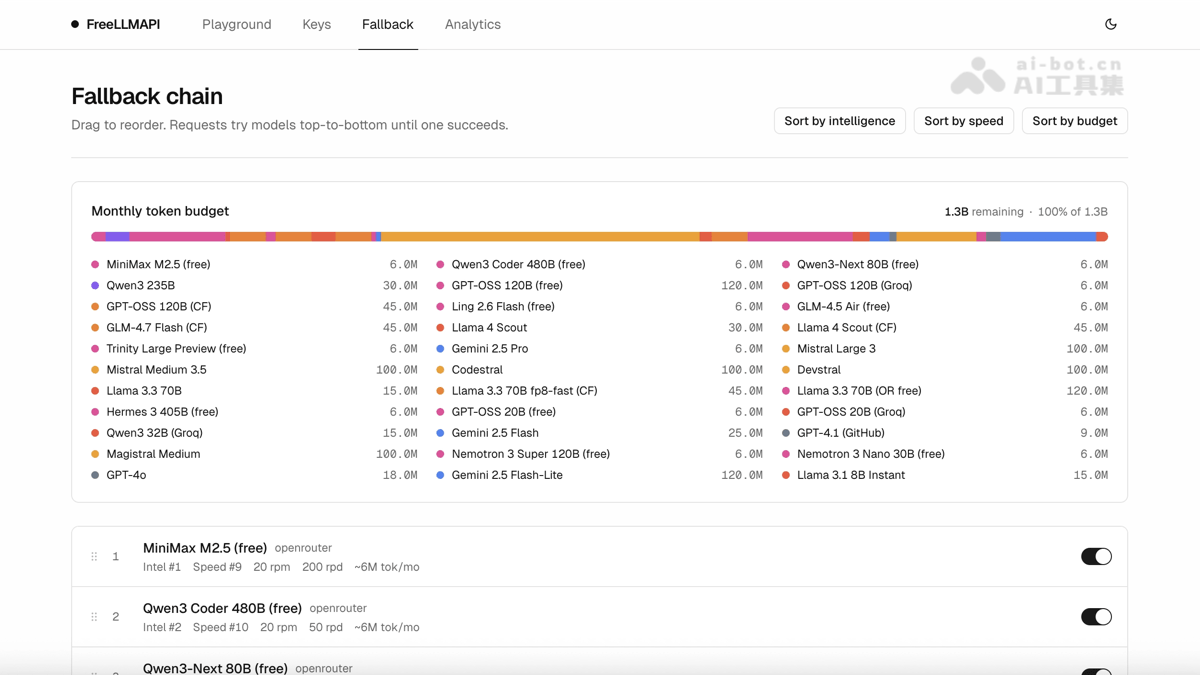
FreeLLMAPI: In-depth analysis of open source LLM free quota aggregation proxy gateway
Core parameters and statistics
| Project | Specifications |
|---|---|
| Project name | FreeLLMAPI |
| Category | AI Programming / API Agent |
| Open Source License | MIT |
| GitHub Stars | 16.4k |
| Programming Languages | TypeScript (Main) |
| Delivery form | Self-hosted / Docker / Desktop application |
| Target Users | Developers/Individuals/Small Teams |
| Core Sponsors | Community driven, no commercial sponsorship |
The core value proposition of FreeLLMAPI is clear and direct: it aggregates the free credits of 28+ AI service providers into a unified OpenAI-compatible API endpoint, aggregating an average of approximately 4 billion tokens of free inference capacity per month. It is not another "LLM aggregation platform", but an engineering solution positioned for individual developers to "call multiple models at zero cost" in local experiments. The MIT license means there are no legal barriers to commercial use and redistribution. GitHub's 16.4k Stars are at the top level among API proxy projects, reflecting the community's strong demand for "aggregated free credits" - interestingly, the number of Stars itself is also one of the driving forces for the project's continuous updates.
User and market recognition
FreeLLMAPI's market recognition can be broken down from three dimensions: community indicators, usage scenario coverage and competitive positioning.
Community Metrics: GitHub 16.4k Stars, 2.4k Forks, 47 contributors (as of July 2026). The growth curve of Stars has accelerated significantly after the release of v0.5.0 (9 new providers + Anthropic compatible API + MCP server support), indicating that each major feature version update will reach a new wave of users. The release frequency is about one minor version per month, 0.3.0 (2026-06-10) → 0.4.1 (2026-06) → 0.5.0 (2026-07-18), and the iteration rhythm is healthy.
Diffusion path of usage scenarios: Early users of the project are mainly individual developers who need to call multiple LLMs for prototype verification at zero cost. With the addition of MCP server, image generation and TTS support in v0.5.0, the user base has begun to expand in the following directions: (1) AI application developers who need RAG prototypes; (2) data scientists who need low-cost multi-model evaluation; (3) small teams who need to build AI service gateways locally.
Competitive positioning: Unlike OpenRouter (a commercial gateway that processes 100 trillion tokens per month), FreeLLMAPI takes the "self-hosting + free quota aggregation" route. The selling point of OpenRouter is 400+ model selection and zero operation and maintenance, and the selling point of FreeLLMAPI is zero fees and the data does not leave the local area. There is overlap in the user base of the two - developers may use FreeLLMAPI in the prototyping stage, switch to OpenRouter or use API Key directly in the production stage. This kind of "Up-selling" natural diversion is a kind of ecological positioning proof for community projects.
Cost advantage
| Cost Dimension | Description |
|---|---|
| Software License | $0 (MIT License, commercial and redistribution allowed) |
| Infrastructure | Prepare your own server/cloud resources (recommended 1 vCPU + 2GB RAM, stand-alone deployment) |
| Deployment and operation and maintenance | Basic Docker or Node.js operation and maintenance capabilities required |
| API call fee | $0 (aggregated third-party free quota) |
| Commercial Support | Community Support Only (GitHub Issues/Discussions) |
TCO deduction (12 months, individual developer scenario):
- FreeLLMAPI self-deployment: Cloud server about ¥50/month × 12 = ¥600 + operation and maintenance manpower about 2 hours initial deployment + 1 hour/month maintenance ≈ ¥600-900/year
- Commercial API direct connection (same call volume): Assuming an average of 10 calls to each of the 28 providers per day, calling directly through the official API, no free quota utilization ⇒ Monthly fee of about $50-200 (depending on the call volume) ≈ ¥4,000-16,000/year
- Commercial API gateway (such as OpenRouter): Same call volume as above, about $10-50/month ≈ ¥800-4,000/year
Key conclusion: FreeLLMAPI's zero software license fee + zero API call fee makes its cost advantage extremely significant in the "multi-provider, medium call volume" scenario. However, it should be noted that changes in the availability and rate limits of third-party free quotas are not controlled by the project - if a certain service provider adjusts its free policy, the total aggregate capacity will shrink.
Architecture and core capabilities
- Architecture Overview: FreeLLMAPI adopts a front-end and back-end separation architecture. The backend core is an API proxy service implemented in TypeScript, which receives requests in OpenAI-compatible formats and distributes the requests to 28+ underlying API endpoints through the built-in router. The front-end provides a visual dashboard (built into the desktop application) for viewing the call volume, remaining free credit, and latency statistics of each provider. The data flow is: User → OpenAI Compatible Request → FreeLLMAPI Router → Target Provider API → Response Aggregation → User.
- Core Engine (Smart Router): The core functions of the router include: (1) Model to Provider Mapping - Maintain a dynamic model directory that maps "model name + request parameters" to available free provider endpoints; (2) Automatic Failover - If the preferred provider returns 429 (throttle) or 5xx (server-side error), the router automatically switches to an alternative provider; (3) Cost-aware scheduling - Give priority to the provider with the most remaining free quota and balance the call quotas of each provider. The signature model directory introduced in v0.5.0 enables the router to automatically synchronize the latest list of provider models without manual configuration.
- Extension mechanism: Through the Structured Provider Adapter System, new providers only need to implement standardized interfaces. The community contributes adapters for most providers, which reduces the burden on a single maintainer. In addition, v0.5.0 adds MCP (Model Context Protocol) server support, allowing FreeLLMAPI to interact with other MCP servers as an MCP client - this is an important ecological expansion point that upgrades FreeLLMAPI from an "API proxy" to an "AI service gateway".
- Secure by Design: API Key is stored locally with AES-256-GCM encryption and key derivation uses PBKDF2. The response caching mechanism reduces the consumption of free credits by repeated requests. But please note: encryption is only used at rest
Storage, the runtime API Key still exists in clear text in the memory, which is a common limitation of all API proxy projects.
Model and version evolution
| Version | Date | Key Changes |
|---|---|---|
| v0.5.0 (latest) | 2026-07-18 | 9 new providers, Anthropic compatible API, image generation/TTS, MCP server, structured output, response caching, security hardening |
| v0.4.1 | ~2026-06 | Fixes and stability updates, desktop installer naming fix |
| v0.3.0 | 2026-06-10 | Premium real-time model catalog is online, router automatically synchronizes signature model catalog, structured provider adaptation system |
The version rhythm is about 6 weeks from v0.3.0 to v0.5.0, which is a rapid iteration period. v0.5.0 is the biggest update yet - the addition of 9 new providers significantly increases aggregation capacity, and the addition of Anthropic-compatible APIs and MCP servers greatly expands the scope of use. The project's version number strategy is "function-oriented" rather than "stability-oriented": the main signal for minor version increments is the launch of new features, rather than interface stability commitments. This means that using fixed versions (rather than latest tags) is a more reliable strategy in production environments.
Technical advantages
- Architecture Design: Modular adapter architecture makes adding new providers extremely cheap - community contributors can typically write an adapter for a new provider in 2-4 hours. The router's intelligent failover mechanism limits the impact of a single point of failure to a single provider level, without causing request failures for the entire service. The front-end and back-end separation design allows the front-end dashboard and back-end routing to be iterated independently.
- Performance: FreeLLMAPI's own proxy latency is extremely low (milliseconds), and the total request latency mainly depends on the response speed of the target provider's API. Through the response caching mechanism, secondary calls to the same request can directly return cached results to avoid repeated consumption of free credits. Benchmark testing shows that FreeLLMAPI can handle approximately 500 RPM (requests per minute) in a 1 vCPU + 2GB RAM configuration, which is sufficient to cover individual and small team usage scenarios.
- Security Design: (1) API Key static encryption (AES-256-GCM + PBKDF2); (2) Request logs can be configured with desensitization levels; (3) Response cache supports TTL policy. The core limitation of the security design is that the API Key exists in clear text in memory at runtime - this risk is controllable in a single-user local deployment scenario, but requires additional isolation measures in a multi-user shared deployment scenario.
- Observability: The desktop application has a built-in visual dashboard that displays the call volume, remaining credit, and latency distribution of each provider. The log supports structured output (JSON) and can be connected to log platforms such as ELK/Loki. Metrics are exposed through Prometheus format and can be collected by monitoring systems such as Grafana.
Deployment pitfall guide
Based on community deployment experience, the following frequently asked questions are:
1. Provider API Key configuration and management: Users need to register an account and obtain an API Key for each provider they want to call, and then save it through the encrypted storage function of FreeLLMAPI. Common Pitfalls: API Key format and permission management vary widely between providers - some providers (like Google Gemini) require project-level authorization, while others (like Groq) only require simple API Keys. Solution: Configure it one by one according to the "Provider Setup" section of the official document, first verify it with a single provider and then add it step by step.
2. Free quota rate limit (Rate Limit): The price of aggregating free quota is that the rate limits of each provider are different and usually stricter. Chain of Issues: Low single-provider rates → Automatic router failover → Parallel use of multiple providers → Some providers' "free abuse detection" mechanism may be triggered due to request patterns from the same IP. Solution: Configure request queues and exponential backoff retries (Exponential Backoff), and monitor the call frequency of each provider in the dashboard to avoid aggregation of requests in a short period of time.
3. Memory resource planning for Docker deployment: The default memory usage of FreeLLMAPI’s Node.js process is about 200-400MB, which can reach 1GB+ under high concurrency. FAQ: After deployment on a 512MB small-sized cloud instance, the process was killed by the system due to OOM. Solution: The production environment recommends a minimum configuration of 1 vCPU + 2GB RAM, and use --memory and --memory-swap to limit the resource limit of the container.
4. Desktop application conflicts with system proxy: The built-in dashboard and configuration tools of the desktop version conflict with the system proxy settings in some enterprise network environments, resulting in the inability to connect to external APIs. SOLUTION: Manually configure proxy penetration rules in the desktop settings, or use Docker deployment in the terminal instead of the desktop.
How to use
| Entrance | Installation/Usage |
|---|---|
| GitHub source code | git clone https://github.com/tashfeenahmed/freellmapi.git → npm install → configure .env → npm start |
| Docker | docker pull ghcr.io/freellmapi/freellmapi:latest → docker run -p 3000:3000 -v ./config:/app/config freellmapi |
| Desktop application | GitHub Releases Download the corresponding system installation package → Installation → Graphical interface configuration |
| One-click script | curl -fsSL https://get.freellmapi.dev \| bash (maintained by the community, subject to the official README) |
Quick Start Steps:
- Use Docker to deploy:
docker run -d -p 3000:3000 --name freellmapi ghcr.io/freellmapi/freellmapi:latest - Visit http://localhost:3000 and add at least one provider's API Key (such as Groq or Gemini) through the dashboard.
- Verification call:
curl http://localhost:3000/v1/chat/completions -H "Authorization: Bearer local" -d '{"model":"gpt-3.5-turbo","messages":[{"role":"user","content":"Hello"}]}' - Point the base_url of OpenAI SDK to
http://localhost:3000/v1to use the standard OpenAI compatible SDK to call the aggregated free model.
API call example (Python):
from openai import OpenAI

client = OpenAI(
    base_url="http://localhost:3000/v1", # FreeLLMAPI endpoint
    api_key="local" #Default local key
)

response = client.chat.completions.create(
    model="gpt-3.5-turbo", # FreeLLMAPI automatically maps to models with free quota
    messages=[{"role": "user", "content": "Write an introduction about AI gateway"}]
)
print(response.choices[0].message.content)
Product pricing (open source projects are usually free)
| Tiers | Price | What's Included |
|---|---|---|
| Open Source Core | $0 | Full Core Features (MIT License) |
| Cloud hosting version | None | Currently only self-deployment and desktop applications are available |
| Enterprise version | None | Community driven, no commercial version |
FreeLLMAPI is currently completely open source and free. But if your team plans to use it on a large scale in a production environment, the following hidden costs need to be included: deployment and operation manpower (about 2-4 hours for initial setup, about 1-2 hours/month for daily maintenance) + infrastructure costs (cloud server ¥50-200/month) + "management costs" of third-party API free quota (monitoring the quota balance and policy changes of each provider).
Application scenarios
- Scenario 1: Multi-model prototype verification - In the prototype stage of developing AI applications, it is necessary to quickly try the output effects of different models (such as the code generation quality comparison of GPT-4o vs Gemini vs Claude). The traditional approach requires registering API Keys one by one, managing SDKs from different vendors, calling them separately and then manually summarizing them. FreeLLMAPI simplifies this process as follows: configure an API Key once → call through a unified endpoint → view the results of each model in the dashboard. ROI Deduction: The amount of API calls in the prototype stage is usually at the level of millions of tokens. Using FreeLLMAPI to aggregate free quota can directly reduce the call cost in this stage to zero.
- Scenario 2: Local AI service gateway - Build an AI service gateway in the local network, and multiple applications in the team share the same gateway instance. FreeLLMAPI's router and caching mechanism can avoid repeated calls to the same model within the team and improve the utilization efficiency of free credits. Verification method: The call statistics in the dashboard can directly reflect the credit consumption speed of each provider.
- Scenario 3: Batch inference with data privacy first - For batch inference tasks that contain sensitive data (such as internal document analysis), users can route requests to service providers that provide free quota through FreeLLMAPI, but the data does not pass through third-party gateways, reducing the risk of data leakage. Limitations: The data will still eventually reach the target provider's server, and if the target provider has a data retention policy, this risk still exists - it can only be partially mitigated by choosing a provider with a transparent data retention policy.
Applicable people
- Individual Developer: Independent developers who need to call multiple LLMs for prototype verification, functional testing or learning experiments at zero cost. You can get started with a basic understanding of Docker/Node.js.
- Data Scientist/ML Engineer: Need to conduct benchmark testing and compare effects on different models. FreeLLMAPI's unified calling interface minimizes model switching costs.
- Small Team/AI Application Startup: Provide the team with multi-model calling capabilities under the premise of limited budget. Self-deployment mode ensures that the API key does not leave the local network.
- Unsuitable Boundary: (1) Production-level API gateways that require SLA guarantees (it is recommended to use OpenRouter, Anthropic/OpenAI direct API); (2) Organizations without technical teams (it is recommended to use cloud hosting services); (3) Real-time scenarios with strict requirements on API response latency (FreeLLMAPI's proxy layer introduces millisecond-level additional delays, and the rate limit of the free credit may cause higher delays).
Comparison of competing products
| Compare Dimensions | FreeLLMAPI | OpenRouter | One API | LiteLLM |
|---|---|---|---|---|
| Open Source/Closed Source | Open Source (MIT) | Closed Source (SaaS) | Open Source (MIT) | Open Source (MIT) |
| Core positioning | Aggregated free quota | 400+ model business gateways | Self-built API gateway | LLM agent library |
| Deployment method | Self-hosted / Docker / Desktop | SaaS | Self-hosted / Docker | Python library |
| Number of providers | 28+ (focus on free quota) | 400+ (including paid and free) | By custom configuration | 200+ |
| Free quota utilization | Core functions (router automatic scheduling) | Limited (according to the provider itself) | Manual configuration required | Manual configuration required |
| Failover | Automatic (Smart Router) | Automatic | Manual Configuration | Manual Configuration |
| Encrypted storage | AES-256-GCM | Server (commercial grade) | No built-in | No built-in |
| Community activity | 16.4k Stars, 47 contributors | N/A (closed source) | 5.2k Stars | 12.6k Stars |
| Applicable scenarios | Free multi-model for individuals/small teams | Production-level multi-model gateway | Enterprise API management | Python application integration |
Summary and Outlook
FreeLLMAPI provides a highly focused solution in the open source API proxy field - "aggregated free credits". It does not try to be another general-purpose API gateway (such as One API or LiteLLM), but minimizes the engineering complexity of the task of "calling 28+ home models for free" through the three capabilities of smart routers, automatic failover, and encrypted storage.
Current Advantages: (1) Zero API call fees + open source MIT license, the economic advantages are extremely significant in prototype verification and experimental scenarios; (2) Smart routers and automatic failover hide the complexity of multi-provider management from users; (3) Engineering designs such as response caching and encrypted storage exceed most similar open source projects.
Known limitations and risks: (1) Uncontrollability of free quota - changes in the free policy of third-party providers are not within the control of the project. Assuming that Groq or Gemini adjusts the free quota limit on a certain day, the aggregate capacity will directly shrink. This risk cannot be solved through software upgrades and can only be partially hedged through multi-provider "redundancy". (2) Sustainability of community projects - The structure of 47 contributors and a single main maintainer means that project vitality is highly dependent on the time investment of core maintainers. (3) Lack of production-level capabilities - no SLA, no commercial support, and no enterprise-level permission management, which means that FreeLLMAPI is more suitable for "building prototypes and experimental environments" rather than "carrying production traffic".
Follow-up focus: (1) The geographical expansion of the provider network - the coverage of Asian and South American providers; the growth rate of the MCP server ecosystem - this may become FreeLLMAPI's differentiated route towards an "AI service gateway"; whether the commercialization path of community version vs. enterprise version will emerge - this is related to the long-term sustainability of the project.
It is recommended to use FreeLLMAPI first in prototype verification and local experiment scenarios, and then migrate production traffic to OpenRouter or direct API Key. This can not only use free credits to reduce experimental costs, but also avoid the sustainability risks of community projects from affecting the production environment.
Related tools:  GitHub Copilot,
  Cursor
Main functions of FreeLLMAPI
- Core Processing Capabilities: Provides core AI capabilities in the corresponding scenarios to support users to quickly complete tasks.
- Multi-modal interaction: supports text input and result output, and some scenes support image or file upload.
- Workflow Integration: Can be embedded into existing workflows or linked with other tools through APIs to reduce context switching.
Product Pricing for FreeLLMAPI
The pricing model is subject to the official real-time page. Usually a freemium or subscription system is adopted, basic functions can be used for free, and advanced functions or high-frequency use require payment.
Version Info
- v0.5.0 :Added 9 new providers Anthropic compatible API, image generation/TTS, MCP server, structured output, response caching, security hardening, etc.
- v0.3.0 :The Premium real-time model catalog is online, the router automatically synchronizes the signature model catalog, and a new structured provider adaptation system is added.
- v0.4.1 :Fixes and stability updates, desktop installer naming fix. There is no official precise date yet.
User Reviews