 Freshdesk AI
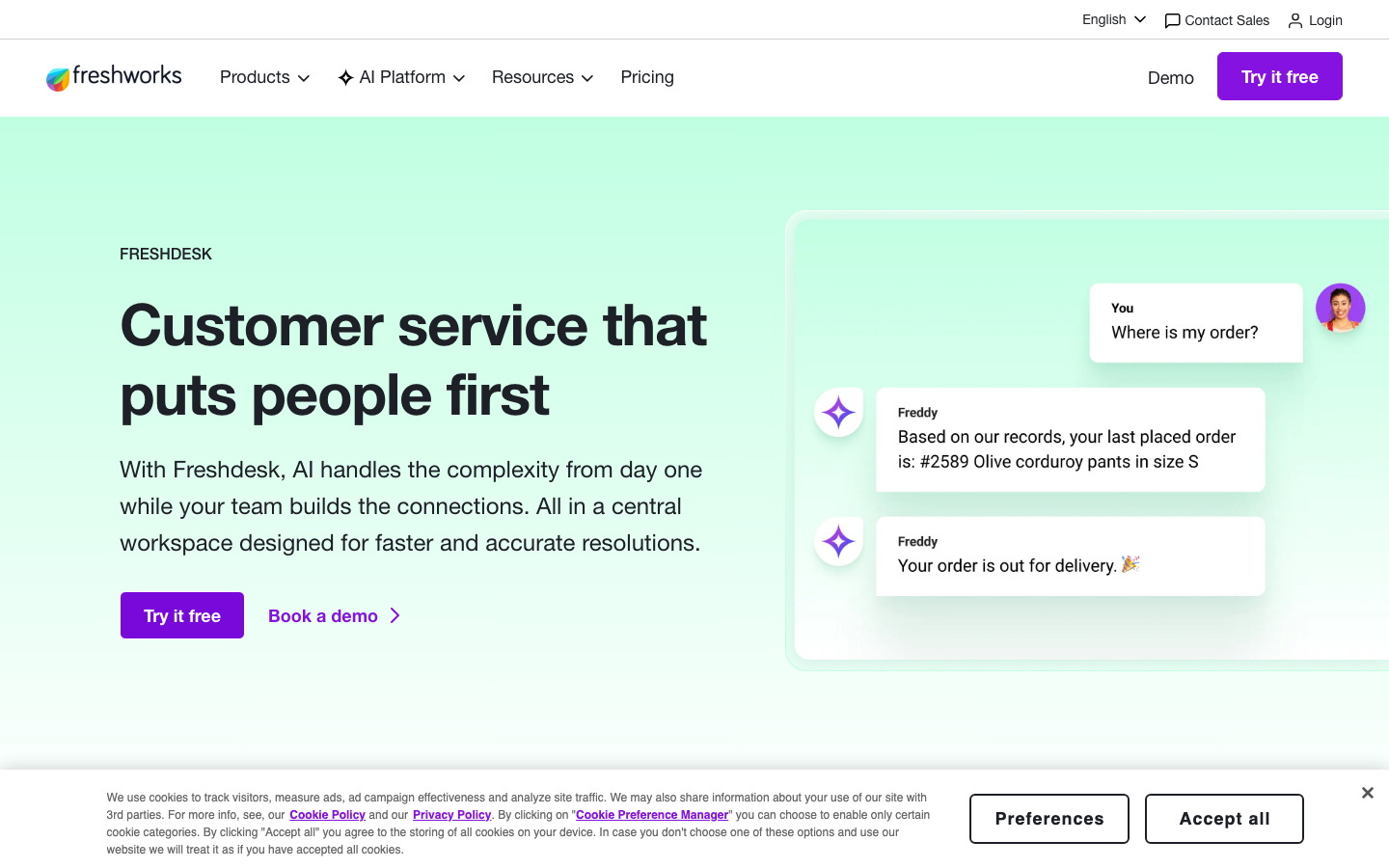
Freshdesk AI (formerly Freshdesk) is an AI customer service work order platform owned by Freshworks. It uses AI to automatically classify work orders, generate response suggestions, automatically assign customer service tasks, and supports omni-channel customer service such as email, chat, phone, and social media. Known for its "high cost performance + rapid deployment", it serves more than 60,000 enterprise customers worldwide.
FreshdeskAI
Core parameters and statistics of Freshdesk AI
Freshdesk AI is an AI-driven customer service work order platform owned by Freshworks. The core product is positioned as an "AI-first customer service platform" and it embeds artificial intelligence capabilities into the work order life cycle through the Freddy AI brand. It forms a direct cost-effective competition with Zendesk in the global customer service market, with "omni-channel inbox + AI automation + rapid deployment" as the triangular capability pillar.
| Parameter dimensions | Description |
|---|---|
| Positioning | AI-first customer service ticket platform, Freshworks core product line |
| Support Channels | Email, Live Chat, Phone Facebook, Twitter, WhatsApp, LINE, Instagram |
| AI Brand | Freddy AI (automatic classification, reply suggestions, summary generation, sentiment analysis AI Agent) |
| Work order management | Unified inbox SLA management, automatic assignment, work order merge/split CSAT investigation |
| Knowledge Base | Built-in knowledge base, supports multi-language and SEO public indexing |
| Automation | Dispatcher rule engine, automated work order rules SLA upgrade rules |
| Market coverage | 60,000+ corporate customers worldwide, distributed in 100+ countries |
| Integration Ecosystem | 1000+ third-party integrations (Salesforce, Shopify, Slack, Jira, etc.) |
| Supported languages | 30+ language interfaces and work order content |
| Security Certification | SOC 2 Type II, GDPR Compliant ISO 27001 |
| Deployment method | Mainly cloud SaaS, Enterprise version supports private cloud option |
Efficiency Benchmark: Freddy AI’s work order automatic classification accuracy is officially claimed to be between 85-95%, depending on the quality of the training data and the richness of the work order type. The combination of automatic classification + automatic allocation reduces the "pre-processing" workload when the work order reaches customer service by about 60-70%. This means that when the customer service opens the ticket, they already know the problem type, customer level and processing priority, instead of reading and understanding it from scratch.
Scale Boundary: The Free version is limited to 10 seats and is suitable for evaluation; the Growth version has no limit on seats. However, when the customer service team exceeds 200 people, the maintenance cost of the Dispatcher rule engine and the flexibility of report customization may become a bottleneck. At this time, the Enterprise version of Freshdesk or the Suite version of Zendesk are more worthy of evaluation.
Users and market recognition of Freshdesk AI
Freshdesk has a clear positioning in the customer service work order market - "80% of Zendesk's functions at 50% of the price". This strategy has allowed it to gain wide penetration in the small and medium-sized enterprise market, and at the same time it is trying to cover the needs of medium-sized enterprises through AI capability upgrades.
Customer base: More than 60,000 corporate customers around the world, covering e-commerce SaaS, education, medical, finance and other industries. The penetration rate of the Asia-Pacific market is particularly outstanding, which is directly related to the genes of its Indian founding team and its early channel construction in the Asia-Pacific. In the North American and European markets, Freshdesk's growth relies more on "migrate from Zendesk" replacement demand than on the green field niche.
Listing Endorsement: Parent company Freshworks listed on Nasdaq in 2021 (ticker FRSH) with an IPO valuation of more than $10 billion. Post-IPO financial disclosures indicate that Freshdesk remains the single product line that contributes the most to its revenue. However, the public financial report does not separately separate Freshdesk's AI function adoption rate and ARPU improvement contribution, so Freddy AI's revenue-boosting effect lacks direct verifiable data.
Industry evaluation: In the Gartner Magic Quadrant for Customer Service, it is always in the Challenger or Niche Player quadrant, but has not entered the Leaders quadrant. It has good ratings on G2 and Capterra. Users generally agree that it is "highly cost-effective" and "quick to get started". Negative comments focus on "insufficient flexibility in advanced customization" and "insufficient depth of large enterprise-level functions". This evaluation distribution is highly consistent with its target customer group - small and medium-sized enterprises are highly satisfied, while large enterprises have a gap.
Competitive Benchmarking: Comparison with Zendesk is a key reference in understanding Freshdesk’s market position. Zendesk still has generational advantages in complex routing rules, enterprise-level audit logs, and global multi-data center deployment; Freshdesk has advantages in price, localization (especially in the Asia-Pacific market), and deployment speed. The comparison with Intercom is in a different direction - Intercom prefers conversational customer service and proactive marketing, while Freshdesk prefers work order management and process automation. The two overlap in functionality but have different starting points.
Cost Advantages of Freshdesk AI
Freshdesk's cost advantage is not only reflected in its absolute price being lower than Zendesk, but also in its gradient design between the free version and the paid version - teams can verify whether the work order management process matches their needs without paying, and then decide whether to upgrade.
C-side/individual and micro-team: The Free version is permanently free, with up to 10 customer service seats, including basic work order management and email + chat channels, but includes Freshdesk brand watermark, no AI function, and no phone channel. For micro customer service teams of 1-3 people, the Free version can be used as a pure work order management tool, but it is not enough in scenarios with high reliance on AI. The hidden cost is that you must pay when the team size exceeds 10 seats, and the configuration and data accumulated in the free version can be retained after upgrading, but cannot be downgraded.
SMB & Medium Teams: Growth Edition $18/person/month (paid annually), includes automatic allocation SLA management, knowledge base and marketing automation integration. AI assistance is limited to basic automatic classification, and deep AI functions need to be upgraded to the Pro version. The Pro version is $59/person/month (paid annually) and is the starting point for most teams that require AI capabilities - including Freddy AI automatic classification and response suggestions, phone channels, and custom reports. The premium from Growth to Pro is $41/person/month. The core difference lies in the AI functionality and phone channels. The team needs to evaluate whether the efficiency improvements brought by AI cover this increase.
Enterprise and Compliance Sensitive Scenarios: The Enterprise version is $95/person/month (annual payment), including complete Freddy AI capabilities (including custom ML model training), advanced security compliance (HIPAA, data residency), and dedicated account manager. Suitable for highly regulated industries such as finance and medical care. Private cloud deployment and customization SLA terms are subject to commercial negotiation and are not included in public pricing.
API/Developer Layer: Freshdesk provides RESTful API, which is included in all paid versions, but the frequency of API calls is limited by version (the Growth version is lower and the Enterprise version is the highest). There is no standalone API-only pricing package, unlike API-only customer service products. For teams that require deep integration, they need to confirm whether the API frequency control upper limit of the target version meets the needs.
Quantitative analysis of comparison with competing products: At the same functional level, the price of Freshdesk Pro ($59/person/month) is about 66% of Zendesk Suite Growth ($89/person/month) and about 55-60% of Intercom’s similar functional packages. This pricing gap is Freshdesk's core weapon in price-sensitive markets (Asia-Pacific, Latin America, Eastern Europe), but it also reflects the gap in its brand premium capabilities and enterprise-level functional depth. Actual TCO (Total Cost of Ownership) also needs to consider: migration costs, customer service training time, integration development effort - these hidden costs are different for each team and are recommended to be evaluated during the trial period.
Freshdesk AI Key Features
Freshdesk AI's functional system is designed around the core logic of "allowing work orders to be pre-processed before being seen by customer service". AI capabilities are injected into six key nodes through the Freddy AI brand:
-
Freddy AI automatic work order classification: Automatically identify the intent (return, complaint, technical issue, consultation) when a work order arrives and label it. It supports a custom classification system, and new users can use industry pre-training templates (e-commerce SaaS, finance, etc.) or build it from scratch. Applicable Boundary: The classification accuracy is highly dependent on the representativeness of the training samples - if the type of work order is unconventional (such as a new product line just launched, seasonal emergencies), the initial accuracy may drop to 60-70%, and it will take about 200-500 samples to be manually labeled before it can rise back to above 85%.
-
AI Reply Suggestions: Generate reply snippets or complete drafts based on the knowledge base and past solved tickets. Customer service can accept, edit and send or ignore with one click. Mechanism: The system gives priority to matching historically resolved work orders with the same category as the current work order and similar customer levels, and extracts their response patterns. After continuous use, the behavior data return model of customer service acceptance/rejection gradually converges to the team's preferred response style.
-
Dispatcher Intelligent Distribution of Work Orders: Automatically allocate work orders based on multi-dimensional rules such as skill groups, load balancing, customer levels, working hours, languages, etc. Supports fallback chain - "If the first acceptance group does not respond within N minutes, it will automatically be upgraded to the second group." Value: The three-step process of "manual dispatch-inspection-redispatch" is compressed into zero steps, and the distribution records are automatically entered into the audit log.
-
AI work order summary: Automatically generate structured summaries for complex work orders with multiple rounds of exchanges (especially email threads and cross-customer service handover scenarios) - problem background, attempted solution steps, current status, and recommended next steps. Applicable scenarios: Relay customer service teams (such as day shift/night shift handover, first line/second line upgrade) to reduce information loss.
-
Customer Sentiment Analysis: Analyze the emotional tendencies (anger, anxiety, satisfaction, neutral) in customer messages, and highlight "high-risk" work orders in the work order list. Data Utilization Method: Sentiment scores flow with work orders, and Dispatcher can be configured to "automatically upgrade to senior customer service when the sentiment score is below the threshold" instead of just marking prompts.
-
Omni-channel unified inbox: Email, chat, phone calls, and social media messages are merged into the same interface. Actual benefits: When customer service receives a message on any channel, the context is complete—the conversation history will not be lost due to channel switching.
[Hidden linkage]: Automatic classification → Dispatcher distribution → Sentiment analysis constitutes a complete event-driven package. Take the e-commerce scenario as an example: the system detects a work order from a VIP customer, contains the keywords "refund" and "complaint", and is marked as "angry" by sentiment analysis → automatically labels it with "refund-high priority-VIP" → assigns it to the most experienced after-sales customer service group → displays an emotional history summary at the top of the work order "This customer has sent 3 emails and has not received a satisfactory reply, and the mood continues to escalate." When customer service opens a work order, the risk assessment information required for decision-making is fully presented, and there is no need to start from scratch to troubleshoot the context.
Freshdesk AI model and version evolution
The evolution of Freshdesk's AI capabilities has gone through four stages: "Rules Engine → Traditional ML → Deep Learning → AI Agent". This evolution route is the key to understanding its current capability boundaries and subsequent iteration directions.
Shadow 2.0 (2021.06): Introducing the collaborative customer service mode (Shadow Agent) to support internal collaborative discussions and work order sharing. The AI capabilities in this version are not yet complete, but the infrastructure for a unified inbox and automation rules engine is established—the data and process foundation for all subsequent AI capabilities.
Mint 2.0 (2023.01): The UI has been fully upgraded to the Mint design language, and the rule engine has been expanded from simple if-then to support multi-condition combinations (AND/OR/NOT) and timing triggers (such as "automatic upgrade if the work order is not responded to within 4 hours"). The engineering significance of this version is that it provides a structured rule framework as a baseline for subsequent ML models. AI's "automatic classification" is a supplement to the existing rule engine rather than a replacement.
Freddy AI 1.0 (2024.02): Freshworks launches the unified AI brand Freddy AI for the first time, which implements automatic work order classification (based on the preset classification system) and knowledge base recommendation in Freshdesk. The initial model uses traditional ML classifiers (such as SVM and random forest), and the accuracy is limited by the amount of training data - companies need to manually label at least 100-200 samples to achieve the available 70-80% accuracy, and the cold start phase experience is average.
Freddy AI 2.0 (2025.04): Upgraded from traditional ML to a deep learning intent recognition model based on Transformer architecture, introducing sentiment analysis and automatic reply suggestions. The key changes are: (1) The industry pre-training model increases the cold start accuracy to 80-85%, and the minimum number of annotations is reduced to about 50; (2) The adoption rate data of customer service feedback is formed, and the relevance of reply suggestions is continuously optimized; (3) Sentiment analysis is upgraded from simple keyword matching to context-aware semantic analysis.
AI Agent Platform (2026.06): The latest version, Freddy AI has been upgraded from an auxiliary tool to an independent AI Agent capability - it can handle simple work orders (such as password reset, order status query, return and exchange application entry) independently without manual intervention. Sentiment analysis dashboard and AI ticket summary are also added. This release aligns Freshdesk’s AI capabilities with those of Zendesk Answer Bot V3 and Intercom Fin, but still falls short of specialized AI agent platforms such as Sierra or Forethought on the complexity and safety margins of autonomous processing of tickets.
Technical Advantages of Freshdesk AI
The technical advantage of Freshdesk AI lies not in the performance of a single AI model, but in the way it embeds AI capabilities into the work order process - allowing AI to make "small decisions" on multiple nodes where work orders flow, rather than making "big decisions" on one node.
Industrial pre-training + small sample fine-tuning: Freshworks has pre-trained intent recognition and sentiment analysis models for common industries such as e-commerce SaaS, finance, and education. Mechanism → Effect: Industry pre-training allows new users to obtain about 80-85% classification accuracy out of the box without labeling a large number of samples. For enterprises that require higher accuracy, they can fine-tune with their own data through few-shot learning. After about 200-500 labeled samples, the accuracy can be increased to 90-95%. Applicable Boundary: For highly vertical industries (such as medical equipment after-sales, industrial IoT support), the coverage of industry pre-trained models is insufficient, and the cold start accuracy may be lower than 70%, requiring more customized annotation investment.
Collaboration with Freshworks product matrix: Freshdesk shares the customer data layer with Freshsales (CRM), Freshservice (ITSM), and Freshteam (HR) in the same ecosystem. Effect: When handling a work order, customer service can see the customer's transaction records in CRM and historical support requests in ITSM, forming a 360-degree view. Prerequisite: This advantage is only valid when customers use multiple Freshworks products at the same time; if only Freshdesk single product is used, there is no such synergistic effect. For teams already using Freshsales or Freshservice, this integration is a strong plus when switching to Freshdesk.
Engineering maturity of Dispatcher rule engine: Automatic allocation supports multi-dimensional condition combinations such as skill groups, languages, regions, customer levels, current loads, working hours, etc., and can set multi-level fallback policies (such as "If the first group is not accepted within 15 minutes, it will automatically be transferred to the second group"). Effects: Large customer service teams (50-200 people) can realize that each work order automatically reaches the correct customer service within 30 seconds, and the allocation accuracy is about 90-95% (depending on the granularity of the rule configuration). Engineering cost: The more detailed the rules, the greater the initial configuration workload, and the rule set needs to be continuously maintained after personnel changes, otherwise there will be a dead letter scenario of "no one can be found to handle the work order".
Architectural limitations: Freshdesk's AI inference tasks run on Freshworks' cloud infrastructure. For Enterprise version customers, the data resides in designated regions (such as the US West, EU, Singapore), but whether AI model inference is also performed in the same region - which will affect latency and data outbound compliance - needs to be confirmed in the contract.
How to use Freshdesk AI
Freshdesk provides four access methods: Web, mobile, browser plug-in and API. The deployment path is mainly cloud SaaS. The Enterprise version supports private cloud options:
| How to use | Suitable for scenarios | Features |
|---|---|---|
| Web application (domain.freshdesk.com) | Daily work order management, system configuration, report viewing | Full-featured portal, administrators and customer service can access through browsers |
| Mobile App (iOS/Android) | Work order processing in out-of-office or on-duty scenarios | Push notifications, quick replies, work order status changes |
| Browser plug-in (Gmail/Outlook) | Convert emails to work orders in real time | Bridge the customer service personal mailbox with the work order system without switching interfaces |
| RESTful API | Deep integration, automated processes | Programmed reading and writing of work orders, configuration rules, synchronization of third-party systems |
Typical getting started path (6 steps to complete): (1) Register a Freshdesk account (starting with the Free version); (2) Configure email channels (bind customer service email domain name, set automatic forwarding rules); (3) Embed chat components on the website or configure social media channel access; (4) Set Dispatcher automatic allocation rules (by skill group and load balancing); (5) Configure Freddy AI - select industry templates, preset classification systems, and enable automatic reply suggestions; (6) Invite team members and assign roles (Admin/Agent/Report Viewer).
Deployment cadence recommendations: The first week focuses on email channel access and automatic assignment rule verification, the second week expands to chat and social media channels, and the third week turns on Freddy AI’s automatic classification and reply suggestions. The accuracy of AI functions is usually low in the first week (the model requires sample accumulation). It is recommended to arrange 1-2 customer service personnel to review the AI classification results and correct deviations in the first week to accelerate model convergence.
Product Pricing for Freshdesk AI
Freshdesk adopts a four-tier pricing structure of "freemium + tiered subscription". AI functions are mainly concentrated in the Pro and Enterprise versions, and the Growth version only includes limited AI assistance:
Free version ($0): Free forever, up to 10 customer service seats, basic work order management, email + chat channels, Freshdesk brand watermark. No AI features, no phone channels, no SLA management. It is suitable for micro-teams of 1-3 people for work order management evaluation, but cannot be used in AI-dependent scenarios for a long time.
Growth version ($18/person/month, paid annually): Unlimited seats, including automatic allocation of SLA management and knowledge base Marketplace integration. AI assistance is limited to basic automatic classification (rules-driven, not ML-driven), and call channels are available at an additional cost. Key Missing: No AI reply suggestions, no sentiment analysis, no AI ticket summary. Suitable for teams that have established a basic ticket process but don’t need deep AI for the time being.
Pro version ($59/person/month, paid annually): Based on Growth, it adds Freddy AI automatic classification (ML driven) and response suggestions, phone channels, custom reports, and multi-product integration. This is the entry-level version of Freddy AI capabilities - Automatic classification and reply suggestions have measurable efficiency improvements for high-frequency ticket scenarios, but custom model training and sentiment analysis still require the Enterprise version.
Enterprise version ($95/person/month, paid annually): Includes complete Freddy AI capabilities (including custom ML model training, sentiment analysis AI Agent), advanced security compliance (HIPAA, data residency, enterprise audit logs), and dedicated account manager. Suitable for finance, medical, government and other scenarios.
Annual payment vs monthly payment: Annual payment usually saves 15-20% than monthly payment, but the lock-in period is longer. It is recommended to use the monthly payment trial for 2-3 months to confirm the product compatibility before switching to annual payment. All pricing is based on the latest official Freshdesk pricing page and business contract. Public prices may be adjusted with version updates.
Hidden Cost: Whether the actual consumption of AI functions (such as the number of calls for AI reply suggestions) is limited by the Fair Use policy needs to be confirmed in the Enterprise version contract. In addition, the cost of data migration tools and data cleaning when migrating from Zendesk or other platforms is not officially included in the subscription fee.
Application scenarios of Freshdesk AI
The applicable scenarios of Freshdesk AI focus on "high-frequency, standardizable, customer service processes that require multi-person collaboration", in which AI plays the role of "pre-processing + diversion + assistance" rather than completely replacing manual labor.
-
Daily management of e-commerce customer service and response to major sales: Frequent repetitive work orders such as order inquiries, return and exchange applications, logistics tracking, etc. are automatically classified by Freddy AI and simple work orders (such as logistics status inquiries) are directly processed by AI Agent, and complex work orders are transferred to manual work. Quantitative revenue deduction: Taking an e-commerce team with an average of 500 work orders per day as an example, about 40-50% of the simple query-type work orders can be directly processed by the AI Agent, and the remaining 50-60% are transferred manually. AI preprocessing reduces manual processing time from an average of 8 minutes/photo to 4-5 minutes/photo (customer service does not need to read the context from scratch). During major promotions (Black Friday/Double Eleven), the volume of work orders may surge 3-5 times, and the marginal cost of AI is almost zero, which can avoid the one-time training and salary costs of temporarily expanding the customer service team. Note: The data here are deductions based on product capabilities and characteristics, and are not official promised actual results.
-
Technical support triage for SaaS products: After the customer submits a technical support request, AI will automatically classify the problem according to the type of problem (bug/function request/usage consultation/account problem) and urgency, and assign it to the corresponding technical support group. Key Acceptance Metric: First Assignment Accuracy. In a typical manual triage scenario, the first allocation accuracy is about 70-75% (because the allocator is not familiar with product details or the work order description is vague). AI's industry pre-training model can increase this to 85-90%, reducing the delay of "the work order is assigned to the wrong one and needs to be dispatched twice". The accuracy rate is subject to actual deployment data and model fine-tuning effects.
-
Financial Services Customer Consultation (Compliance Sensitive Scenario): The Enterprise version supports data residency and HIPAA compliance. AI-assisted customer service generates responses but all responses require manual confirmation before being sent. Human-machine collaboration boundary: (1) AI reply suggestions only generate drafts, which must be confirmed by customer service before sending; (2) Audit logs of all AI-assisted operations are completely retained; (3) Operations involving account transfers, personal information modifications, etc. are only marked by AI as requiring manual processing and do not act autonomously. Benefits: Increase customer service efficiency by 30-50% within a compliance framework while retaining a complete audit trail chain.
-
Multi-language international customer service team: Freshdesk supports 30+ language interfaces, and Freddy AI’s multi-language intent recognition capabilities make it suitable for global customer service teams. The localization experience for users in the Asia-Pacific region is better than that of most European and American competitors - the accuracy of work order classification in Chinese, Japanese, and Korean is listed as "good or above" in official documents, but there is no public benchmark for comparison.
-
Unsuitable Scenarios: (1) Extremely complex customer service for large enterprises with multiple product lines and brands - Zendesk still has the upper hand in the flexibility of complex routing and customized reports; (2) Customer service centers that use phone calls as the main channel - Freshdesk's phone function is an add-on module and is not as deep as professional CCaaS (Contact Center as a Service) solutions such as Genesys or Five9; (3) Scenarios that require highly customized AI models - although Enterprise Version supports custom model training, but its flexibility and iteration speed are not as good as specialized AI platforms such as Forethought or Observe AI.
Applicable groups of Freshdesk AI
-
Small and medium-sized enterprise customer service team (5-100 people): Freshdesk's core user group - reasonable price, sufficient functions, and fast online speed. Prerequisites: The main customer service channels are email and chat, supplemented by phone calls; there are clear service level (SLA) requirements; the team has basic rule configuration capabilities (no development background is required). Value verification method: First run the Free version for 2 weeks, confirm that the basic work order management process meets the needs, and then upgrade to the Growth version.
-
E-commerce Operations and Customer Service Team: There is a strong demand for automatic classification and AI responses in high-frequency work order scenarios. Freddy AI can significantly relieve customer service pressure during the big sales season. Prerequisites: Use mainstream e-commerce platforms such as Shopify, Magento, and WooCommerce - Freshdesk provides in-depth integration that can automatically pull order information and logistics status into the work order context. Not recommended: If the e-commerce company mainly provides telephone consultation (such as some high-priced brands), Freshdesk's telephone capabilities may not be sufficient.
-
International and multilingual customer service team: The team is distributed in multiple time zones and uses multiple languages to serve customers. Freshdesk’s 30+ language support and global deployment options make it a good fit. Precondition: The handover process for each time zone has been configured in the rules engine, otherwise the work order will have a "no response" window period when it crosses time zones.
-
Teams considering migrating from Zendesk: Teams who are dissatisfied with Zendesk's price increase, or find Zendesk's complex features unavailable. Requirements: Teams have been running Zendesk for over 1 year and know exactly which features they use and which they don’t. Must do before migration: Make a list of Zendesk's heavily used functions and compare them with Freshdesk Pro/Enterprise one by one - especially API usage, custom reports, and integration ecological coverage. If you rely heavily on Zendesk's Explore reports and complex automation triggers, the gap after migration may be larger.
-
Not suitable for the crowd: (1) Large organizations that require deep enterprise-level functions (200+ customer service seats, multiple brands and multiple product lines) - Freshdesk still has a gap at the enterprise level; (2) Micro teams with completely zero budget (1-2 people) - Free version has limited functions and no AI, pure work order management can choose lighter solutions such as Help Scout or Tally; (3) Teams that mainly rely on AI Agent autonomous processing and manual supplementation - Freshdesk's AI Agent Still in its early stages and not as mature as a dedicated AI customer service platform.
Summary and Outlook of Freshdesk AI
Freshdesk AI's core competency lies in "embedding AI capabilities into a mature work order platform, providing products covering 80% of core functions at a price that is approximately 35-40% lower than Zendesk." The continuous iteration of Freddy AI (from rules engine to ML classification to Transformer model to AI Agent) shows that Freshworks regards AI as the core direction of competitive differentiation.
Current advantages: (1) Clear cost-effectiveness - In the small and medium-sized enterprise market, Freshdesk Pro's AI capabilities are sufficient for most scenarios, and the price is significantly lower than Zendesk and Intercom; (2) Fast deployment - The SaaS version can be registered and used without infrastructure investment, and the Free version can be verified at zero cost; (3) Freshworks ecological collaboration - For teams that have already used Freshsales/Freshservice, the integration advantages cannot be ignored.
Main limitations: (1) The full version of the AI function requires the Pro ($59/person/month) or Enterprise version, which raises the actual implementation cost from Free/Growth to the mid-range SaaS level; (2) Deep integration with other Freshworks products is a double-edged sword - it is only valuable when customers use multiple Freshworks products at the same time, and users of a single product cannot enjoy this advantage; (3) It still lags behind in complex routing rules, enterprise-level auditing, and the depth of customized reports Zendesk, large enterprises need to confirm capability coverage item by item before purchasing; (4) The autonomous processing capabilities of AI Agent are in the early stages, and the reliability and security boundaries of complex scenarios are not as good as that of a dedicated AI customer service platform.
Procurement/Adoption Risk Assessment: It is recommended to proceed in "three steps" - (1) The Free version verifies whether the basic process of work order management matches, the cycle is 2-4 weeks; (2) Upgrade the Growth version to run the basic automation and allocation rules, and evaluate the flexibility of rule configuration and maintenance costs, the cycle is 4-8 weeks; (3) If AI capabilities are strictly needed, upgrade to the Pro version and set clear acceptance indicators - such as "AI automatic classification accuracy ≥ 90%", "AI Response recommendation adoption rate ≥ 40%" - only if these indicators are met, the additional cost of AI will be justified. For teams migrating from Zendesk, it is recommended to run in parallel for 1-2 months to confirm that there is no gap in core functions before making a final decision. In terms of contracts, monthly payment for a trial period of 2-3 months is worth the "insurance", while annual payment locks in the price but reduces flexibility.
Related tools:  Notion AI, google-workspace
Version Info
- Freshdesk AI Agent Platform :Unify the AI capability platform, integrate Freddy AI (automatic reply/classification/summary) and Freshdesk work order engine, and add AI Agent to independently process work order mode and customer sentiment analysis dashboard.
- Freshdesk Freddy AI 2.0 :Freddy AI has a major update, upgrading from rule-driven automatic classification to ML model intent recognition and sentiment analysis, and adding automatic reply suggestions.
- Freshdesk Freddy AI 1.0 :Freshworks launches its unified AI brand Freddy AI for the first time, integrating automatic work order classification and knowledge base recommendation functions in Freshdesk.
- Freshdesk Mint 2.0 :Comprehensive UI upgrade (Mint design language), enhanced automated work order rules and multi-channel unified inbox.
- Freshdesk Shadow 2.0 :Introducing collaboration functionality (Shadow Agent mode), adding WhatsApp and LINE channel integration.
User Reviews