 FunASR
Free
FunASR
Free
FunASR is an open source industrial-grade speech recognition toolkit from Alibaba Tongyi Lab. It integrates ASR, VAD, punctuation recovery, speaker separation, emotion detection and audio event recognition. It provides a unified Python interface and OpenAI compatible API, supports 340x real-time rate inference in 50+ languages, and can be fully privatized for deployment.
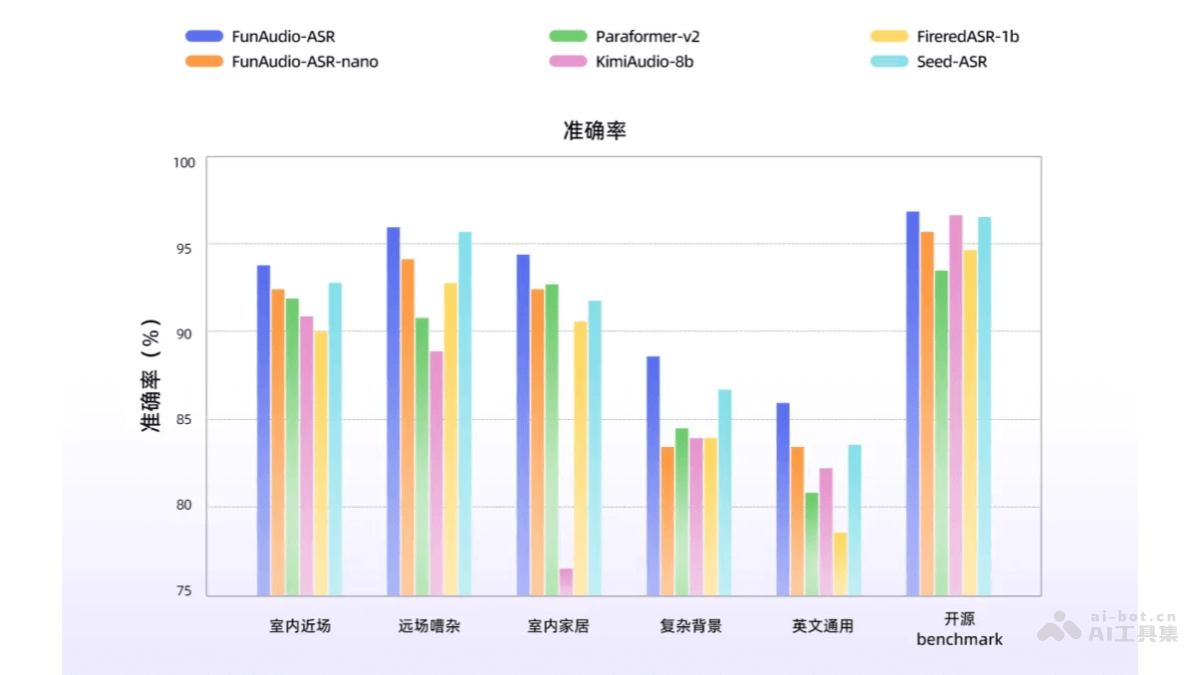
FunASR: Alibaba Tongyi Lab’s open source industrial-grade speech recognition toolkit
Core parameters and statistics of FunASR
| Project | Details |
|---|---|
| Product Name | FunASR (Fun Audio Speech Recognition) |
| Product Type | Open Source Speech Recognition Toolkit |
| Delivery Form | Python SDK / CLI / OpenAI Compatible API Server / Docker / llama.cpp Edge Deployment |
| Supported languages | 50+ languages (Fun-ASR-Nano supports Chinese/English/Japanese and Chinese dialects; MLT-Nano supports 31 languages; Qwen3-ASR supports 52 languages) |
| Model size | 0.4M (fsmn-vad) ~ 1.7B (Qwen3-ASR) |
| GitHub Stars | 19.3k |
| Open source agreement | MIT (toolkit); model weights are licensed according to respective agreements |
| Target users | Developers, enterprise AI teams, voice product integrators |
FunASR is not a single SaaS product, but a complete open source speech understanding tool chain. It provides an "end-to-end pipeline" from raw audio to structured text - VAD segmentation ASR recognition, punctuation recovery, speaker separation, emotion detection, audio event recognition - all through a single line of AutoModel API calls. Developers can deploy independently locally, intranet or in the cloud without sending audio data to third-party API services.
Key quantitative indicators: Fun-ASR-Nano + vLLM inference can reach 340x real-time rate (RTF), SenseVoiceSmall can reach 17x real-time rate on CPU, and CER is as low as 7.81%-8.20%, which are both better than Whisper-large-v3's 20% CER and 13x real-time rate.
Users and market recognition of FunASR
- GitHub 19.3k Stars, 178 contributors, 25 official Releases, is one of the most active open source ASR toolkits on GitHub.
- PyPI monthly downloads continue to grow, and the
funasrpackage has become one of the core dependencies of the Python ASR ecosystem. - Enterprise Adoption: Integrated as a voice input module by mainstream AI frameworks such as RAGFlow, Dify, LangChain, and AutoGen; the community has accumulated more than 30 integration projects.
- Industry Benchmarking: In the Chinese ASR scenario, FunASR's CER and real-time rate are comprehensively ahead of the Whisper series (the Chinese word error rate is about 60% lower, and the CPU inference speed is 10-20 times higher), and it supports speaker separation, emotion detection and other capabilities that Whisper does not have.
Cost Advantages of FunASR
| Cost Dimension | Description |
|---|---|
| Open source and free | Core toolkit MIT license, no license fees, no API call fees |
| Private deployment | Can be run completely offline on the intranet/single machine, with zero risk of data leakage and no pressure on pay-as-you-go billing |
| Hardware threshold | SenseVoiceSmall can achieve 17x real-time rate on CPU without GPU; Fun-ASR-Nano recommends 8GB+ GPU |
| Compare Whisper API | Cloud ASR service is about $0.006/minute; FunASR self-construction cost is only hardware depreciation and electricity, which can save 90%+ in high-frequency scenarios |
Comparative Analysis: For a mid-to-high-frequency scenario that processes 1,000 hours of audio per day, the monthly fee for using cloud ASR is about $10,800+, while the self-built deployment of FunASR requires only one-time hardware investment (a server with a GPU costs about $3,000-$8,000), and the subsequent marginal cost is close to zero. For privacy-sensitive scenarios (medical, financial, legal), the value of privatized deployment cannot be measured by price.
Main functions of FunASR
- Multi-model ASR recognition: Integrate Fun-ASR-Nano (Chinese/English/Japanese + dialect), SenseVoiceSmall (5 languages + emotions + events), Paraformer (streaming/offline), Qwen3-ASR (52 languages), Whisper, etc., and switch models with the same API.
- Voice Activity Detection (VAD): millisecond-level fsmn-vad, adaptive silence threshold, automatic segmentation of long audio.
- Punctuation recovery and inverse text regularization:
ct-puncmodel automatically adds punctuation and outputs canonical text that can be read directly. - Speaker Diarization: The CAM++ model automatically annotates "who said what at what time" and supports multi-person meetings.
- Emotion Detection and Audio Event Recognition: SenseVoice has built-in emotion recognition (happy/sad/angry/neutral) and event detection (applause/laughter/music/crying).
- OpenAI compatible API service: One-line command
funasr-serverstarts the RESTful service. The SDK is compatible with OpenAI Audio API and directly connects to LangChain/Dify/AutoGen. - MCP Server for AI Agents: Agents such as Claude/Cursor can directly call local ASR capabilities.
- Edge Deployment (llama.cpp/GGUF): No Python context required, single binary runs on CPU/edge device, supports Windows CUDA.
FunASR model and version evolution
The FunASR project started in 2022 and was originally released by Alibaba Damo Academy as an end-to-end speech recognition toolkit (INTERSPEECH 2023 paper). 2025-2026 will enter a rapid iteration period:
| Version | Date | Core Changes |
|---|---|---|
| v1.3.19 | 2026-07-19 | WebSocket long session troubleshooting documentation; CLI SRT segmented subtitles improvements |
| v1.3.16 | 2026-07-18 | client-driven real-time endpoint; llama.cpp Windows CUDA package |
| v1.3.12 | 2026-06-21 | Qwen3-ASR / GLM-ASR fix |
| v1.3.3 | 2026-05-24 | funasr-server CLI, OpenAI API, MCP Server, Dynamic VAD |
| v1.3.0 | 2026-05-20 | Qwen3-ASR (52 languages), GLM-ASR-Nano (17 languages) supported |
| v1.2.x | 2025-2026 | Fun-ASR-Nano, vLLM inference engine llama.cpp edge runtime |
| v1.0 | 2024 | First stable version, Paraformer/SenseVoice integration |
| v0.x | 2022-2023 | Initial version, basic ASR and training framework |
Technical advantages of FunASR
Toolkit instead of single model: Unlike single-model solutions such as Whisper, FunASR is a "model supermarket" - there is a dedicated model for each sub-task (VAD, ASR, punctuation, speaker separation, emotion) and can be freely combined. For example, the production pipeline SenseVoice + fsmn-vad + ct-punc + cam++ completes all processing in one call.
Inference efficiency suppression:
- Fun-ASR-Nano + vLLM: 340x real-time rate (26x faster than Whisper-large-v3), CER 8.20%
- SenseVoiceSmall: 17x real-time on CPU (faster than Whisper on GPU), CER 7.81%
- Non-autoregressive architecture (Paraformer): extremely low first word delay in streaming scenarios, supports WebSocket real-time recognition
Deployment Flexibility: Covers the full spectrum from "pip install" to Docker/Kubernetes containerization to llama.cpp single binary CPU/edge deployment. funasr-server provides OpenAI compatible API. Applications with existing SDK only need to change base_url to switch.
Agent native support: Built-in MCP Server and OpenAI API, AI Agent frameworks such as Claude Desktop, Cursor, LangChain, Dify, AutoGen, etc. can directly integrate voice capabilities to realize voice-driven automated workflow.
How to use FunASR
| Entrance | Description |
|---|---|
| Python SDK | pip install funasr, AutoModel one line call |
| CLI | funasr audio.wav direct transcription, supports JSON/SRT/TSV output |
| API Server | funasr-server --device cuda starts the OpenAI compatible endpoint |
| Docker | Offline/streaming Docker image, one-line startup |
| llama.cpp | Single binary CPU/edge deployment, no Python runtime required |
Python Quick Start:
from funasr import AutoModel

model = AutoModel(model="sensevoice", vad_model="fsmn-vad",
                  punc_model="ct-punc", spk_model="cam++", device="cuda")
result = model.generate(input="meeting.wav", batch_size_s=300)
for seg in result[0]["sentence_info"]:
    print(f"[{seg['start']/1000:.1f}s] Speaker {seg['spk']}: {seg['text']}")
Start API service:
pip install funasr vllm fastapi uvicorn python-multipart
funasr-server --device cuda --port 8899
# call
curl -X POST http://localhost:8899/v1/audio/transcriptions \
  -F "[email protected]" -F "model=fun-asr-nano" -F "response_format=verbose_json"
MCP Mount (Claude Desktop):
{
  "mcpServers": {
    "funasr": {
      "command": "funasr-server",
      "args": ["--mcp", "--port", "8899"]
    }
  }
}
Product Pricing for FunASR
The FunASR core toolkit adopts the MIT open source license and is completely free, with no hidden charges, no limit on the number of calls, and no functional emasculation. Enterprises can carry out secondary development and commercial integration based on the source code without paying licensing fees.
The model weights adopt an independent licensing agreement. Most models (SenseVoice, Paraformer, fsmn-vad, ct-punc, cam++, emotion2vec) can be commercially used for free. The details are subject to the license of each model card.
Hidden Cost Assessment:
- GPU server hardware cost (8GB+ VRAM recommended for Fun-ASR-Nano; SenseVoiceSmall available for CPU)
- Operation and maintenance costs (Docker/K8s deployment and maintenance)
- If you use vLLM acceleration, you need to install additional vLLM dependencies
Compared with commercial cloud ASR (such as Alibaba Cloud speech recognition Azure Speech, Whisper API), in the scenario of processing an average of 100 hours of audio per day, FunASR's self-built deployment can recover the hardware cost within 3-6 months.
Application scenarios of FunASR
- Meeting Records and Intelligent Minutes: Automatically convert corporate meeting audio into structured text with speaker tags, and integrate the RAG knowledge base to implement "voice question and answer". Compared with manual transcription, the efficiency is increased by 10-20 times.
- Video subtitles and content production: Supports SRT/TSV subtitle export, processing speed 170-340x real-time rate. When new media operations batch process video corpus, the transcription can be completed in about 10-20 seconds for a one-hour video.
- Customer service quality inspection and emotional analysis: SenseVoice automatically detects users' emotional states and key audio events (such as quarrels, complaint escalations), and assists the quality inspection team to increase the random inspection coverage rate from 5% to 100%.
- AI Voice Agent/Assistant: Connect to Agent frameworks such as Claude/Cursor/Dify through MCP Server or OpenAI API to provide local voice input capabilities for AI assistants and avoid external transmission of voice data.
- Medical/Financial/Legal Voice Transcription: 100% privatized deployment, audio data does not leave the intranet, and meets HIPAA/MLI compliance requirements.
Not fitting boundaries:
- For real-time communication scenarios (such as real-time transcription in conference calls), it is recommended to use the Paraformer streaming endpoint and optimize the first word delay
- Very small languages (such as African/Native American languages) need to be trained by themselves or use Qwen3-ASR, and the coverage may be incomplete
- Interactive scenes that require extremely high recognition latency (<50ms) require custom optimization of streaming VAD and Paraformer.
Applicable groups of FunASR
- AI application developers: Need to integrate voice capabilities into products. FunASR provides Python SDK and OpenAI compatible API, with extremely low integration costs. Replaces cloud ASR services and saves on long-term API fees.
- Enterprise AI Team: In industries that have strict requirements for data privacy and compliance (medical, financial, legal), FunASR's privatized deployment capabilities are in urgent need. It is recommended to prioritize the evaluation of model selection and hardware planning.
- Voice Product Integrator: ISV/SI who need to customize the ASR pipeline. FunASR's modular architecture allows the replacement of any component and supports fine-tune.
- Individual developers and researchers: The MIT license allows free use and secondary development, with no restrictions on academic research. Colab Quick Start lets you beat your first identification task in 5 minutes.
- Not suitable for scenarios: Direct use by zero-code/non-technical users, currently mainly interacted through Python/CLI/API, no graphical interface; scenarios that require end-to-end SaaS out-of-the-box use, it is recommended to use third-party UI packaging.
Summary and Outlook of FunASR
FunASR is currently the most complete and most advanced industrial-grade speech recognition toolkit in the open source community. Its core competitiveness lies in the trinity of "multi-model combination + ultimate reasoning efficiency + full spectrum deployment solution": developers can freely combine ASR/VAD/punctuation/speaker separation models according to the scenario, achieve 340x real-time rate through vLLM, and deploy it in any way such as Python SDK / OpenAI API / MCP / llama.cpp.
Current Limitations:
- Documents and tutorials are still mainly in English and Chinese, and Japanese/Korean documents are under construction
- Some models (Fun-ASR-Nano) are recommended to run on GPU, CPU is available but SenseVoiceSmall needs to be selected
- Real-time WebSocket services still need to tune parameters for specific hardware in high-concurrency scenarios
Acquisition/Adoption Risk Assessment: FunASR is open source, free and MIT licensed, with extremely low adoption risk. Before enterprise deployment, it is recommended to conduct CER and RTF benchmark tests on representative audio data and select the most suitable model combination (it is recommended to start with SenseVoiceSmall for verification). The risk of long-term dependence mainly comes from the continuity of community maintenance, but the continuous investment of Alibaba Tongyi Lab and ModelScope (an average of 2-3 version updates per month in 2025-2026) provides good protection. For enterprises that require commercial support, Alibaba Cloud speech recognition products can be considered as an alternative. Summary: As the underlying ASR engine, FunASR is superior to closed-source cloud APIs and Whisper's self-built solutions in terms of technical indicators and compliance freedom, and is the preferred open source toolkit for the "speech-to-text" infrastructure layer.
Related tools:  ElevenLabs, udio
Version Info
- v1.3.19 :Added real-time WebSocket long session troubleshooting documentation; CLI SRT/TSV subtitle output improvements; client-driven real-time endpoint supports Fun-ASR-Nano.
- v1.3.18 :CLI SRT/TSV subtitle output uses sentence timestamps to write segmented subtitle prompts.
- v1.3.16 :Added client-driven real-time WebSocket endpoint for streaming recognition without server-side VAD.
- v1.3.12 :Qwen3-ASR language code fix GLM-ASR fix vLLM repetition_penalty fix.
- v1.3.3 :Added funasr-server CLI, OpenAI compatible API, MCP Server for AI Agents, and Dynamic VAD.
User Reviews