 Furion
Free
Furion
Free
Furion is an open source .NET development framework based on the MIT protocol, developed and maintained by Baixian Technology (Guangdong) Co., Ltd. Built-in dynamic Web API, dependency injection ORM, permission management, scheduled tasks, logs, multi-tenants, event bus and other modules, supports .NET5/6/7/8/9/10+, and NuGet downloads exceed 45 million times.
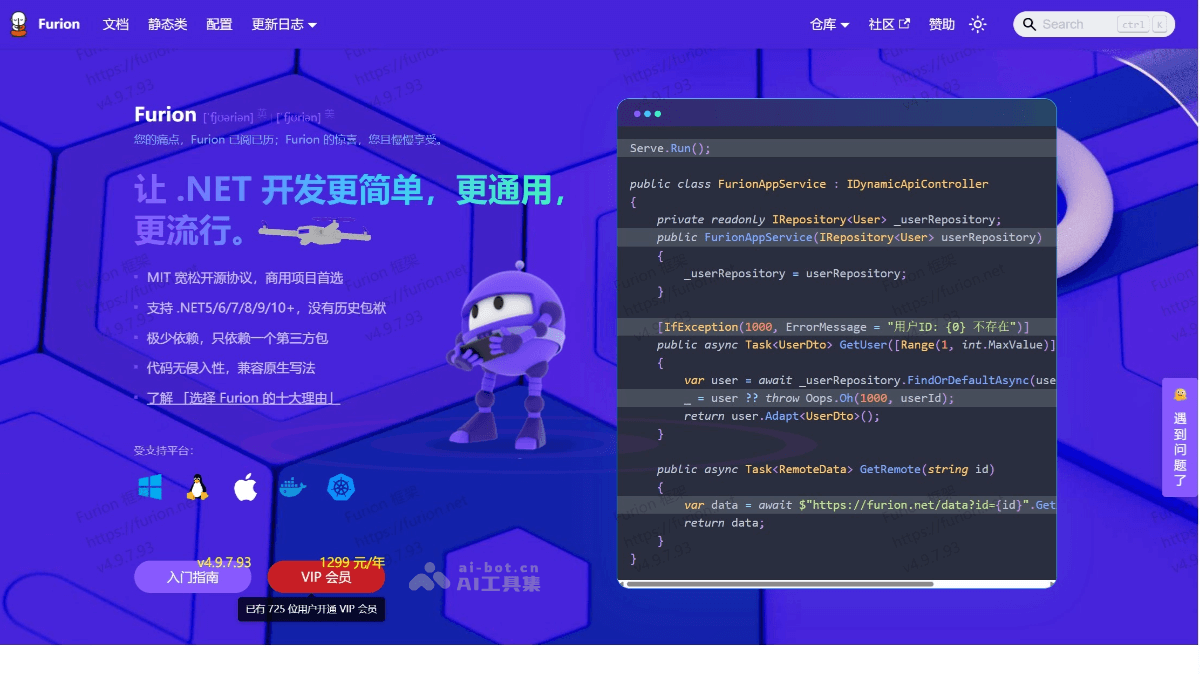
Furion
Core parameters and statistics
| Project | Specifications |
|---|---|
| Project Name | Furion |
| Category | .NET Development Framework |
| Open Source License | MIT + Apache-2.0 |
| GitHub Stars | 2,200+ |
| Gitee Stars | 14,500+ |
| Programming Language | C# (.NET) |
| Delivery form | NuGet package / source code self-compilation |
| Target Users | .NET Developers/Software Companies/Enterprise IT Departments |
| Core sponsor (if any) | Baixian Technology (Guangdong) Co., Ltd. |
The number of GitHub stars, forks, and contributors to an open source project are key indicators of community activity. The license type determines the freedom for commercial use and redistribution. Furion adopts the MIT protocol and has zero restrictions on commercial projects. This is its core advantage that distinguishes it from AGPL-like frameworks.
Furion is a pure .NET development framework. Its core positioning is to reduce the duplication of work in .NET enterprise-level development, rather than an AI application for end users. The framework integrates seamlessly into existing .NET projects through a zero-intrusion design, and developers can enable most features simply through the Inject() method. Its value lies in encapsulating high-frequency requirements such as dynamic Web API, dependency injection ORM, permission management, and scheduled tasks into out-of-the-box modules, allowing the team to focus on business logic rather than infrastructure construction.
User and market recognition
5000+ enterprise production environment verification: Covering manufacturing, finance, e-commerce, education, government affairs and other industries. Typical users include Weichai Power, TPV Display Technology and other large enterprises.
Community Data:
- Gitee GVP (most valuable open source project), 14,500+ Stars, 4,200+ Forks
- GitHub 2,200+ Stars, 472 Forks
- 165 contributors (GitHub) + 259 contributors (Gitee)
- NuGet platform has accumulated 45 million+ downloads (as of 2026.07)
Technical community reputation: Widely recommended as the "preferred enterprise-level framework" in the .NET Chinese community. Developer feedback focuses on "40-60% reduction in code volume", "low cost of zero-invasive migration" and "dynamic Web API significantly shortens the delivery cycle".
Risk Warning: The core maintainer is only Bai Xiaoseng, and the team size is limited. Enterprise-level users should evaluate maintenance continuity before relying on it for critical business.
Cost advantage
| Cost Dimension | Description |
|---|---|
| Software License | $0 (MIT open source license, can be used for commercial projects) |
| Infrastructure | Bring your own server/cloud resources, no additional framework licensing fees |
| Deployment and operation and maintenance | .NET technical manpower is required, and the framework itself has no additional operation and maintenance overhead |
| Commercial support | Free community support / ¥299-1,299/year value-added technical support |
The core cost advantage of the open source model is zero license fees + complete data sovereignty, but you need to bear the deployment and operation and maintenance costs yourself. Comparing the total cost of ownership with SaaS solutions requires comprehensive consideration of the three dimensions of software fee + infrastructure + manpower. Compared with ABP vNext (AGPL license), Furion's MIT protocol avoids the risk of open source contagion, and enterprises do not need to pay for compliance.
Architecture and core capabilities
- Architecture Overview: Zero-invasive injection based on .NET native
IServiceCollectionextension method. The core links are: startup registration (Inject()) → runtime scanning → dynamic generation of API routes → request pipeline processing (authentication/log/cache/exception) → business logic execution → response output. All modules are loaded on demand through NuGet packages and are not forced to be fully imported. - Core Engine: Dynamic Web API engine - automatically generates RESTful API routes and Swagger documents through runtime reflection scanning of the
[DynamicApiController]feature, eliminating the need to manually write Controllers. The permission management engine is based on the RBAC model and is automatically bound to API endpoints. The scheduled task engine supports Cron scheduling, cluster distributed execution and persistent storage. The event bus engine supports intra-process and cross-process publish/subscribe, exception retry, and transaction integration. - Extension Mechanism: Modularization through .NET native DI container. Each feature (caching/logging/ORM/multi-tenancy) is a standalone NuGet package that can be enabled on demand via the
AddXxx()extension method. The community can develop custom modules based on public interfaces. - Deployment Options: Supports Docker containerized deployment, IIS / Kestrel / Nginx reverse proxy, Jenkins CI/CD integration. Provides
dotnet new furionapiscaffolding template to create projects with one click.
Model and version evolution
| Version | Date | Key Changes |
|---|---|---|
| v4.9.9.36 | 2026-07 | Added HTTP remote declarative request ValueTask/ValueTask |
| v4.9.9 | 2026-07 | Regular iteration, fix known issues |
| v4.9.2.3 | ~2024 | Support [DisplayName] feature generation Swagger annotation |
| v4.8.8.21 | ~2023 | Support Jenkins continuous integration release documentation |
| v4.0 | ~2022 | Architecture reconstruction, fully adapted to .NET6+ |
| v3.x | ~2021 | Function expansion, support for microservices and multi-tenancy |
| v2.x | ~2020 | The framework is mature and the community size is growing rapidly |
| v1.x | 2019 | Initial release, basic function construction |
Version records are subject to the GitHub Releases page. The framework strictly follows semantic versioning and has an active release rhythm (168+ GitHub Release / 183+ Gitee Release has been released as of 2026.07). The framework adheres to the engineering principle of "rejecting AI-generated core logic", and all framework core codes are written and maintained manually.
Technical advantages
- Architecture Design: Zero-intrusion design - does not require projects to inherit specific base classes or implement specific interfaces (except for dynamic APIs), and inject functionality through the .NET native
IServiceCollectionextension method. Migration costs are lower than heavy frameworks like ABP vNext. Minimalist dependencies - the core of the framework only relies on one third-party package, and the rest of the functions are based on .NET native APIs or implemented by self-development. Lower dependency graph = lower probability of conflicts + fasterdotnet restore. - Performance: The dynamic API engine avoids the build-time overhead caused by code generation through runtime scanning instead of code generation. Multi-level cache (memory + Redis) supports cache penetration/penetration/avalanche protection. Asynchronous non-blocking design supports high concurrency scenarios.
- Security Design: Built-in RBAC permission verification middleware, data verification pipeline, exception handling middleware, SQL injection protection (through EF Core parameterized query). Supports request frequency limiting and CORS policy configuration.
- Observability: Structured log output (Serilog/NLog/Log4Net), supports writing to files, databases, and Elasticsearch. Built-in health check endpoint, combined with scheduled task dashboard to realize operation and maintenance monitoring.
Deployment pitfall guide
Based on community deployment experience, the following frequently asked questions are:
1. Dependency conflicts and environment configuration: Furion is sensitive to the .NET SDK version, and there are differences in the APIs used by different major versions (.NET6/7/8/9). Solution: Prioritize deployment with Docker and lock the runtime version through the mcr.microsoft.com/dotnet/sdk official image. In a multi-project solution ensure that all projects have a consistent TargetFramework.
2. Dynamic API routing conflict: When multiple service classes use the same routing prefix, [DynamicApiController] may cause routing conflicts and cause startup failure. Solution: Explicitly specify the [Route("api/[controller]")] attribute on the service class to avoid automatic routing guessing. In higher versions, you can use app.UseInject("YourAssemblyName") to limit the scanning range.
3. Scheduled task cluster lock is lost: In Redis mode, scheduled task locks between cluster nodes may be executed repeatedly due to network partitions. Solution: Set a reasonable lock expiration time (TaskSchedulerOptions.LockTimeout); add idempotent design (such as database unique constraints) for key tasks.
4. Multi-tenant data isolation configuration is complex: When row-level tenants are isolated, EF Core query filters may conflict with other global filters. Solution: Explicitly register tenant filters in OnModelCreating to avoid SQL generation exceptions caused by nested use of filters such as soft delete.
How to use
| Entrance | Installation/Usage |
|---|---|
| GitHub source code | git clone https://github.com/monksoul/Furion → Install dependencies → Configuration → Start |
| Gitee source code | git clone https://gitee.com/dotnetchina/Furion |
| NuGet | dotnet add package Furion |
| Scaffolding template | dotnet new install Furion.Template.Api → dotnet new furionapi -n MyProject |
# Quick start
dotnet new furionapi -n MyFurionWebApi
cd MyFurionWebApi
dotnet run --project ./MyFurionWebApi.Web.Entry/MyFurionWebApi.Web.Entry.csproj
// First API - no controller required
using Furion.DynamicApiController;
[DynamicApiController]
public class HelloService
{
public string Say() => "Hello, Furion";
}Product pricing (open source projects are usually free)
| Tiers | Price | What's Included |
|---|---|---|
| Open source core | $0 | All core functions (MIT license, free for commercial use) |
| Document membership | ¥299/year | Full document permissions to experience new features first |
| VIP membership | ¥399/quarter or ¥1,299/year | Exclusive WeChat group remote assistance with 2-hour response |
| Corporate Procurement | Corporate transfers can be invoiced | Customized solutions + technical support |
The framework itself is permanently free, and payment is only for value-added documentation and technical support services. All prices include tax.
Application scenarios
- Rapid Development of Enterprise Information Systems: Building back-end APIs for management systems such as CRM, ERP, OA, and project management. Dynamic Web API allows a service class to complete additions, deletions, modifications, and queries, and can be quickly launched in the enterprise with the permissions and log modules.
- Microservice Architecture Transformation: When existing .NET Framework or .NET Core projects need to evolve to microservices, the zero-intrusion design allows migration of services one by one, and cooperates with Consul/Nacos to realize service registration discovery.
- SaaS multi-tenant platform: Database-level or row-level data isolation is achieved through multi-tenant modules, which is suitable for SaaS products that provide independent data spaces for different customers.
- IoT data center: scheduled tasks (device status polling) + HTTP remote requests (API docking) + log management (data collection) collaboration.
Applicable people
- .NET Developer: Look for out-of-the-box, well-documented development frameworks to reduce duplication of effort.
- Software Enterprise Technology Team: We are selecting or reconstructing enterprise-level .NET projects and need to reduce development costs and maintenance burdens.
- Traditional industry IT departments: Internal development teams in manufacturing, finance, government affairs and other industries, with technology stacks based on .NET.
- Not suitable for boundaries: Business scenarios that require SLA guarantees, non-.NET technology stack teams (Java/Go/Node.js), and ultra-large-scale microservice governance scenarios.
Comparison of competing products
| Compare Dimensions | Furion | ABP vNext | SqlSugar | Native .NET Core |
|---|---|---|---|---|
| Open Source/Closed Source | Open Source | Open Source | Open Source | Open Source |
| License Type | MIT | AGPL (Community Edition) | LGPL + Commercial License | MIT |
| Community activity | Gitee 14.5k★ | GitHub 13k★ | Gitee 5k★ | — |
| Deployment complexity | Low: zero intrusion + NuGet package introduction | High: module architecture + DB Migration | Low: ORM level | Medium: all modules need to be built by yourself |
| Enterprise features | Fully built-in | Fully built-in | ORM only | No out-of-the-box functionality |
| Learning cost | Low (detailed Chinese documents) | Medium (mainly English documents) | Low | High (need to combine by yourself) |
| Business friendliness | ✅ MIT zero restrictions | ⚠️ AGPL infection risk | ⚠️ LGPL needs attention | ✅ MIT |
Summary and Outlook
As one of the open source development frameworks with the highest number of stars in the domestic .NET ecosystem and the most widely adopted by enterprises, Furion's core advantage lies in "zero intrusion + dynamic API + full module built-in" - allowing the .NET team to achieve a delivery speed close to that of a low-code platform without increasing architectural complexity, while maintaining the performance and flexibility of native .NET.
Development Risk: The framework is led by Bai Xiaoseng personally, and Baishuan Technology provides commercial support but the team size is limited. For very large business-critical systems, technical support responsiveness and long-term maintenance commitment need to be evaluated. The free community version is not guaranteed by SLA. It is recommended that enterprises purchase at least one VIP membership to obtain official support channels, while retaining the framework source code fork to deal with extreme situations. Future directions are expected to continue to focus on .NET version follow-up, module expansion and developer experience optimization.
Related tools:  GitHub Copilot,
  Cursor
Furion’s main features
- Core Processing Capabilities: Provides core AI capabilities in the corresponding scenarios to support users to quickly complete tasks.
- Multi-modal interaction: supports text input and result output, and some scenes support image or file upload.
- Workflow Integration: Can be embedded into existing workflows or linked with other tools through APIs to reduce context switching.
Furion’s Product Pricing
The pricing model is subject to the official real-time page. Usually a freemium or subscription system is adopted, basic functions can be used for free, and advanced functions or high-frequency use require payment.
Version Info
- v4.9.9 :Added HTTP remote declarative request ValueTask/ValueTask<T> return value type support
- v4.9.9 :Regular iterative version, fixing known issues and optimizing performance
- v4.8.8 :Support Jenkins continuous integration release documentation
User Reviews