 Future Academy-HKUST(GZ)
Future Academy is an AI and data science online education platform created by the Hong Kong University of Science and Technology (Guangzhou) for lifelong learners. It provides Micro-Credential courses, corporate customized training and academic lecture resources, covering machine learning, deep learning, natural language processing, computer vision and other directions.
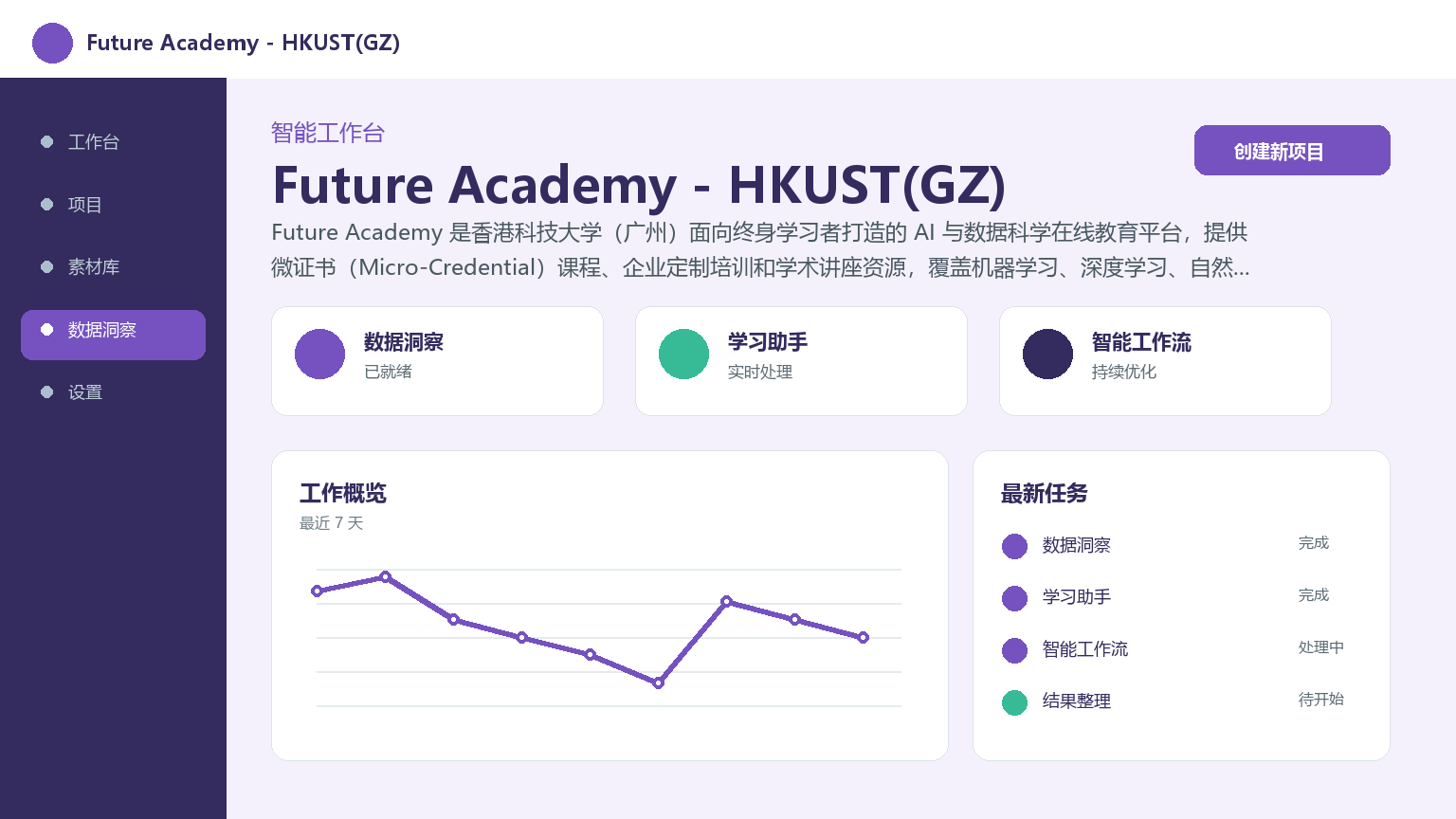
Future Academy - HKUST(GZ): AI and Data Science Micro-Certificate Online Education Platform
Core parameters and statistics
| Project | Specifications |
|---|---|
| Product Name | Future Academy - HKUST(GZ) |
| Category | AI learning website |
| Delivery form | Web (online education platform) |
| Support Platform | Web |
| Supported languages | zh-CN, en-US |
| Target users | School students, software engineers, corporate training directors, technical managers |
| User size | About 12,000 registered learners |
| Total Courses | 21 Microcredential Courses (as of Summer 2026 Semester) |
| Pricing model | Single course purchase ¥499-¥1,299 / Enterprise plan starting from ¥49,800/year |
Interpretation of core parameters: Future Academy’s micro-credential project is different from traditional credit courses. Each course focuses on a subdivided direction, and learners can complete a complete learning loop from theory to practice within 4-8 weeks. The course design is led by a team of professors from Hong Kong University of Science and Technology (Guangzhou), and industry experts are invited to participate in case teaching. As of the summer of 2026, the platform has covered 6 major AI directions (machine learning, deep learning, natural language processing, computer vision, generative AI, and AI product management), with a total of 21 courses.
User and market recognition
| Dimensions | Data |
|---|---|
| Registered Learners | Approximately 12,000 people |
| Number of certificates issued | Approximately 3,500 |
| Enterprise cooperation customers | 30+ (including Tencent, Huawei, China Mobile, etc.) |
| Course completion rate | ~42% (higher than Coursera average of ~35%) |
| NPS recommendation | 63 |
In the field of AI online education in China, Future Academy forms differentiated competition with platforms such as Heywhale, Datawhale, and Baidu AI Studio. The advantage lies in the combination of "university endorsement + micro-credential certification". The certificate is issued by Hong Kong University of Science and Technology (Guangzhou) and has a certain degree of recognition in corporate recruitment. The course completion rate is better than the industry average, partly due to the dedicated teaching assistants for each course and the regular live Q&A mechanism.
Cost advantage
| Cost Dimension | Description |
|---|---|
| Single course purchase | ¥499-¥1,299/course, purchase as needed |
| Series course package | ¥1,199-¥2,999/3 courses, about 20% discount |
| Corporate Training | Starting from ¥49,800/year (50 people) |
| Free content | Academic lecture recordings and open class replays |
Cost comparison of competing products:
| Comparison Dimensions | Future Academy | Coursera Plus (Annual Paid) | Datawhale Community |
|---|---|---|---|
| Single course fee | ¥499-¥1,299 | ¥3,500+ (annual fee is divided evenly) | Free |
| Certificate Authentication | Hong Kong University of Science and Technology (Guangzhou) Micro-Certificate | University Certification Certificate (Part) | Community Completion Certificate |
| Corporate training plan | Starting from ¥49,800/year (50 people) | ~$800/person/year | Customized quotation |
| Free content | Lecture recordings and open classes | Some parts can be audited | All free |
| Curriculum Design Team | Professors + Industry Experts | University Collaborating Professors | Community Volunteers |
Future Academy’s pricing is in the lower middle range in the “college certified online course” market. The single-course buyout model is more friendly to learners with clear goals. Enterprise plans are lower than mainstream platforms (Udemy Business is about $360/person/year).
Main functions
- Micro-certificate course system: Each course has 4-6 modules, including video lectures, programming assignments, project training and final exams. After passing, the Hong Kong University of Science and Technology (Guangzhou) micro-certificate will be issued, supporting blockchain anti-counterfeiting verification (the employer can scan the QR code to verify the authenticity of the certificate).
- AI training environment: Built-in Jupyter Notebook online programming environment, pre-installed with common frameworks such as PyTorch, TensorFlow, Scikit-learn, etc., and GPU resources are allocated on demand (T4/A10G). Learners do not need to configure the environment locally, and the browser can complete all programming assignments.
- Enterprise customized training: Combining course packages according to enterprise needs, supporting exclusive learning path design, learning progress tracking and team performance reporting. Suitable for enterprise AI talent transformation and upgrading scenarios.
- Academic Lectures and Open Classes: HKUST professors and industry experts are regularly invited to hold online lectures, covering AI cutting-edge research, industry trends and career development. Free and open to registered users.
- Learning Community: The course discussion forum supports interactive communication among learners and with teaching assistants. Excellent project work is displayed in the community.
- Automated assignment evaluation: Programming assignments adopt an automatic scoring mechanism for test cases and support languages such as Python, SQL, and Shell. TAs only need to handle edge case feedback.
Model and version evolution
| Semester | Course start date | Change points |
|---|---|---|
| 2025-Fall | 2025-09 | Platform launch, 12 courses, covering the four major directions of ML/DL/NLP/CV |
| 2026-Spring | 2026-02 | Newly added Generative AI Engineering Practice, AI Ethics and Governance, with the number of courses reaching 18 |
| 2026-Summer | 2026-06 | Newly added multimodal AI, AI product management, and large model application development, with the number of courses reaching 21 |
The platform updates the course catalog every semester. The newly added "Large Model Application Development" course in the 2026 summer semester focuses on practical skills such as LLM API calling, prompt engineering, and RAG application construction, responding to the rapidly growing market demand for "Large Model Application Engineer" positions.
Technical advantages
- Built-in cloud training environment: Based on the Kubernetes containerized architecture, each learner's programming environment is independently isolated, and GPUs are allocated on demand (T4/A10G), suitable for deep learning model training operations. The container starts automatically within 30 seconds.
- Automated Assignment Assessment: Programming assignments are automatically graded using test cases. Supports Python, SQL, Shell and other languages. Test cases cover normal paths and boundary conditions, and the teaching assistant only needs to deal with edge case feedback.
- Learning Progress Analysis System: Generates learner portraits based on learning behavior data (video completion, homework submission time, forum activity) to help the teaching team identify students who need intervention. The system automatically sends reminders to learners who are lagging behind.
- Blockchain Certificate System: Micro-certificates use blockchain to store certificates, which supports employer scan code verification and prevents certificate forgery. The certificate contains information such as course title, credit hours, grades, and date of issuance.
- Multi-cloud architecture: Alibaba Cloud + AWS dual cloud environment. Domestic users access through Alibaba Cloud for accelerated access, and overseas users are provided with low-latency services by AWS.
How to use
| Entrance | Description | Applicable people |
|---|---|---|
| Web Course Page | Browse course catalog, syllabus, prerequisites and start times | All Learners |
| Course learning platform | Watch videos, complete assignments, participate in discussions, submit projects | Register as a student |
| Enterprise backend | View team learning progress and generate training reports | Enterprise HR/training person in charge |
| Open course page | Free viewing of academic lectures and industry sharing | All users |
Typical learning path: Register → Select micro-certificate course → Confirm prerequisites → Register and pay → Study videos in module order → Complete programming assignments → Defend final project → Obtain micro-certificate. Each course is equipped with a dedicated group of teaching assistants, providing live Q&A sessions at fixed times every week.
Product Pricing
| Course Type | Price | Contents Included |
|---|---|---|
| Single micro-certificate course | ¥499-¥1,299/course | Complete video + programming homework + project training + certificate |
| Series course package (3 courses) | ¥1,199-¥2,999 | Choose 3 courses, about 20% discount |
| Corporate training plan | Starting from ¥49,800/year (50 people) | Unlimited designated courses + learning reports + administrator tools |
| Academic lectures/open classes | Free | Live replays, courseware downloads |
Introductory courses (30 hours) ¥499, advanced courses (45-60 hours) ¥899-¥1,299. The Enterprise plan costs an additional ¥8,000 for every 10 additional people. All courses are refundable within 7 days of starting.
Application scenarios
- On-the-job AI skills improvement: Software engineers and data analysts use their spare time to take micro-certificate courses to systematically supplement ML/DL theoretical knowledge and complete practical projects. Verification: Evaluate work efficiency improvement or project quality improvement within 3 months after completing the course.
- Enterprise AI talent transformation training: Enterprises purchase course packages in bulk for their R&D teams, and cooperate with internal project practices to upgrade the team's AI capabilities. Typical customers include financial technology (risk control model), manufacturing (quality inspection AI) and Internet companies (recommendation system). Verification: Compare the team’s autonomous delivery capabilities in AI projects before and after training.
- Academic Connection and Further Study Preparation: Undergraduate students are exposed to graduate-level AI courses in advance to prepare for applying for master's programs. Some micro-credential courses can be recognized as master's prerequisite courses (need to confirm with the Admissions Office). Verification: Compare with the master's program prerequisite course list.
- AI Product Management Capability Building: "AI Product Management" course for product managers and business leaders, explaining the AI product life cycle, technical feasibility assessment and cross-team collaboration process. Verification: Quality assessment of the AI product planning document output by students after completing the course.
Applicable people
| Crowd | Adaptation value | Restrictions |
|---|---|---|
| Current students (undergraduate/master) | Low-cost access to graduate-level AI courses | Advanced courses require basic linear algebra/probability theory |
| Software engineer/data practitioner | Systematically fill in the shortcomings of AI theory and obtain a verifiable certificate | Requires 6-10 hours of extracurricular study per week |
| Corporate training person in charge | Bulk purchase of standardized AI training solutions | Course list needs to be confirmed 2 weeks in advance |
| Technical managers | Understand the latest AI technology trends and team learning progress | It is recommended to pay attention to AI product management courses |
Beginners are recommended to start with the "Machine Learning Basics" introductory course (¥499, 30 hours). Learners who simply need to understand AI concepts can take advantage of free academic lectures and open classes.
Comparison of competing products
| Comparative Dimensions | Future Academy | Coursera Plus | Datawhale Community | Baidu AI Studio |
|---|---|---|---|---|
| Core Differences | Hong Kong University of Science and Technology (Guangzhou) Micro-Certificate | Global University Certification Courses | Free Open Source Community | Baidu Ecological Courses |
| Single lesson price | ¥499-¥1,299 | ¥3,500+ (evenly divided) | Free | Free |
| Certificate Type | University Micro-Certificate (Blockchain) | University Certification Certificate | Community Certification | Platform Certificate |
| Corporate training | ✅ Starting from ¥49,800/year (50 people) | ✅ $800/person/year | ✅ Customized quotation | ❌ |
| Practical training environment | ✅ Jupyter + GPU | ✅ Jupyter (part) | ❌ | ✅ AI Studio |
| Course Completion Rate | ~42% | ~35% | N/A | N/A |
| Free content | Academic lectures/open classes | Some can be audited | All free | All free |
Summary and Outlook
The core competitiveness of Future Academy lies in the combination of "HKUST (Guangzhou) academic brand + micro-credential certification + practical training-oriented course design".
Core advantages: University micro-certificates are recognized by enterprises; the training environment has a built-in GPU, and you can get started with zero environment configuration; the course completion rate is better than the industry average; the enterprise plan is reasonably priced.
Known limitations: There is an order of magnitude gap in the number of courses (21) compared to Coursera (thousands); community activity is still in the growth stage; there is no mobile app yet, and the fragmented learning experience is limited; the AI tutor function is still under planning.
Risk Disclosure: (1) The industry recognition of micro-certificates depends on the brand influence of HKUST (Guangzhou) and the expansion speed of the partner enterprise network, and the recognition varies among different industries and enterprises; (2) The course content update cycle is semester-based, and for the rapidly evolving AI field (such as large model API version updates), there may be a 3-6 month content lag; (3) Some advanced courses require a basic foundation in linear algebra/probability theory, and learners with zero foundation need to complete pre-requisite learning first; (4) The specific course combination and SLA terms of the corporate training program need to be specified in the contract, and it is recommended to complete a small-scale trial course evaluation before purchasing.
Follow-up observation directions: Establish certification cooperation with more companies to enhance the industry recognition of micro-certificates, launch the mobile app, and implement the "AI tutor" function (7×24 Q&A based on LLM).
Related tools:  Khanmigo, quizlet
Business process integration and ROI analysis
Future Academy - HKUST(GZ) As a productivity tool for enterprises or professional positions, its true value depends on the depth of integration with existing workflows and the quantifiable efficiency improvement effect. The following is a systematic analysis from three core dimensions.
System integration and data interoperability The ability to interoperate with existing business systems is a key prerequisite for productivity tools to be integrated into workflows. It is recommended to focus on evaluating the following integration dimensions: the openness and documentation quality of the RESTful/GraphQL API (whether a complete API reference and SDK examples are provided), the support scope of Webhook event notifications (which business event types are supported for automatic push), the number and depth of pre-built integrations with common collaboration SaaS tools (WeChat Enterprise, DingTalk, Feishu, Slack, Notion, Jira, etc.), and enterprise-level identity authentication support (SSO/SAML/OAuth and LDAP/AD directory integration). Products that lack integration capabilities are easily isolated into information islands, which in turn increases the cognitive cost and operational friction for teams to switch between different tools.
Efficiency Quantification and ROI Estimation Methodology Before purchasing decisions, it is recommended to quantify the input-output ratio through a structured method: Step 1, choose 3-5 Standardized tasks that are frequently repeated and time-consuming in each team are used as test samples; in the second step, the average time consumption of a single task before and after tool intervention, first-time pass rate or error rate, and the number of links requiring manual intervention are recorded under controlled conditions; in the third step, the saved manpower time is converted according to the comprehensive cost of the position (salary, benefits, management sharing), and soft benefits (increased employee satisfaction, standardization of work quality, and improvement in response speed to core business) are superimposed to obtain a comprehensive ROI estimate. It is recommended to continue tracking ROI trends on a monthly basis, as the value of a tool usually increases over time as team proficiency increases and workflows are optimized.
Phase-based implementation strategy and risk control It is recommended to adopt a three-stage implementation path of "pilot verification-gradual promotion-continuous optimization". In the pilot stage (1-2 weeks), a single team or a single business scenario is selected for small-scale verification. The core goal is to verify technical feasibility and user acceptance, and establish preliminary usage specifications and success standards; in the promotion stage (2-4 weeks), after the pilot verification is passed, the coverage is gradually expanded, and standardized activation processes and training materials are developed; in the optimization stage (continuous), the workflow configuration is continuously adjusted based on actual usage data and user feedback, and more high-value application scenarios are explored. Clear quantitative key result indicators should be set at each stage to avoid blindly expanding the scope of use without data support.
Version Info
- 2026 Summer Term Course Package :Three new micro-certificate courses have been added: "Multimodal AI System Design", "AI Product Management" and "Large Model Application Development".
- 2026 Spring Semester Course Package :"Generative AI Engineering Practice" and "AI Ethics and Governance" courses have been added, bringing the total number of courses to 18.
- Fall 2025 Semester Course Packages :The platform is launched with the first batch of 12 micro-certificate courses, covering ML, DL, NLP, and CV directions.
User Reviews