 Galileo
Free
Galileo
Free
Galileo is a GenAI evaluation AI observability and production guardrail platform for AI training model scenarios, covering offline experimental RAG/Agent indicators, online traces, low-latency Luna-2 evaluation model and enterprise-level deployment.
Galileo
Core parameters and statistics
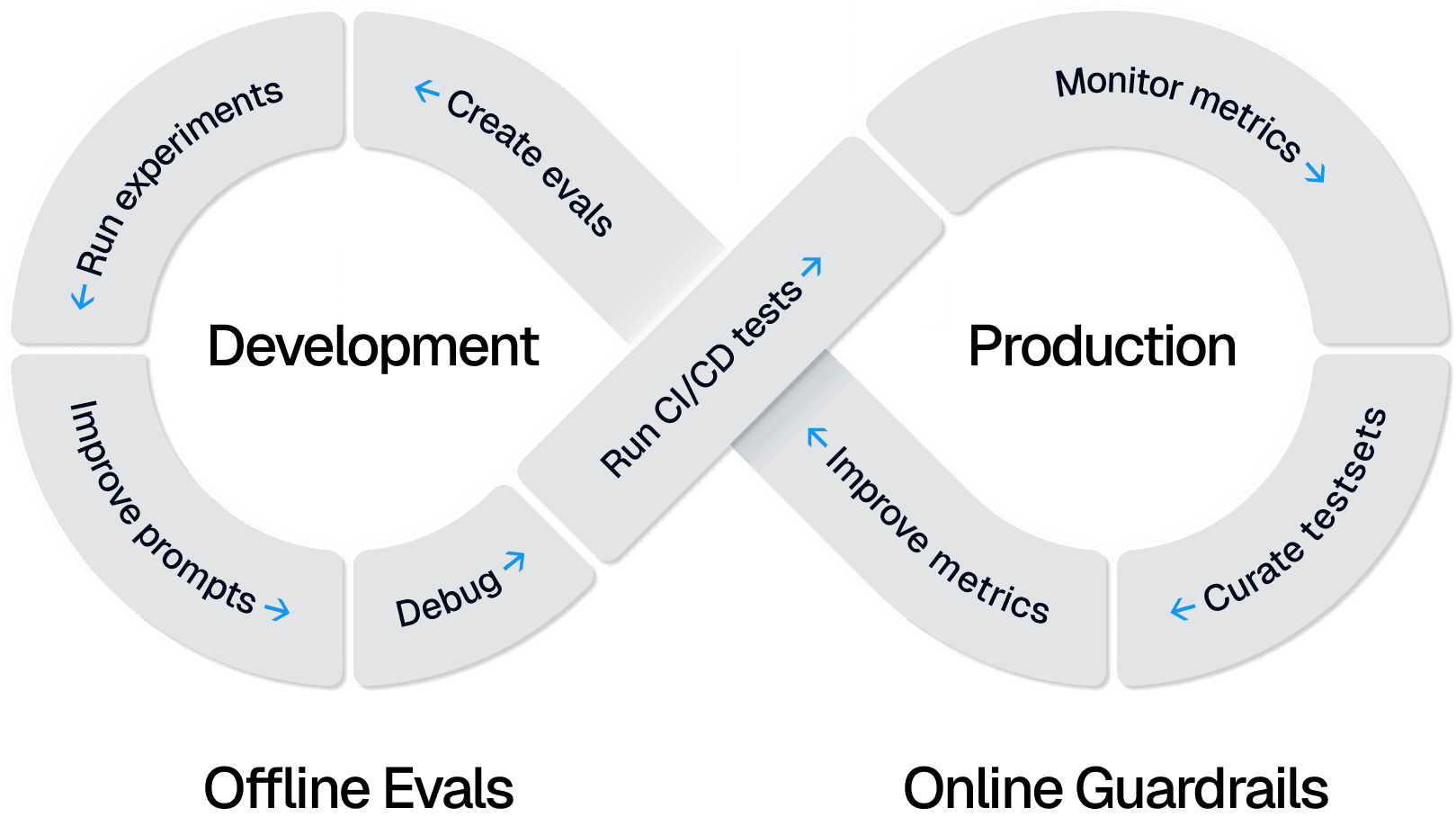
Galileo positions itself as an AI reliability platform, and its core delivery is an integrated workflow that "turns offline evaluation into production guardrails." The product covers three major modules: AI Evaluation, AI Observability, and Real-time Protection. It is accessed through SDK, API, and Web console, and supports three deployment methods: SaaS, VPC, and On-Premises.
| Projects | Public Information |
|---|---|
| Product positioning | Evaluation, observability and production guardrail platform for GenAI and Agentic applications |
| Core objects | traces, sessions, spans, datasets, prompts, metrics, guardrails |
| Preset indicators | 20+ out-of-box evals, covering RAG, Agent, Safety, Security and other categories |
| Access method | Web console Python SDK, TypeScript SDK, REST API, mainstream Agent framework integration |
| Workflow coverage | Offline experiment (Evaluate), online observation (Observe), real-time guardrail (Protect) |
| Deployment forms | SaaS, Virtual Private Cloud, On-Premises |
| Luna-2 evaluation model | $0.12/1M tokens, 0.95 accuracy, 152ms average latency, 128k context |
| Latest public update | 2026-06-05 Agent Control for enterprise customers |
| Pricing plans | Free / Pro ($100/mo) / Enterprise (Contact us) three tiers |
Boundary Note: Galileo is not a general chatbot or a pure logging platform. It requires teams that already have a GenAI, RAG, or Agent application and are willing to invest time in building groundtruth, calibrating metrics, and defining guardrail strategies. If the team has not yet entered AI application development or lacks evaluation methodology, the initial onboarding cost of the platform will be higher than the price of the tool itself.
User and market recognition
Galileo's market signals focus on the two dimensions of enterprise-level customer adoption and capital recognition, rather than C-port reputation or GitHub stars.
Financing and Corporate Growth: In October 2024, it was officially announced that it had completed Series B of US$45 million, with a total financing of US$68 million; the same announcement disclosed that revenue has increased by 834% since 2024, the number of corporate customers has increased by 4 times, and 6 Fortune 50 companies have been introduced. The investors have not been disclosed on the public page, but the financing scale is at the top level in the AI evaluation track.
Customer and Eco-Partners: Customer or partner reviews such as Twilio, Comcast, HP, Writer, Cisco Outshift, Ema, NVIDIA, Satisfi Labs, MongoDB, CrewAI, Clearwater Analytics, etc. appear on the product page and pricing page. The evaluation focused on "Using Galileo as Agent to observe Luna-2 production evaluation and RAG quality management", indicating that its focus is on enterprise-level AI governance scenarios.
Developer Community: The GitHub organization rungalileo has 184 followers and 58 repositories. The main open source projects include agent-leaderboard (224 stars, used to rank LLM Agent capabilities), hallucination-index (116 stars, evaluate LLM hallucination tendency), galileo-python SDK (22 stars, Apache-2.0 license). The open source warehouse is more of a demonstration and integration example, and the core capabilities of the product are in the closed source SaaS layer.
Cost advantage
Galileo's cost structure is fundamentally different from traditional LLM monitoring tools: it does not rely on calling GPT-5.4 or Claude to be the judge every time, but uses the Luna-2 dedicated evaluation model to reduce the cost of high-frequency evaluation to 3%-5% of the general solution.
C client/individual: Free plan $0/month, includes 5,000 traces/month, unlimited users, unlimited custom evals. Suitable for individual developers to do small-scale proof of concept. The limitation is that the free quota is far lower than the production requirements (high-frequency Agent systems can generate tens of thousands of traces a day), and it lacks SSO, RBAC and dedicated support.
Developer/API: Pro plan starts at $100/month (save 33% on annual annotations) and includes 50,000 traces/month, Standard RBAC, advanced analytics, and Slack support. The pricing page notes that prices scale linearly with the number of traces. The actual costs for the development team include not only the subscription fee, but also the overhead of LLM-as-a-judge calling Luna indicators, data retention, and experiment storage.
Enterprise/Private: Enterprise is Contact us and includes unlimited traces, custom rate limits, Hosted/VPC/on-prem deployment options, enterprise-grade RBAC/SSO, Dedicated CSM, real-time guardrail 24/7 support, low-latency dedicated inference servers, and forward deployed engineering support. Luna-2's $0.12/1M tokens can save about 97% of the evaluation cost compared to GPT-5.4's $5.00/1M tokens. However, Luna metrics are open according to enterprise contracts and are not available to all users by default.
Hidden Costs: The true cost of AI measurement comes not only from the Galileo subscription, but also includes: LLM-as-a-judge call fees invested in building and calibrating measurement metrics, data retention and bandwidth, operation and maintenance of dedicated inference servers, and team time to learn and develop the measurement process. Luna-2 reduces the marginal cost of high-frequency evaluation, but the initial engineering investment in groundtruth construction and indicator optimization cannot be ignored.
Main functions
Galileo's functions are organized around the four stages of "data capture → evaluation and construction → failure analysis → guardrail launch", rather than being stacked independently by modules.
- Data and annotation asset management: Construct data sets from synthetic data, development context, and production traffic, and support annotations from domain experts to form continuously updated groundtruth assets. The key acceptance points are whether the annotation workflow can be connected with the existing data pipeline, and the version management and rollback mechanism of groundtruth.
- 20+ preset evaluation indicators + custom evaluation: covering RAG Evals (retrieval quality, context precision), Agent Evals (tool selection, action advancement, action completion), Safety Evals (bias, toxicity), Security Evals (prompt injection, PII leak). Custom reviews support code-based or LLM-as-judge automatic generation. The key acceptance points are whether the preset indicators are aligned with the business domain and whether the accuracy rate (F1) of the custom indicators can reach more than 80%.
- Graph Engine Agent Observation: Expand Agent's branches, tool calls, decision paths and session contexts from linear logs to graph paths, supporting multi-Agent system A2A protocols and distributed tracing. The key acceptance point is being able to quickly locate a failing span and see the full attribution link within 2-3 clicks.
- Insights Engine automatic failure analysis: Analyze Agent behavior data, identify failure patterns, hidden patterns and root causes, and give actionable suggestions (such as "add few-shot examples to tool input"). Key acceptance points are the accuracy and false positive rates of recommendations, and the rate at which the engineering team adopts the recommendations.
- Luna-2 production-level evaluation: Use SLM with 3B/8B parameters to replace the general LLM-as-judge, achieving low-cost evaluation with sub-200ms latency, 128k context, and $0.12/1M tokens. Key acceptance points are the consistency of Luna metrics with human annotations, and latency stability at high QPS.
- Agent Control centralized guardrail management: Use a centralized control plane to define guardrail policies to block risks such as harmful content prompt injection, PII leakage, and cross-user operations without changing the Agent code. Key acceptance points are false interception rate, audit log integrity, and manual fallback paths.
- Auto-tune and Continuous Learning: via CLHF (Continuous Lear
ning with Human Feedback) mechanism, using few-shot examples to automatically optimize the evaluation prompt and gradually improve the indicator accuracy. The key acceptance points are the validity period of auto-tune and whether frequent manual intervention is required.
Model and version evolution
Galileo is a SaaS platform that continues to iterate. The version history can be divided into four stages according to official public milestones:
Main line milestones
- 2024-10-15: Evaluation Intelligence Platform. The Series B announcement redefines the main product line as Evaluation Intelligence, covering the four stages of Fine-Tune, Evaluate, Observe, and Protect, emphasizing the full link from offline experimentation to production management. This is a key transition for Galileo from an early NLP tool to a GenAI evaluation platform.
- 2025-07-16: Agent Reliability Platform. Release Agent Reliability Platform for free, introduce Graph Engine (Agent path observation), Insights Engine (automatic failure analysis) and Luna-2 (low-latency evaluation model), and expand the product focus from "RAG evaluation" to "Agent full life cycle reliability".
- 2026-05-22: Luna Studio and Integration Costs. Release Notes releases Luna Studio enterprise capabilities, allowing enterprises to train custom low-latency SLM indicators; and also adds the Integration Costs cost management page, allowing teams to visually track LLM-as-judge, Luna and retained expenditure structures.
- 2026-06-05: Agent Control. Release Notes releases enterprise Agent Control, using a centralized control plane to manage guardrails and governance policies, and block risks such as prompt injection, PII leakage, and cross-user operations without changing the code. This is a product extension of Galileo from "observation + evaluation" to "governance + blocking".
Key points of verification
2026-06-05 Agent Control is the latest public capability node, but the actual availability is affected by enterprise packages, deployment forms, and sales activation. Luna metrics are marked "Only open to customers upon request" on the Luna-2 page, and all preset metrics cannot be considered ready-to-use by default. When purchasing, enterprises need to confirm the specific activation conditions of Luna Studio and Agent Control within the scope of the current contract.
Technical advantages
Galileo's technical advantage comes from the three-layered integration of evaluation models, observational data and production guardrails, rather than a single point model or single indicator.
Evaluation model layer (Luna-2): Luna-2 uses decoder-only SLM with lightweight metric heads for deterministic evaluation output. Mechanically, it adapts to different evaluation dimensions through fine-tuning and adapter on the 3B/8B base. In effect, $0.12/1M tokens reduces the cost of each evaluation by about 97% compared to GPT-5.4's $5.00/1M tokens, while maintaining an accuracy of 0.95. The applicable scenario is high-frequency, multi-index parallel production context evaluation, such as customer service Agent, RAG Q&A and financial compliance checks. Luna-2’s 128k context window means it supports end-to-end evaluation of long conversation scenarios, whereas the 3k window of similarly priced competitors (such as Azure Content Safety) loses context.
Observation layer (Graph Engine): Graph Engine converts Agent calls from a linear log into a directed graph. Each node is a tool call or LLM request, and the edges are information flow and control transfer. Mechanically, it captures spans and traces through OpenTelemetry extensions and SDK bureaus, and then reconstructs the path topology on the backend. In effect, the engineering team can see all branches, retries, and error paths of the Agent in one observation. The applicable scenarios are complex orchestration scenarios such as multi-Agent collaboration, A2A protocol MCP server calls, etc.
Guardrail Layer (Agent Control): Agent Control directly maps evaluation scores to execution control actions. Mechanically, the guardrail determines whether execution is allowed based on predefined policies before the tool is called; in effect, the team can block harmful operations without modifying the Agent code; applicable scenarios are PII leakage prevention Prompt Injection blocking, cross-user operation interception, and economic loss risk control (such as the upper limit of a single transfer).
Engineering Observability Basics: Galileo's Insights Engine is not a simple log aggregation, but does pattern recognition on millions of signals (model prompts, functions, context datasets, traces, MCP server). The product page shows a case: Galileo automatically detects "hallucinations causing incorrect tool inputs" and gives the suggestion to "add a few-shot example to demonstrate correct tool inputs", indicating that its root cause analysis capabilities have been upgraded from statistical summary to rule generation.
How to use
Galileo's entrances are divided into three categories: Web console SDK/API and enterprise deployment. Developers can start by signing up for free, but enterprise teams often need to clarify data boundaries and compliance requirements first.
| How to use | Suitable for everyone | Main actions | Precautions |
|---|---|---|---|
| Web console | Product and operation AI quality manager | View traces/sessions/metrics, run experiments, configure guardrails | Need to access application logs or import evaluation data first |
| Python SDK (galileo-python) | Engineering team ML engineer | pip install galileo → Initialize GalileoLogger → Record traces and experiments |
Need to manage API Key, project Key, log fields and sampling strategy |
| TypeScript SDK (galileo-js) | Agent developer, full-stack engineer | npm install @rungalileo/galileo-js → Initialize the client → Connect to the Agent framework |
Middleware or callback that needs to cooperate with the framework (LangGraph, CrewAI, etc.) |
| REST API | Multi-language context, customized integration | Call /v1/traces, /v1/experiments, /v1/guardrails and other endpoints |
Need to handle authentication, current limiting and error retry by yourself |
| Enterprise Deployments | Security, Compliance, and Platform Teams | Evaluate Hosted / VPC / On-Prem Scenarios | Requires Business Verification Contract, Data Residency SLA, and Dedicated Inference |
Typical getting started path: Register for free from the official website → Create a project → Install the SDK and record the first trace → Run preset evaluation indicators on traces → View the failure mode in Insights → Expand the stable indicators to experiment and guardrail. For the RAG system, priority is given to verifying retrieval quality and hallucination; for the Agent system, priority is given to verifying tool selection quality and action completion.
Quick Integration Example (Python):
from galileo import GalileoLogger

galileo_logger = GalileoLogger(project="my-project")
with galileo_logger.start_trace("user-query") as trace:
    trace.log_input("User problem")
    response = llm_call(prompt)
    trace.log_output(response)
    trace.log_metric("latency", 320)
Product Pricing
Galileo's pricing page exposes a three-tier plan, with the core billing dimensions being the number of traces and premium feature coverage.
| Plan | Public price | Core quota | Key capabilities | Applicable boundaries |
|---|---|---|---|---|
| Free | $0/month | 5,000 traces/month, unlimited users, unlimited custom evals | Basic evaluation, community support | Experimentation and small-scale proof-of-concept |
| Pro | Starting at $100/month (33% off annual payment) | 50,000 traces/month, Standard RBAC | Advanced analytics Insights, Slack support | Growing teams, small-scale production |
| Enterprise | Contact us | Unlimited traces, custom rate limits | VPC/on-prem, SSO/RBAC, real-time guardrails, dedicated inference 24/7 support Dedicated CSM | Enterprise scale, compliance and deployment requirements |
Luna-2 cost comparison: The evaluation cost of Luna-2 (3B/8B) is $0.12/1M tokens. Compared with GPT-5.4’s $5.00/1M tokens and GPT-5.4 mini’s $0.15/1M tokens, it has obvious advantages in high-frequency evaluation scenarios. However, it should be noted that the activation conditions, specific indicator coverage and inference server configuration of Luna metrics all need to be confirmed by the enterprise contract, and the total amount cannot be estimated directly based on the public price.
Billing Risk Point: The final cost of AI evaluation is determined by the amount of traces × sampling rate × number of indicators × calling frequency. The upper limit of traces for Free and Pro plans may be quickly exhausted during in-depth evaluation; although Enterprise has no upper limit for traces, custom rate limits and the cost of exclusive inference require business negotiation. It is recommended to use 1-2 weeks of actual traces data for cost simulation before purchasing, and then select the corresponding solution.
Application scenarios
- RAG Quality Measurement and Regression: Measures retrieval accuracy, contextual relevance, answer illusion, and citation consistency. The focus of acceptance is the alignment of the retrieval indicator with the business groundtruth, and whether the regression report can be automatically triggered after each model update, rather than relying on a single manual evaluation.
- AI Agent full-link observation: used for multi-step Agent tool call, branch, handoff, action completion and conversation quality monitoring. The focus of acceptance is whether the root cause of a failed Agent interaction can be located in Insights within 5 minutes, and improvements can be fed back to prompt or tool schema.
- Security and compliance real-time guardrails: Used for high-risk scenarios such as prompt injection, PII leakage, harmful content, cross-user operations, and unauthorized tool calls. The acceptance focus is on low-latency blocking (Luna's sub-200ms level), false interception rate, audit log integrity, and manual fallback mechanisms.
- Eval Engineering platform: used to integrate datasets, experiments, custom metrics, human feedback and release gate into the CI/CD process. The focus of acceptance is to evaluate whether the pipeline can be automatically executed every time the model or prompt is updated, and give a pass/fail signal.
- Enterprise AI Operations Governance and Cost Control: Used to aggregate production traces, Luna evaluation costs, LLM-as-judge expenses and abnormal trends across departments. The focus of acceptance is whether permission isolation, data retention, deployment isolation and cost attribution meet organizational requirements.
Applicable people
- AI Application Engineering Team: A team that is building a RAG, Agent, customer service robot or search Q&A system to unify logs, reviews and online anomaly diagnosis into a single view. The prerequisite is that the team has basic concepts of log burying and traces, and no full-time AI platform engineer is required.
- AI Quality and Evaluation Engineer (Eval Engineer): An engineering role specifically responsible for building evaluation data sets, calibrating indicators, managing experiments, and designing release access control. Galileo's custom evals, auto-tune and Luna Studio are the core toolchain for this role.
- Product and Domain Experts (SME): Product managers and business experts who need to participate in annotation, evaluate answer quality, and define business success criteria. Convert subjective judgments into traceable and reusable quality indicators through annotations and custom evaluators.
- Platform and Security Operations Team: Enterprise platform team requiring SSO/RBAC, data retention, production guardrail PII, and Prompt Injection risk control. Galileo's Enterprise solution and Agent Control are the main value points for this group.
Unsuitable situations: Teams that only need general chat or simple LLM calls (killing a chicken with a knife); organizations that do not have online AI applications or cannot provide traces/datasets (the platform has no data to analyze); teams that do not have a clear evaluation leader or indicator governance process (the tool will become "one more dashboard"); scenarios that have strict geographical requirements for data residency but Galileo has not yet covered the corresponding area.
Summary and Outlook
Galileo's core competency lies in putting the GenAI Evaluation Agent observable Luna-2 low-latency evaluation model and production guardrails into the same workflow. It solves the most difficult problem for enterprise AI after it goes from POC to production: how to continuously prove that models and agents are reliable, explainable, improveable, and can prevent risks in real traffic. In the AI evaluation track, Galileo is one of the few products that covers the complete link of "offline experiment → online observation → real-time guardrail" at the same time, rather than a single point indicator tool.
Current limitations and uncertainties: Although Luna-2's 0.95 accuracy is higher than GPT-5.4's 0.94, this is a benchmark test result under a specific evaluation dimension. Whether it can maintain the same quality in a highly customized business scenario requires actual verification; some enterprise capabilities (Luna Studio, Agent Control) require business confirmation to activate; the depth of SDK/Agent framework integration depends on the current technology stack and OTel compatibility; the long-term accuracy of evaluation indicators depends on groundtruth Ongoing maintenance and SME feedback.
Procurement/Adoption Risk Assessment: It is recommended to first select a high-value, measurable RAG or Agent process for 2-4 weeks as a pilot, and set indicators such as trace coverage, failure location time, amount of manual review, interception false alarm rate, and online access control pass rate. When the indicators are stable and the team reaches a consensus on the evaluation process, expand to multi-team, multi-agent or enterprise deployment. Before purchasing, enterprises should focus on reviewing: whether the VPC/on-prem terms and data residency meet compliance requirements; the activation scope and fee structure of Luna-2 and Luna Studio within the scope of the current contract; the compatibility of SSO/RBAC and the enterprise identity management system (IdP); the actual response time and upgrade path of 24/7 support; and the data export and migration support terms when the contract is terminated.
Related tools:  Hugging Face, replicate
Version Info
- Agent Control for enterprise customers :The official Release Notes released Agent Control, which centrally defines guardrails and manages Agent governance for enterprise customers. It can block harmful content prompt injection, PII leakage and other risks without changing the Agent code.
- Luna Studio and Integration cost charts :Official Release Notes announce the release of Luna Studio enterprise capabilities for training low-latency, low-cost SLM metrics and the addition of the Integration Costs management page to track LLM-as-a-judge costs.
- Agent Reliability Platform :The official blog announced the free Agent Reliability Platform, which revolves around Graph Engine, Insights Engine and Luna-2 real-time guardrails, supporting multi-Agent system observation, failure mode analysis and production protection.
- Evaluation Intelligence Platform :The official blog announced US$45 million in Series B financing and defined the main product line as Evaluation Intelligence Platform, covering the AI quality life cycle such as Fine-Tune, Evaluate, Observe, and Protect.
User Reviews