 Galileo AI
Free
Galileo AI
Free
Galileo AI is a GenAI evaluation AI observability and production guardrail platform for AI data processing scenarios, covering offline experimental RAG/Agent indicators, online traces, low-latency Luna-2 evaluation model and enterprise-level deployment.
GalileoAI
Core parameters and statistics
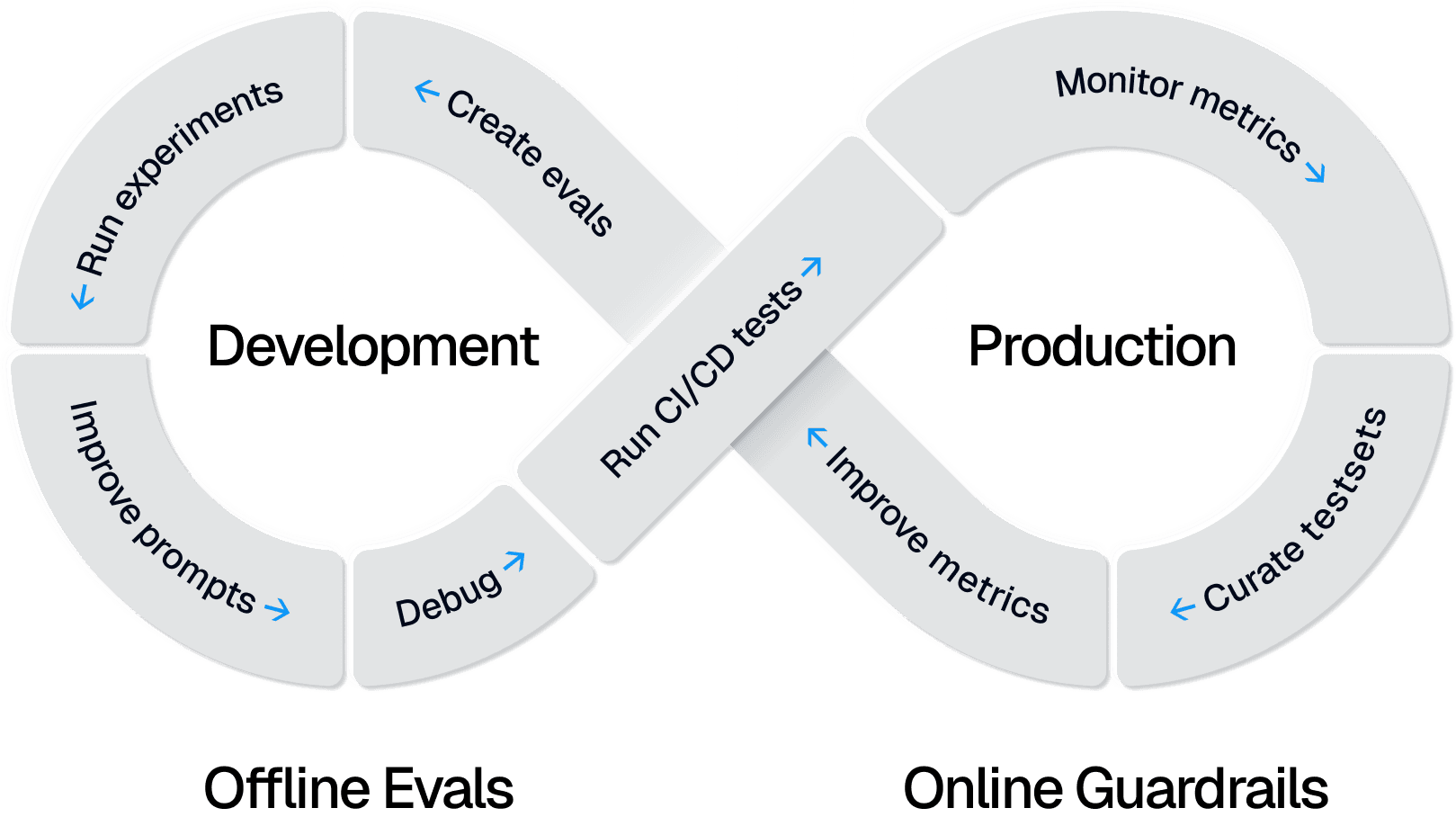
Galileo AI's product page defines the platform as an AI observability and eval engineering platform, with the goal of transforming offline evaluation into production guardrails. The documentation page further explains that Galileo is for GenAI and agentic applications, serving engineers, product managers and domain experts, and can be accessed through the Agent framework Python SDK, TypeScript SDK or API (Official Document).
| Projects | Public Information |
|---|---|
| Product positioning | Observation, evaluation and production guardrail platform for GenAI and Agentic applications |
| Key objects | traces, sessions, spans, datasets, prompts, metrics, guardrails |
| Main Scenario | RAG Evals, Agent Evals, Safety Evals, Security Evals, Custom Evals |
| Access method | Web console Python SDK, TypeScript SDK, API, common Agent/LLM framework integration |
| Production Capacity | Offline evaluation, online observation, indicator tuning Luna-2 low-latency evaluation, real-time guardrails |
| Deployment forms | SaaS, Virtual Private Cloud, On-Premises |
| Latest public update | 2026-06-05 Agent Control for enterprise customers |
| Pricing portal | Free, Pro, and Enterprise three-tier public pricing pages |
Capability Boundary: Galileo AI is not a general chatbot, nor is it a simple logging platform; it is more suitable for teams that already have GenAI, RAG or Agent applications and need to measure quality, locate failure modes and control production risks. If the team has not yet entered AI application development or has no online traffic, the value of the platform will be more reflected in the construction of evaluation methods rather than immediate business benefits.
User and market recognition
Galileo's market signals mainly come from corporate customers, financing and cooperation ecosystem. The official Series B announcement disclosed that Galileo announced US$45 million in Series B on October 15, 2024, with cumulative financing reaching US$68 million. The same announcement also disclosed that revenue has increased by 834% since 2024, the number of enterprise customers has increased by 4 times, and 6 Fortune 50 companies have been introduced, and Twilio, Comcast, HP, ServiceTitan are listed. Waiting for customers or partners (Official Announcement).
Corporate Approval: Customer or partner reviews such as Writer, Cisco Outshift, Ema, NVIDIA, Satisfi Labs, MongoDB, CrewAI, HP, Clearwater Analytics, etc. appear on the product page and pricing page. What’s more important for purchasing judgments is that these evaluations focus on “Evaluation Tool Chain”, “Agent Observation”, “NVIDIA NeMo Integration” and “Luna-2 Production Evaluation”, indicating that Galileo’s focus is on enterprise-level AI quality management rather than personal efficiency tools.
Ecological Approval: The official Agent Reliability release article disclosed that Graph Engine supports CrewAI, LangGraph, OpenAI Agents SDK, LlamaIndex and other frameworks; the 2026-05-08 Release Notes also added A2A multi-Agent distributed tracing and OpenTelemetry extensions. This type of ecological adaptation reduces access costs, but actual availability still depends on the team's current framework, logging standards, and data retention requirements.
Cost advantage
The cost advantage of Galileo AI is not the “cheapest SaaS subscription” but replacing expensive, slow general-purpose LLM-as-a-judge pipelines with purpose-built review models like Luna-2. The product page states that Luna can distill optimized evals into a model that monitors 100% of traffic and runs at 96% lower cost; the Agent Reliability release states that Luna-2 supports 20+ indicators while running sub-200ms latency, and is 97% cheaper than traditional LLM-based solutions.
C client/individual: The Free plan is publicly available for $0/month, including 5,000 traces/month, unlimited users and unlimited custom evals, which is suitable for developers and small teams to verify and evaluate ideas. The limitation is that the free quota mainly covers experiments and small-scale applications, and cannot replace the SSO, dedicated support, deployment isolation and data governance requirements of enterprise production environments.
Developer/API: The Pro plan is disclosed for $100/month, saves 33% on annual payment, and includes 50,000 traces/month, Standard RBAC, Advanced analytics & insights, and Slack support; the pricing page indicates that the price will scale with the number of traces. The development team needs to calculate the amount of traces, the number of evaluation indicators, LLM-as-a-judge calls, Luna indicator calls, and log retention together.
Enterprise/Private: Enterprise is Contact us and includes unlimited traces, custom rate limits, Hosted/VPC/on-prem deployments, enterprise-grade RBAC/SSO, Dedicated CSM, real-time guardrails, 24/7 support, low-latency dedicated inference servers, and forward deployed engineering support. When it comes to VPC, on-prem, dedicated reasoning and security terms, the actual quotation and contract boundaries are subject to the official real-time page and business confirmation.
Main functions
The functions of Galileo AI revolve around "capturing real data, constructing evaluations, discovering failures, and putting evaluations online as guardrails". It is suitable for extending AI quality from offline testing to online governance.
- Data and annotation assets: Build datasets from synthetic, development, and live production data, and form continuously updated groundtruth assets through domain expert annotations.
- RAG/Agent/Safety/Security indicators: The official product page exposes 20+ out-of-box evals, covering RAG, agents, safety, security, and supports custom evaluators.
- Agent Graph and Trace Observation: Agent Reliability page description Graph View can present each branch, decision and tool call, helping the team locate offset points in the multi-step Agent path.
- Insights Engine: Perform failure mode analysis on Agent behavior, locate root cause, multi-agent handoff, tool selection pattern, and provide linked evidence and actionable suggestions.
- Luna-2 Production Evaluation: The Luna-2 page discloses indicators such as $0.12/1M tokens, 0.95 accuracy, 152ms average latency, 128k max tokens, etc. for low-cost, low-latency production evaluation.
- Agent Control and Guardrail Management: 2026-06-05 Release Notes shows that Agent Control can centrally manage enterprise Agent guardrails to block risks such as harmful content prompt injection and PII leakage.
Model and version evolution
The relevant information has not been made public, please refer to the official real-time page.
Technical advantages
The technical advantage of Galileo AI comes from the combination of "evaluation model + observation data + production guardrails" rather than single-point model performance.
Dedicated evaluation model: Luna-2 uses an SLM specifically designed for evaluation to undertake high-frequency quality judgments. Mechanically, it distills expensive LLM-as-a-judge tasks into a low-latency model; in effect, the platform can continuously evaluate production traffic at a high sampling rate; applicable scenarios are applications that require continuous risk control, such as customer service agents, RAG Q&A, finance/medical care, etc.
Agent native observation: Graph Engine presents the Agent's branches, tool calls, decision paths and session context in a unified manner. Mechanically, it extends spans/traces from linear logs to graphic paths; in effect, it makes it easier for engineering teams to locate errors such as tool selection, handoff, and action completion; applicable scenarios are multi-step, multi-tool, and multi-Agent business flows.
From eval to guardrail: The platform connects offline indicators, online signals and real-time blocking. Mechanically, evaluation scores can control actions, tool access, and escalation paths; in effect, quality judgment is not limited to reports, but can trigger protection in production; applicable scenarios are businesses that have strong constraints on PII leakage prompt injection, harmful output, or incorrect tool calls.
How to use
The entrance to Galileo AI is divided into three categories: product console SDK/API and enterprise deployment. Developers can start by registering for free on the official website. Enterprise teams usually need to first clarify data boundaries, log retention policies SSO/RBAC and deployment forms.
| How to use | Suitable for everyone | Main actions | Precautions |
|---|---|---|---|
| Web console | Product and operation AI quality manager | View traces, sessions, metrics, experiments, insights | You need to access application logs or import experimental data first |
| Python/TypeScript SDK | Engineering team Agent developer | Log first trace, run experiments, access framework | Need to manage API Key, project Key, log fields and sampling strategy |
| Agent/LLM framework integration | Teams using LangGraph, CrewAI, OpenAI Agents SDK, etc. | Automatically record Agent path tool calls and traces | Integration depth depends on current framework version and OTel support |
| Enterprise Deployments | Security, Compliance, and Platform Teams | Hosted, VPC, or on-prem Scenario Evaluation | Requires Business Validation Contract, Data Residency, Support SLA, and Dedicated Inference |
The typical implementation path is to first record a real trace, then run evaluation indicators on the traces, and then expand the stable indicators to experiment and guardrail. For the RAG system, priority is given to verifying retrieval quality, context precision, and hallucination; for the Agent system, priority is given to verifying tool selection quality, action advancement, action completion, and conversation quality.
Product Pricing
The Galileo AI pricing page is open to three tiers: Free, Pro, and Enterprise. Free is for developers and small teams, Pro is for teams who want to go live with more confidence, and Enterprise is for organizations that need scale, security, and advanced support.
| Plan | Public price | Public quota/capacity | Applicable boundary |
|---|---|---|---|
| Free | $0/month | 5,000 traces/month, unlimited users, unlimited custom evals | Experimentation, evaluation concepts, early stage small teams |
| Pro | Starting at $100/month, paid annually; price scales with traces | 50,000 traces/month, Standard RBAC, Advanced analytics & insights, Slack support | Small-scale production or growing teams |
| Enterprise | Contact us | Unlimited traces, custom rate limits, Hosted/VPC/on-prem, RBAC/SSO, real-time guardrails, 24/7 support, dedicated inference servers | Enterprise scale, compliance, private or dedicated support |
Billing Risk Point: AI evaluation costs not only come from Galileo subscriptions, but also include LLM-as-a-judge model invocation, data retention, number of evaluation indicators, trace sampling rate, dedicated inference server, and internal operation and maintenance. Luna-2 can reduce the cost of high-frequency evaluation, but the activation conditions, specific indicator coverage and corporate contract terms of Luna metrics still need to be subject to the official real-time page and business confirmation.
Application scenarios
- RAG Quality Measures: Measures retrieval quality, contextual relevance, answer illusion, and citation consistency. The focus of acceptance is whether the retrieval indicators are aligned with the real business groundtruth, rather than just looking at a single Q&A demonstration.
- AI Agent Production Observation: used for tool call, branch, handoff, action completion and conversation quality monitoring of multi-step Agents. The focus of acceptance is whether the failed span can be quickly located, and suggestions can be fed back to prompt, tool schema or process design.
- Security and Compliance Guardrails: Used for high-risk scenarios such as prompt injection, PII leakage, harmful content, and incorrect tool calls. The focus of acceptance is low-latency blocking, false interception rate, audit logs and manual rollback mechanism.
- Evaluation engineering platform: used to integrate datasets, experiments, custom metrics, human feedback and release gate into the research and development process. The focus of acceptance is whether CI/CD or release access control can be stably reused without relying on one-time manual review.
- Enterprise AI Operations Governance: Used to aggregate production traces, costs, exceptions and improvement suggestions across departments. The focus of acceptance is whether permissions, data retention VPC/on-prem, SSO/RBAC and support SLA meet organizational requirements.
Applicable people
- AI Application Engineering Team: Suitable for teams that are building RAG, Agent, customer service robots, search Q&A, or automated workflows to unify logs, reviews, and online anomaly diagnosis into one platform.
- Product and Domain Experts: Suitable for product managers and SMEs who need to participate in annotation, evaluate answer quality, and define business success criteria. Use annotations and custom evals to transform subjective judgments into trackable indicators.
- Platform & Security Teams: For enterprise platform teams requiring SSO/RBAC, data retention, production guardrails PII, and Prompt Injection risk control.
- High-frequency experiment team: Suitable for AI product teams that need to compare prompts, models, datasets and experiments, and upgrade spot testing to systematic evaluation.
Situations that are not very suitable are: only general chat is required, there is no online AI application, traces/datasets cannot be provided, or the team temporarily does not have an indicator governance leader. The value of Galileo AI comes from continuous measurement and continuous improvement. Without data flow and organizational owners, the platform becomes "one more dashboard."
Summary and Outlook
Galileo AI's core competency lies in putting the GenAI Evaluation Agent observable Luna-2 low-latency evaluation model and production guardrails into the same workflow. It solves the most difficult part of enterprise AI from POC to production: how to prove that models and agents are reliable, explainable, improveable, and capable of blocking risks in real traffic.
The current limitations are also very clear: some enterprise capabilities require business confirmation, and Luna metrics are activated on request; pricing will change with traces and enterprise terms; whether SDK/framework integration can be successfully implemented depends on the existing architecture; evaluation indicators require continuous calibration of business groundtruth and SME feedback. For high-risk industries, there will still be a need to combine Galileo's automated assessment results with manual audits, compliance processes and security testing.
The implementation suggestion is to first select a high-value, measurable RAG or Agent process for piloting, and set indicators such as trace coverage, failure location time, manual review volume, interception false alarm rate, and online access control pass rate; when the indicators are stable, expand to multi-team, multi-Agent or enterprise deployment. Before purchasing, enterprises should focus on reviewing VPC/on-prem terms SSO/RBAC, data retention Luna-2 activation scope, dedicated inference costs and 24/7 support boundaries.
Galileo AI version and product evolution
Galileo AI is a continuously iterative cloud platform that does not have a fixed version number like traditional desktop software. A more appropriate version context is divided according to official public milestones: Evaluation Intelligence, Agent Reliability, Luna Studio, and Agent Control.
Main line milestones
- 2024-10-15: Evaluation Intelligence Platform. The official Series B announcement describes the platform as Evaluation Intelligence covering the AI development workflow. The product components include Fine-Tune, Evaluate, Observe, and Protect, and emphasizes that the Luna Evaluation Suite can evaluate hallucinations, retrieval efficacy, agent quality and other factors.
- 2025-07-16: Agent Reliability Platform. The official blog announced the free Agent Reliability Platform, which uses Graph Engine to solve Agent observations, Insights Engine to automatically analyze failure modes, and Luna-2 to support real-time guardrails.
- 2026-05-22: Luna Studio. Release Notes releases Luna Studio for enterprise customers, which is used to train low-latency, low-cost SLM metrics, and adds Integration Costs to observe the evaluation budget.
- 2026-06-05: Agent Control. Release Notes release enterprise Agent Control, using a centralized control plane to define guardrails and governance policies, and block harmful content prompt injection, PII leakage and other risks without changing the Agent code.
Key points of verification
The production environment should regard 2026-06-05 Agent Control as the latest public capability node, but the actual availability may be affected by enterprise permissions, packages, deployment forms, and sales activation. The Luna metrics page also states that Luna metrics are only open to customers upon request, so all Luna-2 metrics cannot be considered ready-to-use for all accounts by default.
Version Info
- Agent Control for enterprise customers :The official Release Notes released Agent Control, which centrally defines guardrails and manages Agent governance for enterprise customers. It can block harmful content prompt injection, PII leakage and other risks without changing the Agent code.
- Luna Studio and Integration cost charts :Official Release Notes announce the release of Luna Studio enterprise capabilities for training low-latency, low-cost SLM metrics and the addition of the Integration Costs management page to track LLM-as-a-judge costs.
- Agent Reliability Platform :The official blog announced the free Agent Reliability Platform, which revolves around Graph Engine, Insights Engine and Luna-2 real-time guardrails, supporting multi-Agent system observation, failure mode analysis and production protection.
- Evaluation Intelligence Platform :The official blog announced US$45 million in Series B financing and defined the main product line as Evaluation Intelligence Platform, covering the AI quality life cycle such as Fine-Tune, Evaluate, Observe, and Protect.
User Reviews