 Gambit
Free
Gambit
Free
Gambit is a next-generation chess platform built by Sweden's Gambit Technologies AB. It integrates AI learning capabilities and real-money competition mode. It provides AI chess game review, opening library training, tactical puzzles, anti-cheating detection and other modules, covering the entire chain of needs from casual chess players to serious competitive players.
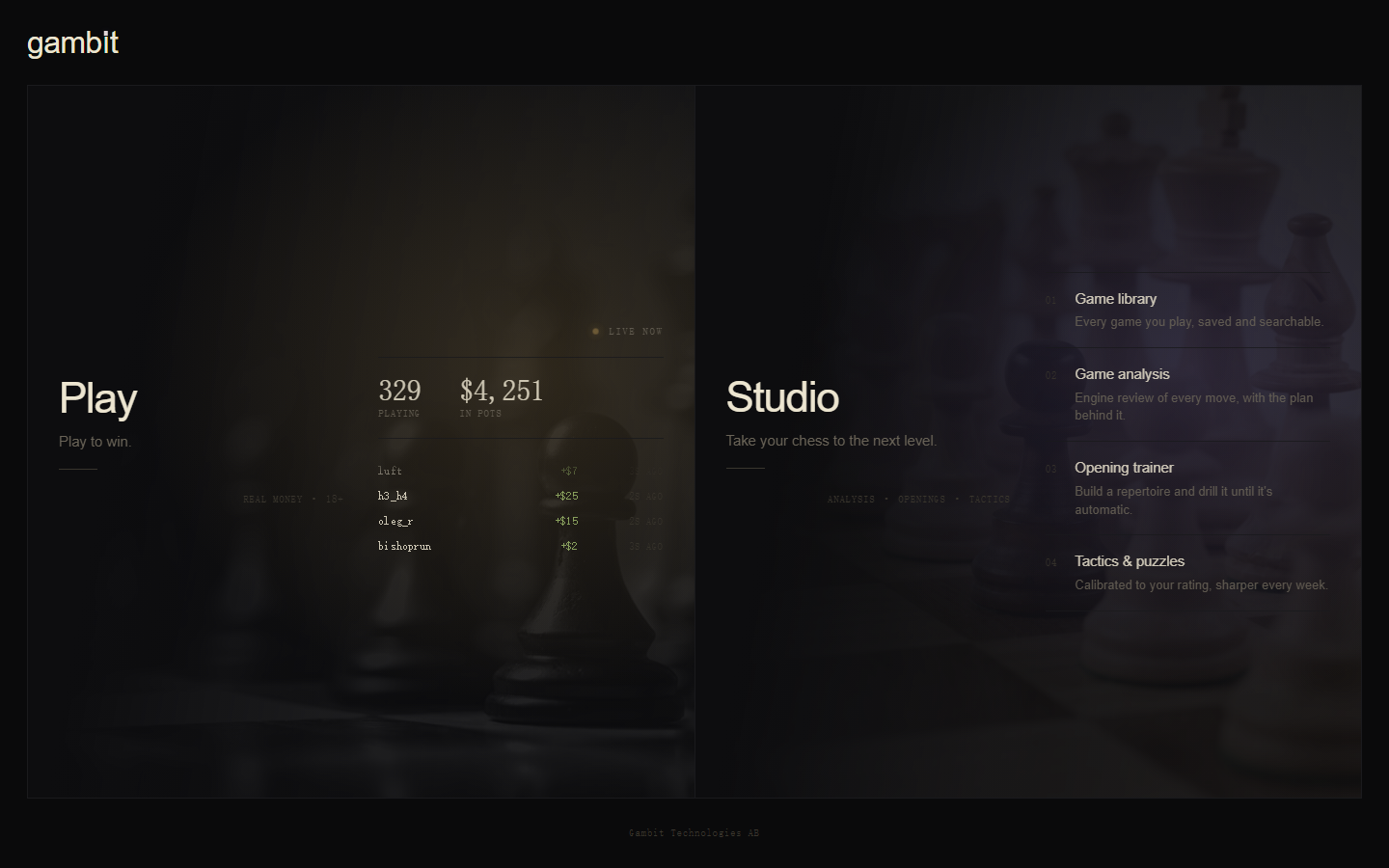
Gambit
Core parameters and statistics
Gambit is a next-generation chess platform launched by Sweden's Gambit Technologies AB, which integrates AI chess game analysis, tactical training and real-money competition in the same ecosystem. It is not a simple chess app, but a comprehensive platform covering the entire link of "training → chess → review → competition".
| Projects | Public Information |
|---|---|
| Official positioning | Next-Gen Chess Platform, Powered By Innovation |
| Development Company | Gambit Technologies AB (Stockholm, Sweden) |
| Date of establishment | Company organization number 559334-6439 |
| Core Team | CEO Viktor Brolin, Backend Markus Läll, Frontend Ludwig Bolling, Web Stefan Haack |
| Product Form | Web + iOS App |
| Game mode | Bullet (1 minute), Blitz (3-5 minutes), Rapid (10+ minutes) |
| Training Module | Game Library, Game Analysis, Opening Trainer, Tactics & Puzzles |
| Competitive Mode | Real Money Head-to-Head Play (Skill-Based Betting) |
| Anti-cheating | AI real-time detection + player identity verification |
| Age limit | 18+ |
| Latest version | 1.1.180 (2025-04-27, iOS) |
| App Store Rating | 1.7 stars (5 ratings) |
| App Size | 109.9 MB |
| Minimum system requirements | iOS 14.4+ |
Platform positioning: The core difference of Gambit is the dual-engine model of "real money competition + AI training". Unlike Lichess (completely free and open source) or Chess.com (subscription-based Freemium), Gambit introduces a real-money betting mechanism, so that each game has actual economic incentives, while providing AI-driven chess game review and opening training on the training side.
User Scale and Market Stage: Public data shows that the number of App Store ratings is small (5), indicating that the product is still in the early customer acquisition stage. Its core market appeal focuses on the narrative of "making money with chess skills", which is essentially different from the community atmosphere of traditional chess platforms.
Copyright History: The App Store page shows Copyright © Immortal Game AB, indicating that Gambit may have operated under the Immortal Game brand in the early stages, and later changed its name to Gambit Technologies AB.
User and market recognition
Community Popularity: Public market data for Gambit is currently limited. The App Store rating is only 1.7 stars (5 ratings), and user feedback focuses on the negative comments of "too many robot opponents", indicating that the platform still has much room for improvement in terms of real user scale and anti-cheating experience.
Media and Reports: The company blog (company.gambit.ai) published the "New Website, Same Mission" announcement in August 2025, announcing the launch of the official website revision. The platform has social accounts on Instagram (@gambit_app), Facebook (@gambitai), X/Twitter (@gambit_ai), and LinkedIn, but the number of fan interactions is not disclosed.
Target Customer Group: Gambit is clearly aimed at competitive chess players over 18 years old who are willing to invest real money in chess skills. This is in sharp contrast to Chess.com's pan-entertainment positioning and Lichess' geek public welfare positioning.
Prerequisites for implementation: The core barrier of the real money competitive platform is not the number of functions, but trust - that is, users must believe that the anti-cheating system of the platform is sufficient to ensure fairness and that the safety of funds is guaranteed. Gambit's current anti-cheating strategy (AI real-time detection + identity verification) theoretically covers mainstream cheating methods (engine assistance, machine accounts), but the actual effect still requires more user verification.
Cost advantage
Gambit's cost structure is fundamentally different from traditional chess platforms - instead of making money from subscription fees or advertising, it generates revenue from the rollover or rake of real-money games.
C-side fee: Registration and downloading are free. Players deposit funds for the game, and the winner receives a bonus pool, from which the platform draws a certain percentage (the specific draw ratio is not disclosed). Under this model, the user's "cost" is not the subscription fee, but the net loss and rake in the game.
Compare Chess.com: Chess.com’s paid membership (Diamond membership is about $9.99/month) offers unlimited puzzles, AI analysis, video lessons, and more. Gambit does not have a subscription system, but real money play means that the cost of a single game of chess may far exceed the monthly fee - a user with moderate chess skills and frequent participation may consume $50-$500 in a single month.
Comparison with Lichess: Lichess is completely free and open source, with no ads and no paywalls, and its AI analysis (Stockfish) is completely free and open. Gambit also offers free features on the training side (Game Analysis, Opening Trainer), but real money competition is something Lichess does not offer.
| Comparative Dimensions | Gambit | Chess.com | Lichess |
|---|---|---|---|
| Registration fee | Free | Free (membership $6.99-$9.99/month) | Totally free |
| AI chess game analysis | Free | Free (Basic) / In-depth analysis requires membership | Free (Stockfish) |
| Start training | Free | Member function | Free (open source tool) |
| Tactical puzzles | Free | Daily limit (unlimited membership required) | Free, unlimited |
| Real money competition | Support (platform rake) | Not supported | Not supported |
| Anti-cheating mechanism | AI detection + identity verification | Detection scoring + manual review | Open source detection tools |
| Business Model | Game Rake | Subscription + Advertising | Donation + Sponsorship |
Hidden costs: For users participating in real-money competitions, the biggest cost is not the platform fee, but a "competition tax" - high-level players have a significant winning rate advantage when facing low-level players, which may cause funds to be concentrated at the top; while beginners may lose money due to continuous losses before they have established sufficient chess strength. In addition, the platform’s pump ratio, withdrawal fees, and payment cycles directly affect players’ net income, but this information is not yet fully disclosed on the public page.
Main functions
Gambit's functional system is divided into two major sections: "Game Competition" and "AI Training". The two are connected in series through the Game Library:
- AI Game Analysis: Automatically generate an engine review after each game, marking the key winning and losing players and planning suggestions. Unlike pure Stockfish output, Gambit's review interface emphasizes the "plan behind the moves" to help users understand the strategic logic behind AI recommendations.
- Opening Trainer: Supports users to build a personal opening system and conducts targeted memory training through the Spaced Repetition mechanism, covering mainstream openings (King's Gambit, Queen's Gambit, Italian Gambling, etc.) to unpopular variations.
- Tactics & Puzzles: The difficulty of the questions is dynamically calibrated based on the user's current level. The question bank is updated every week, covering tactical combinations (double-click, containment, blitz, decoy, etc.) and endgame skills.
- Game Library: Automatically archives all games and supports multi-dimensional retrieval by time, opponent, opening, and winning and losing status, which facilitates systematic review and learning.
- Real-Money Matches: Bullet (1 minute), Blitz (3-5 minutes), and Rapid (10+ minutes) real-money head-to-head competitions with three time limits. The AI matching system automatically matches players based on their level and the amount of funds.
Hidden linkage: Game Library is not just a chess game archive, it is the "data bus" of the entire Gambit training system - each real-money game is automatically entered into the library. Users can directly retrieve any chess game from the library and enter Game Analysis for in-depth review. The weak points in the opening found in the review can be directly connected to the Opening Trainer for targeted training, forming a "game → review → training → game again" structure. This linkage mechanism is the core difference between Gambit and the fragmented feature experience of Lichess/Chess.com.
Model and version evolution
Gambit's version iteration has gone through the transformation from "pure chess app" to "AI training + real money competition platform":
Early stage (~2022): Listed on the iOS App Store under the name Gambit Chess, supporting basic game functions (Bullet/Blitz/Rapid) and Puzzle mode. The copyright owner is marked as Immortal Game AB, indicating that the product may be incubated under an independent brand during the seed stage.
Function expansion period (~2024): Introduce four major modules: Game Library, Game Analysis, Opening Trainer, Tactics & Puzzles, and initially complete the "game + training" dual-engine puzzle. At the same time, the company brand was switched from Immortal Game AB to Gambit Technologies AB, with the domain name gambit.ai.
Brand upgrade period (2025): iOS v1.1.180 (the latest verifiable version) will be released in April 2025, with bug fixes and performance optimization. In August 2025, a new official website (company.gambit.ai) will be launched to unify the brand image. Launched the Gambit Studio subdomain (studio.gambit.ai) to centrally host training modules.
| Version | Date | Core Changes |
|---|---|---|
| v1.0.0 | ~2022 | Initial release, supports Bullet/Blitz/Rapid game + Puzzle mode |
| v~1.1.0 | ~2024 | Introducing Game Library, Game Analysis, Opening Trainer, Tactics; brand switch to Gambit Technologies AB |
| v1.1.180 | 2025-04-27 | Bug fixes and performance optimization, anti-cheating system upgrade; the latest version can currently be verified |
Technical advantages
Gambit's technical architecture revolves around the two core propositions of "fair competition" and "intelligent training":
AI anti-cheating system: Gambit deploys a real-time AI detection model to continuously analyze the player's placement patterns, thinking time distribution and operating behavior characteristics during the game, and cross-compare with known engine recommended moves. When suspected engine-assisted behavior is detected, the system automatically triggers a flag and submits it for manual review. With the pre-existing identity verification (KYC) process, batch registration of machine accounts will be blocked from the moment of registration.
Intelligent Matching System: The AI matching engine considers the four dimensions of level score (Elo), historical winning rate, game time limit preference and fund level at the same time, making a dynamic trade-off between matching speed and fairness. In games with high capital levels, opponents with the same capital range will be matched first to avoid the asymmetric game of "small capital vs big capital".
Cross-platform synchronization: Based on the cloud account system, the user's chess game library, level score, fund balance and training progress are synchronized in real time between the Web and iOS. The technology stack supports seamless switching from browser to native app.
Training engine: The spaced repetition algorithm behind Opening Trainer automatically adjusts the review frequency of opening variations based on the user's historical memory curve; the difficulty calibration engine of the Tactics module dynamically adjusts the complexity of the questions based on the user's grade changes and problem-solving accuracy to maintain the best "flow zone."
Technical limitations: Gambit does not disclose the false positive rate and recall rate indicators of its anti-cheating model, nor does it specify the specific engine version used by the AI analysis engine (it may be Stockfish or a self-developed variant). For serious chess players, the depth of understanding and granularity of training details may not be as good as with professional desktop analysis tools (such as ChessBase, Fritz).
How to use
The relevant information has not been made public, please refer to the official real-time page.
Product Pricing
Gambit's charging model is completely different from traditional chess platforms - it is not a Freemium subscription, but a "free registration + real money game rake" model.
Free features: Registration, chess game library archiving, AI chess game analysis, opening training, and tactical puzzles are all free. In other words, all training features are paywall-free.
Real Money Competition Fees: Users deposit funds to participate in head-to-head matches, and the winner receives a bonus pool after deducting platform rake. The specific pumping ratio is not stated on the public page. Withdrawals may involve handling fees and processing cycles, which are subject to the platform's real-time rules.
Pricing comparison with competitive products:
| Projects | Gambit | Chess.com | Lichess |
|---|---|---|---|
| Free training | All free | Basic free, advanced requires membership | All free |
| Real money games | Support (platform margin) | Not supported | Not supported |
| Monthly fee | None (but the game cost depends on the frequency of participation and the amount of funds) | Platinum $6.99/month, Diamond $9.99/month | $0 |
| Potential monthly payout (active users) | Estimated $20-$200 (depending on bankroll and win rate) | $6.99-$9.99 | $0 |
| AI in-depth analysis | Free | Diamond membership required | Free |
Cost Warning: The user cost of the real money competitive platform is highly uncertain - if a user with a chess strength of 1200 Elo competes in a room with 1500 Elo, he may suffer continuous losses due to the gap in strength. Gambit does not provide clear guidance on "expected losses" or "responsible gaming" on its public page, and users need to assess the risks themselves.
Application scenarios
Gambit's product design determines that it covers three core scenarios, but it is obviously different from the applicable scenarios of traditional chess platforms:
- Scenario 1: Real money competition and social chess - Suitable for chess players who have a certain foundation of chess skills and want to verify their training results in competition and obtain financial rewards. Typical user portraits: club chess players, retired youth chess players, and online chess betting players. Gambit's AI matching and anti-cheating system reduce the risk of being "dominated by cheaters" to a certain extent, but the atmosphere of real-money competition is also more tense and not suitable for recreational players.
- Scenario 2: AI-assisted training and omission detection - Suitable for amateur chess players (Elo 1200-2000) whose goal is to improve their level. Review key losses with Game Analysis, strengthen weak starts with Opening Trainer, and stay tactically sharp with Tactics. In this scenario, Gambit's training depth is better than Chess.com's limited free quota, and is close to the Lichess experience but adds the real sense of pressure brought by "playing money".
- Scenario Three: Content Creators and Chess Educators - Gambit's chess game library supports export/sharing (the specific export format is not disclosed). Coaches can use students' real-money game data to conduct targeted analysis, and even use Gambit's real-money competition as a practical assessment for training camps. However, Gambit currently lacks a dedicated teaching dashboard or student management function, and covering this scenario requires the use of external tools.
Not suitable for scenarios: Gambit is not suitable for the following people - young chess players under 18 years old (age restriction); users who just want to play chess for free and casually (real money competitive atmosphere is too strong); professional chess players who need in-depth database analysis (such as ChessBase-level opening tree statistics, annotated GM game library); and users whose countries/regions are restricted by Gambit services.
Applicable people
Gambit's "free training + real money competition" dual-engine model determines that its user profiles are highly differentiated:
- Competitive chess players (core users): Players who are over 18 years old, have a certain foundation of chess skills, and are willing to monetize their chess skills. The real-money arena Gambit offers is its core value, and the AI training module is ancillary. This type of user is most sensitive to matching fairness and fund security.
- Self-taught amateur chess players: Players with an Elo in the 1200-2000 range and whose primary goal is to improve their chess skills. Gambit's free AI analysis, opening training and tactical questions are close to the Lichess experience, but the psychological pressure brought by the "real money" element may interfere with the training state, which is not an ideal choice for users who are easily nervous.
- Chess Educators: It can be used as an auxiliary teaching tool, using the chess game library and AI review function to provide students with post-class analysis. However, it lacks academic management and student progress tracking modules, and its large-scale use is limited.
Not applicable to the crowd:
- Youth under 18 years old: The platform has an age limit of 18+ and cannot be registered and used normally.
- Pure entertainment/casual chess players: Users who just want to play a casual game after get off work may feel uncomfortable in a real money competitive atmosphere.
- Professional Chess Players (>2200 Elo): The training depth and database functions are not as good as professional desktop tools such as ChessBase, and there is a lack of high-level opponents of the same level in real money competitions.
- Users restricted in their country: The list of countries/regions where platform services are available is not public, and some areas may not be accessible.
Summary and Outlook
Core Competencies: Gambit has opened up a unique dual-engine route of "real money competition + AI training" in the chess platform. Its core competitive barrier does not lie in the number of functions (Lichess provides almost the same amount of free analysis functions), but in the business model innovation of "directly converting competitiveness on the chessboard into economic gains". The combination of the AI anti-cheating system and the identity verification mechanism alleviates to a certain extent the core problem of "how to prevent cheaters from harvesting bonuses" in real money competitions. The four major modules on the training side (Game Library, Game Analysis, Opening Trainer, and Tactics) form an effective "game-review-training" structure, providing a structured improvement path for chess players.
Current Limitations:
- Insufficient user base: The App Store has a small number of ratings and low overall ratings, indicating that the product is still in the early customer acquisition stage, and the matching speed and opponent quality may be affected.
- Insufficient transparency: Key information such as the technical indicators of the anti-cheating model (false positive rate, recall rate), platform pumping ratio, and engine version are not disclosed, which affects the trust decision-making of serious users.
- Negative User Feedback: The negative reviews of "too many bot opponents" indicate that the actual effect of the anti-cheat system may not be as good as advertised.
- Compliance Risk: The legal positioning of real money sports in different countries/regions is different (involving gambling regulations). Gambit has not disclosed its operating license and compliance certification information. Users need to evaluate the legal risks in their region by themselves.
- No Android client: Currently only supports iOS and Web, and there is a gap in covering the Android user group.
Procurement/Adoption Risk Assessment: For adult competitive chess players who want to monetize their shogi skills, Gambit provides a low-threshold entrance to try it out - free registration, free use of training modules, and a small amount of money to participate in the game. However, before investing large amounts of money, it is recommended to focus on the following risk points: ① Whether the platform's pump ratio and withdrawal rules are clearly defined in the terms of service; ② The actual false positive rate of the anti-cheating system - mistakenly blocking accounts may lead to funds being frozen; ③ The company Gambit Technologies AB has a short operating history (organization number 559334-6439), and its long-term stability and fund custody security lack third-party audit endorsement; ④ The legal characterization of real money chess competition in your country/region. It is recommended to conduct a trial run with a low amount of funds for 1-2 months first, and then decide whether to increase the investment after verifying the matching experience and the smooth flow of funds.
Follow-up observation points: ① Android client release timeline; ② Release of anti-cheating system technical white paper or third-party audit report; ③ Whether the depth and professionalism of the opening library continue to improve (such as access to stronger engines, increased master chess game comparison); ④ Introduction of responsible gaming (Responsible Gaming) mechanism; ⑤ Company financing and team expansion.
Related tools:  Khanmigo, quizlet
How to use Gambit
Gambit provides two entrances, Web and iOS App, suitable for usage habits in different scenarios:
| How to use | Access address | Suitable scenarios | Remarks |
|---|---|---|---|
| Web browser | https://gambit.ai/ | Desktop in-depth analysis, multi-window operation | Just open the browser to use |
| Gambit Studio | https://studio.gambit.ai/ | Centralized access to analysis/opening/tactics modules | Training function entrance |
| iOS App | App Store Search "Gambit Chess" | Quick mobile chess game and fragmented training | Requires iOS 14.4+, 109.9 MB |
| Company information | https://company.gambit.ai/ | Get to know the team, blog FAQ | Non-product entrance |
Standard usage process:
- Registration and Verification: Visit gambit.ai or download the iOS App to register an account. Participating in real money games requires completing identity verification (KYC), which includes submitting identification documents and proof of address.
- Fund Deposit: Select the payment method to deposit funds (specific support channels are subject to the real-time page of the platform).
- Start the game: Select the Bullet/Blitz/Rapid time limit and fund level, and wait for the AI to match the opponent. You can also choose to practice in casual mode without funds (if provided by the platform).
- Review and Training: After the game, enter the Game Library and select any game to start Game Analysis. After discovering the weak points in the opening, switch to Opening Trainer for targeted training.
- Continuous Improvement: Complete Tactics & Puzzles every day to maintain tactical sensitivity and regularly backtest weak opening variations.
Quick Start Tips: New users can first use the free Puzzle mode to familiarize themselves with platform operations, and then participate in Blitz games with a small amount of money to test the matching quality and anti-cheating experience. After accumulating 20-30 game records, use Game Library + Game Analysis to conduct a systematic review to determine your opening system preferences and tactical weaknesses, and then transfer to Opening Trainer for targeted strengthening.
Version Info
- Gambit Chess 1.1.180 :The iOS version update includes bug fixes and performance optimization, and continues to strengthen AI anti-cheating detection and platform stability.
- Gambit Chess extended version :The introduction of four modules: Game Library (chess game library), Game Analysis (AI engine review), Opening Trainer (opening training) and Tactics & Puzzles (tactical puzzles) marks the transformation of Gambit from a pure chess platform to an AI training platform.
- Gambit Chess initial version :The first public version of Gambit Chess is launched on the iOS App Store, supporting Bullet/Blitz/Rapid games and Puzzle modes. The specific release date is subject to App Store history.
User Reviews