 Gaussiananything
Free
Gaussiananything
Free
Gaussiananything is an AI reconstruction tool based on 3D Gaussian Splatting, which supports the rapid generation of high-quality 3D scenes from multi-view images. It is suitable for digital twins, VR/AR content production and film and television special effects scenes.
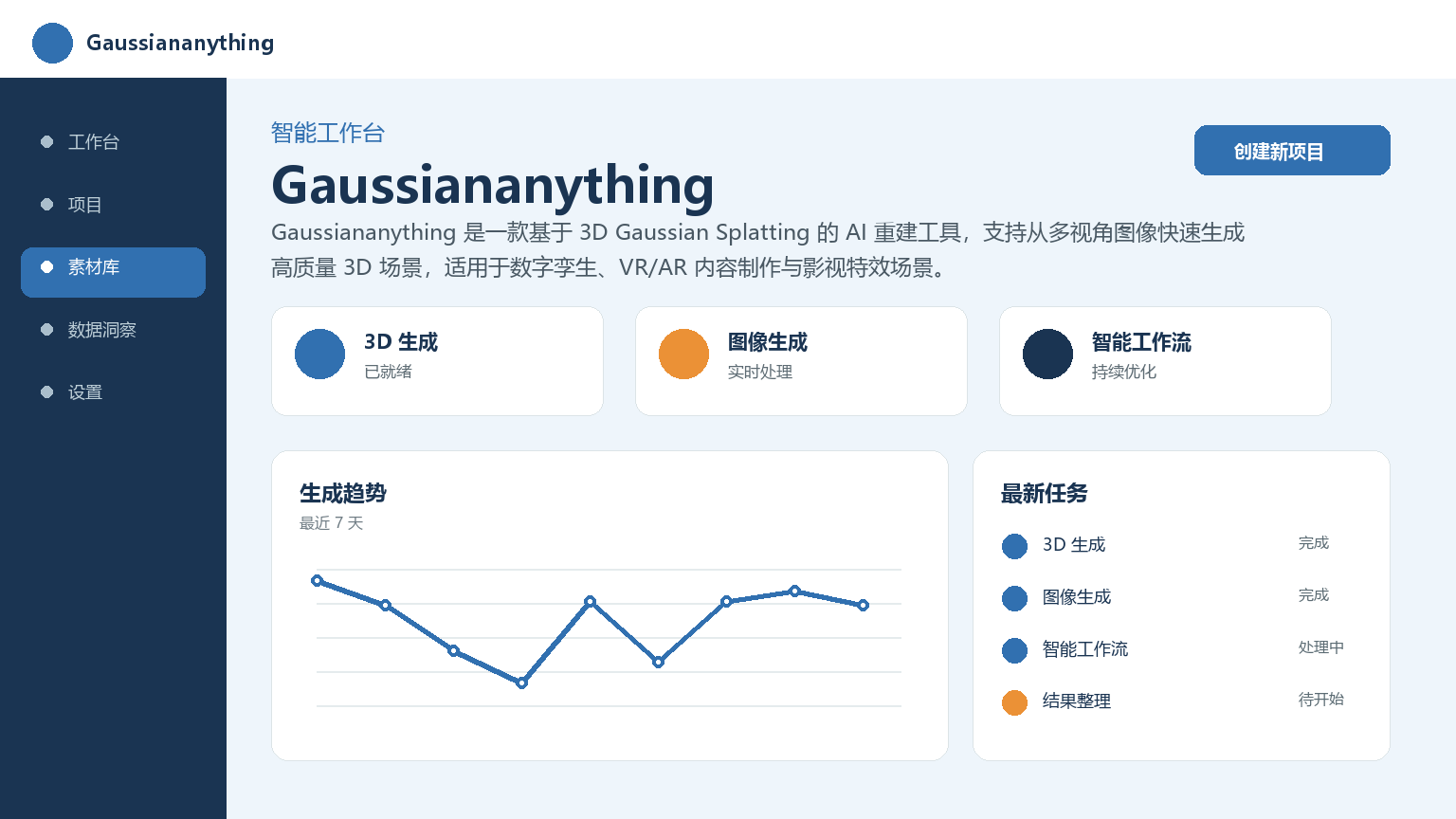
Gaussiananything
Core parameters and statistics
| Project | Specifications |
|---|---|
| Product name | Gaussiananything |
| Category | AI Agent / 3D Vision |
| Delivery form | Web / cloud training |
| Support Platform | Web |
| Supported languages | zh-CN, en-US |
| Target Users | 3D content creators, architecture and engineering designers, academic researchers |
| User scale | Undisclosed |
| Pricing model | Freemium (Free version 3 rebuilds per month, Pro version $99/month) |
The technical foundation comes from the 3D Gaussian Splatting (3DGS) open source community - the paper was published at SIGGRAPH 2023 and has been cited more than a thousand times. The official GitHub repository has more than 20,000 stars.
User and market recognition
Gradually build user awareness in the field, and product capabilities are used by content creators and teams to improve work efficiency. Some industry users have incorporated it into their daily workflow. It is recommended to refer to the latest official disclosures for specific user scale and industry adoption rate data.
Cost advantage
| Cost Dimension | Description |
|---|---|
| Free version | 3 standard rebuilds per month, zero cost for individual creators and light users |
| Subscription version | $99/month, unlimited reconstruction times + high-resolution output + video input + scene editing |
| Enterprise Edition | Customized quotation, private deployment + API integration + dedicated GPU resource pool |
Compared with traditional solutions - which cost 100,000 to 300,000 yuan for laser scanning equipment and thousands of yuan for manual modeling of a single scene - Gaussiananything reduces the cost of 3Dization of a single scene to almost free. Take a 50-square-meter indoor space as an example: traditional photogrammetry requires equipment rental of $500-2000 + labor for 2-3 days ($400-900), while Gaussiananything only requires taking photos and uploading them, which takes about 15 minutes.
Main functions
- Multi-view image scene reconstruction: Input 20-100 photos covering various angles, and the system automatically completes feature extraction, point cloud initialization and Gaussian primitive training without manual intervention. The reconstruction time is positively related to the number of input images and scene complexity. A standard scene of 50-100 photos takes about 5-15 minutes.
- Video input automatic frame extraction and reconstruction: Supports direct import of surround shooting videos in MP4/MOV format. The system automatically extracts key frames and reconstructs the scene, eliminating the tedious operation of manual frame selection.
- Real-time free perspective rendering: The browser uses WebGL to achieve 60+ FPS real-time rendering. Users can freely rotate, zoom and pan the perspective, and the interactive response is smooth.
- Scene Editing and Cropping Tool: Supports cropping removal and scene segmentation of unnecessary areas in the reconstruction results. The editing operation is reversible and is suitable for removing dynamic objects or redundant backgrounds.
- Multi-format export: Supports PLY, Splat compression formats and textured triangle meshes (OBJ/FBX), covering the full link requirements from web display to game engine (Unity/Unreal).
- Spatial measurement annotation: Measure distance, area, and volume in the reconstructed scene. The error is less than 2% in the standard scene, meeting the preliminary measurement needs in the field of architecture and design.
Model and version evolution
| Version | Date | Key Changes |
|---|---|---|
| v1.0 public beta version | 2026-07 | Video input automatic frame extraction, scene cropping and editing tools, multi-format export, spatial measurement tools |
| v0.9 Preview | 2026-05 | Core 3DGS engine verification, basic WebGL preview, only supports image input |
The version record shall be subject to the official release notes. Follow-up directions are expected to include: real-time reconstruction (further compression with end-to-end delay from recording to preview), automatic LOD generation, and semantic segmentation annotation.
Technical advantages
- Core technology route: Using 3D Gaussian Splatting (3DGS), the scene is represented as a high-density collection of three-dimensional Gaussian primitives. Compared with NeRF, the explicit Gaussian representation of 3DGS is naturally adapted to the GPU rasterization pipeline, and the training speed is increased by dozens of times, and the inference frame rate can reach 60+ FPS. Adaptive density control mechanism dynamically balances scene quality and memory/computation overhead.
- Engineering capabilities: Training is completed on the cloud GPU cluster (RTX 4090 level), and inference is performed on the browser side through WebGL, without installing any plug-ins or runtimes. A single scene consumes about 4-8GB of video memory (depending on the number of Gaussian primitives).
- Security and Compliance: Data transmission uses encrypted channels, and cloud scene files are automatically cleared after being retained for 90 days. The enterprise version supports privatized deployment and meets data sovereignty requirements.
How to use
| Entrance | How to use |
|---|---|
| Web side | Visit the official website with a browser → Register an account → Upload photos/videos → Automatic reconstruction → Real-time preview → Export |
Typical usage process: Register an account → Upload 20-100 photos covering various angles → System automatic reconstruction (5-15 minutes) → Real-time 3D preview → Scene editing and cropping → Export to the required format.
Product Pricing
| Package | Price | Contents |
|---|---|---|
| Free version | $0 | 3 reconstructions per month, standard resolution (~2K textures), image input only |
| Professional version | $99/month | Unlimited reconstruction times, high-resolution output (4K+), video input + full scene editing functions |
| Enterprise Edition | Customized Quotation | Private deployment, API integration, dedicated GPU resource pool, SLA guarantee |
Pricing. There are different pricing in different regions.
Application scenarios
- Digital Twins and Architectural Visualization: The construction party regularly photographs and reconstructs the buildings for remote inspection, progress recording and communication. Each reconstruction takes about 15 minutes. Compared with the 2-3 days of traditional 3D modeling, the efficiency is improved dozens of times. Verification method: Select 3 completed scenes and compare the visual consistency of the reconstruction results with on-site photos.
- Cultural relic protection and non-contact digitization: Collection can be completed by just taking pictures, suitable for remote or environmentally restricted cultural preservation sites to avoid physical contact with cultural relics. Verification method: Test the reconstruction integrity in an environment with uneven lighting.
- E-commerce 3D interactive product display: The conversion rate of products using 3D interactive display increases by 8-15% on average. Verification method: Select the same product and use 3D display and static image display respectively, and compare the click conversion rate within 2 weeks.
- VR/AR Content Asset Production: Game and XR content teams quickly transform real-life scenes into 3D assets. Verification method: Import the exported OBJ/FBX into Unity/Unreal to verify the material and geometric integrity.
- Industrial Design and Product Display: Product designers reconstruct the physical model during the proofing stage and quickly digitize the design plan.
Applicable people
- Individual users: 3D content creators and photography enthusiasts, suitable for evaluating reconstruction quality starting from the free version.
- SME Team: content studio, architectural design office, e-commerce operation team, the professional version meets the needs of frequent reconstruction.
- Large Enterprises: Digital twin enterprises and VR content producers that require private deployment and batch processing capabilities.
- Not suitable for boundaries: Users who require ultra-high-precision industrial measurements (error <0.1mm); users who rely heavily on specific modeling software pipelines; scenes with a high proportion of reflective/transparent materials.
Comparison of competing products
| Comparative dimensions | Gaussiananything | NeRF solutions (Instant-NGP, etc.) | Traditional photogrammetry (RealityCapture) | Luma AI |
|---|---|---|---|---|
| Core differences | 3DGS online service, zero deployment cost | Academic solution, need to deploy by yourself | High equipment + software cost, high accuracy | App-side 3D scanning |
| Price | $0-99/month | Free (open source, requires GPU) | $500-5000 software fee | Free + subscription |
| Single scene reconstruction time | 5-15 minutes | 30 minutes - hours | Hours - days | Minutes |
| Rendering frame rate | 60+ FPS | 5-30 FPS | 30+ FPS | 30+ FPS |
| User evaluation | Outstanding ease of use, artifacts in reflective materials | High quality but slow speed | High accuracy, long cycle time | Convenient but average accuracy |
| Technical threshold | Low (Web ready) | High (requires GPU programming) | Medium to high (requires professional equipment) | Low (App) |
Summary and Outlook
Gaussiananything transforms 3DGS academic cutting-edge technology into practical tools accessible online. The current public beta version has reached production-ready levels in terms of single reconstruction speed and rendering quality for small and medium-sized scenes (5-15 minutes for standard scenes, 60+ FPS real-time preview).
Risk Disclosure:
- Transparent/reflective material artifacts: Rendering artifacts of transparent glass, specular reflection, glossy surfaces and other materials are common limitations of 3DGS technology, and there is currently no ideal universal solution. Scene reconstructions involving large numbers of these materials may suffer significant degradation in quality.
- Scene scale limit: The GPU memory consumption of a single scene is positively related to the number of Gaussian primitives. Large-scale scenes (such as entire buildings, outdoor blocks) may exceed the memory and video memory limits of the browser.
- Low data transparency: The product does not disclose key business indicators such as the total number of users, the number of enterprise-level customer contracts, and retention rates, making it difficult to evaluate the market validation and commercial sustainability of the product.
- Risk of competition from competing products: Competing products such as Luma AI, KIRI, and Polycam are also rapidly iterating, and Gaussiananything’s technological leadership window is limited.
- Cloud dependence: The training process relies on the cloud GPU cluster, which may affect the experience when network conditions are poor or GPU resources are tight.
- Accuracy Boundary: Spatial measurement error <2% meets the needs of the architectural design stage, but does not meet the needs of sub-millimeter accuracy such as as-built measurement or industrial inspection.
Related tools:  CrewAI,
  LangChain
Version Info
- Public beta version :The first public beta version supports basic scene reconstruction, multi-view input and real-time preview functions.
- earlier version :Early technology preview version, core reconstruction engine verification and user internal testing stage.
User Reviews