 Gemini
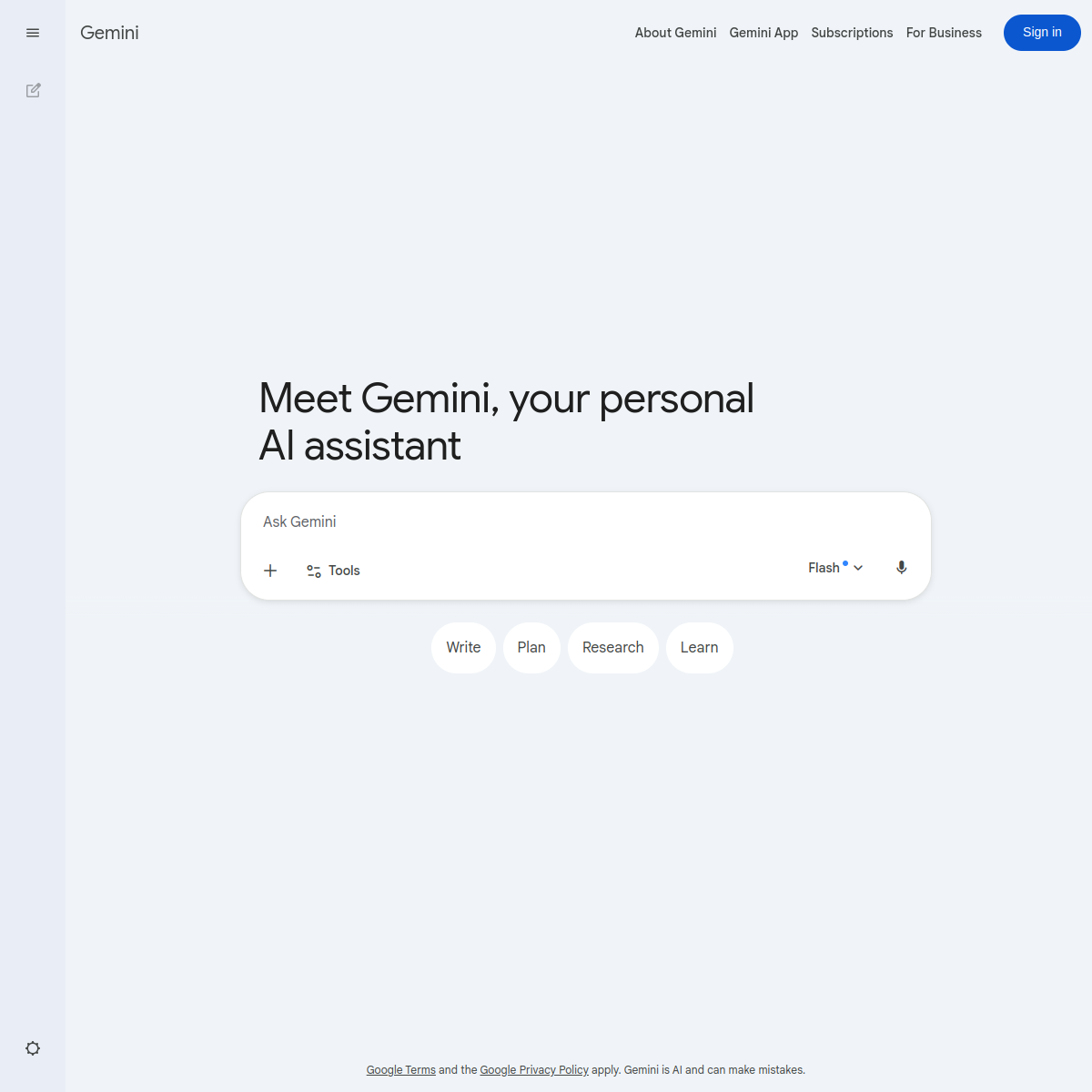
Gemini is AI chat assistant launched by Google. It is driven by the Gemini model family developed by Google DeepMind. It provides native multi-modal, long-context Deep Research and Agent capabilities, covering Web, mobile App, Google Workspace and developer API. The current main models include Gemini 3 Pro, Gemini 2.5 Pro and Gemini 2.5 Flash.
Gemini
Gemini’s core parameters and statistics
Gemini is not a single product, but a combination of "consumer App + developer platform + industry solution + model matrix" built by Google with the Gemini model family as the core. To judge its actual capabilities, you need to look at the specific model version, subscription package API call price, AI Studio/Vertex AI access method, and functional differences in Search, Workspace, Android and other scenarios.
| Dimensions | Key facts |
|---|---|
| Current flagship model | Gemini 3 Pro (released on 2025-11-18) |
| Main production models | Gemini 2.5 Pro, Gemini 2.5 Flash, Gemini 2.5 Flash-Lite |
| Multimodal models | Nano Banana Pro (image), Veo 3.1 (video), Imagen 4, Lyria 2 (music) |
| Context window | Gemini 2.5 / 3 Pro: up to 1M token; 2.5 Pro history supports 2M token |
| Product entrance | Gemini App (Web / iOS / Android), AI Studio, Vertex AI, Search AI Mode, Workspace, NotebookLM, Antigravity |
| Developer Platform | Google AI Studio (ai.studio), Vertex AI, Gemini API, Firebase AI Logic |
| Agent capabilities | Deep Research, Canvas, Gems, Agent Mode, Computer Use (preview) |
| Peripheral products | Antigravity (IDE), Jules (asynchronous coding agent), NotebookLM, AI Mode in Search |
| Applicable people | Individual users, professional users, developers, enterprises, education and public sectors |
| Public information status | Model, pricing, and product matrix are public at official deepmind.google and ai.google.dev |
The actual meaning of model layering: Gemini 3 Pro is the flagship, maintaining the highest level within Google on benchmarks such as mathematics (AIME, MATH), science (GPQA), and coding (SWE-bench); Gemini 2.5 Pro is a long-term proven thinking workhorse, performing stably in long-context reasoning and Agent tasks; Gemini 2.5 Flash is the first choice for cost-effectiveness, suitable for large-scale production and real-time interaction; Flash-Lite It pushes low latency and low cost to the extreme, targeting embedded and edge scenarios. The four-layer model forms a clear gradient in terms of capability-cost-latency, and the mixed calling strategy (Flash for daily processing + Pro for solving difficult problems) is the officially recommended mainstream usage.
Three-level design of context window: Gemini 2.5 Pro / 3 Pro provides up to 1M token context (2.5 Pro historically supports 2M). 1M token is enough to process the core source files of a very large code warehouse or a collection of hundreds of pages of technical documents at one time. However, the longer the context, the greater the inference delay and KV cache overhead. In actual use, it is recommended to enable the full context in scenarios that really require cross-chapter and cross-file association. Daily tasks should be controlled within 128K to control costs and response times.
Performance and Deployment Metrics: Google has not continued to disclose the precise TTFT (first word delay) and TPM/RPM frequency control values of the Gemini model. According to feedback from AI Studio and Vertex AI, the TTFT of Gemini 2.5 Flash under medium concurrency is about 200-500ms, and that of Gemini 3 Pro is about 500-1500ms (including thinking mode). In terms of frequency control, the free tier of AI Studio has a certain number of requests per minute and daily token quota limit by default, and the Vertex AI Enterprise Edition can be expanded as needed. The specific values are based on the official real-time page and actual deployment tests.
Gemini’s users and market recognition
Gemini's market recognition is reflected in the large-scale distribution of Google's own channels and extensive access to the developer ecosystem, but it is not as transparent as OpenAI and Anthropic in terms of third-party independent evaluation.
Distribution advantages for individual users: Gemini App is publicly available on the Web, iOS, and Android, and has replaced Google Assistant as the default AI assistant for Android devices in many countries. Relying on pre-installation on flagship models such as Pixel and Samsung Galaxy, Gemini reaches far more users in the Android ecosystem than similar chat AI products. However, Google has not made public the actual user activity and retention rate data, and it is impossible to directly compare ChatGPT or Claude’s user engagement.
Dual platform entrance for developers: Google AI Studio (ai.studio) provides developers with zero-threshold model trial and API Key acquisition channels. The free tier allows you to call Gemini 2.5 Flash and experience Deep Research, image/video generation and other capabilities. Vertex AI is geared towards enterprise-level scenarios, providing SLA, regional residency, audit logs and private data fine-tuning. This path of "AI Studio rapid verification → Vertex AI production deployment" enables Gemini to have access points across the spectrum from independent developers to large enterprises.
Industry coverage of enterprise customers: Google Cloud’s public customer cases include Mercedes-Benz (cars), Wendy’s (retail catering), Verizon (telecommunications), HSBC (finance), Deutsche Bank (finance), Wayfair (e-commerce), Toyota (travel) and other industry leading companies. These cases cover customer service, marketing content generation, code assistance, document processing and other scenarios, but most of them belong to the "integration exploration" stage rather than full business line replacement. Enterprises need to clarify Gemini’s ROI expectations in specific businesses and Vertex AI’s business terms before purchasing.
Breadth of ecological distribution: Gemini is embedded in Google Workspace (Docs/Sheets/Gmail/Meet), Google Search (AI Mode/AI Overviews), Android system Chrome browser NotebookLM and other products. In the developer tool ecosystem, the Gemini model is accessed as an optional model by mainstream frameworks and tools such as Cursor, Vercel v0, Replit, Anthropic Claude Code, LangChain, and LlamaIndex. This third-party access verifies Gemini's recognition in the developer community, but the depth of ecological integration and the amount of model calls are weaker than OpenAI's GPT series.
Gemini’s cost advantage
Gemini's cost structure is divided into two paths: "consumer-level subscription" and "developer API/cloud platform call", covering the three layers of C-side, developer and enterprise.
C Client/Personal Tier (Google AI Plans): The Free Tier is completely free and provides Gemini 2.5 Flash, basic Deep Research, and limited image and video generation quota. Google AI Plus (approximately $19.99/month) unlocks more Gemini 3 Pro quota, expanded Deep Research, Veo 3.1 video quota and Workspace AI capabilities 2TB cloud storage. Google AI Pro (also about US$19.99/month, mainly recommended in Asia-Pacific) focuses on providing Gemini 3 Pro high quota NotebookLM Plus and Whisk/Flow creative tools. Google AI Ultra (approximately US$249.99/month) is aimed at heavy users and provides priority access to cutting-edge capabilities such as Gemini 3 Pro / Deep Think's highest quota, Veo 3.1's flagship quota, Project Mariner. The price is subject to the actual display on the landing page of each region.
Developer/API layer (per million tokens, text):
| Model | Input (≤200K / >200K) | Output (≤200K / >200K) |
|---|---|---|
| Gemini 3 Pro | $2 / $4 | $12 / $18 |
| Gemini 2.5 Pro | $1.25 / $2.50 | $10 / $15 |
| Gemini 2.5 Flash | $0.30 | $2.50 |
| Gemini 2.5 Flash-Lite | $0.10 | $0.40 |
Key insights into the cost structure: Flash-Lite and Flash reduce the unit token cost to the input range of 0.10-0.30 US dollars/million tokens, which is in the same order of magnitude as DeepSeek V4-Flash (1 yuan/million tokens, about 0.14 US dollars), and is the default choice for large-scale production and high-throughput scenarios. The price difference between 3 Pro and 2.5 Pro combined with the 1M context window makes the hybrid strategy of "Flash or Flash-Lite processing daily > 200K tokens use Pro" feasible in terms of cost. Context Caching (lower price on cache hits) and Batch API (~50% discount) have a significant impact on the actual unit cost for scenarios such as long prompts, RAG, batch analysis, etc.
Enterprise Tier (Vertex AI): Enterprise pricing is negotiated based on usage, compliance area, and deployment model. The core added value lies in SLA guarantee, data residency compliance, private model fine-tuning (Tuning), and Google Cloud ecological integration (BigQuery, Cloud Storage, Looker, etc.). For customers with strict data sovereignty requirements or large-scale inference needs, Vertex AI’s bargaining space and compliance coverage are key decision factors. Please contact the Google Cloud sales team for specific quotes.
Main functions of Gemini
Gemini's functional coverage is not a single chat box, but a modular matrix centered around six lines of capabilities: "Conversation Understanding + In-depth Research + Multi-modal Generation + Coding + Agent + Enterprise Collaboration". The following six functions are officially verified core capabilities and have significant synergy with each other - the output of one task can directly become the input of another task, reducing cross-tool switching costs.
-
Conversation and Daily AI Assistant: Gemini App provides a unified entrance on Web / iOS / Android, supporting voice, text and image input. Hidden linkage: The copy generated in the conversation can be sent to Gemini in Workspace for further editing or translation with one click, without copying and pasting across applications.
-
Deep Research and Long Task Automation: Schedule Gemini models for multi-step retrieval, reading, sorting and output of research reports with citations. Synergy effect: Research conclusions can be directly used as input material for multi-modal generation (Nano Banana infographic, Veo video abstract), forming a one-stop link of "research → content generation → distribution". For industry researchers, analysts and content teams, this means the end-to-end time from writing to visual presentation of an industry research report can be reduced from days to hours.
-
Native multi-modal generation: image generation and editing (Nano Banana Pro), video generation (Veo 3.1), music generation (Lyria 2), creative flow (Whisk/Flow). Core points of difference: Nano Banana Pro is an image model of the Gemini 3 era. It natively supports multiple rounds of editing, precise text rendering and style consistency. It is not the "uncontrollable one-time generation" of traditional Vincentian images. Veo 3.1 supports high-fidelity video generation and editing with original audio. These models are linked within the same app, allowing creators to go from inspirational sketches to complete videos in a conversation.
-
Coding and IDE experience: Antigravity (AI native IDE launched by Google) and Jules (asynchronous coding agent) cooperate with Gemini 3 Pro / 2.5 Pro to provide interactive coding and background task execution. Implementation Tips: Antigravity’s cross-file editing capability relies on Gemini’s long context window. It is recommended to open the context window to 1M for best results when dealing with large code bases, but please note that the first word delay will increase accordingly.
-
Agent and Computer Use: Gemini API provides native tool calling (Function Calling), Live API (bidirectional real-time multi-modal flow), and Agent Mode. Project Mariner is a browser automation exploration project based on Gemini. Agent Tool open list: The core tools that Gemini exposes to model calls include
google_search(real-time retrieval),code_execution(sandbox code running),function_call(custom API call),computer_use(screen interaction, preview),image_generation(Nano Banana),video_generation(Veo). The model completes an Agent closure by "receiving instructions → planning subtasks → sequentially calling tools → summarizing results". -
Google Workspace and Search integration: Gemini is embedded in Workspace applications (writing assistance, meeting summary, formula generation) such as Gmail, Docs, Sheets, Slides, Meet, etc., and is integrated into the main traffic portal of Google Search in the form of AI Mode/AI Overviews. NotebookLM provides "source-driven" note organization and question-and-answer capabilities, and strictly limits model output within the scope of user-uploaded materials, making it suitable for rigorous knowledge work scenarios.
Gemini model and version evolution
Gemini's version iteration has gone through three architectural transitions from the first release in December 2023 to Gemini 3 Pro in November 2025, forming an evolutionary path of "Basic Multimodality → Long Context → Agent Native → Deep Reasoning and Multimodal Unification".
First generation: Gemini 1.0 series (2023-12)
Gemini 1.0 Ultra/Pro/Nano is the first version of the Gemini model family, officially replacing Bard and PaLM 2 as Google's flagship generative AI matrix. The three levels of specifications are respectively aimed at complex reasoning, general tasks and device-side deployment. The core breakthrough at this time is the multi-modal native architecture - text, images, audio, and video share the same model representation, rather than superimposing a visual encoder on the text model like GPT-4V.
Second generation: Long context and Agent foundation (2024-02 to 2024-12)
- Gemini 1.5 Pro (2024-02-15): Implements 1M/2M token long context for the first time, promoting engineering practice of long documents and code base-level understanding. This capability directly affected the design direction of subsequent NotebookLM and Deep Research products.
- Gemini 2.0 Flash (2024-12-11): Introducing native tool calls and Live API (real-time multi-modal API), marking Gemini's entry into the Agent era. Live API supports real-time bidirectional streaming of audio and video, providing underlying capabilities for voice assistants and multi-modal interactive products.
Third Generation: Thinking Model and Cost-Effectiveness Stratification (Mid-2025)
- Gemini 2.5 Pro (2025-06-17): Add thinking mode to significantly improve the quality of tasks that require chain reasoning such as mathematics, science, and coding. Long-standing high-quality default option in AI Studio and Vertex AI.
- Gemini 2.5 Flash (2025-06-17): Released on the same day as Pro, bringing the thinking model into a cost-effective model. Supports multi-modal input and is oriented to large-scale production.
- Gemini 2.5 Flash-Lite (2025-07-22): Pushing the extremes in cost and latency, suitable for embedded, high-throughput, and edge scenarios.
Fourth Generation: Gemini 3 and Multimodal Unification (2025-11)
- Gemini 3 Pro (2025-11-18): The flagship of the Gemini 3 series, focusing on cutting-edge reasoning, native multi-modal Agent and 1M long context. Refresh benchmarks in math, science, coding, and more.
- Nano Banana Pro (2025-11-20): The image generation and editing model of the Gemini 3 era, natively supports multiple rounds of editing, text rendering, and style consistency.
- Veo 3.1 (2025-10-15): Video generation model with original audio, high-fidelity output, integrated in Gemini App and Vertex AI.
Key points of version context: Gemini’s naming jumps from the numerical series (1.0 → 1.5 → 2.0 → 2.5 → 3), and each major version is accompanied by architecture-level changes (long context agent, deep reasoning). It is worth noting that Google maintains two technical lines: "Gemini Model" and "Multimodal Special Model (Nano Banana/Veo/Imagen/Lyria)" at the same time. The former is a general inference engine and the latter is a professional generation engine. The two are used in combination in Gemini App and AI Studio. When evaluating Gemini's capabilities, you should not only look at model benchmarks, but also at the depth of multi-modal specialized models and product integration.
Gemini’s technical advantages
Gemini's technical barrier is not a single indicator lead, but a systemic advantage from model architecture, infrastructure to product distribution.
Mechanism and effect of native multi-modal architecture: Gemini has been designed as a native multi-modal model since the first version. Text, images, audio, and video share the same model representation layer, instead of plugging in a visual/audio encoder on the text model. This means that Gemini does not need to switch data formats between multiple professional models when performing cross-modal inference (such as "audio describing this picture and translated into Japanese"), resulting in lower latency and accuracy loss. Applicable scenarios include mixed image and text understanding, video content summary, multi-modal Agent tasks, etc.
Engineering implementation of long context window: Gemini 2.5/3 Pro’s maximum 1M token (2.5 Pro historically supports 2M) is derived from Google’s accumulation of Transformer long sequence optimization, including sparse attention, memory compression and inter-TPU communication optimization. For developers, 1M context means that the entire medium to large code repository or hundreds of pages of technical documents can be read in at once for cross-file/cross-chapter analysis, without the need for manual chunking and splicing. However, the longer the context, the inference delay increases sub-linearly - the first word delay of an extreme full 1M scenario may reach 3-5 seconds. For daily use, it is recommended to control the context length as needed.
Deep Think's controllable reasoning intensity: The flagship model supports the Deep Think extended thinking mode, which automatically generates longer chain reasoning paths to obtain higher-quality answers on tasks such as mathematical proofs, competition programming, and complex planning. Developers can control the intensity of thinking through API parameters to make a trade-off between speed and quality. This is similar to DeepSeek's "three-level reasoning mode" (Non-think / Think High / Think Max) design idea, but Gemini's thinking mode has a coarser granularity (default vs depth), and the Token consumption of the thinking process will be additionally included in the output billing.
Scale effects of TPU infrastructure: Gemini series models are trained and served on Google TPU (Tensor Processing Unit) clusters. TPU's matrix operation unit specifically designed for deep learning makes it superior to GPUs of the same generation (such as NVIDIA H100) in terms of unit computing power cost, and Google's internal large-scale TPU deployment ensures the capacity stability of model services. For batch inference and high-concurrency scenarios, the marginal cost advantage of TPU will be directly reflected in API pricing competitiveness.
Natural distribution of the product matrix: Gemini is not just an API or an App, but an AI capability layer embedded in products with billions of monthly users, such as Search (AI Mode/AI Overviews), Workspace (Docs/Gmail/Meet), Android (system-level Assistant replacement), Chrome, and YouTube. This means that Gemini’s user access cost is almost zero, and each product scenario is providing Gemini with real interaction data to optimize the model. This is a structural advantage that OpenAI and Anthropic cannot replicate.
Gemini usage path
Gemini provides multi-level usage paths from zero-threshold chat to enterprise-level API integration. Different entrances correspond to different capability sets and service terms.
Webpage and App (Consumer Level Entry)
- Entrance: gemini.google.com (Web), iOS App Store, Android Google Play and system integration
- Scope of capabilities: Dialogue Deep Research, image/video generation Gemini in Apps (Google account associated)
- Applicable people: individual users, light creators, daily learning and research
- Cost: Free tier $0; Plus/Pro approximately $19.99/month; Ultra approximately $249.99/month
Google AI Studio (Developer Experience and Prototyping)
- Entrance: https://ai.studio/
- Scope of capabilities: All Gemini models try Prompt debugging API Key management, multi-modal generation demonstration
- Applicable people: independent developers, entrepreneurial teams, product prototype verification
- Cost: The free tier includes quota limits, and the excess is billed according to API pricing.
Gemini API (Production Level Integration)
- Entrance: https://ai.google.dev/gemini-api/docs
- Model ID:
gemini-3-pro,gemini-2.5-pro,gemini-2.5-flash,gemini-2.5-flash-lite - Core Parameters SDK Example (Python):
import google.generativeai as genai

genai.configure(api_key="<YOUR_API_KEY>")

model = genai.GenerativeModel(
    model_name="gemini-2.5-flash",
    system_instruction="You are a professional technical documentation assistant. Please answer in Chinese."
)

response = model.generate_content(
    "Explaining how Gemini's context caching mechanism works",
    generation_config=genai.types.GenerationConfig(
        temperature=0.3,
        max_output_tokens=2048,
        response_mime_type="text/plain",
    ),
    stream=False
)
print(response.text)
Vertex AI (Enterprise Grade Platform)
- Entrance: https://cloud.google.com/vertex-ai
- Capability scope: enterprise-level SLA, data residency, model fine-tuning (Tuning), access control, audit logs
- Applicable people: medium and large enterprises, compliance-sensitive industries
- Cost: Pricing based on usage and business contract
Google Workspace and Search
- Entrance: Gemini sidebar Google Search AI Mode in the Workspace app
- Scope of abilities: email writing, document summarization, meeting minutes, complex search Q&A
- Applicable people: enterprise office users, knowledge workers
Typical calling link (Agent scenario): User command → Gemini API parsing intent → Function Calling selection tool → Call google_search / code_execution / image_generation → Aggregate results → Return to user. For Agent tasks, it is recommended to use Gemini 2.5 Flash as the daily planning engine, and Gemini 3 Pro to handle subtasks that require deep reasoning. The number of Agent execution steps can be controlled through the max_steps parameter to prevent infinite loops.
Gemini product pricing
Gemini's pricing system covers different user groups with three layers of "consumer-level subscription × API pay-per-use billing × enterprise negotiation". The following is a layer-by-layer analysis from individuals to enterprises.
Consumer Google AI Plans:
| Package | Monthly Fee | Core Competencies | Applicable People |
|---|---|---|---|
| Free | $0 | Gemini 2.5 Flash, basic Deep Research, limited image/video generation | Light individual users |
| Google AI Plus | ~$19.99 | Gemini 3 Pro quota, extended Deep Research, Veo 3.1 quota Workspace AI, 2TB cloud storage | Daily heavy user |
| Google AI Pro | ~USD 19.99 | Gemini 3 Pro High Quota NotebookLM Plus, Veo/Imagen High Quota Whisk/Flow | Asia Pacific Region Mainstream (Content Creator) |
| Google AI Ultra | ~$249.99 | Gemini 3 Pro / Deep Think Highest Quota Veo 3.1 Flagship Quota Project Mariner Priority Access | Professional Users/Heavy Creators |
API pay-as-you-go: See the price list in the cost advantage chapter above. Key additions - Multi-modal input (image, audio, video) is charged based on token equivalent conversion. The specific conversion coefficient is subject to the AI Studio pricing page; Context Caching greatly reduces the input cost when the cache is hit, which is suitable for scenarios where the system prompt word is fixed and the dialogue prefix is stable; the Batch API provides about 50% discount, which is suitable for non-real-time batch inference tasks.
Enterprise/Vertex AI Pricing: No public standard pricing, please contact Google Cloud Sales for a commercial quote. Typical billing dimensions include model call volume, data residence area, compliance certification requirement SLA level, fine-tuning resources, and whether to bundle other Google Cloud services. For larger customers with annual consumption exceeding a million dollars, significant discounts and dedicated support teams can often be negotiated.
Hidden Cost Tip: When using Deep Think/thinking mode, the amount of output tokens may be 3-8 times that of the normal mode, and the actual cost of a single call will be significantly higher than the basic pricing table. In the Agent multi-step call scenario, the intermediate Token consumption of the tool call will also be included in the billing. It is recommended to set a call budget limit and monitor Token consumption distribution in the production environment.
Gemini application scenarios
The following six types of scenarios are the application scope of Gemini's proven capabilities. Each type of scenario is marked with the boundaries of human-machine collaboration - which ones can be automated and which ones require manual confirmation points.
Personal AI assistant and learning: daily conversation, writing assistance, translation, study plan, life planning. Human-computer collaboration: Information retrieval and first draft generation can be 100% automated; responses involving financial decisions, medical advice, and legal opinions must have manual review points. Cost reduction and efficiency improvement: The daily information retrieval time of individual users is reduced from an average of 15 minutes/time to 3-5 minutes/time; the time for writing the first draft of the document is shortened from 40 minutes to 8-12 minutes (deduction value, based on medium complexity tasks).
Research and decision support: industry research, literature review, market research, competitive product analysis. Deep Research can automatically complete multi-step search-reading-organizing-outputting reports with citations. Human-computer collaboration: Data collection and structuring can be automated; the accuracy of core conclusions, the authenticity of cited sources, and the timeliness of data require manual verification. Implementation Tip: The output quality of Deep Research is highly dependent on the quality of the initial prompt. It is recommended to clearly limit the information source range and time window in the prompt.
Multi-modal creation: marketing visual design, social media content production, short video generation, music creation. Nano Banana Pro supports multiple rounds of editing and text rendering, and Veo 3.1 can generate videos with original audio. Human-computer collaboration: Concept sketches and first draft generation can be highly automated; copyright compliance review and brand consistency checks for final publications or commercial materials must be completed manually. Cost reduction and efficiency increase deduction: The iteration cycle of the marketing team from idea to first draft is shortened from 3-5 days to 1-2 days (deduction value).
Software engineering and code collaboration: code generation, cross-file editing, automated refactoring, code review assistance, and unit test completion. Antigravity and Jules cover IDE interaction and background asynchronous tasks. Human-computer collaboration: Code generation and unit test completion can be highly automated; key code reviews, security compliance checks, and architecture decisions in production contexts must be completed manually by engineers. Implementation Tips: It is recommended that the code generated by Antigravity passes the automatic testing and security scanning of the CI/CD pipeline before integration.
Enterprise knowledge work and collaboration: email writing, document summary, meeting minutes generation, table analysis and formula generation. Gemini comes with built-in Workspace app and NotebookLM. Human-computer collaboration: Draft generation and information sorting can be automated; output involving customer communication, interpretation of contract terms, and financial data analysis must be reviewed manually.
Search decision-making and planning: complex search intent, itinerary planning, product comparison, shopping decision-making. AI Mode provides multiple rounds of conversational answer generation within the main search traffic. Human-machine collaboration: Information collection and solution generation can be automated; final decisions (especially operations involving payment or privacy) must be confirmed by the user.
Applicable groups of Gemini
Individual users: Gemini 2.5 Flash can be used through the Free tier to integrate with basic Deep Research and Android systems to make it a daily AI assistant. Not suitable for the boundary: High-frequency use of advanced models (Gemini 3 Pro) and multi-modal generation (Veo, Nano Banana) requires a subscription to Plus/Pro/Ultra; if the Gemini App is not open in your region, you can only access it through Vertex AI or third-party compliance channels.
Independent developers and start-up teams: AI Studio provides zero-threshold model experience and API Key acquisition channels, and the free tier quota is sufficient to support prototype development. Gemini API + Google Cloud ecosystem (Firebase, Cloud Run) can quickly build AI applications. Unsuitable Boundary: For scenarios that require strong transparency in the model inference process or require white-box auditing, Gemini’s closed-source attributes may not be suitable; high-frequency API call scenarios require attention to frequency control limitations.
Enterprises and mid-to-large organizations: Vertex AI provides SLA, compliance, regional residency, model fine-tuning and audit logs. There have been benchmark cases in finance, automobiles, retail, telecommunications and other industries. Purchasing Prerequisites: Enterprises should have clear application scenarios and quantifiable efficiency indicators (such as increased customer service resolution rate and shortened report generation time). It is recommended to pilot the non-critical processes first and then expand to production in a controlled manner. Procurement Risk Tip: SLA details, data sovereignty clauses, model version update strategies (such as compatibility after API endpoint switching), and data migration plans after service termination need to be clearly stated in the contract.
Content Creators and Marketing Team: Nano Banana Pro, Veo 3.1, Imagen 4, Whisk/Flow provides a complete multi-modal generation tool chain from images to videos. Unsuitable Boundary: In scenarios where there are strict requirements for copyright ownership and commercial authorization of generated content, Google's latest service terms and authorization policies need to be confirmed item by item - Google's multi-modal generation model content authorization terms may change with versions.
Education and Researchers: Deep Research is suitable for literature review and data collection, and NotebookLM is suitable for in-depth questions and answers based on specific materials. Unfit Boundary: The citation verification and data authenticity verification of formal academic papers still need to be completed manually, and the model output cannot be directly used as academic evidence.
Summary and Outlook of Gemini
Core Competencies: Gemini has formed a clear capability-cost-latency gradient around a four-layer model (3 Pro / 2.5 Pro / 2.5 Flash / Flash-Lite). Native multi-modal + 1M long context + Deep Think + Agent/Live API form a complete technical base. Obtain ultra-large-scale natural distribution with its own products such as Google Search, Workspace, Android, Chrome, and YouTube. This is the only AI product matrix that simultaneously covers search, office, mobile operating systems, and developer platforms. Covering both individual developers and enterprise customers through AI Studio and Vertex AI.
Main current limitations: Gemini App and Google AI Plans are not available in some regions (including mainland China). Chinese users mainly use Vertex AI and enterprise channels, and product availability is limited. Highly complex tasks and multi-modal advanced capabilities are concentrated in Plus/Ultra packages and high-priced API calls, which require higher cost planning in large-scale production scenarios. Agents (Computer Use, Project Mariner) are mostly in the preview stage, and production-level stability and compliance boundaries need further verification. Compared with DeepSeek and Claude, Gemini's system transparency in third-party independent evaluations is lower, and some benchmark data relies on Google's self-reporting.
Follow-up observation points: The iteration rhythm of Pro/Flash/Flash-Lite after Gemini 3; the penetration rate of Nano Banana Pro and Veo 3.1 in creators and enterprise content workflows; the maturity and depth of third-party ecological integration of Agent and IDE products such as Antigravity, Jules, and Project Mariner; the pace of implementation and pricing adjustment of Google AI Plans package structure in various regions; the expansion of compliance access paths for Chinese users.
Procurement and Adoption Risk Assessment: For individual users and developers, the Free tier and free AI Studio quota provide a zero-cost trial and error path. At this stage, it is worth incorporating Gemini into the tool chain as the main AI assistant or alternative model. For enterprises, it is recommended to first verify model capabilities and team acceptance in non-critical processes (internal knowledge Q&A, first draft document generation, code-assisted review), and then gradually expand to quasi-production scenarios. In compliance-sensitive industries (finance, medical care, government affairs), priority should be given to accessing through the Vertex AI Enterprise Edition to ensure data sovereignty and SLA, and the model version switching notice period and data migration terms should be clearly stated in the contract. Considering that the Gemini model family continues to iterate and the API endpoints may change with versions, it is recommended to abstract the model at the application layer (such as shielding underlying model switching through a proxy layer such as LiteLLM) to avoid business interruption caused by Google's model upgrade.
Related tools:  DeepSeek,
  ChatGPT
Comparison of competing products
| Comparison dimensions | The tool | Competitor A | Competitor B |
|---|---|---|---|
| Core Differences | — | — | — |
| Price | — | — | — |
| Target User | — | — | -- |
Version Info
- Nano Banana Pro (Gemini 3 Pro Image) :The image generation and editing model in the Gemini 3 era natively supports multiple rounds of editing, text rendering, and style consistency, and is integrated in Gemini App and AI Studio.
- Gemini 3 Pro :Gemini 3 series flagship models feature cutting-edge reasoning, native multi-modal agents and long contexts, refreshing many benchmarks in mathematics, science, coding, etc.; they are simultaneously launched for products such as Gemini App, AI Studio, Vertex AI and AI Mode.
- Veo 3.1 :Google video generation model supports high-fidelity video generation and editing with original audio, integrated in Gemini App and Vertex AI Studio.
- Gemini 2.5 Flash-Lite :The lightweight version with the most cost and latency advantages, oriented to high-throughput, embedded and edge scenarios.
- Gemini 2.5 Pro :The main thinking model, the cutting-edge of long context, reasoning and coding capabilities, has long been the high-quality default option in AI Studio and Vertex AI.
- Gemini 2.5 Flash :The cost-effective main model is designed for large-scale production workloads and supports thinking modes and multi-modal input.
- Gemini 2.0 Flash :The first cost-effective model in the Gemini 2.0 series introduces native tool calls and real-time multi-modal API (Live API), ushering in the Agent era.
- Gemini 1.5 Pro :The first batch of main models that support 1M/2M token long context, promoting the engineering practice of long document and code base level understanding.
User Reviews