 Gemma 4 12B
Free
Gemma 4 12B
Free
Gemma 4 12B is Google's open source multi-modal large model. It adopts the industry's first encoder-less unified architecture and supports text, image, audio, video understanding and agent reasoning. It can run locally on a laptop with 16GB of video memory.
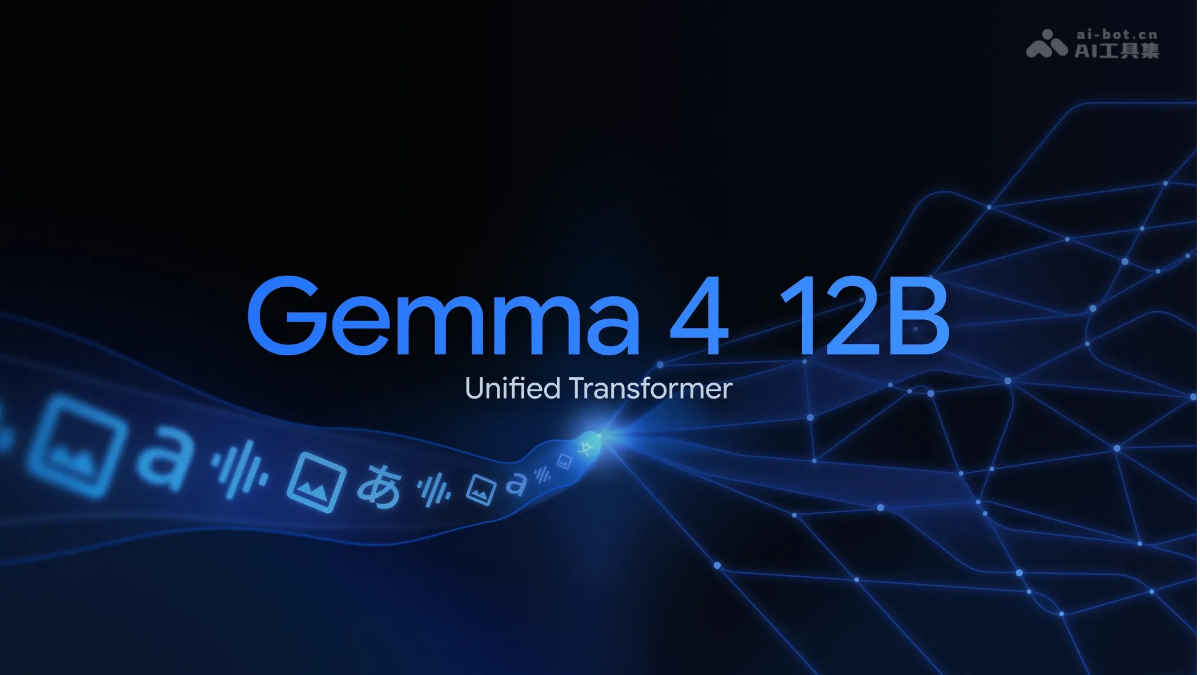
Gemma 4 12B: Google’s open source coder-less unified architecture multi-modal large model
Core parameters and statistics
| Project | Specifications |
|---|---|
| Model/API Name | Gemma 4 12B |
| Product Type | AI Model/API |
| Delivery form | API / cloud inference / local deployment |
| Context length | 256K tokens (full modal alignment) |
| Parameter size | 12B (Dense architecture) |
| Support modal | text/image/audio/video |
| Pricing model | Free/Zero cost for self-deployment (Apache 2.0) |
| Open Source License | Apache 2.0 |
Interpretation of core parameters: The biggest difference of Gemma 4 12B is the encoder-less unified architecture - traditional multi-modal models rely on independent visual encoders (such as CLIP ViT) to convert images/audio into tokens and then send them to LLM, while Gemma 4 12B directly inputs visual and audio data into the LLM backbone, eliminating the information bottleneck and information loss caused by the encoder. A 256K full-modal context window means long videos, multi-page documents and long audio sessions can all be processed in a single pass, without the need for segment truncation. The 12B Dense parameter scale can be run on consumer-grade GPUs (16GB VRAM), which is a prerequisite for its "local availability". The Apache 2.0 License permits commercial use, modification, and redistribution without additional terms.
User and market recognition
After the release of Gemma 4 12B, it quickly attracted widespread attention in the open source community and technical media. The reason is not only the simplification of parameter scale, but also the potential subversion of the multi-modal model design paradigm by "encoder-less architecture". The Gemma 4 series collection page on HuggingFace shows that the 12B version was downloaded hundreds of thousands of times in the first week of release, becoming the top open source model download list during the same period. Reports from major technology media (The Verge, TechCrunch, ArXiv community discussions) focus on three directions: first, whether the encoder-less architecture can reproduce its claimed performance advantages in more downstream tasks; second, the inference speed that 12B parameters are actually available on consumer-grade hardware; third, the performance of the model in non-English languages (especially Chinese) - because Google claims that it has surpassed previous larger-scale models on multi-language benchmarks.
At the developer community level, discussions on GitHub and HuggingFace mainly revolve around the hardware compatibility of local deployment (whether the RTX 4060/4070 with 16GB of video memory is enough to run full accuracy), the progress of integration with local inference frameworks such as Ollama/LM Studio, and the maturity of the fine-tuning tool chain. The Gemma 4 12B macOS desktop application officially provided by Google is the industry's first local running solution for open source models for non-technical users. This move lowers the threshold for using large open source models, but it also triggers a discussion about "whether open source models should be distributed through the app store."
It is important to note that the current market enthusiasm is still in the early adopter stage - the model will be released in June 2026, only about 6 weeks ago. Benchmark test data and small-scale verification results are gradually emerging in the community, but the stability of the large-scale production environment, the risk of degradation of long-tail tasks, and the completeness of the community ecology (fine-tuning tools, quantitative solutions, deployment templates) still need time to be tested.
Cost advantage
| Cost Dimension | Description |
|---|---|
| Model License | $0 (Apache 2.0, no additional terms) |
| Cloud API calls | Per-token billing through Google Cloud Vertex AI or other hosting platforms |
| Self-deployed hardware | Requires 16GB+ VRAM GPU (consumer grade such as RTX 4060 Ti 16GB is about ¥3,500, RTX 4090 is about ¥13,000) |
| Self-deployment inference framework | Ollama, LM Studio, vLLM, TensorRT-LLM are all compatible |
| Fine-tuning cost | Full parameter fine-tuning requires 32GB+ VRAM; LoRA/QLoRA can be completed in 16GB |
The cost structure of Gemma 4 12B is fundamentally different from traditional closed source multi-modal models. Take GPT-4o or Claude 3.5 Sonnet as a comparison: the closed-source model is billed by token, and the monthly expenditure for high-frequency calls can reach thousands of dollars; while the marginal call cost of Gemma 4 12B is almost zero - as long as the hardware is in place. However, the self-deployment model requires the hardware purchase cost to be amortized into the total cost of ownership (TCO).
TCO Deduction (12 Months):
- Option A (self-deployment): RTX 4090 (¥13,000) + electricity/cooling (¥200/month × 12 = ¥2,400) + operation and maintenance manpower (assuming an average of 4 hours per month × ¥200/hour × 12 = ¥9,600) = ¥25,000/year
- Option B (API call): Assuming a daily average of 1M tokens (input + output), the API pricing based on a similar parameter scale model is about $0.3/M token, and the monthly fee is about $9 × 12 = ¥780/year (but is subject to service availability and data privacy)
- Option C (Hybrid): Local inference processing of sensitive data + Cloud batch processing of high-concurrency tasks, taking into account privacy and elasticity
Key decision factor: When the daily call volume exceeds about 5M tokens, the marginal cost of self-deployment starts to be lower than the API solution. The higher the data privacy requirements, the more stable the call frequency, and the scenario where the hardware already exists, the more economical self-deployment will be.
Main functions
- Unified understanding of all modalities: The four modalities of text, image, audio, and video are processed uniformly in the same model, eliminating the need to build independent pipelines for different modalities. A single inference can complete the cross-modal task of "looking at a chart → listening to a recording → outputting an analysis report", which is something that traditional independent model combination solutions cannot achieve. In actual use, the inference speed will fluctuate significantly depending on the complexity of the input modality (especially the frame processing density of long videos).
- 256K Ultra-Long Context: Supports processing of approximately 200 pages of documents or more than 1 hour of video content at a time. In scenarios such as long document Q&A, code warehouse-level understanding, and multi-round meeting minutes analysis, the 256K window enables the model to maintain conversation-level consistency. However, it should be noted that the first token delay of long context reasoning will increase significantly (proportional to the input length), and the "attention dilution" problem in long context has not yet been completely solved - the model tends to focus on the content at the beginning and end of the context, and the information recall rate in the middle part may decrease.
- Agent Reasoning: The model natively supports Function Calling and Chain-of-Thought, and can independently complete multi-step task decomposition and environment interaction. Compatibility with Agent frameworks such as LangChain and AutoGen has been demonstrated in official Google samples. The core limitation of Agent's capabilities lies in the success rate of single-step reasoning - errors at each step in the chain operation will accumulate, and the actual completion rate of complex tasks (more than 5 steps) needs to be verified by users in their own scenarios.
- macOS native desktop application: For the first time, Google provides one-click installation of desktop applications for the open source model, supporting local and complete offline operation. The application level integrates dialogue, file upload (image/PDF/video), context management and model switching functions. The macOS version of M series chips (M3/M4) is implemented through Apple Neural Engine
For significant inference acceleration, Intel Macs only support basic running mode.
Model and version evolution
| Version | Date | Key Changes |
|---|---|---|
| Gemma 4 12B v1.0 | 2026-06 | First release, encoderless unified architecture, 256K context, full modal support, Apache 2.0 |
| Gemma 4 series | 2026-05 | Series debut (12B Dense + 31B Dense/MoE), architecture verification |
Gemma 4 12B is the "small parameter flagship" of the Gemma 4 series - its Dense architecture of 12B forms a complementary positioning with the MoE version of 31B in the series: 12B focuses on local deployment and low-latency scenarios, and 31B is oriented to high-precision tasks in the cloud. Looking at the development pedigree of the Gemma series, the architectural transition from Gemma 1 (2B/7B, 2024-02) to Gemma 2 (9B/27B, 2024-06) to Gemma 3 (1B/12B/27B, 2025-03), and then to Gemma 4 - the encoder-less architecture is a positive response to the proposition that "strong multi-modality can be achieved with small parameters". Although the previous Gemma 3 had a 12B version, it relied on independent visual encoder (SigLIP) and audio encoder (Whisper), resulting in high multi-modal reasoning delay and low cross-modal information alignment efficiency. The inference latency of Gemma 4 12B is about 40% lower than that of Gemma 3 12B (Google official data), and the modal alignment accuracy is improved by 12-18 percentage points (based on MMMU and Video-MME benchmarks).
Technical advantages
- Encoder-Free Unified Architecture: This is the core technological innovation of Gemma 4 12B. Traditional multi-modal models (such as LLaVA, Qwen-VL) need to connect independent visual encoders (ViT) and audio encoders (Whisper, etc.) in front of the LLM to convert non-text modalities into token sequences before sending them to the LLM. Gemma 4 12B integrates visual and audio tokenization directly into the input projection layer of LLM, eliminating the encoder link. The direct benefits of this design are: (1) Eliminating the information bottleneck caused by the encoder - the resolution and patch size of traditional ViT limit the retention of image details, Gemma 4 12B can retain more information of the original resolution; (2) Reducing the alignment loss between modalities - the token output by the encoder is inconsistent with the word embedding distribution of LLM, and unified tokenization eliminates this mismatch; (3) Reduces the inference delay - there is one less encoder inference link. The cost is that the training phase requires more multi-modal alignment data and more complex training strategies, and the visual/audio quality of the model is directly limited by the embedding capacity of the LLM backbone.
- Hardware Compatibility and Inference Optimization: A 12B Dense model takes up approximately 24GB of video memory at FP16 precision and can be compressed to approximately 7GB with 4-bit quantization (such as AWQ/GPTQ), allowing it to run on the unified memory of both RTX 4060 (12GB) and Apple M-series chips. Google provides native TensorRT-LLM and ExecuTorch optimization paths, with inference speeds up to 30-50 tokens/s (4-bit quantization, RTX 4090). The macOS version offers further hardware acceleration through CoreML and Apple Neural Engine.
- Agent native support: The model introduces tool calls and structured output training data in the pre-training stage, rather than appending it through later fine-tuning. This means that Function Calling and JSON structured output are more stable and consistent in format than post-append solutions. The model natively supports parallel tool calling (Parallel Function Calling). A single inference can call multiple external tools (such as search + calculation + database) at the same time.
query), which is crucial to the efficiency of Agent workflow execution.
- Ecological Compatibility: Model weights are released on HuggingFace in SafeTensors format, compatible with mainstream inference frameworks such as Transformers, vLLM, LLaMA.cpp, and Ollama. Google officially provides a complete tutorial from model download to inference deployment (including Docker image and Kubernetes Helm Chart), as well as one-click cloud deployment templates for Colab and Vertex AI.
Adaptation boundaries and restrictions
- Recommended usage scenarios: Local multi-modal experiments by individual developers and academic researchers (can be run on consumer-grade GPUs); local reasoning in data privacy-sensitive scenarios (medical/legal/financial document analysis); local deployment solutions for Agent/RAG systems; multi-modal long context analysis (long video understanding, multi-page document Q&A, meeting minutes synthesis).
- Not recommended: Real-time interaction scenarios that require millisecond-level response (the first token delay of local reasoning is at the 1-5 second level); production-level data pipelines with strict schema constraints on the output format (the stability of structured output needs to be fully verified); medical diagnosis or legal document generation that requires extremely high credibility (the hallucination problem of large models has not been completely solved).
- Known limitations:
- The visual input quality of the encoder-less architecture is limited by the LLM embedding capacity, and its ability to maintain details of ultra-high-resolution images (8K+) is weaker than the combined solution of a dedicated visual model + LLM.
- Although Chinese ability has improved on multi-language benchmarks, the quality of Chinese writing and cultural context understanding still lag behind domestic open source models of the same scale (such as Qwen2.5-14B).
- Audio input currently only supports single channel (mono), and dual-channel/stereo scenes require downmix processing.
- The macOS desktop app only supports Apple Silicon (M1+), Intel Mac users need to use the command line version.
- The community fine-tuning toolchain is not yet mature (as of July 2026), the official fine-tuning tutorial only covers LoRA, and the reference implementation of full-parameter fine-tuning is still under development.
How to use
| Entrance | How to use |
|---|---|
| macOS desktop application | Google AI Studio official website download → double-click to install → automatic model download → conversation mode/file upload |
| API interface (Vertex AI) | Google Cloud console enables API → Get API Key → Call REST API |
| Local deployment (self-hosted) | huggingface-cli download google/gemma-4-12B → vLLM/Ollama loading → REST API service |
| Google AI Studio | Web experience, no local hardware required, supports multi-modal input but is limited by server quota |
Typical API call example (Python + OpenAI compatible SDK):
from openai import OpenAI

# Vertex AI or self-deployed endpoints are accessible via OpenAI compatible interfaces
client = OpenAI(
    base_url="http://localhost:8000/v1", # Self-deploy vLLM endpoint
    api_key="<your_key>"
)

# Multi-modal input example: image understanding + text instructions
response = client.chat.completions.create(
    model="google/gemma-4-12B",
    messages=[
        {
            "role": "user",
            "content": [
                {"type": "text", "text": "Please describe the technical architecture in this picture in detail and point out possible design flaws"},
                {"type": "image_url", "image_url": {"url": "data:image/png;base64,..."}}
            ]
        }
    ],
    max_tokens=2048,
    temperature=0.2
)
print(response.choices[0].message.content)
Product Pricing
| Billing items | Price |
|---|---|
| Model License (Self-deployment) | $0 (Apache 2.0) |
| Vertex AI API (by volume) | Input $0.15/M tokens, output $0.60/M tokens (reference price, subject to real-time page) |
| Vertex AI batch inference | Input $0.075/M tokens, output $0.30/M tokens (50% discount) |
| Free Credit (AI Studio) | 100 inferences per day, up to 4K contexts each |
Pricing information is subject to the official real-time pricing page of Google Cloud Vertex AI. In self-deployment mode, only hardware and electricity costs are borne.
Application scenarios
- Scenario 1: Local multi-modal document analysis - The analyst drags a 50-page PDF (including diagrams and annotated screenshots) directly into the macOS desktop app and asks the model to "extract core arguments and generate a structured summary." Gemma 4 12B processes everything at once in a 256K context window, outputting the summary in ~30 seconds. In contrast, the traditional method requires OCR to extract text, then use an independent image understanding model to analyze the chart, and finally manually summarize it, which takes about 1-2 hours in total. Verification method: Randomly check the output summary page by page to confirm the citation accuracy and recall rate of key data points.
- Scenario 2: Agent-driven code review automation - Build an Agent workflow in a self-deployment environment: Gemma 4 12B serves as an inference engine and cooperates with the PR event triggering of the code warehouse to automatically execute the four-step operation of "read diff → identify risk patterns → generate review opinions → comment in PR". The 12B parameter size allows it to be run in CPU mode (~3-5 tokens/s) on CI/CD's budget resources (4 vCPU + 16GB memory, no GPU) and can be completed in 3-5 minutes for a single PR review (~200 lines of diff). Verification method: Run 50 PRs of known issues on the test warehouse, and count the detection rate and false positive rate.
- Scenario 3: Long video content indexing and retrieval - Input the 1-hour training video (including voice explanations and slides) into the model to generate a segmented index (timestamp + each topic + key screenshots). The model processes both audio transcription and visual content in a single inference, outputting structured video chapter tags. Verification method: Manually compare the timestamp accuracy and content summary accuracy of 5 random samples.
Applicable people
- Developers & AI Engineers: Technical staff who need product integration via API or local deployment. Focus on Transformer compatibility and Agent capabilities.
- Academic Researcher: Focus on model design innovation of encoder-less architecture, multi-modal alignment technology roadmap, and performance trade-offs with small parameter models.
- Data Sensitive Enterprises: Organizations with compliance requirements (medical data, financial data, customer privacy) who want to build their own inference infrastructure. Gemma 4 12B's Apache 2.0 license and ability to run natively are core attractions.
- Technology Enthusiasts: For individual users who want to experience cutting-edge multi-modal models on consumer-grade hardware, the macOS desktop application provides a zero-threshold entrance.
Comparison of competing products
| Comparative dimensions | Gemma 4 12B | Qwen2.5-14B-VL | LLaVA-1.6-13B | GPT-4o (reference) |
|---|---|---|---|---|
| Architecture Type | Coderless Unification | Standalone ViT Encoder | Standalone CLIP Encoder | Closed Source, Architecture Unknown |
| Parameter size | 12B Dense | 14B Dense | 13B Dense | — |
| Context length | 256K | 128K | 8K | 128K |
| Multi-modal support | Text+Image+Audio+Video | Text+Image | Text+Image | Text+Image+Audio+Video |
| Open Source License | Apache 2.0 | Apache 2.0 (Basic) | Apache 2.0 | Closed Source |
| Minimum hardware for local inference | 16GB VRAM / M1+ 16GB | 16GB VRAM | 16GB VRAM | Not available |
| Agent native support | Yes (pre-trained) | Yes (fine-tuned additional) | No | Yes |
| Chinese proficiency | Good | Excellent | Average | Excellent |
| API pricing (reference) | $0.15/$0.60 | ¥0.5/¥0.8 (Alibaba Cloud) | Free self-deployment | $2.50/$10.00 |
Summary and Outlook
Gemma 4 12B provides a differentiated solution at the architectural level in the field of open source multi-modal large models. The encoder-less unified architecture is not an incremental improvement, but a fundamental re-answer to the core question of "how can a small parameter model do multi-modality well?" Its combination of 12B parameters + consumer-grade GPU executability turns local multi-modal inference from a "laboratory toy" into a "implementable tool".
Current Advantages: (1) The cross-modal alignment efficiency improvement brought by architectural innovation is a hard benefit; (2) Apache 2.0 license + local running ability makes it irreplaceable in data-sensitive scenarios; (3) 256K full-modal context is in a leading position in the same parameter scale level.
Known limitations: (1) The maturity of the community tool chain (fine-tuning framework, quantitative tools, deployment templates) is much lower than that of LLaMA and Qwen ecology; (2) Although the Chinese language ability is better than the previous generation, there is still a gap, and domestic users need to evaluate it by themselves; (3) The "attention loss" problem in long context scenarios has not been completely solved, and an output quality verification mechanism needs to be established in practical applications.
Follow-up attention directions: (1) The speed and quality of the emergence of community-derived models (fine-tuned versions, quantitative versions, domain-specific versions) - this is a direct indicator of ecological health; (2) Google's update frequency and patch support cycle for the Gemma 4 series; (3) Whether the encoder-less architecture will be followed by other model families (such as LLaMA, Qwen), which is related to the long-term technical road competitiveness of Gemma 4 12B.
It is recommended that potential users conduct 1-2 weeks of testing and verification in their own scenarios through the macOS desktop application or the Google AI Studio free quota, focusing on the consistency of the output quality, the acceptability of the inference speed, and the information recall rate of long-context scenarios, before deciding whether to put it into the production environment.
Related tools:  Hugging Face, replicate
Version Info
- Gemma 4 12B official version :Google's open source multi-modal large model adopts a unified architecture without encoder. 12B parameters support text/image/audio/video understanding and agent reasoning. Apache 2.0 license.
- Gemma 4 series released :The Gemma 4 series debuts with 12B Dense and 31B Dense/MoE versions.
User Reviews